The counseling service of the feminist organization Mujeres Creando in La Paz in Bolivia not only offers advice and help, but also a place to celebrate your divorce.
I always thought it made more sense to celebrate freedom instead of its loss.
But in South America, this thought is still rather revolutionary. Too many people here regard unmarried women (and, to a lesser extent, men) as sad losers who deserve pity. Too many parents push their children into unhappy marriages far too early, resulting in violence, alcoholism and femicide.
Are you also tired of the CIA, the NSA and others spying on you all the time? Are you worried about the heaps of data they are trying to collect? Do you also suck at technology and have no idea how to use e-mail encryption?
Then I present to you the best way to avoid CIA surveillance. Two surprisingly simple steps will do the trick:
1. Use only your girlfriend’s phone and computer.
2. Change your girlfriend at least once every week.
(Dieser subversive Ratschlag ist natürlich auch auf Deutsch erhältlich.)
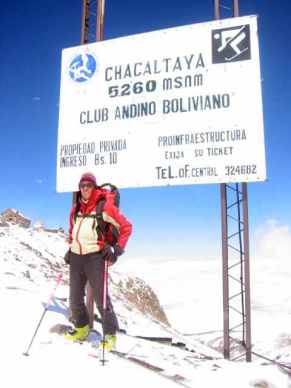
From my current base in La Paz in Bolivia, I wanted to climb Chacaltaya. It seemed like a relatively easy mountain above 5000 m, and thus a good opportunity to set a new altitude record without falling into crevasses and battling with yetis.
In Bolivia, you can reach almost any destination by bus, even in the mountains. But not this time, because nobody lives in that area. So I went to one of the many travel agencies in La Paz, all of which are offering the same: the salt flats in Uyuni, cycling down the “Death Road”, a day trip to Tiwanaku and an excursion to Chacaltaya. The latter is however only available in combination with a subsequent visit to Valle de la Luna, where I had already wandered around for half a day. The combined tour costs 100 bolivianos, around 15 dollars and thus actually not too much. But I only needed the bus to Chacaltaya in the morning, would leave the tour there and would either walk back the 20 km to La Paz or find some other way to get back. This had always worked in Bolivia so far. The girl at the agency wanted to pinch the same 100 bolivianos from me for that plan, not without pointing out that a taxi would cost me 300 bolivianos at least.
At that moment, I was struck by the double motivation of parsimony and ambition. “Then I will walk there.” It earned me a shocked gaze, like the one Roald Amundsen must have received when he was at the travel agency and announced that in the absence of a good train connection, he would have to walk to the South Pole, which, as anyone will admit, can hardly be compared with the daredevil ascent of a mountain of 5300 m.
Lesson 1: Never listen to people who offer services for a business! Of course they want to sell their tours and have to portray any endeavor in such a complicated way that it will scare off most people from trying it themselves. Usually for no reason.
I don’t think much of hikers who over-prepare such a short walk and acquire alpine boots, ski masks, thermos flasks and more weighty gewgaw. On the way home, I walked past the market and bought 3 liters of water and 2 Snickers bars. I didn’t pack more because I am far less opposed to preparation if it doesn’t cost anything and had therefore read about the existence of a hut at the peak, run by the Alpine Association. There, I would at least get a warm soup.
I had also read online that there is a bus going from El Alto to Zongo every morning at 6 o’clock to take the workers of a hydroelectric power plant into the valley which was exactly the direction I had to take. I could get off half-way and would then only have to walk a few kilometers to the summit. There is even a serpentine road up to 5200 m, taken by the offered-but-declined buses and taxis. In the back of my mind, I was of course thinking that the tour bus would see me walking and would give me a ride out of pity or for a few bolivianos. So, I had planned everything mighty cleverly.
The next morning at 5:50, I am indeed at Plaza Ballivian in El Alto, the colder because higher, more dangerous because poorer, and therefore generally shunned neighboring city, which has meanwhile grown together with La Paz into one large agglomeration. It is already rather busy, with minibuses filling up quickly, men going to work and zealous traders selling juices and tea. I ask one of them for the bus into the valley of Milluni. “Oh, now in summer it already leaves at 3:30.” – My wonderful plan is destroyed, even before I can set off.
Lesson 2: Get up early! In nature, every hour of sunlight counts, and in 12 hours you can experience quite a lot. If you only wallow out of the house at noon, you’re still caught up in the stress of your busy day and you have to start counting the minutes until your return soon. An adventure deserves a whole day. You can still work and clean your house for the rest of your life.
But after having risen early, I am in the mood for hiking and don’t want to postpone the expedition until tomorrow. “Is there a bus to the end of the city in that direction?” I ask. From there, I could then walk. Of course there is a bus. After all, people live there. “Just wait here. I will point out the right bus to you when it will come by.”
Lesson 3: Just ask, and someone will help you.
Indeed it takes less than a minute until the lady stops a minibus and explains my plan to the driver in far greater detail than necessary, asking him to take me to the end of the city as far as possible. He goes beyond his usual route and drops me off at a church with a narrow steeple. “Simply follow this road, turn left after the transformer station, and then you will see the mountains already.” I don’t see anything, for it is still dark, but I got the general direction.
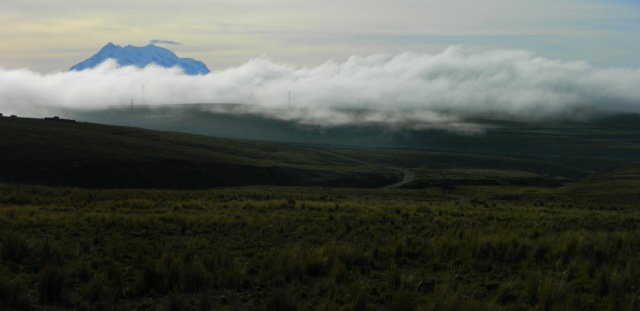
As the sun slowly wakes up and appears from behind Illimani, I see fog. Or are these clouds? Yes, I am already in the clouds, only minutes after leaving the city.
Empty houses dot green hills, these empty, window-less houses you see all over Bolivia and the purpose of which I still haven’t quite figured out. They are too small to live in, and the open door reveals that nothing is being stored in them either.
I had seen similar dwellings in the desert in Peru, and there, someone explained to me that people who don’t own a house simply put these mini houses into the landscape in order to collectively claim after five years that they had always been living there and that the government should now please build a road and a school and provide water and electricity. (If not, there will be protests.) One day, mortgage brokers will discover the Bolivian market and put an end to this unconventional method.
I am already above 4000 m, it isn’t even 7 o’clock, but it is surprisingly mild. At home, I would be freezing at this time, but the sun is warming the green meadows around me, which are beginning to get populated by a few children with flocks of llamas. Also, my energetic steps warm me better than my bed could.
Lesson 4: Outside is almost always better than inside. You’ve spent enough of your life in fuggy buildings.
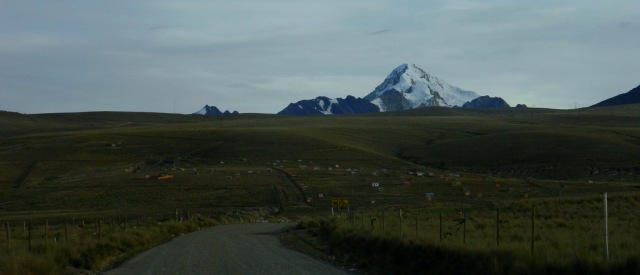
I should manage the approximately 15 km to the summit in a few hours, but each time a motorized vehicle passes by, I put on my hopeful and friendly smile and stretch out my thumb. Apparently, the valley is not as empty of people as I had thought. After about an hour of walking, a bright yellow minibus stops. Expressing my gratitude, I get on without saying where I want to go, because the direction is right. The other passengers are a young Bolivian mountaineer who is going to climb Huayna Potosi, the snow-covered peak we can already see, over the next three days, the driver’s wife in colorful skirts and a hat, and two very old men of the type fisherman/farmer/shepherd sitting on the rear bench. “Can you drop me off from where the path goes up to Chacaltaya?“ I ask after a while. “Of course, young man,” he replies. Despite my 41 years, I am often addressed as “young man” (joven) in Bolivia, including by people who could easily be younger than me. But I am not complaining.
The more edentulous of the two old men calls forward: “Hey, it’s better if you keep going a bit. The path up to Chacaltaya along the road is damn long. I know a shortcut, from there you only walk half an hour to the peak.”
There is no other path depicted on my map. But
Lesson 5: If you encounter a stranger in the wilderness or in the mountains who suggests a shorter or a more beautiful unknown path, accept the offer. This is adventure beckoning!
“All right, thank you” I say, and the bus passes by the road which I originally wanted to walk up. Every two or three kilometers the driver asks the self-appointed pathfinder “you mean here, right?” and he always replies: “No, keep going! I know a secret path, a super shortcut. From there, it’s just half an hour to the peak.” Each time, the mountaineer looks at me with more skepticism, each time the two old men argue more between themselves. But the one of them who has now assumed leadership over my expedition, stresses again and again “media hora, media hora“, meaning that thanks to his (apparently very secret) shortcut, I would need only half an hour.
We finally reach the secret spot when the road makes a curve. “Here!”, the old man stops the bus. He points to the right, explaining that this is the path. I don’t recognize any path, but at least the direction. “And the path goes to the left or the right of the valley?” I ask shyly. He mumbles something undecipherable-evasive, “but you see the summit up there, don’t you? Just walk towards it. Media hora!“ Well, now I don’t have any other option. I offer to pay for the ride, and after reflecting on this for a while, the bus driver’s wife asks me to pay 5 bolivianos, less than a dollar.
This is where I need to go up.
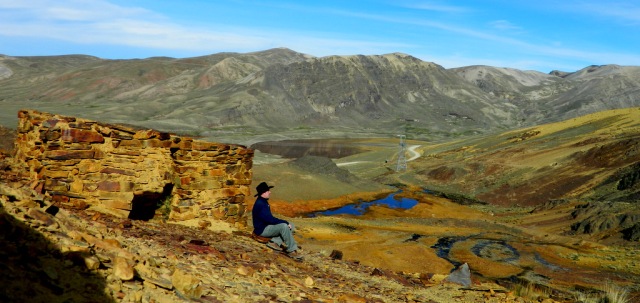
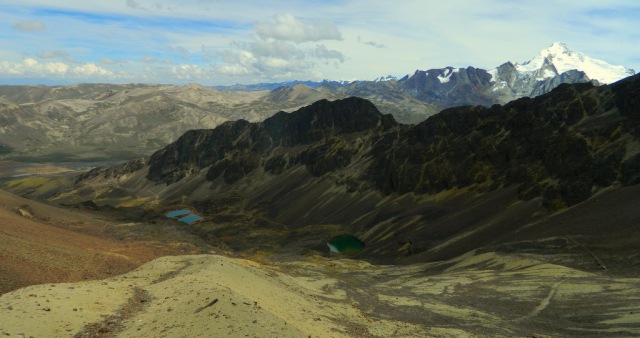
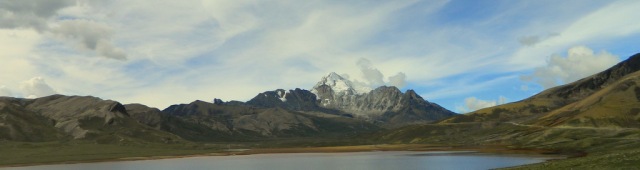
Now I am alone. Alone in a noticeably oxygen-deficient landscape with perfectly shaped green hills and the white teeth of Huayna Potosi. Behind me are mounds with colors ranging from strong ocher to reddish yellow. In the valley there is a lake, surrounded by grass that glistens golden in the morning sun. The sky is blue, no sound to be heard, and the beauty of the place, the loneliness, the full day ahead of me and the unknown expecting me, combined with the recognition of all the dangers from getting lost and falling off the mountain to altitude sickness and dying of thirst cause me to break out in laughter. Loud, heartfelt, happy, long laughter.
Lesson 6: The deeper I go into nature and the further I get away from cities, roads, cars and people, the happier I am. Probably not all people feel the same, but it’s worth to try out escaping into nature for once, at least.
But I have to laugh even more when I look at the distance I have to cover to the summit on the map. It’s 2.8 km as the crow flies. Even for 2.8 km in flat terrain, I would almost need half an hour. But I cannot hike as the crow flies because there is a steep ascent ahead of me, across slopes of broken stones, without a discernible path and the first time in my life above 5000 m. Now it’s me who keeps exclaiming “media hora!“, laughing and shaking my head about the old man’s optimism.
Every 15 minutes, I need to sit down, pause and take deep breaths.
It’s a battle, but in beautiful surroundings. Like the battles at the Isonzo River in days of yore. At least someone has invented Snickers since then. Soon, the first one disappears. Only now do I realize that by choosing the so-called shortcut, I gave up any chance of stopping a passing bus. I am really on my own.
At times, I do indeed find a path snaking its way up the barren slopes. And then, even a few houses appear.
I shout out “buenos dias” to announce my probably unexpected arrival. Instead of a reception with dogs and shotguns, I would prefer one with tea and cake. To no avail, because nobody lives here anymore. Between the houses there are some small streams with moss. I want to feel the soft moss, but it is still frozen and hard as stone. The doors of the partially decaying houses are open, but none of them contains anything of use for me. Only one door is adorned with graffiti: “Burglary not permitted.” The instruction is absurd because (1) this is already governed by the criminal code, (2) even non-lawyers are aware of the ban on breaking into houses and stealing, (3) potential law-breakers will hardly be dissuaded by such a note. But we are in Bolivia, the land of politeness and respect. This door is really the only one which is not broken.
Lesson 7: If you keep your eyes open, you will detect funny things everywhere.
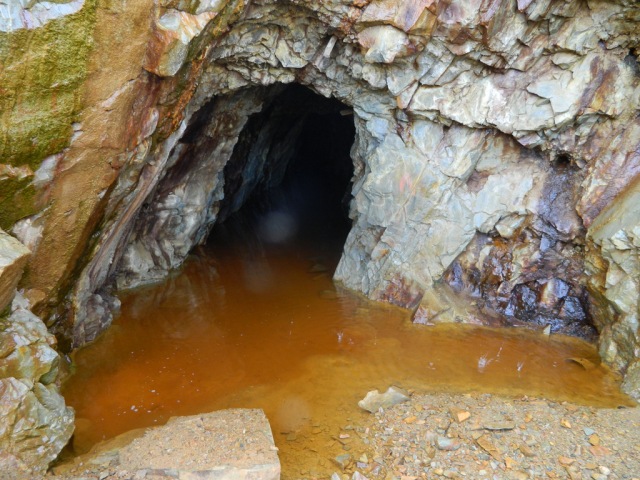
Behind the ruins, I spot the reason for this remote village: mines. This explains the gaudy colors of the geology, but due to not having studied that subject, I cannot explain what minerals the colors indicate. High-altitude euphoria already makes me dream of finding gold.
Mines at an altitude of 5000 m – in Europe we cannot even imagine such an altitude, it’s already halfway in space for us – are nothing special in the Andes. After I will have climbed Chacaltaya, by which I anticipate the result of the expedition for a parenthesis which hardly belongs into this story, I proudly tell a friend from Peru who works in mining of my new altitude record of 5300 m. “Oh, I once worked in a mine at 5300 m for a few months. It was damn cold,” she replies.
Lesson 8: If you have mountaineering friends who constantly annoy you with their tales of Mount Whitney or the Matterhorn, go to Bolivia, go for a short hike, and henceforth nip any bragging in the bud.
“Media hora” my ass! I have been hiking for one hour, admittedly with many and long breaks, and I am still facing 2 km, again as the crow flies. And now begins the steep part. Until here I could walk, but from now on I have to use my hands and sometimes crawl up the slope on all fours. Sometimes I reach a dead end, from where I cannot continue without getting dizzy from vertigo and I have to turn around to look for another way. Only the view back across crystal-clear lakes towards the green hills and dramatic peaks in the distance keeps rewarding me. Nowhere in the world have I seen color combinations as beautiful as in the Bolivian altiplano.
I am no stranger to altitude sickness. I have already felt it twice before, the first time when I went above 4000 m to Lake Wara Wara near Cochabamba, and when I set my existing record of 4800 m on Cerro Rico in Potosi. You get a very strong and penetrative headache, which lasted for a couple of days the first time, so that I already feared that I had damaged my head forever. But I am OK again, don’t worry. You also feel nauseous, but in my case it never erupted. And sometimes you don’t feel your fingers, but differently from when they are frozen. You don’t feel any pain, you can still move them normally and control them, but you don’t feel anything when you touch them.
Today, I experience a new symptom: when I sit down for a break, I fall over and asleep immediately. It happens three times over the day. Twice I wake up again because I am cold, the third time because the sun shines into my face under the brim of my hat. But I have the feeling as if I had just dozed off for a few minutes respectively. Probably, I am just exhausted.
Lesson 9: Go to bed early the night before such an adventure to avoid fatigue.
On a positive note, the ability to fall asleep quickly is a sign of being happy and not being worried. So everything is fine, at least psychologically. If I die, I will die happy. But this time I looked ahead and brought some anti-sorojchi pills. When I had my last attack of altitude sickness, they helped quickly and effectively, and this time too, they make the headache disappear. After everything I have heard from other travelers, half of them say that the pills don’t help at all, and the other half react like me, with an almost immediate positive effect.
Lesson 10: If you know of possible medical problems in advance, take some medicine. The little extra weight is worth it. Sometimes, you can also help other hikers or travelers, which is a good way to endear yourself.
The most important remedy against altitude sickness is actually to turn around and descend. But I really haven’t come that far to give up.
Lesson 11: Some basic endurance is helpful. I go running from time to time and walk every distance on foot that takes less than an hour. I climb the stairs instead of taking the lift, even when I live on the 10th floor. If a city is built for it, I get around by bicycle. I have never spent a single dollar on gyms, and yet I am usually fitter than people who pay for sweating.
I am getting ahead at the speed of about one kilometer per hour. Hidden between the rocks are more deserted dwellings of gold seekers. An old helmet and rusty cans lie in the grass. Like in the previous settlement, nobody lives here anymore. I am a bit worried that I will find human skeletons. But everybody got home safely after the end of the gold rush.
After three hours of rough going, I finally made it. Looking back down, I am shaking my head: in half an hour, I wouldn’t even be able to descend that mountain. Impossible. Nonetheless, I am thankful to the old man when I glimpse the “regular way” from the summit, which I would have taken without his intervention. The route recommended by him is a hundred times more beautiful and exciting. The route for cars on the other hand is almost boring. As it is boring anyway to take a car up to 5200 m and to walk the remaining 100 m. Wimps!
Lesson 12: The journey is the destination. That’s a worn out saying, but on such a day, I wholeheartedly concur.
Lesson 13: Anyone can do more than they believe they can do. There are always reserves of energy and stamina, particularly when there is no opportunity to give up. Based on my experience of the few times when I went hiking with other people, willpower is much more important than training, strength or equipment.
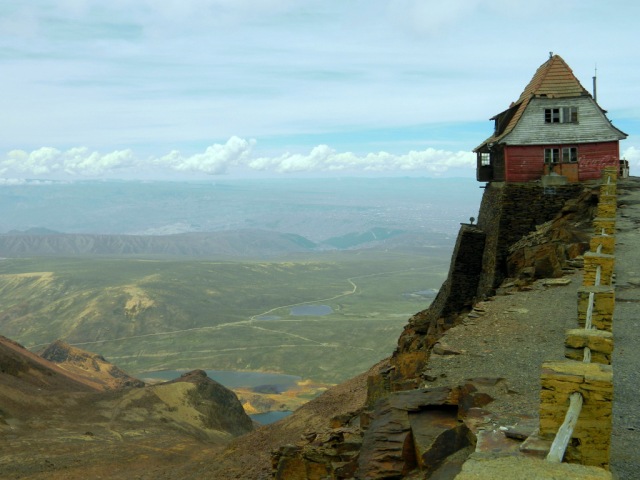
And there it is, the longed for shelter of the Alpine Association. It’s almost lunchtime, so the chili con carne must be brewing on the stove already. After great strain, simple things are enough to make one happy. The hut doesn’t inspire too much confidence, it rather looks like it’s about to fall down the flank of the hill with the next gust, but then it has been standing since 1939 already.
It was built by refugees from Austria. Yes, back then it was the Europeans who had to flee. Luckily, nobody in Bolivia said “we don’t have space” or “but these people have a completely different culture,” although South Americans would have had good reason to be skeptical towards European immigrants based on the history since 1492. The Austrians were mainly Jews and Socialists and intellectuals, but they were also typical Austrians. As such they saw the mountain and immediately thought “skiing!” With a car engine, they got a drag lift going (somebody sat in the car and regulated the speed of the ski lift by pushing the accelerator), and from then on, Chacaltaya was the highest ski resort of the world. The locals found the newfangled sport as dubious as Kaiserschmarrn, which unfortunately never took root in South America.
The attentive reader will have noticed that I fell into the past tense when describing the ski resort. That’s because skiing is a thing of the past. Why? Not because the Austrians aren’t here anymore (Yes, dear refugee-scaremongers, when peace returns to the homeland, many refugees return.), but because there is no more snow.
The glacier on Chacaltaya, which had existed for 18,000 years, is gone. It disappeared completely, literally went down the drain. The former ski slope has been reduced to a sad heap of pebble and boulder. All of this occurred relatively recently. Due to rising temperatures, the glacier shrank in size and thickness towards the end of the 20th century, and after the winter of 2009/2010, nothing was left at all. That’s how global warming works, not only at the South, North and other poles. Probably irreversibly, there is no point in kidding ourselves with all the climate conferences.
This used to be the ski slope.
This is another reason why I had wanted to go to Chacaltaya, because I had of course read about this drastic example of climate change effects before. I am from Central Europe, where we are blessed with a moderate climate and where the Alps protects us against the ever-expanding deserts. There, it’s easy to dismiss global warming as something abstract, something theoretical, something far-off. Of course we are aware of the statistics. But if you don’t live next to a mountain that has been covered by a glacier since mankind has been around and which is now barren, naked and ugly since 7 years ago, then you cannot grasp how dramatic, how fast and how irreversible this process is.
The end of skiing is not the real problem here, of course. Such a glacier is a huge reservoir of sweet water, enormously important to agriculture. Without it, nothing grows, the valley dies, and the people have to move to the slums of El Alto. They are refugees too, like our Austrian friends used to be. Climate refugees and, that’s why they are hard to spot in statistics, internal refugees. Everywhere in the Andes you stumble across dead or half-empty villages, where a few stubborn elderly folks are holding our, but where anyone younger than 50 years has emigrated to the cities because the soil doesn’t provide enough anymore. This is exacerbated by population growth, again something that we Europeans know about from statistics, but we cannot really imagine what it looks like. In Bolivia, the population has doubled since 1980.
Lesson 14: Although this article pleads for a certain spontaneity, I don’t think much of people who travel around the world like bums, visiting a beach here and a beach there, taking some photos and finding everything superb, beautiful and wonderful. That may be something for the eye, but what about the organ that sets us apart as human beings, the brain? I also want to know, to recognize, to understand, to analyze the problems of the world, I want to read, think, discuss and write about them. Therefore, I suggest that any trip that goes beyond a simple walk should be preceded by preparatory reading. Because if I don’t know what to look out for, how am I supposed to recognize for example that there used to be a glacier here? How am I supposed to learn about the history of the place?
Still, as you have already seen, I do leave enough room for spontaneous decisions, for changing the plan and for unexpected discoveries (I didn’t know anything of the deserted miners’ villages, for example). This combination of preparation, experience and then reflecting on it makes for intellectually stimulating travels. Or as Wilhelm Dilthey put it: “Understanding requires experience, but experience only becomes life experience by taking the understanding out of the narrowness and subjectivity of the experience and leading it into the region of the whole and the general.”
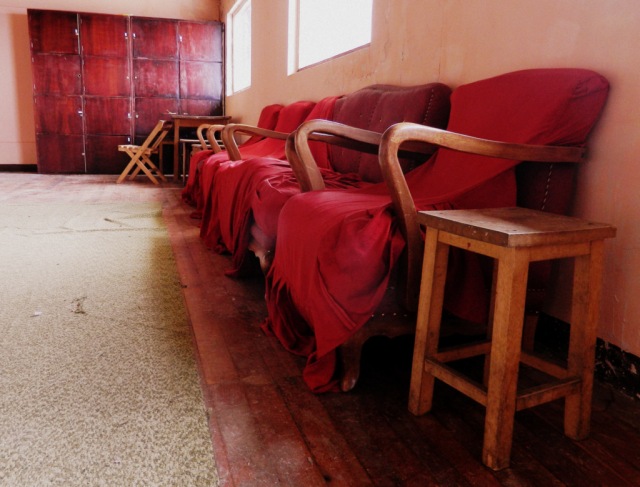
Now that I have shaken off half of the readers, it’s time for a schnitzel. I open the creaking wooden door, ready to throw an Austrian “Grüss Gott” into the comfy, warm and full lounge, but – here too – everybody is dead or has moved away. There are still a few coffee mugs and a sugar bowl on a table, as if the last visitor just left. In the room with the cold fireplace there are plenty of chairs. Judging by the style, they must be from the 1950s.
The windows seem to be in order, so I could spend the night here in case of an emergency. But I didn’t bring a sleeping bag.
Lesson 15: Hiking itself isn’t really that hard. But you will feel every additional item in your backpack. Carrying an extra kilogram for 20 kilometers is something completely different than carrying the same kilogram on the way to work. Always carry as little weight as possible!
It probably varies from person to person, but I notice everything above 5 kg. For me, 15 kg is the absolute maximum if I don’t want to hate my backpack with every step. When I walked along Hadrian’s Wall in England (125 km), I wanted to carry all the food I needed for five days. After two days, I angrily threw out some of the heavy cans with beans and lentil soup just to reduce the load.
Lesson 16: By the way, it’s the same in life. The more material possessions you collect, the more complicated you are making it for yourself.
Besides the ghost hut, there is also a station of the Universidad Mayor de San Andres on the summit, measuring all kinds of meteorological and geophysical data, which is protected by a dog who is first curious, then friendly and then starts barking when he notices that he won’t get any food. On the last hundred meters to the actual summit, I encounter four workers in overalls who are carrying gadgets with them that look like radio sets from the 1950s. They explain that they too have to measure something, but I don’t understand what. “Do you come here regularly?” I ask, although I can hardly breathe. “Every day.” Well, at least they have a nice view and fresh air.
Looking over to Huayna Potosi, I am thinking of my uncle who climbed that mountain some 40 or 50 years ago.
Back then, a journey to South America must have been a real adventure. No GPS, no mobile phone, no internet to research hostels, buses, anything. You simply left home and hoped that everything would work out fine. The biggest luxury was a guidebook with outdated information and maybe a dictionary. Half of the countries in South America were dictatorships, and every week there was a military coup, a revolution or another overthrow of government somewhere. If you wanted to arrange to meet someone, you wrote a letter five months in advance: “I suggest that we meet at the Public Library in La Paz on 3 June 1972 at 2 o’clock in the afternoon. If you cannot make it, please leave a note with further instructions.”
Lesson 17: Life works fine without technology. – I admit that I make one exception: I have a small tablet with GPS and use the Maps.me app to sometimes determine my location and to find the way. It’s relaxing to have it with me, but I don’t want to become too dependent on it. It’s much more interesting to ask for directions or to use mountains or rivers for orientation. Or even to get lost!
Lesson 18: Compared to what you parents and grandparents did, all of our adventures are a piece of cake. So, have no fear!
For the way back, I choose the road, hoping that the workers will see and pick me up on their way back to La Paz. But we won’t run into each other again. Because the official way is so boring and dust-dry, that I look for a new destination on the map and walk straight towards it cross-country: the village of Milluni. Again, it’s more the way than the destination that lures me. I simply want to spend more time walking across these hills, with the view of the lake, enjoying the solitude.
It’s good that I didn’t focus too much on imagining the village. Because when I reach it after a further two or three hours of walking, the village is like anything else I encountered today: dead and deserted. Even more dead than anything I have seen. Only a cemetery is left. But what a cemetery, what a location, what a view! I have already expressed my wish to be buried where I die, hopefully in a remote location. This would be a beautiful place.
But not today, because I still have some energy left. Which I have to because the sun slowly approaches the horizon, indicating that it’s time to march back to El Alto.
Lesson 19: Don’t carry a watch! The sun will tell you when it’s time to walk back home or to start looking for a place to camp.
The way back is about 20 km on relatively flat terrain, for which I will need about 4 hours. Maybe more because I am already exhausted any my legs are aching with every step. Thus, I walk along the road, again hoping for a ride.
There is only one car every 30 minutes. The first two don’t stop. It’s getting colder, the shadows are getting longer, time is running out. This morning, I realized that my flashlight was broken, so I would need to walk through darkness.
Lesson 20: It’s better to walk when there is a full moon. On open terrain and if there are no clouds, the moon provides plenty of light to find the way. That is actually a particularly beautiful experience.
Then comes a truck, the driver of which takes pity on me after I had shouted through the open window “do you have one more space to El Alto?” He signals me that I can climb up the loading space on the back. It’s a big dumper truck, so I have to climb on the rear tire, pull myself up and fall into the dust of the bed. There are already two workers from a zinc mine in the valley. They show me how I need to stand up and use both hands to avoid being thrown off from the truck which is thundering along a dusty and curvy road with around 60 km/h.
Lesson 21: Don’t worry if you have walked too far or if you got lost. There will always be someone who will offer to take you back to town.
I already hear you protest “maybe that works in Bolivia, but not in X”. Not true. I know several people who only travel by hitchhiking (one example), and they have done so on all continents without major problems.
I am standing exactly behind the vertical exhaust pipe, with soot blowing into my face. It’s damn cold, my hands are hurting from gripping the sharp metal edge, I can hardly remain upright, but this shaky trip is the most beautiful hitchhiking experience I ever had. Because when I look around, I see the valley between Huayna Potosi and Chacaltaya. The lush green of the meadows and the glowing white of the snow seem stronger in the late afternoon sun. This is mirrored by the lake, doubling nature’s beauty. Llamas and sheep cross the road. It is paradise. Because I constantly have to hold on to the truck, I cannot operate the camera, which is sad at first, but then I don’t care, because at least I myself can enjoy every moment of the 30-minute ride.
The road on the right is the route I took with the truck.
Lesson 22: Whatever you do, don’t do it in order to tell others or to share your photos. Do it for yourself. On some of my best journeys I didn’t have any camera with me, and I still wouldn’t be taking photos if it wasn’t for this blog. In any case, a photo can only capture a small part of your sensations.
If you want to know how the valley looked to me on that evening, you may remember the landscape in the “Lord of the Rings” movies. Yes, it was that spectacular. Actually, this kitschy melodrama could have easily been filmed in Bolivia.
In El Alto, the two miners and me jump off the truck and each of us pays 5 bolivianos (less than a dollar) to the driver. It’s quite common in Bolivia for trucks to double as buses. Continuing to La Paz, some people look at me weirdly. Only at home I notice that my face is totally black due to the soot, making me look like a chimney sweep. After such a day, falling asleep is not a problem. Because of the windy return journey, I will suffer from a severe cold for the coming weeks, but it was worth the experience.
Lesson 23: An adventure doesn’t need to cost much. For all buses and rides taken together, I paid less than 3 dollars that day. The water and the two Snickers were even cheaper than if I had stayed in town and eaten at a restaurant. – So please don’t make the lame excuse “I can’t afford to travel”!
Lesson 24: If anyone replies “but you had to fly to Bolivia first”, this is not only wrong because I went to South America by boat, it would also completely misunderstand the core message of this article. You can have a small adventure everywhere! You too can break out from your routine for one day!
Just go somewhere where you have never been before.
Use the time-tested method of blindly putting your finger on the map.
Take a train for 30 km, get off at a small station and then walk back home.
Take a piece of cardboard, write “Buenos Aires” or “Kuala Lumpur” on it, stand next to the highway and see what happens.
Walk out of the front door, turn right at the next intersection, left at the following one, then right again, left, right, and so on until you don’t know where you are.
Go for a walk in a night with a full moon.
Ask your friends what the ugliest and most boring town in your area is and try to find something interesting and beautiful there.
Invite a Couchsurfing guest. They will tell you stories from their trips around the world, and listening to a traveler is almost like traveling yourself. Without mosquitoes and all the other problems.
There are hundreds of ideas. If you need more, write me. And please tell me how it went. Have fun!
Links:
That was tough work! Not the hike, but turning it into an article that captured your interest and hopefully motivated you. My motivation comes from your feedback and from your support for this blog. I appreciate everything you do to keep me writing!
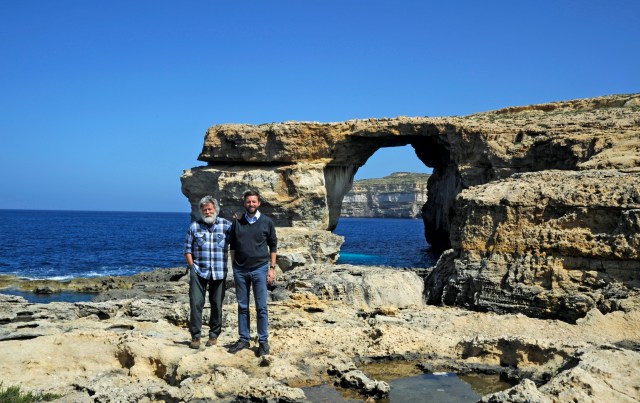
I have written about the ferocious storms on Malta before, much stronger than any I have ever experienced in the Atlantic or the Pacific, and unimaginable to people who only visit the Mediterranean in summer.
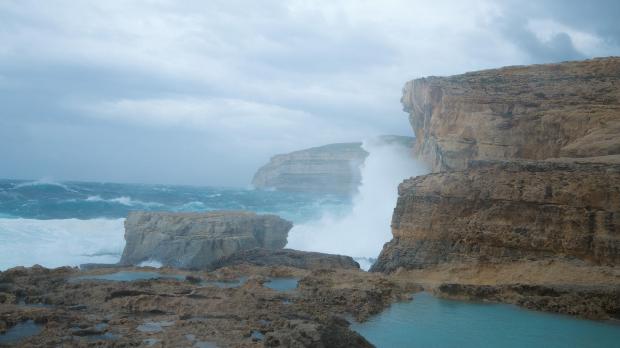
Today, a storm took away the Azure Window, a landmark of Malta’s sister island Gozo.
Now it looks like this:
Whenever I told you about the force of the gales on Malta, you didn’t believe me. When I told you that the storms blew me from one side of the road to the other, you didn’t believe me. When I told you that parts of houses and trees were flying through the air, you didn’t believe me. When I told you that the wind blew so strong that I couldn’t sleep all night, you didn’t believe me. – Look at the huge chunk of massive rock that the storm took away – and rethink your doubts.
Many tourists will now wonder “is it still worthwhile to visit Gozo?” Yes, it is! The island is much quieter than Malta, with the charming capital Victoria (Rabat) and a coastline of dramatic cliffs for a full day of hiking.
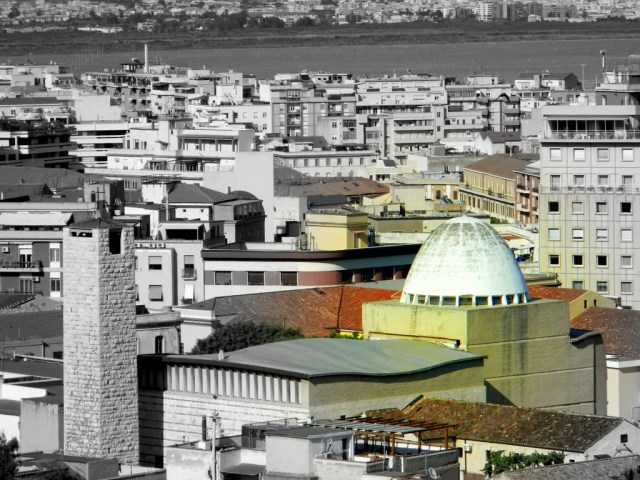
As I stood on top of the Bastion of Saint Remy and looked down over Cagliari, my sharp eyes noticed something suspicious.
Can you spot it?
Yes, there is a nuclear reactor in the middle of the city. Cleverly hidden in and disguised as a church. This is Italy, so the Catholic Church enjoys quite some authority and can get away with things that other organizations can’t, including nasty and criminal activities.
Together with the next church, the structure of which looks suspiciously like one of SPECTRE’s underwater spaceships, it raises doubts about the peaceful purpose of the Vatican’s secret nuclear program.
This is what Ben Carson, the new US Secretary for Housing and Urban Development, said today, calling African slaves “immigrants who worked even harder”.
During the Republican primaries, I referred to Ben Carson as the most stupid candidate, despite the existence of Donald Trump. He hasn’t said anything yet to change my opinion.
But why on earth did nobody in the audience stand up, say something, call out this falsification of history? I don’t mind stupid people or liars that much, we will always have to deal with them. But I am disappointed by a room full of intelligent people who know better, who will shake their heads and go on Twitter afterwards, but don’t have the courage to say a single sentence to the speaker’s face. Which would have been enough to stop this travesty.
If nobody ever speaks up, one day you have a situation in which speaking up won’t be enough.










 The attentive reader will have noticed that I fell into the past tense when describing the ski resort. That’s because skiing is a thing of the past. Why? Not because the Austrians aren’t here anymore (Yes, dear refugee-scaremongers, when peace returns to the homeland, many refugees return.), but because there is no more snow.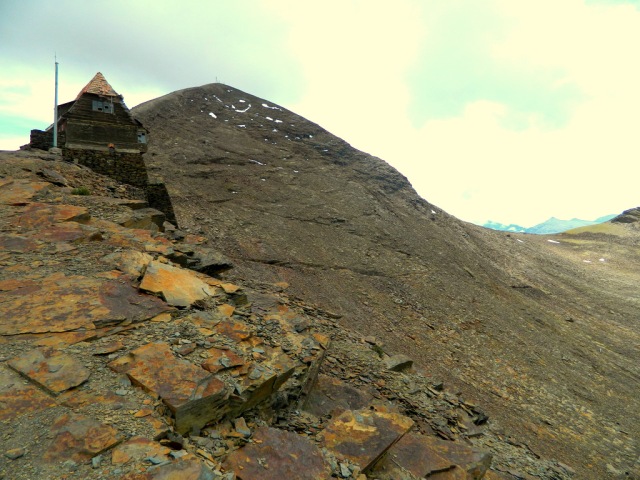







 The Happy Hermit