Zur deutschen Fassung dieses Berichts.
1
“If I take the night bus from Heathrow to Newquay, I’ll get there well rested,” I had thought, although I should have known that I can’t really sleep on night buses. But the last hours of the nine-hour ride are nice. It’s already dawn, and the National Express bus is winding its way on narrow country roads between high hedges, passing green hills with grazing sheep.

At 6:35, the driver kicks me out in Newquay. Objectively, it’s still cold, but I’ve just come from Canada, so anything above zero feels mild. And finally I’m back in a small town where you can quickly find your way around and walk from one end to the other.
I head down to the beach, because the sea is one reason I came to Cornwall. On this early morning, I am the only one awake, it seems. All the waves just for me.

Swimming makes hungry.
2
For breakfast, I’m craving a hot pasty, but the stores are not in any hurry to open. They can afford it because they are world champions. All of them. Every single bakery. One touts itself as “Voted best Cornish Pasty Shop in 2018,” the other as “Winner of World Pasty Championship 2018,” the third as “Winner of Cornwall Pasty Competition 2018.” It’s like boxing, where everyone has their own association to act as a world champion. The “Oldest Cornish Pasty Maker in the World” can rest on its laurels without subjecting itself to these annual competitions.
At 8 o’clock, the first store opens. The baker puts me in a hopeful mood: “The pasties are already in the oven!” I’ll gladly wait for that, I proclaim, until she informs me that it will be another hour. Oh, this pasty is apparently as elaborate as a goulash. My excitement for Cornwall’s favorite pastry mounts, but I postpone making its acquaintance until later in the day. The fact that bakers don’t start work until 8 a.m. would probably make their colleagues in other places laugh.
(If you’re here just for the pasties, you can skip to chapter 7).
3
Instead of waiting around all day, I’ll use the time to introduce myself at my workplace for the next two weeks. As a house sitter, I will take care of a small house and a fat cat.
On the way, I pass the library with a bilingual sign: “Library – Lyverva”.
4
The job with the cat seems to be easy. Bigfoot, as the big cat is called, allows me to pet him right away. He doesn’t seem to care that suddenly someone else lives in the house, as long as he gets fed every day and can continue to come and go when he wants. He also doesn’t seem to be averse to longer trips, because he immediately jumps into my bag.

The next morning, the cat gives me an enormous fright. While I’m in the bathroom, someone is tampering with the door handle from the outside. I thought I was alone in the house, and of course I didn’t lock the door. Helplessly, I look around for a weapon, but I don’t even have a hair dryer.
The door opens and in walks Bigfoot.
The cat is so independent that he doesn’t really need a house sitter. Except at night, when he likes to open the door to the bedroom, come to bed and read spy novels with me.
And another thing makes this house sit easier: the last cat sitter was a rather strange fellow who ate the entire pantry, then went to the local food bank and, other than that, never left the house. At the end of his stay, he asked the landlady for the bus fare because he didn’t have a penny.
Unfortunately, my predecessor also left the heating on too long and too much, so now I don’t dare ask if it could be turned on just a little bit, to help against the terrible cold I caught in Canada. But no, this is England, from April on, the windows are open and the Atlantic winds are whistling through the house, no matter if someone almost dies from coughing.
5
Did I say England?
“Cornwall,” the owner of the house and the cat corrects me, before taking the bus to the small airport of Newquay to enjoy her last vacation in Europe before Brexit. (At least that’s what we thought back in May 2019. As we all know, things turned out a bit different).
I ask Susan if she speaks Cornish.
She laughs, “Nobody speaks Cornish!”, and immediately takes another swipe at the Southwest nationalists: “Half the words are made up anyway, because there simply were no words for modern objects at the time the language was spoken.” I venture a guess that “lyverva” is one of them.
6
But Cornish is not alone. Newquay is hosting an International Celtic Festival this week, with guests from Scotland, the Isle of Man, Brittany, Ireland and Wales.
The Cornish flag is flown in some gardens. Many cars and several stores display the white cross on black background.
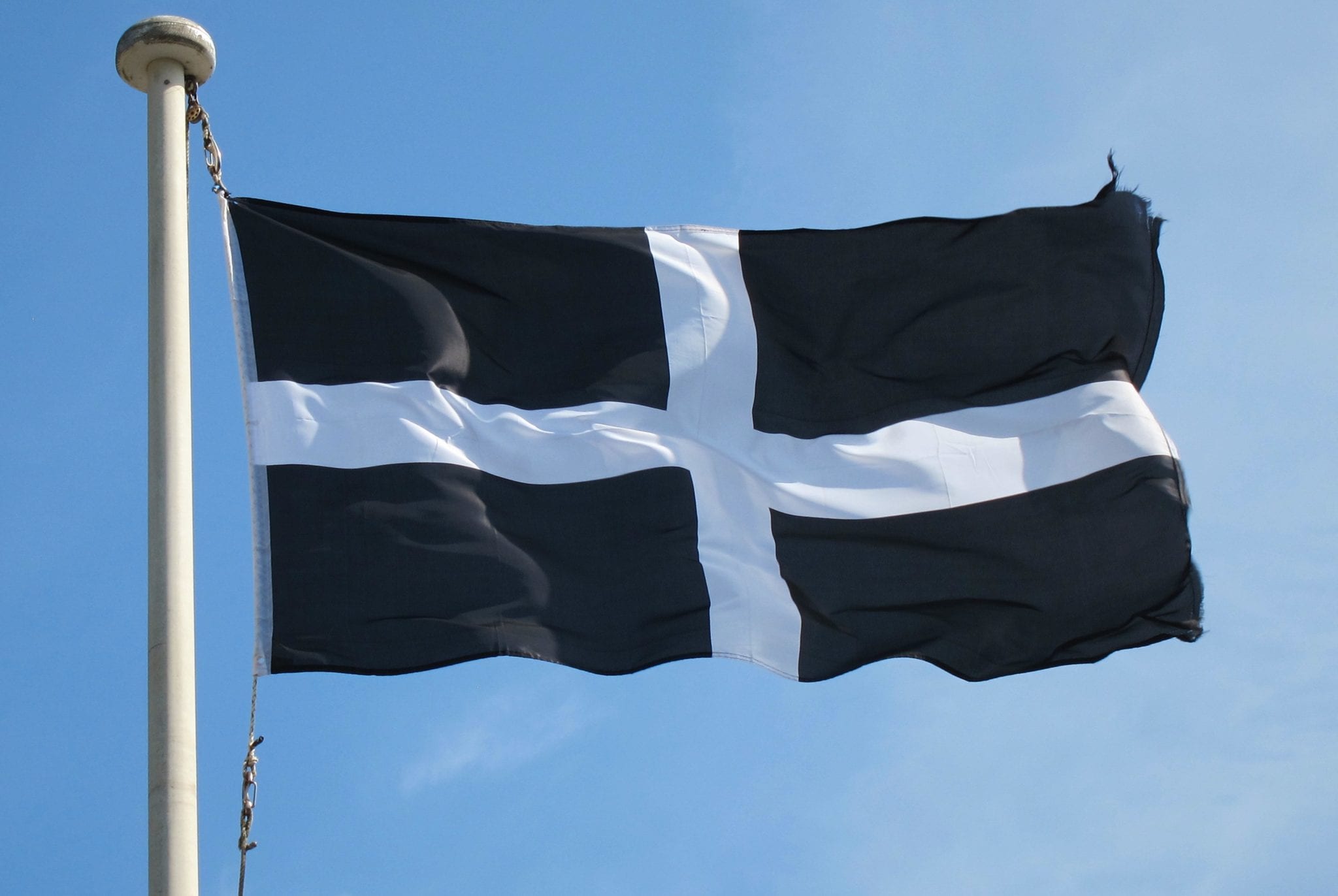
That doesn’t have to mean anything, though. In Bavaria, too, the white-blue rhombuses are everywhere, yet nobody wants Bavaria to become independent. Mebyon Kernow, the most important party supporting autonomy for Cornwall, scores between 2% and 4% in elections. Apparently, the issue doesn’t rank quite as high as the flags are flying.
7
The world champions from chapter 2 don’t have to work long either, because when I get to the bakery at 17:30, the girl is already closing the shop. Therefore, they are offering a discount on the leftovers of the day. 1.50 £ instead of 3.50 £ for a large pasty, which is perfectly sufficient for dinner. Here, I can live cheaply.
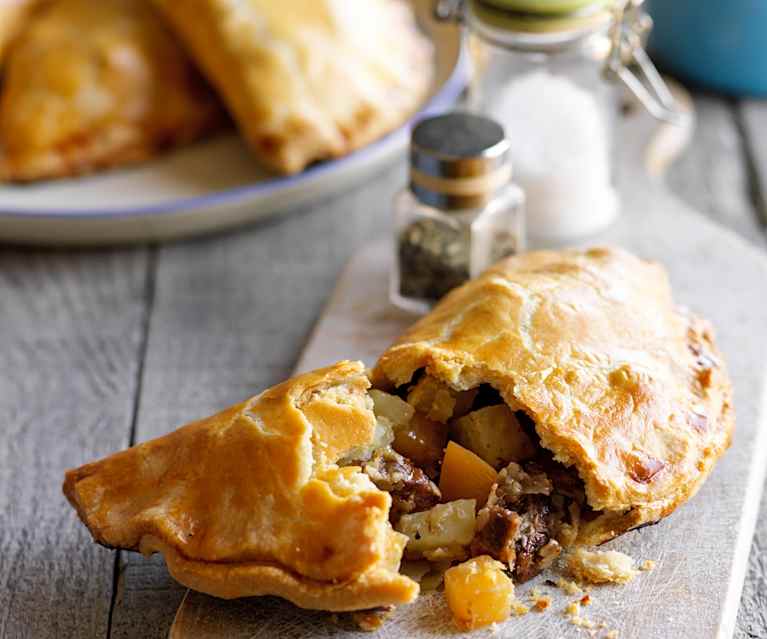
Well, it’s not world class, let alone in the league of Kaiserschmarrn, but in Great Britain you can become famous even with culinary mediocrity.
When eating in the park or on the beach, you have to watch out for the seagulls, which are either always hungry or always up to mischief.
8
The best thing about Newquay is that the South West Coast Path goes through here. This is a long-distance hiking trail of just over 1000 kilometers, closely following the coast and circling the southwestern tip of England, Cornwall and Devon.
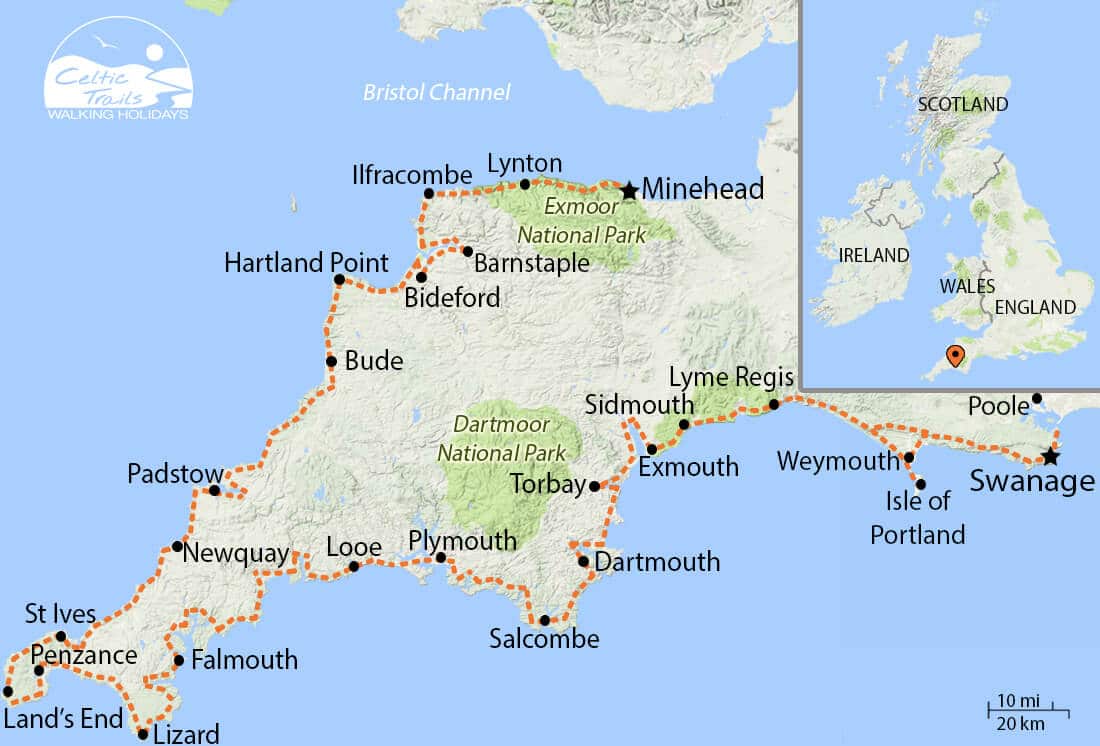
Long-distance hiking trails in Great Britain, the “National Trails”, are something special. A paradise for hikers! Always in beautiful nature. Only rarely do you share the path with roads and vehicles for a short stretch. Soft paths. Comfortable resting places. At least one pub per day. Well signposted. Okay, the latter is not really needed for a coastal hike, where you can’t stray too far from the path or always find your way back onto it.
And another advantage, very useful for me on this occasion: In the UK, there are buses even to remote bays or to the middle of nature. I can only leave the cat alone during the day, otherwise he will eat the orchids, which to protect is another of my responsibilities. But with the double-decker buses, I get away from Newquay in the morning and then walk 20 km or so back to town during the day. Then the same in the other direction, and so on, further and further.

As I don’t aim to win a hiking competition, but just a first impression, this approach is enough for the moment. In the back of my mind, there is the idea of the European Coastal Path, and I want to give coastal hiking a test before I embark on the 5000 km from Leningrad to the Algarve.
9
I take the bus to Harlyn Bay to walk back in the direction of Newquay.

It is perfect hiking weather.


10
Such a bay presents the hiker with at least two options: Either walk through the sand close to the sea and climb back up at the other end (beginners). Or choose the leisurely path above the cliffs and enjoy the view (experienced hikers). Or you run down to the water, delighted at first, but then you start looking for a place to climb up to the trail (me).


Personally, I prefer to hike on the high ground, because I like to have a wide and broad view. Besides, the sea looks a bit suspicious to me, a sentiment that will still turn out to be perfectly justified.
11
And there is nice company up here.

Because I think that animals, at least mammals, deserve to be treated with respect and courtesy, I talk to the sheep. About the weather. About the salinity of the grass in the immediate vicinity of the sea. About their opinion of llamas. About Brexit.
“Good morning,” says a cheerful young woman whom I didn’t even see coming.
Very generously and in typical British politeness, she ignores the fact that I’ve been having a conversation with balls of wool and tells me that she’s hiking the entire South West Coast Path.
Hannah has taken two months off for this project, but she laughs: “At work, they probably wouldn’t even have noticed that I am not there.” I suspect some procurement and controlling department in the far-flung branches of municipal bureaucracy. But no, Hannah is a producer with the BBC, responsible for television series like Top Gear and Cars of the People. People who thunder through the Jordanian desert in 250-horsepower cars or tackle the world’s most difficult alpine road at work apparently long for nature and tranquility in their free time.
We don’t even ask each other if we want to continue hiking together, but simply remain in conversation as we leave the sheep behind. And for lunch, we share corn, salad and bread. Disappointingly, the chicken is raw, because I only had eyes for the price when I was shopping. Useless. (Both the decapitated chicken and mindless me).
12
Just past the sheep, in Mother Ivey’s Bay, there is a hangar like out of a James Bond movie. A ramp leads out of the sea to a building on stilts, apparently for smugglers’ boats. From the coastal path, it can only be reached by a steep staircase.


Very mysterious.
Until I realize that this is not the launchpad for nefarious fishing expeditions, but for heroic rescue missions.
On a sunny day with calm waters, it looks like fun. But the volunteers with the Royal National Lifeboat Institution RNLI are usually called to sea when there’s a storm. It storms a lot and often and violently in the waters around the British Isles. (Incidentally, one reason for Brexit was that bureaucrats in Brussels wanted to regulate wave heights and ban storms on weekends.)
13
Other types of maritime disasters are supposed to be prevented by lighthouses, like the one at Trevose Head.

In the old days, you could always stop by the lighthouse keeper for a grog and a pipe, but nowadays these gizmos are all electrified, automated and remote-controlled. The former lighthouse keeper’s cottage is a vacation home.
Hannah has a tent with her, but in between she stays with friends, many of whom conveniently live in small harbor towns on the coast. Today she stays in Porthcothan, so I’m alone again for the rest of the day.
That’s what I like about the long-distance paths in Britain. The trails are not crowded, so you are happy to meet other hikers. You get to talk to each other. You share food and tips. You hike together for a few hours until someone wants to walk faster or slower, take more breaks, or just prefers peace and quiet again. Everything is very informal. If you’re hiking in the same direction, maybe you’ll meet up again later. If not, then not.
14
I envy Hannah, because she didn’t take a single photo during the whole walk together. She just enjoys the moments. For herself. As she said: “The photo never captures the mood anyway, the waves, the salt, the exhaustion.”
That’s true freedom!
But I’m burdened with this blog and demanding readers around the world, so I documented a bit of the afternoon walk for you as well.


On this stretch, Mawgan Porth is a good place to swim in the sheltered bay and to refuel with fish & chips.
15
Because the next place, Watergate Bay, is as unsuitable for this as one could imagine. As you can see from afar, judging by the poor architectural taste, there is pretentiousness in the air and on the table. Normal food? Normal prices? Not here. “I hope that bloody Jamie Oliver will go bankrupt!” I scream into the wind, angry about the menu, with its prices unaffordable for ordinary working people, let alone those depending on welfare.

(That was in early May 2019. Two weeks later, the restaurant chain did indeed file for bankruptcy. So, beware of my curses criticizing capitalism!)
16
I catch sight of Newquay, but the coastline is so rugged that my sweet temporary home is still hours away. Hopefully I’ve left enough cat food for Bigfoot. (Although he looks like he could easily do with a day’s diet.)


17
On Saturday evening, the town is visibly more crowded than usual. Weekend, May, sunshine, some festival, all this makes the people flock to Newquay.
The visitors are different than in the rest of Cornwall. Fewer pensioners who come to paint in watercolors. More English underclass, wearing shorts far too early in the year and not letting the cold get to them because, after all, you only go to the seaside once a year. Parents who don’t have a free hand for the outstretched hand of the girl balancing on the harbor wall because they are busy with their cell phones.
“Newquay is pretty rough and run-down, isn’t it?” Hannah had asked, and anyone who can translate British politeness will guess what she really means. But I have to disagree. Newquay is not St Ives, but neither is it a Brazilian favela.


18
Sure, there are such rotten corners. But there are also very beautiful and cozy spots. The park under the railroad viaduct, for example. Or the park with a pond, where I sit down exhausted after every hike, soak up some sun and chat with people.

I still commit the faux pas of referring to England instead of Cornwall, which regularly leads to rebuke. Helpfully, however, in English, not Cornish.
“What makes the difference between England and Cornwall?” I ask curiously.
The answers remain vague for the most part.
“We are friendly people, with a sense of community.”
“Life is more chilled here.”
“Look at the beaches! Isn’t it beautiful here?”
Sometimes I get the impression that England is synonymous with London, the stressful big city, where people reluctantly go when they have to appear in court or before a parliamentary committee. The fact that most of England is also green and pretty and laid-back doesn’t even occur to the southwestern patriots.

“We have a sense of identity and pride and place.”
This is true everywhere else, but the statement unintentionally sums up how most nations come into being: By wanting them to come into being and firmly believing that they will.

19
When I ask if anyone speaks Cornish, there is an embarrassed silence. In the 18th century, the language died out, and now there are some attempts to artificially revive it.
To what purpose? Well, for identity and pride and things like that.
“We old people still have a hard time with it, but the children, they grow up with Cornish. They learn it all by themselves,” the gentlemen in the park hope, but I think they might be a tad too optimistic there.
In addition to its uselessness, the Cornish language project suffers from the fact that there are three different variants of Neo-Cornish that not only cannot communicate with each other, but are downright enemies. (More on Cornish terrorism in chapter 34.)
But they all agree on one thing: “We are definitely not English!”

Oh, you must be curious what Cornish actually sounds like. Here it is:
Honestly, this seems to be more of an alcoholic than a linguistic project.
20
One afternoon in the park, I carelessly mention that I am studying history. That gives new rise to the enthusiasm among the older gentlemen:
“Dumnonia was already autonomous under the Romans.”
“Tamar River is one of the oldest borders in Europe.”
“When the West Saxons conquered Devon, Cornwall remained independent.”
“Even King Æthelstan recognized that.”
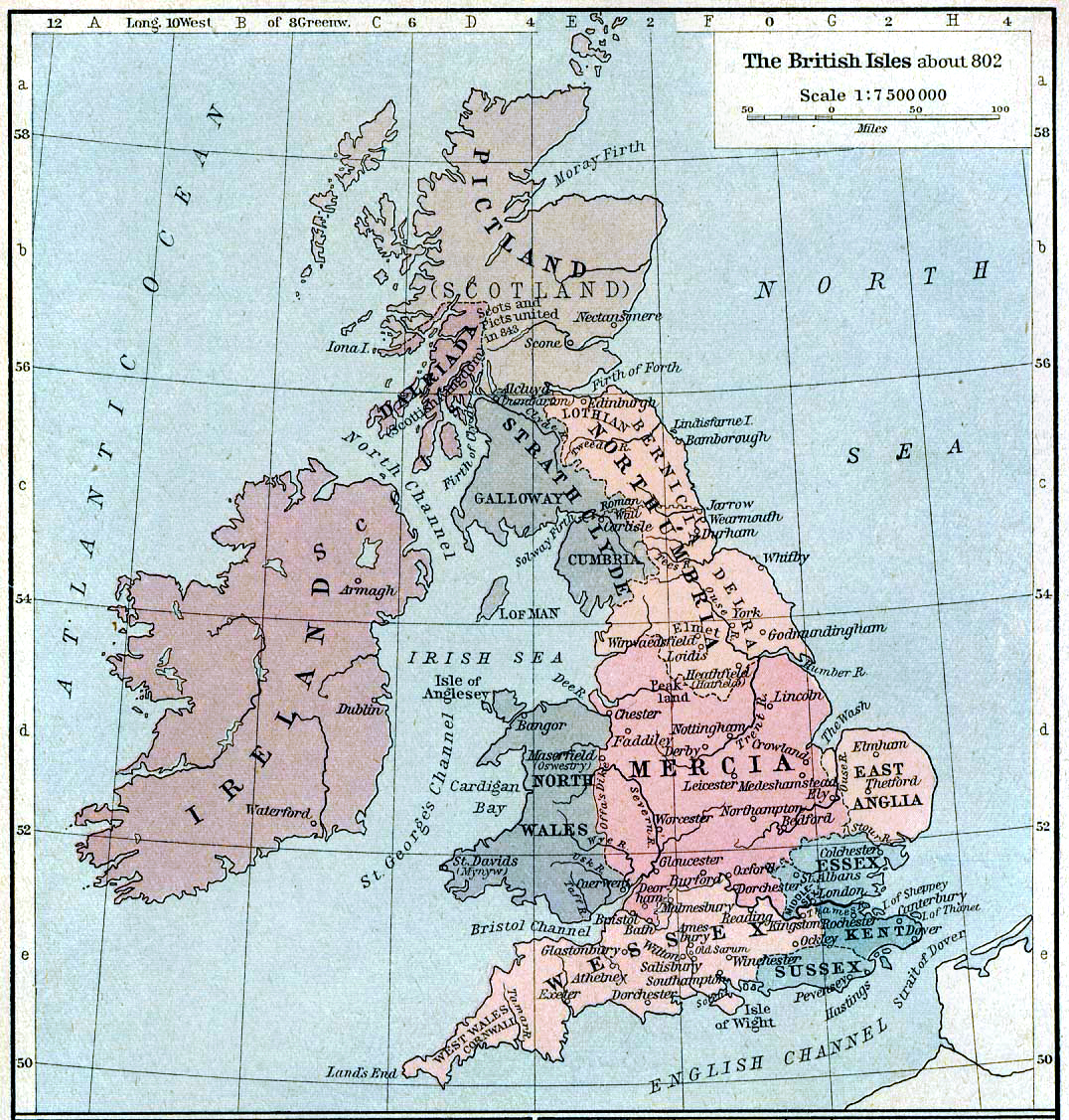
“The Mappa Mundi mentions Cornwall separately, as one of the few regions in Britain.”

“Same on Sebastian Münster’s map.”
“Only Mercator got it wrong, the old geezer,” says one of the old geezers.
“Virgil already mentioned us as a separate nation in his Anglica Historia.” I wouldn’t have thought that the men in the park were that old.
This, by the way, is only the short version, as far as I still remembered it later. Because I don’t dare to pull out my notebook. Normally, I fear that the presentation of this instrument of inquisition will silence my interlocutors. But in this circle, I am sure that it would have the opposite effect and would lead to lectures as long as a Cornish mile. But trust me: Even with all the details, the story wouldn’t make more sense.
“Queen Elizabeth II only insists that Cornwall be part of England because that way, she could bestow the Duchy of Cornwall on her son.”
“As a consolation prize,” laughs another.
“Whose tax collectors squeeze us like a lemon,” pouts yet another.
In the course of the increasingly heated discussion, it turns out that the current queen cannot really be at fault for the complicated constitutional construction of Cornwall, because the duchy was created in 1337 to provide a private colony for the respective prince of Wales (currently Prince Charles). Just like the Congo for the Belgian king.
The gentlemen then speak of bailiffs, rights of escheat, royal fish and tin levies, of which I understand nothing at all, as always when Britons fall back on precedents from the Middle Ages to justify current rights or wrongs.
An example, and let’s stick with tin levies for a moment: In 2000, a Revived Cornish Stannary Parliament walked onto the stage, declaring itself the successor to the Cornish Stannary Parliament, a representative body of Cornish tin miners, somehow established by royal charter in 1201, which had last convened in 1753. By British standards, that’s the day before yesterday. This body calculated that the Duchy of Cornwall had collected too much tax in the period from 1337 to 1837, and filed a claim for 20 billion pounds.
The bill was sent to Prince Charles, who is however not authorized to sell parts of the Duchy of Cornwall, because he is only the trustee. (In fact, no one has that right, which is why the duchy cannot be dissolved, but instead – because of the bona vacantia rules on ownerless property – accumulates more and more real estate.) Thus, he could only collect the money through higher feudal charges or taxes, meaning that the people of Cornwall would have to finance the compensation themselves. The case of Cornwall v Cornwall has been pending in the High Court ever since, and will probably continue to do so for as long as the case of Jarndyce v Jarndyce.
21
If all this is too confusing for you, you definitely shouldn’t order cognitive dissonance for lunch.

Still, it tasted good. Fish should really only be eaten with a view of the sea or the lake from which it was taken that morning.
Newquay also has a harbor, of course, from where fishermen go into battle every day against the EU fishing armada, fighting a cod war.

In former times, this was quite an important industrial port, but with the change from sailing to steam navigation, this chapter was over. Now, with Brexit, good old smuggling is likely to become a boom business again.
The fishermen are happy to take you on a tour, starting at £ 15 for two hours. You get to keep the catch, so it can turn into a profitable journey. I’m thinking of going to sea with them, just for Bigfoot’s sake. But I don’t want to hold an ugly sunfish in my hands, nor fall into the clutches of a basking shark.
22
Instead, I recommend the really good ice cream from Oggy Oggy, which, together with fish & chips, constitutes my balanced diet.
Only a few meters from the ice cream parlor, there is a small park with a view over the sea and the cottage of the most unsociable inhabitant of Newquay. I guess for him, even Brexit doesn’t go far enough.

23
A heavy stone commemorates the Beatles’ visit to Newquay in 1967, where they filmed the movie “Magical Mystery Tour”, a film so terribly bad that it has rightfully been forgotten.

At the moment, they must be filming a surfing movie, because every day surfboards are being carried around town by exactly the kind of people you’d expect to see in surfing movies: tanned long-haired guys, girls with freckles, all with tattooed compasses so they don’t get lost, and all unhealthily thin and muscular.
Also, surfing seems to be so boring that you can only endure it under the influence of drugs.

While I am sitting on the beach, smoking a cigar, the surfer chicks think that I have built a particularly badass joint. After several flirting looks, which I don’t take seriously because the girls are clearly too young and too attractive for me, two of them dare to walk over to me.
Damn, it’s too late to run away now. I just hope they don’t want to recruit me for their stupid movie.

“Hey!”
“Hey.” (I guess that’s how you say hello in the surfing community.)
“How long are you staying here?”
“Another week.”
“Oh cool, then we’ll see each other around.”
“That would be great,” I say, because it’s okay to lie to young people.
24
To be on the safe side, I promptly get up and continue the walk along the South West Coast Path, which conveniently passes through Newquay, unsurprisingly always along the coast.

It’s nice that the entire coastline has been kept clear for the trail. The buildings are somewhat set back, sparse and – except in Watergate Bay (chapter 15) – never ostentatious.


25
Again and again, wooden crosses mark where hikers have strayed from the trail.


Because the morbid readership wants to inspect the exact scene of the calamity, and because I haven’t done anything stupid yet today, I climb down the cliff onto a small but seemingly stable ledge.
The grass is so deep and thick and fresh and soft that I would love to fall asleep here, even though I have a house with a bed and cat at my disposal. The soft green hugs the body like those couches that adapt to the shape of your body. There are even little grass hills that work perfectly as head and arm rests. In the store, people pay € 1499 for something like this, here I only pay one euro for the cigar to make the perfection complete. Hopefully, I won’t set the grassy coast ablaze.


Maybe that’s why so many homeless people come to Cornwall?
People who become homeless in Glasgow or in Newcastle apparently take a look at the sad British weather forecast, see only one little sun smiling shyly over Cornwall, and hitchhike southwest. But sunshine and temperature are almost meaningless figures here. The power of the wind alone determines how much you freeze.

26
Usually, I find my way around quickly wherever I go. One long walk around town, east, west, north, south, and I can answer tourists’ questions about how to get to the beach or the train station. But in Newquay, it takes me a few days.

That’s because of the promontory peninsulas that extend far into the sea, turning my exploratory walks, which consistently follow the coastline, into hour-long endeavors, only to end up, confusingly, almost where I started. And because of the Gannel, south of town, which I first deem to be a river, although it is an estuary. I don’t know what that is, either, and that ignorance will take bitter revenge in chapter 39.
Actually, it is only a riverbed in which one can hike and ride horses. Of the water marked on the map, only a trickle can be seen, across which leads a path of stone blocks.


And the southern shore is beautiful. Hardly any construction, but colorful flowers sprouting with happiness. A peaceful flock of sheep has been so startled by a tractor that it rushes across the slope, bleating wildly.


27
A more impressive cross than for those who accidentally rolled off the cliff (chapter 25) has been erected for the sons of Newquay who lost their lives on the cliffs of Gallipoli, on Okinawa or on Gold Beach in the struggle against emperors, fascism and other evil.


Aden 1964 and the Falklands 1982 are still added below the dead of World War II, but a new plaque has been added for Afghanistan, as if expecting the military campaign there to last forever. Only 20 more years and we will be able to celebrate the 200th anniversary of the First Anglo-Afghan War.
28

As I walk back to Newquay, enjoying the sunset, the two surfer chicks from chapter 23 catch sight of me.
“Hey!!”
Oh no.
But one of them is reading a book, which makes me curious. Besides, they’re alone now. Their surfing buddies probably had to go to bed early.
The book is “The Reckoning,” I realize as I approach.
“Are you studying law?” I ask, because who else reads books by John Grisham.
“Yeah!” they exclaim enthusiastically, introducing themselves as Kensa (23) and Jessica (25), as if their respective age should mean anything to me.
How neat! Finally I found experts with whom I can continue the constitutional-historical discussion from chapter 20. Unfortunately, it soon turns out that with their lawyer robes, they have also disrobed themselves of all legal knowledge. Girls in bathing suits are not good conversation partners. Fortunately, I remember that I urgently need to feed and cuddle the cat.
29
In a side street from the Sainsbury supermarket, there are two down-and-out men sitting on the sidewalk, marked by poverty, alcohol and perhaps worse. I can’t spare the requested change, but I have some time. Alex and Craig introduce themselves, we formally shake hands. They ask where I am from. “From Germany,” I reply, and Alex is delighted: “Like Heisenberg! Guten Tag.”
It remains unclear whether he knows the physicist personally or whether he once studied physics, because Craig keeps interrupting him.
Alex stands up so that we can walk a few steps further and apologizes for his buddy, who unfortunately has psychological problems. “That’s why I’m on the road with him. He needs someone to protect him.”
Old-fashioned solidarity, the kind that probably only exists among the poor. Charles Dickens was right about that.
But Alex is no longer completely sober either, because five times he asks me what my name is, and five times he shakes my hand to introduce himself.
Craig heaves up his body, which is wrapped in far too many sweaters, and a lighter falls from his hand. Instinctively, I pick it up and hand it back to him. This has apparently never happened to either of them before, because they keep mentioning it, as if to reassure themselves that it’s true: “Did you see that? The gentleman picked up my lighter.”
As we say goodbye, they thank me warmly and effusively: “You really are a good person.” Craig hugs me like a bear.
They don’t even ask for money anymore. It’s obvious how rarely anyone treats them as humans. Yet, it would be so easy. Just talk for a few minutes, look each other in the eye, show no fear or loathing, but interest. And please don’t tell me that you don’t have time for that.
30
The next day is another hiking day, this time from Perranporth to Newquay, about 20 km.
The beach in Perranporth is not exactly crowded, but if you have a dog, you have to go out even when it’s cloudy. Whereby the nominally colder and cloudier day again turns out to be milder than a sunny but windy day.


The beach is so long and wide that ten thousand people could walk twenty thousand dogs without it becoming crowded. And between them, there would still be enough room for two Marine divisions to land.
The Marines come to mind because Perranporth beach is as treacherous as the beaches in Normandy. Small rivulets of water are criss-crossing the sand, suddenly filling up around you and cutting you off from land. Then, you have to run back quickly and take another path. Or daringly jump over a channel that has just appeared. Or get wet.
31
All over the world, the 24-hour cycle is divided into day and night. At the equator this rhythm is stable, closer to the poles it varies with the seasons, but the principle is the same all around the globe.
On the coasts of Cornwall, another phenomenon divides the day: low tide and high tide.
“So what? You’re not a ship, are you?” readers in the mountain regions are wondering, thinking of low and high tide as the difference between a full and an empty bathtub.
But for hikers, knowledge of the tides is of vital importance, a matter of life or death. Because when the sea expands at high tide, it claims the space that landscape planners actually set aside for recreation. Thus, it can happen that you spot a wide bay with a sandy beach, imposingly enclosed by steep cliffs, take a nap there – and a few hours later, you are washed away.

I have to decide whether to take the path over the cliffs or walk barefoot over the sand. The bay looks peaceful, so I choose the surfer’s path instead of the via ferrata.
Whenever you are exactly in the middle of the bay (which is 3 km wide in this instance), the spring tide comes rushing in, and you run for your life towards the cliffs, hoping to find a place to climb up.
And climb you must, because the tide here is not measured in bathtubs. It brings more than 7 meters of additional water! That’s like a two-story building. If the cliffs are too steep, and they often are, you die.
An alternative is to run towards one of the rocks jutting out of the sea and hold out there until the tide goes out. But of course, as a stranger to the area, I don’t know which rocks or sandbanks protect you from the tide and which don’t. So, I would probably stand in the sea and just drown more slowly and less dramatically instead of slamming into the rocks.

32
Smart hikers have a cell phone with them for such cases, to call the sea rescue. Repeatedly, I see low-flying helicopters rescuing helpless dogs and their owners from hungry sharks.


But if you know me, you know that I absolutely abhor the thought of bothering someone else because of a self-inflicted predicament.
Besides, as you can see from the last photos, I just managed to climb up the steep rocks. It’s amazing what nimbleness and dexterity the approaching water brings to light. Like a water-shy cat, I sprinted up the almost vertical cliff.
33
Henceforth, I shall only hike on top of the cliffs and not be lured into supposedly romantic bays, not even if a mermaid were to show up.
But up here lurks another danger, around the clock, regardless of weather and tide. You look out over the sea, peer into the clouds, pick a few flowers, and suddenly a crater opens up, as if the wildflowers had been the last thread holding the earth’s crust together.

I don’t know why people travel all the way to Turkmenistan to see that fire pit, when here, the gate to hell opens at every turn. And right next to the hiking trail. Without a warning sign, without a protective fence. That’s how capitalism works. Ships have lighthouses guiding them to safety, but people are left to disappear and die.
34
Or maybe the holes were dug on purpose.
In chapter 19 I already announced it – now we have come to the darkest chapter in this report: Cornish terrorism.
When one has been arguing, discussing, publishing and litigating for an independent Cornwall for centuries (see chapter 20), it is inevitable that even among the most good-natured peoples of this earth, some will run out of patience. We know from ISIS and the Republican Party how quickly one can become radicalized.
The Cornish terrorist groups are called An Gof, named after the blacksmith Michael An Gof – you know, the leader of the 1497 uprising -, Cornish National Liberation Army and Cornish Republican Army. They’ve already set fires in a barbershop, in a bingo hall, and in one of the detested snooty restaurants, but always at night, so that no one gets hurt. Apart from that, they tear down English flags, and in Tressilian, they are even said to have once sprayed anti-English graffiti on a garden wall in 2007.
In 2017, the Cornish Republican Army claimed that a female suicide bomber was ready to give her life for Cornwall. However, they had not yet found a suitable target and they did not want to waste the young woman’s life pointlessly. Probably the terrorists are waiting for the next bingo championship under the English flag.
I can imagine that at international terrorist conferences, the Cornish brothers are not taken quite seriously.
35
But onward with the hike, because today it is so cloudy that I – as always having left the house without a watch – have no idea if it’s still feasible to make it to Newquay before nightfall. With all the nasty floods and climbing, my progress is way behind my non-existent plan.


36
Today, I don’t meet any hiking and conversation partners. Everyone else on the path already has company, either human or canine. The shepherds do not like to see the dogs, by the way, because the sheep are apparently so pacifistic that they let themselves be mauled by a dachshund, as a cruel photo on a fence vividly illustrates.

37
West of Hollywell, huge holes gape in the cliffs, so rectangular they look unnatural. Like submarine bases.

An association that is reinforced by the military base that I am walking past. But even here, enough space has been left between the barracks and the sea for the hiking trail. Priorities. Walking takes precedence over war, nature over NATO.

However, the base looks like it hasn’t been used since World War II. And maybe not even then. Because starting in 1939, a number of mock villages, mock airports and mock barracks were built in Britain to attract German bombs and thus protect real villages, airports and barracks. At the mock airports, lights went on and off constantly, and radio traffic was simulated to feign busy air traffic. One man who was fooled by this was Rudolf Hess. But then, he was guided by even more far-reaching misconceptions about Great Britain when he crashed into a meadow disguised as an airport.

38
Even those who remain strictly on the path are not safe from falling into a sudden abyss.

The United Kingdom is consistently losing territory. Sometimes large chunks at a time, as in North America in 1776, India in 1947 and Scotland in the next referendum. But more often, small stretches of coastline drift off to independence. Erosion, like so much that sounds erotic at first glance, is destructive and avaricious. With its wet claws, it tears shreds out of the island, not minding whether people still live there or not.

I’ve always told you: Don’t invest in real estate!
39
Back to the hike, which will hopefully take me back to Newquay before nightfall. If I read the map correctly, I only have to climb one more hill, cross the riverbed of the dried-up Gannel, and I’m home, where Bigfoot is already waiting for me to spend the whole evening in front of the TV, with him in my lap.
But behind the last hill, it becomes complicated. Unlike the night, the tide doesn’t come once, but twice every 24 hours. And not every day at the same time. And, of course, at different times at each section of the coast. Bookstores sell a booklet that predicts the exact low tide and high tide times for all beaches, harbors and lighthouses, but the tables look like you can’t understand anything without a degree from the Naval Academy.

If I had a captain’s license from Dartmouth, I would have known what an estuary is. It’s something between a river delta and a firth. And now I know why the little stream needs such a huge riverbed: It fills up twice a day with the water masses washed in by the boisterous tide.
Unfortunately, this is happening right now.
My way back is cut off.

The pegs mark where the path would otherwise be, but it is already more than a meter under water. Well, I could still wade through and get wet, but there’s another problem: The water level is rising incessantly, and strong currents are pushing inland.
From minute to minute, I am cut off more.


I am doing some emergency calculations: High tide twice a day, low tide twice a day. So a flood lasts at least 6 hours. It should be about 6 p.m. now, and the tide is just beginning. That means I’d have to wait until after midnight for the tide to go out again, and then venture through the treacherous estuary in the dark.
No, that’s too risky, even I concede that.
Instead, I must first climb back up the hill to safety, and then run inland in a race against the tide. If I’m faster than the water, I’ll eventually have to reach a place where I can still wade through the riverbed. (Or get stuck in quicksand and drown.)
The valley is filling up with water relentlessly. Again and again, I descend from the hills, hoping to cross from south to north, from danger to safety, from wilderness to home. But each time, the water is already there, as if it was mocking my feeble attempts.

Each time I have to retreat disappointed, losing yet more valuable time in the race against the tide. The water masses pushing in from the Atlantic Ocean are much faster than I could ever be, even forgoing smoke breaks.
In the end, I have no choice but to detour for several miles and hours until I reach a road that leads safely across the waterway.
Of course, the problem could be solved by building a high bridge at the mouth of the Gannel. But whenever I suggest that, the people of Newquay say, “What for?” “But there’s never been a bridge.” “Nobody needs that.” Apparently, when you live here, the tides become second nature and you glide through the aquatic confusion with somnambulistic confidence.
40
The next day, I take the bus to Perranporth to walk further west along the South West Coast Path. For that, I don’t have to remember any tide times, but only when the last bus will return to Newquay.
From Perranporth, the track goes so steeply uphill that I am glad to find a bench at the top of the cliffs with a wide view over the morning sea. Time for the first break, after about 20 minutes of walking.

The bench stands in front of a cottage, which hopefully never spoils its view by watching news like those in chapter 38.
I am wondering who lives here, when – as if to prove that Cornwall is even smaller than the proverbial small world – Hannah steps out of the cottage, backpack shouldered and full of energy. “This is a youth hostel,” she explains, “and one of the nicest I’ve ever stayed at.” A small fence has been drawn around the campsite in the garden for safety’s sake; one could fall down a few meters, after all.
Hannah is only walking a short distance today because she’s staying with friends in St Agnes. That’s on my way, and so we head west together, often dangerously close to the cliffs.


I should really tell fewer stories and pay more attention to the way, otherwise I myself become the story, against which, as this blog testifies, I have no objections in principle, but for which I prefer, if not a Hollywood cliché happy ending, then at least the unharmed survival of the protagonist.
41
The tin industry has also fallen to its death, not least because of the feudal lord’s overtaxation mentioned in chapter 20. If Prince Charles were not so rapacious, the hammers would still be beating, the furnaces glowing and the coins jingling.
Now, only the bats flutter up in fright as we climb through the ruins.


42
St Agnes is the kind of place I would walk by without giving it a second thought if I hadn’t seen on the map that it has a church, a library and even a pub.

At the Railway Inn, however, it is as silent when we enter as if we were interrupting a funeral. The two men at the counter continue to look deep into their beers. The innkeeper comes out of the kitchen and informs us that there is no lunch, not even feigning regret.
We move on to the Miners & Mechanic Institute, where friendly women serve cheerful healthy food in a colorful café.
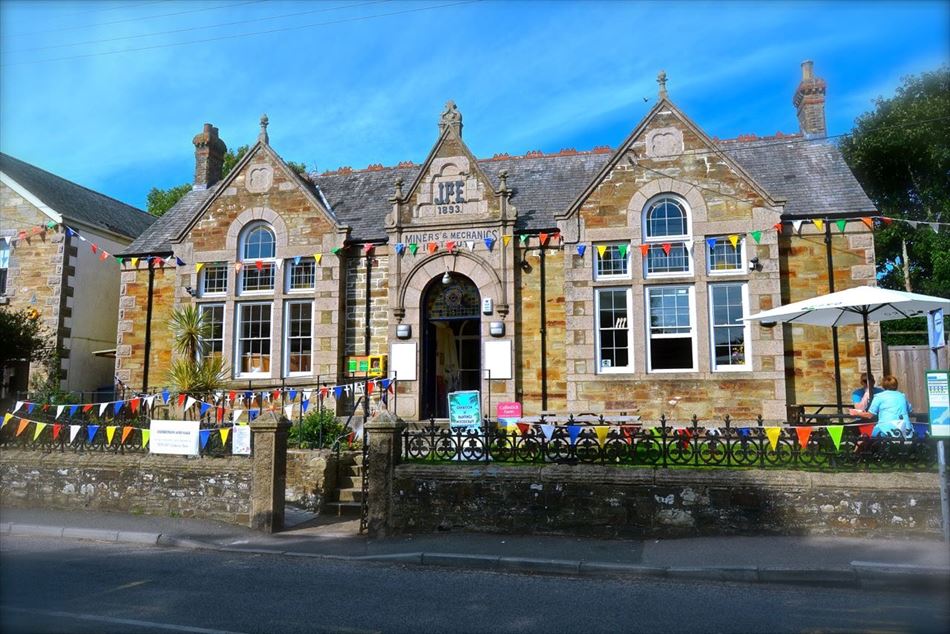

Such cafés also make long-distance walks in Great Britain a pleasure. You’ll find them in small towns, providing an aura as if stepping into a living room, seeing themselves more as a meeting place for conversation than a commercial enterprise. The menu is handwritten. The mother is in the kitchen, and when the food is ready, the daughter gets up from her schoolwork to bring it to the table. Watercolors, pottery and knitted gloves are for sale. Often to collect money for a community member who has been diagnosed with cancer or lost a leg. There are books to borrow or to take home. A brochure from St Agnes Writers Club invites people to contribute poems for the next anthology. Too bad they’re not looking for travel writers.
43
Two ladies at the next table are talking about the people who have fallen off the cliffs in recent days.
“The three teenagers who tried to climb the fence to the festival, that’s sad.”
“And the boy who was walking along the wall of an old brickyard and fell off the cliff at the end.”
“The rescue crews were busy for five hours!”
“I saw the helicopter.”
“He’s in the hospital. He’ll never be able to live carefree again, they say.”
“At least he’s not dead.”
“I don’t know.”
“In Newquay, somebody fell into the sea last week.”
“But that was a tourist.”
“The tourists are really the dumbest ones.”
And that was when I recognized the folly of what I had been doing. As a bus turned up in front of the café, I ran outside, hopped on and flew to Bavaria, a safe 1000 km away from the sea.
Links:
- The South West Coast Path website has all the information you need to plan, including suggested stages for different walking paces, day trips, bus and rail information, where to stay and everything to see along the way.
- There are plenty of hiking guides. The Trailblazer ones are usually the best (volume 1, volume 2, volume 3).
- More hikes.
- More from the UK.
- If you want to do house sitting yourself – in Cornwall or elsewhere -, I have some tips for you.
- Donations for the RNLI (chapter 12) and for this blog.

















 The Happy Hermit