
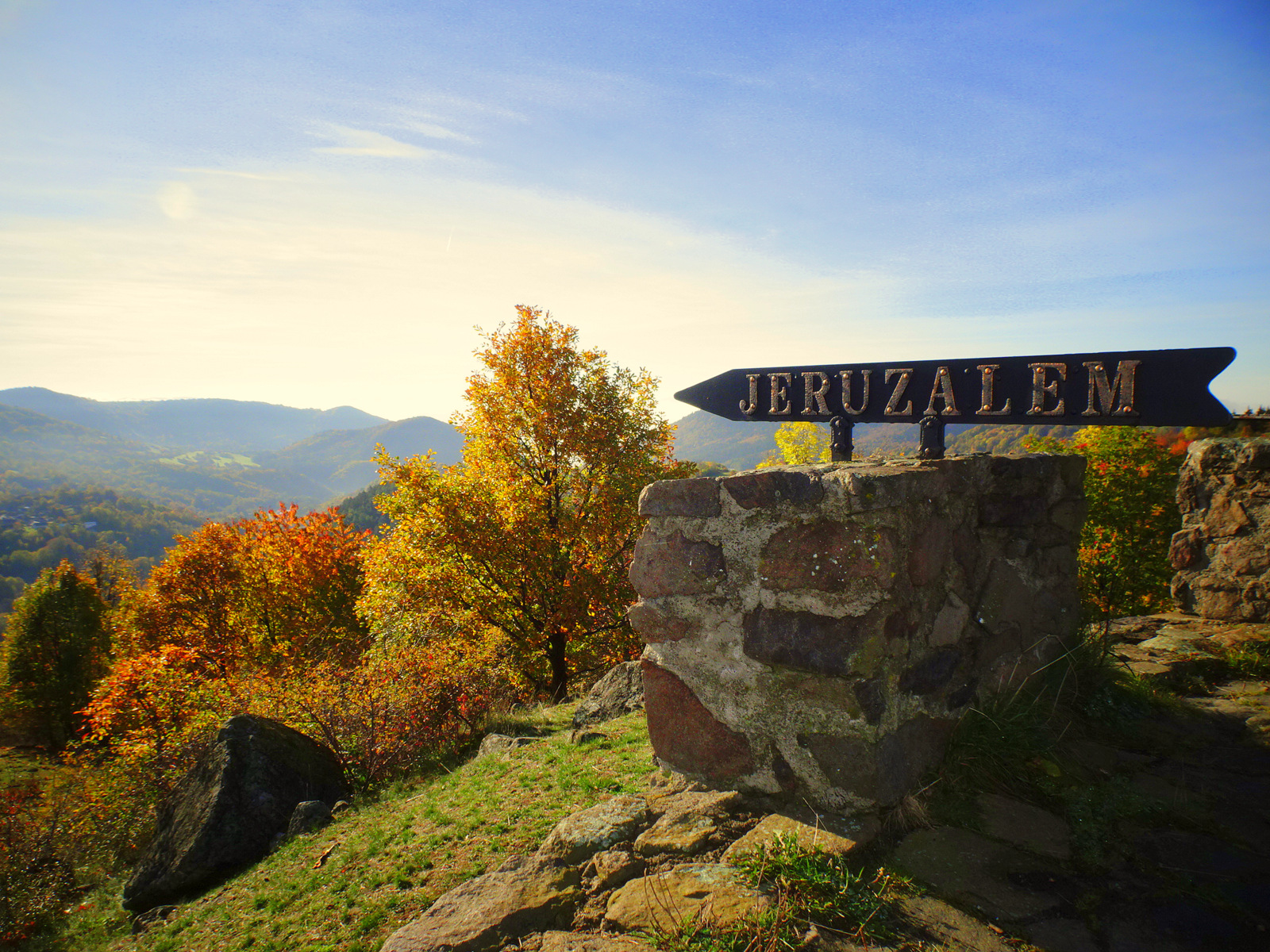
Photographed in Kremnica, Slovakia, a mere 2,325 km away from Jerusalem.
There is actually a hamlet called Jeruzalem in Slovakia, between Jablonka and Krajné, but the arrow clearly points in the direction of the Holy Land.
Photographed in Kremnica, Slovakia, a mere 2,325 km away from Jerusalem.
There is actually a hamlet called Jeruzalem in Slovakia, between Jablonka and Krajné, but the arrow clearly points in the direction of the Holy Land.
Many visitors are surprised when, in the center of the German capital, right next to Brandenburg Gate and Parliament, between plenty of other monuments, and only a short walk from the train station, they see two Soviet tanks and an impressive Soviet War Memorial.
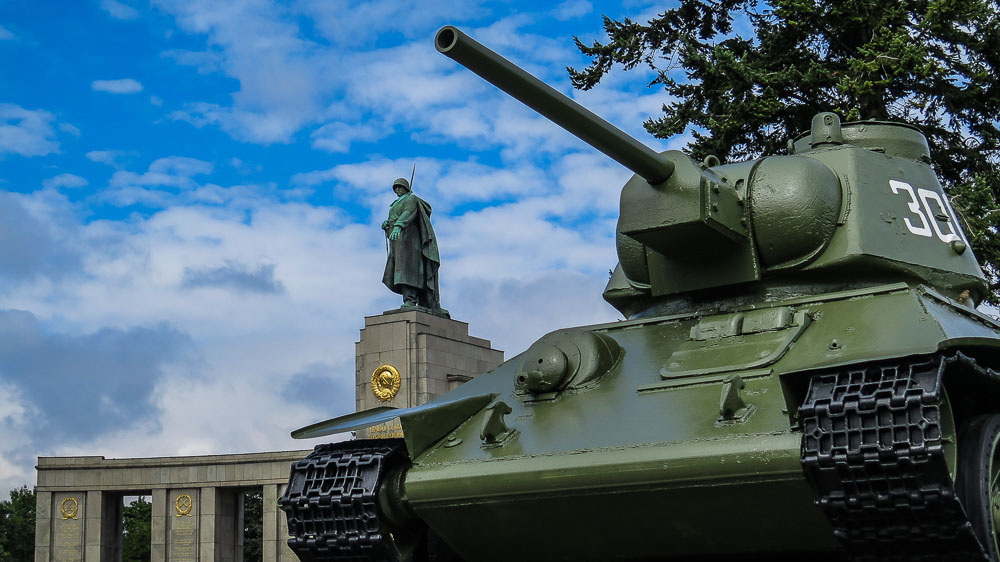
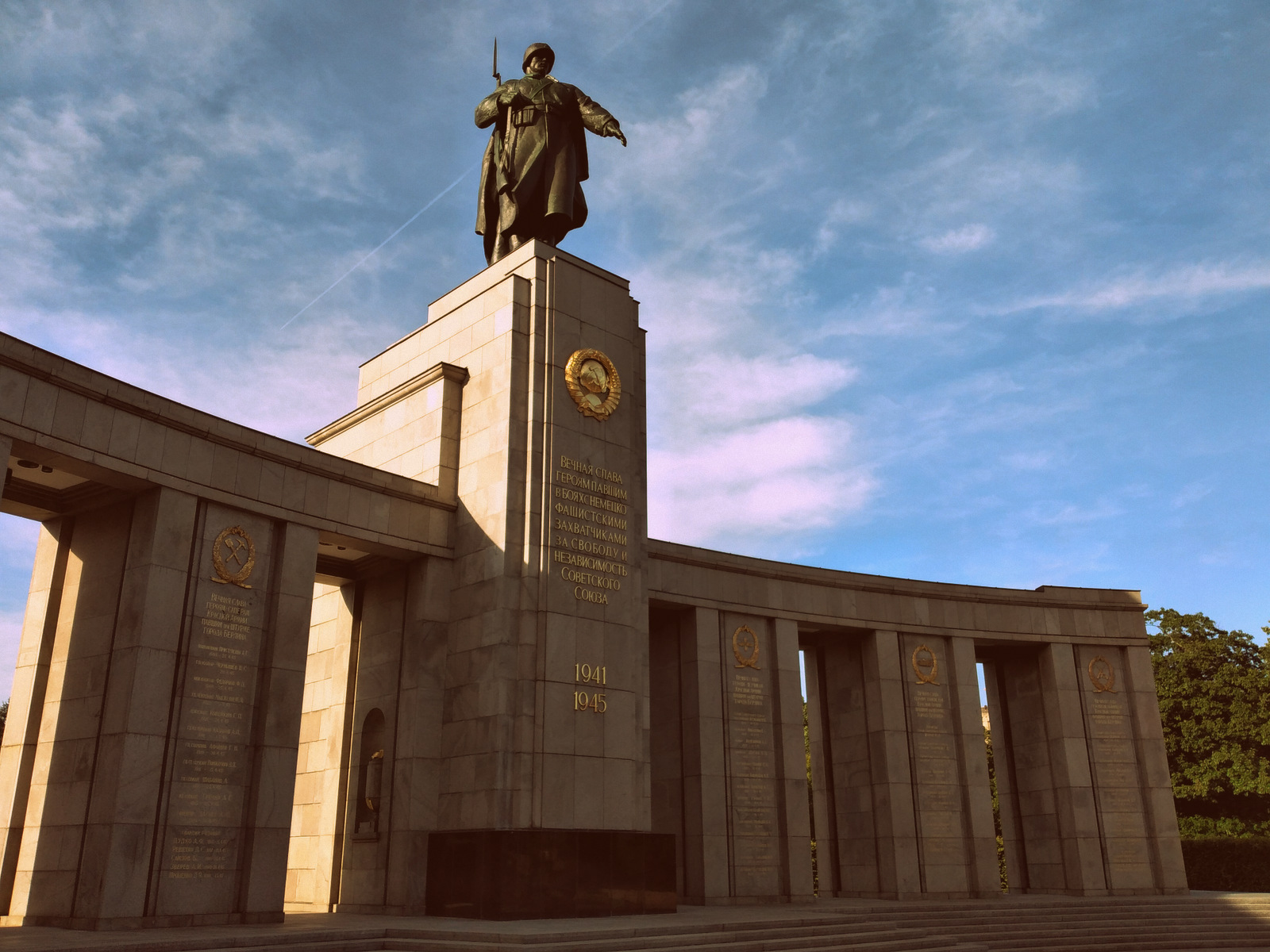
Every year, hundreds of thousands of visitors excitedly snap photos of the Tiergarten Memorial, thinking they have been to the Soviet War Memorial in Berlin.
In reality, they ain’t seen nothing yet.
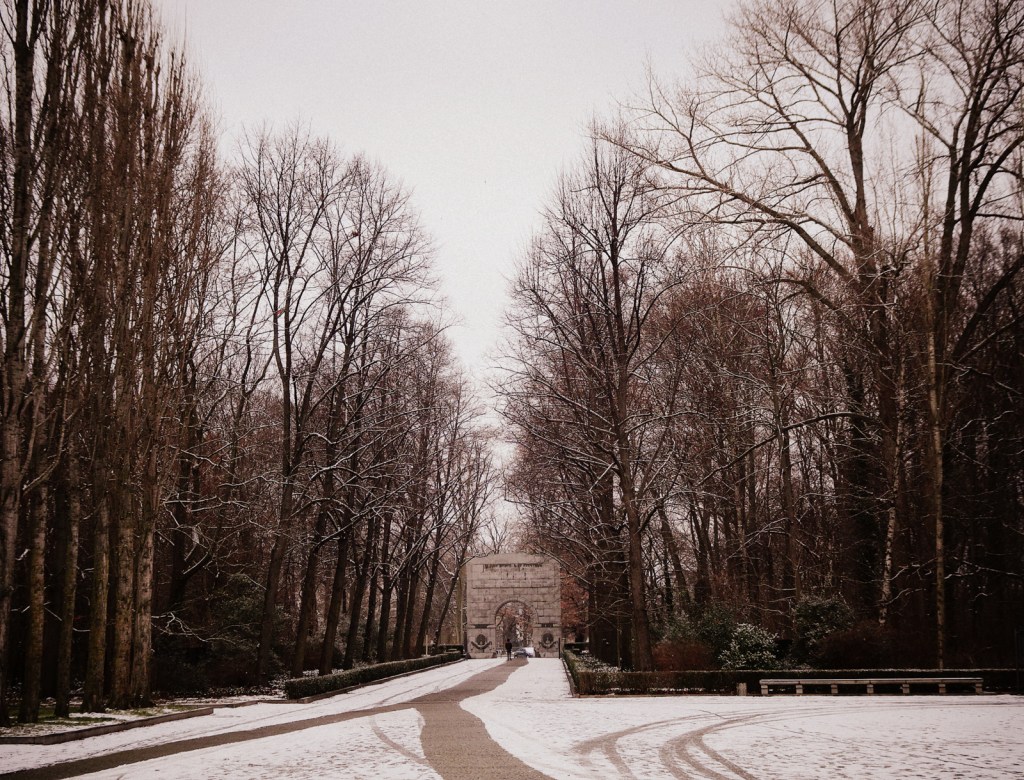
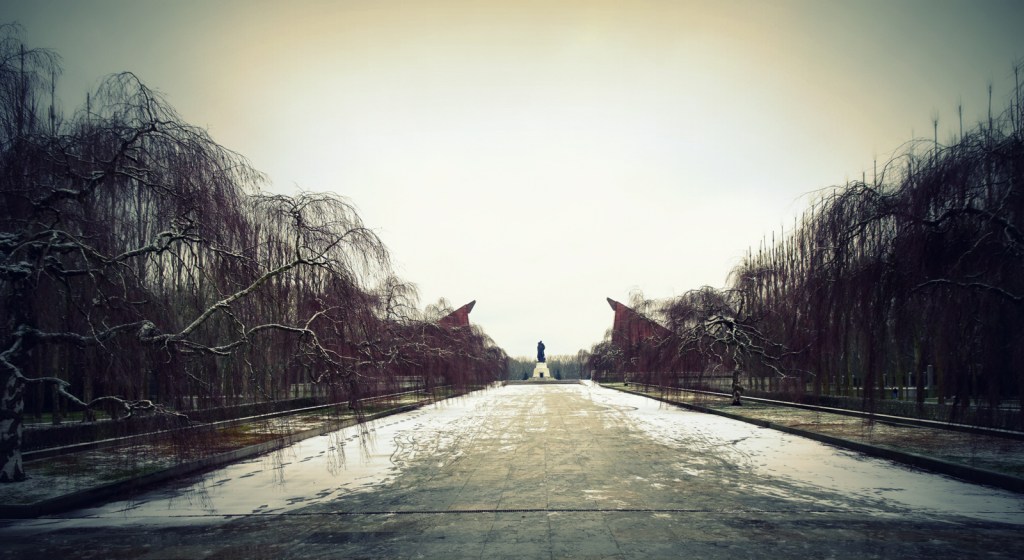
For the real thing, you gotta hop on the S-Bahn to Treptower Park and walk towards said park, where soon, through the trees, you will spot massive structures. Once you enter, you will find yourself in the largest Soviet memorial built outside of the Soviet Union.
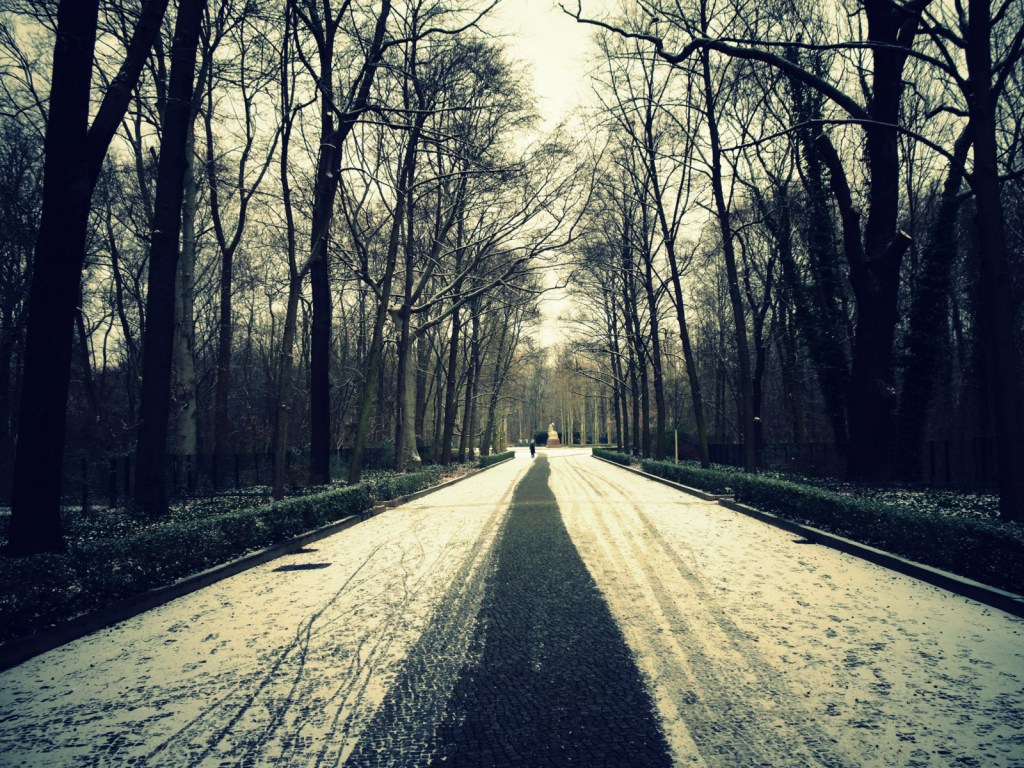
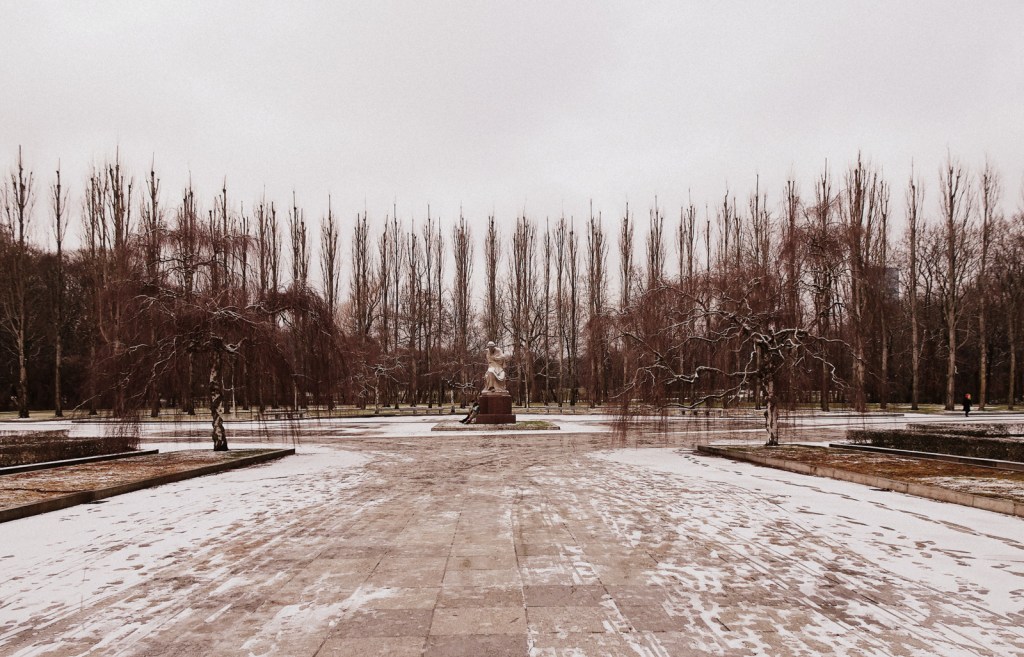
Because you probably missed this when you were in Berlin, I went there on your behalf. And as befits war memorials, I went on a snowy, cold and grey morning in February.
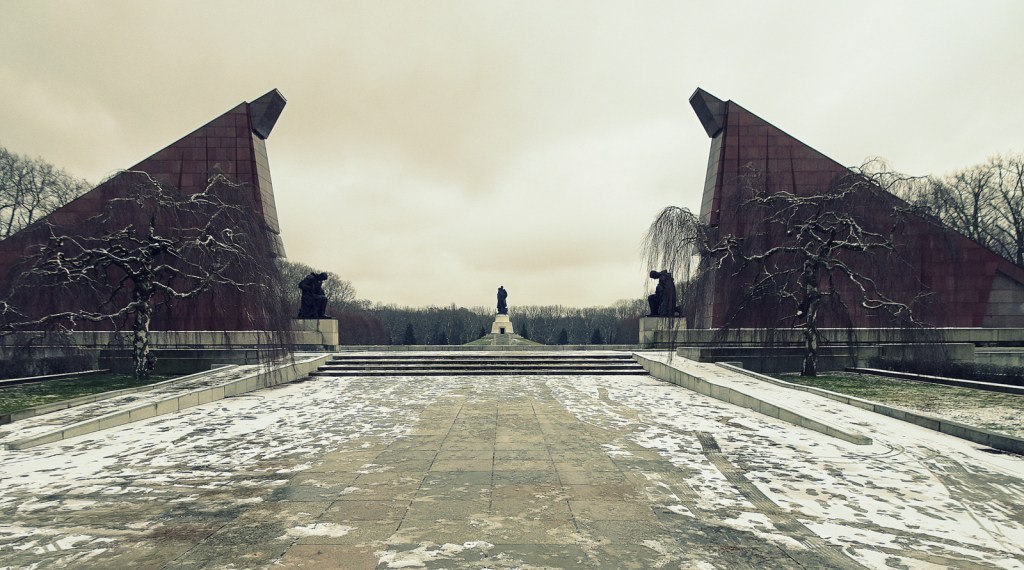
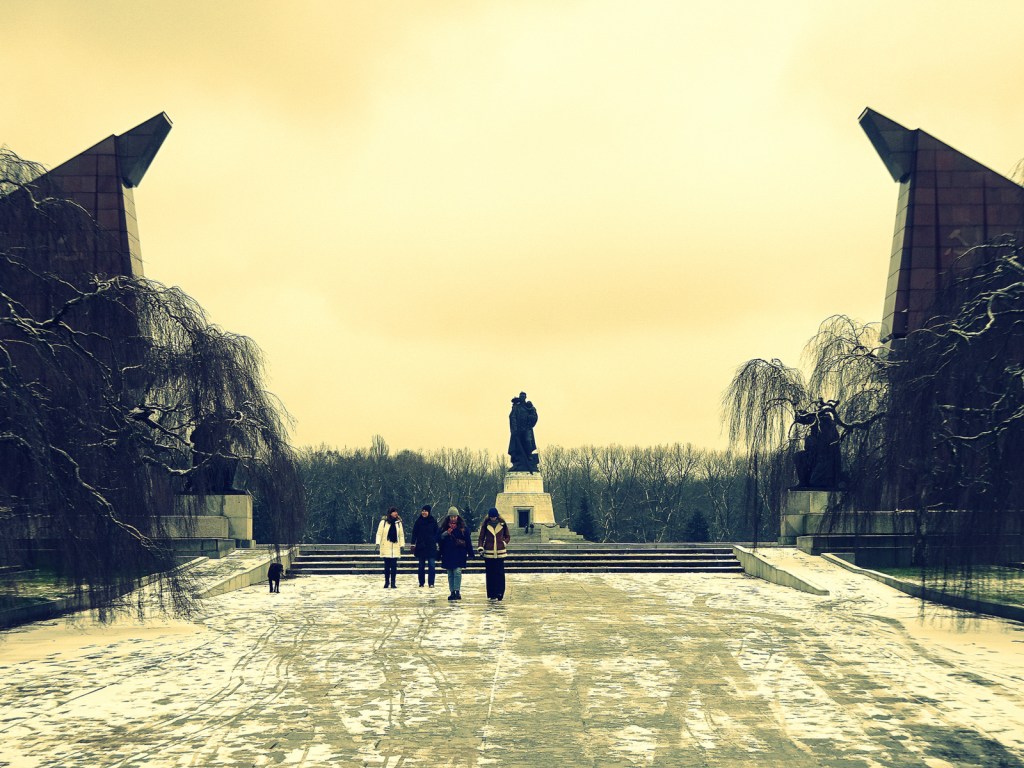

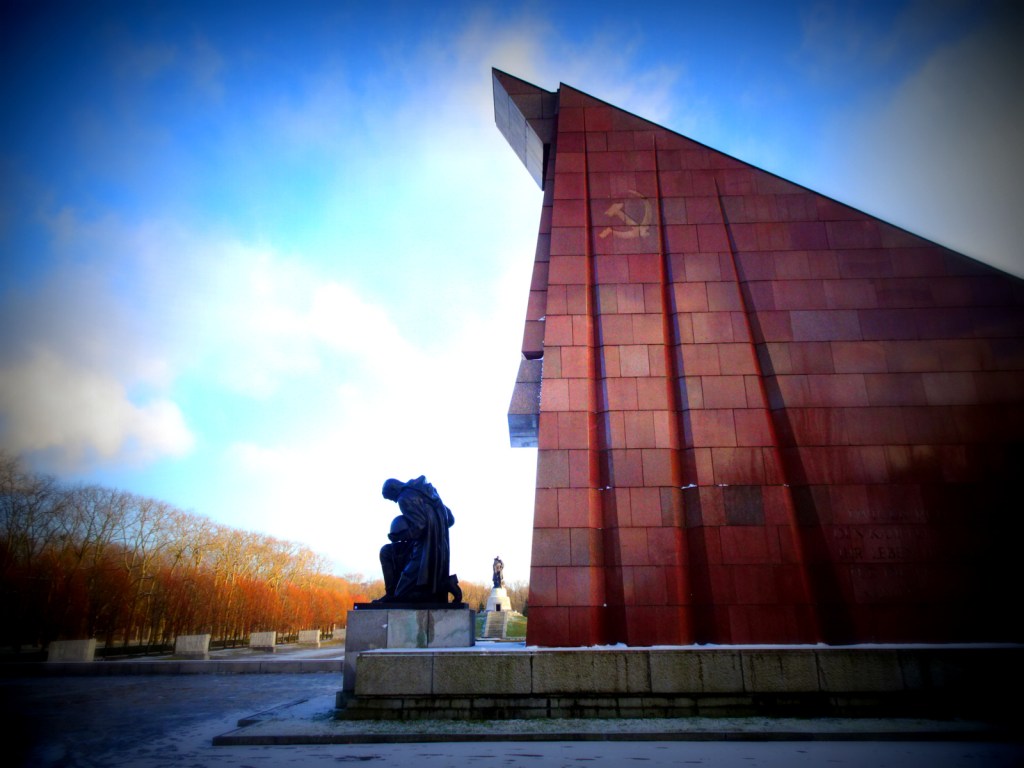
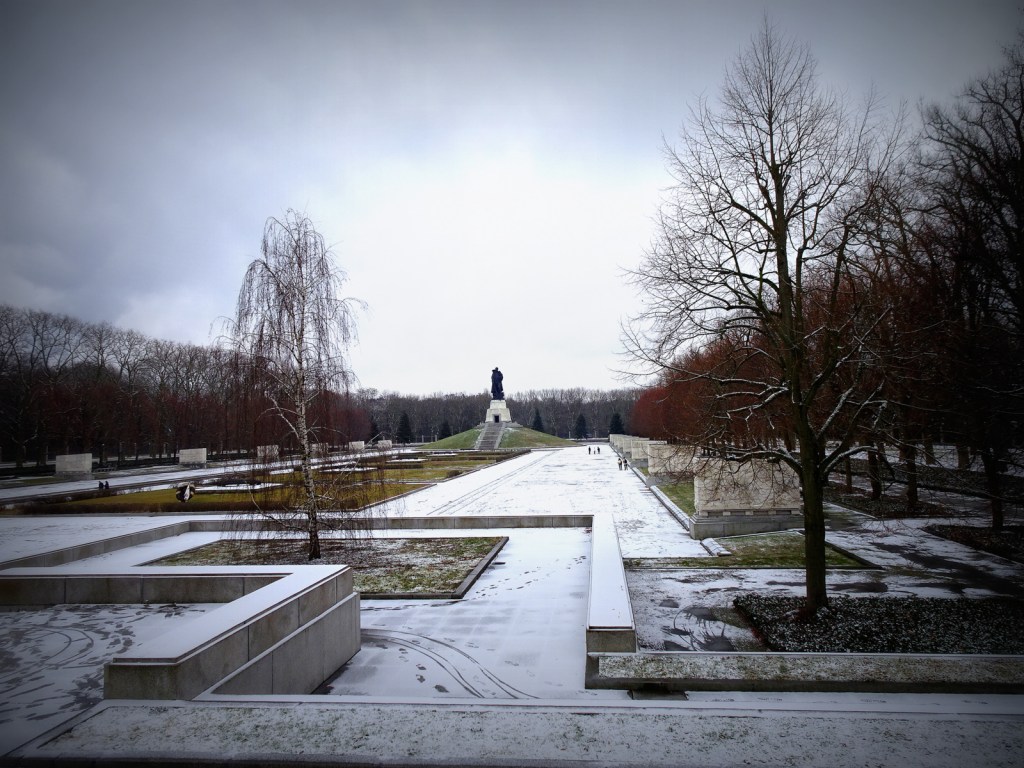


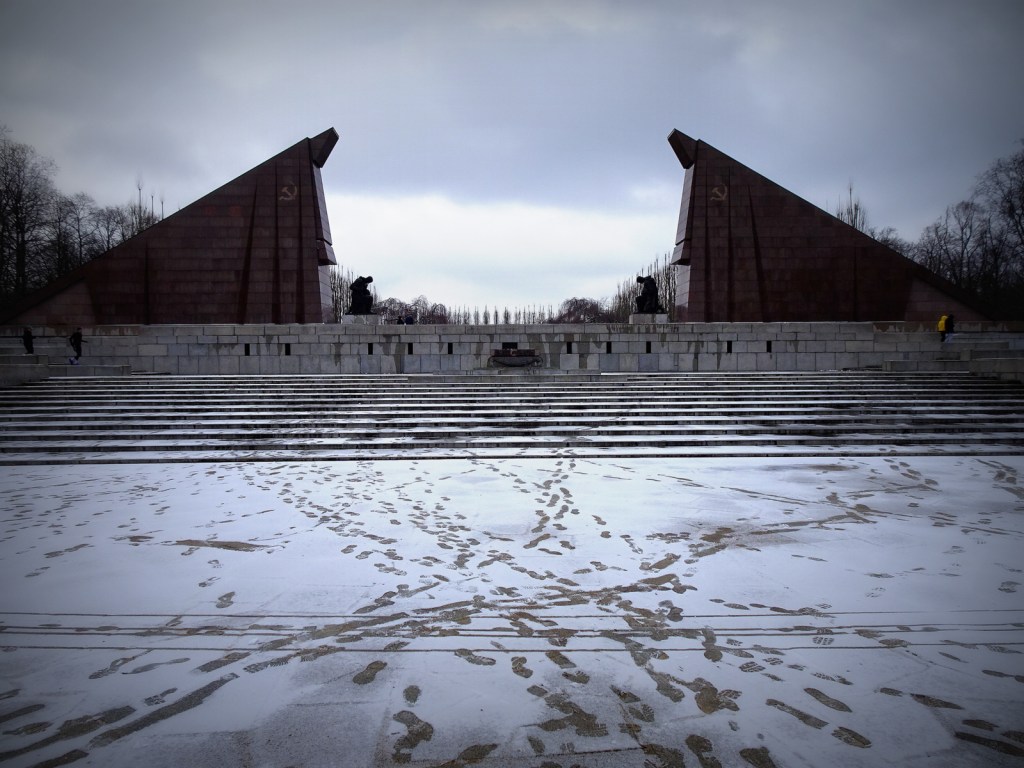
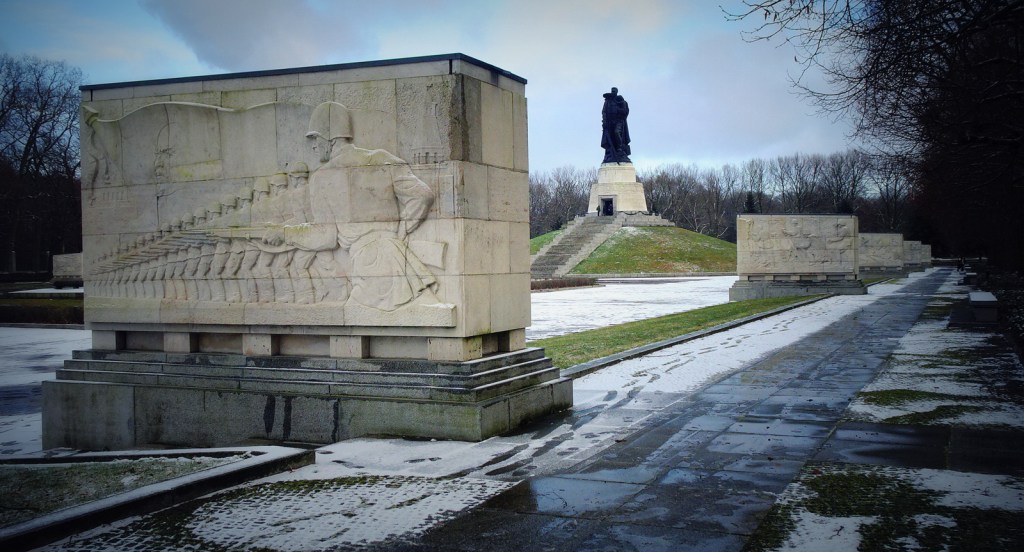


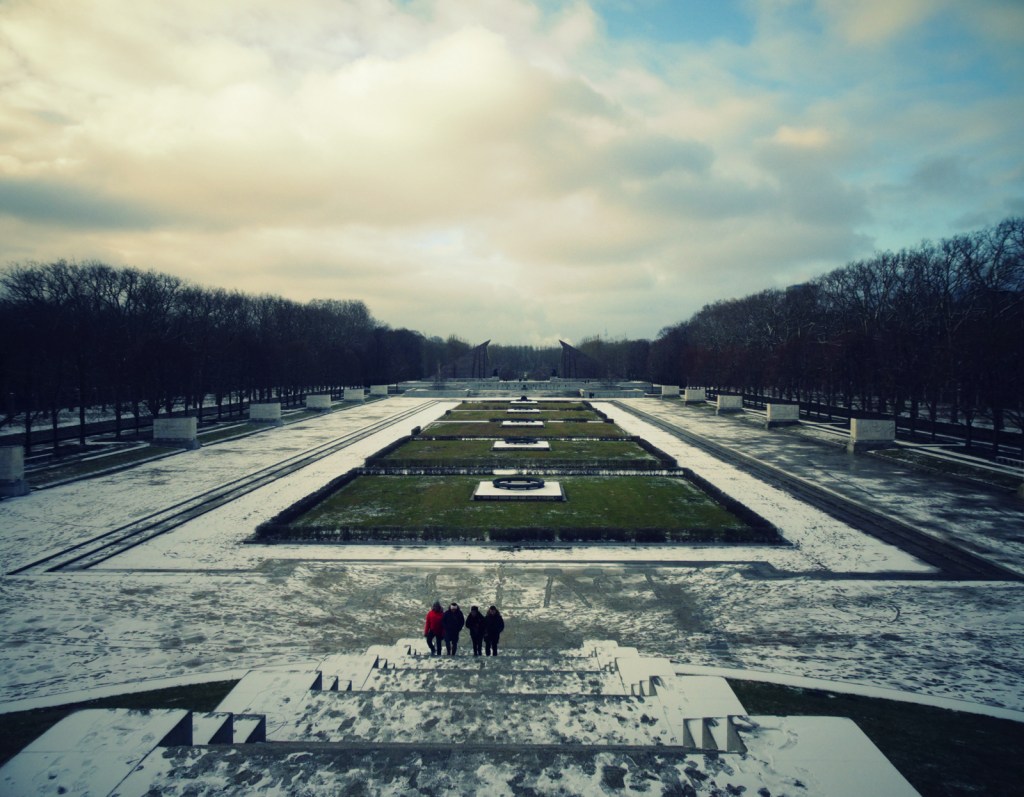
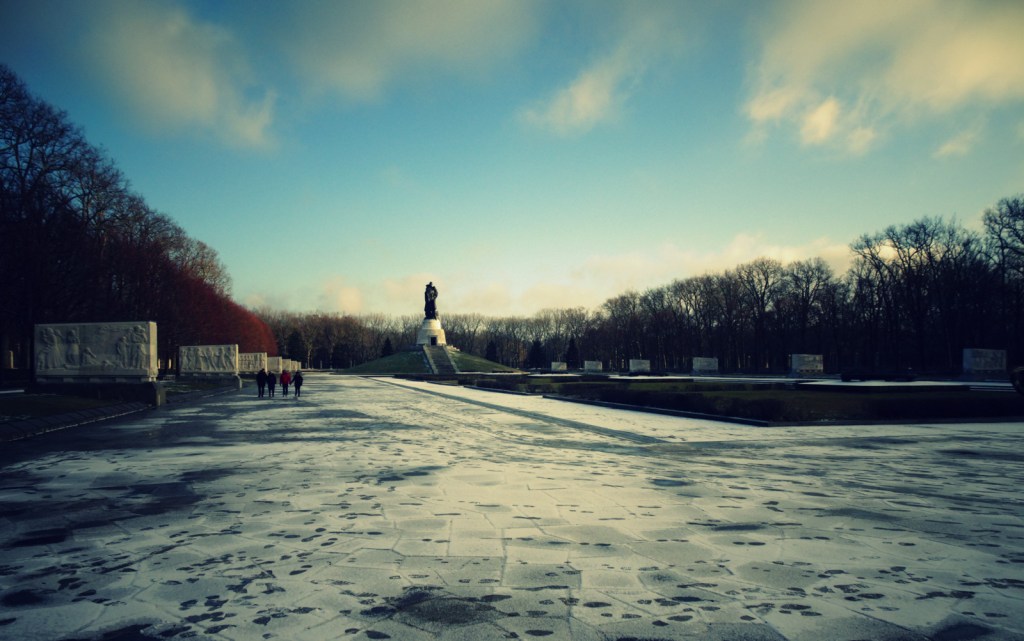
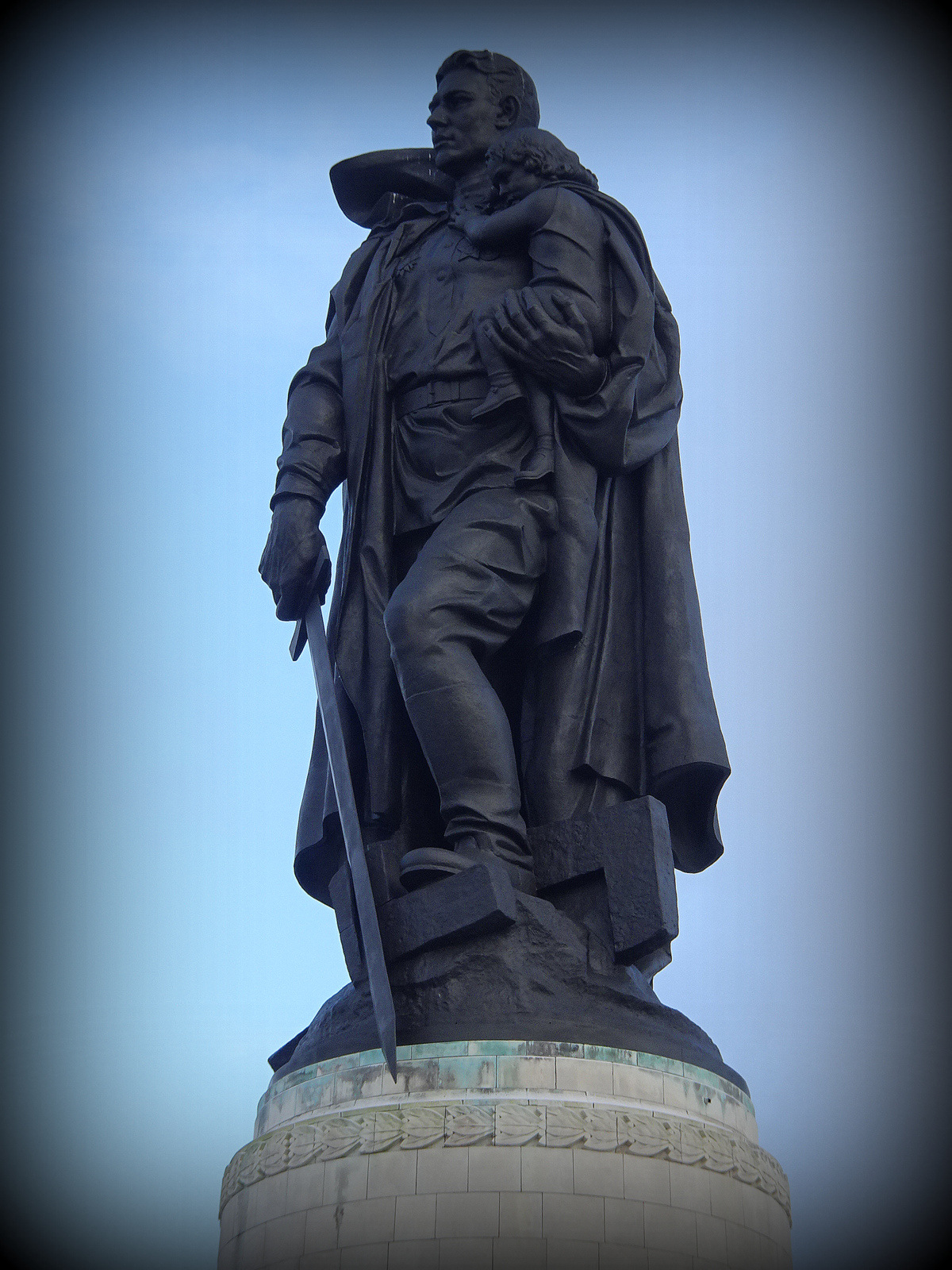
On top of the monument stands a Soviet soldier protecting a child and squashing a swastika.
Another interesting detail lies in the text chiseled into the large slabs of stone on both sides of the enormous square. The history of the Great Patriotic War, allegedly written by Stalin himself, explicitly mentions that “Hitler’s henchmen tried to enslave or exterminate the people of Ukraine, Belarus, of the Baltics, of Moldova, of Crimea and of the Caucasus”, stressing the multi-ethnic composition of the Soviet Union – and of the Red Army. The attempt by modern Russia to exclusively equate itself with the Soviet Union and its fight against fascism is clearly a falsification of history.


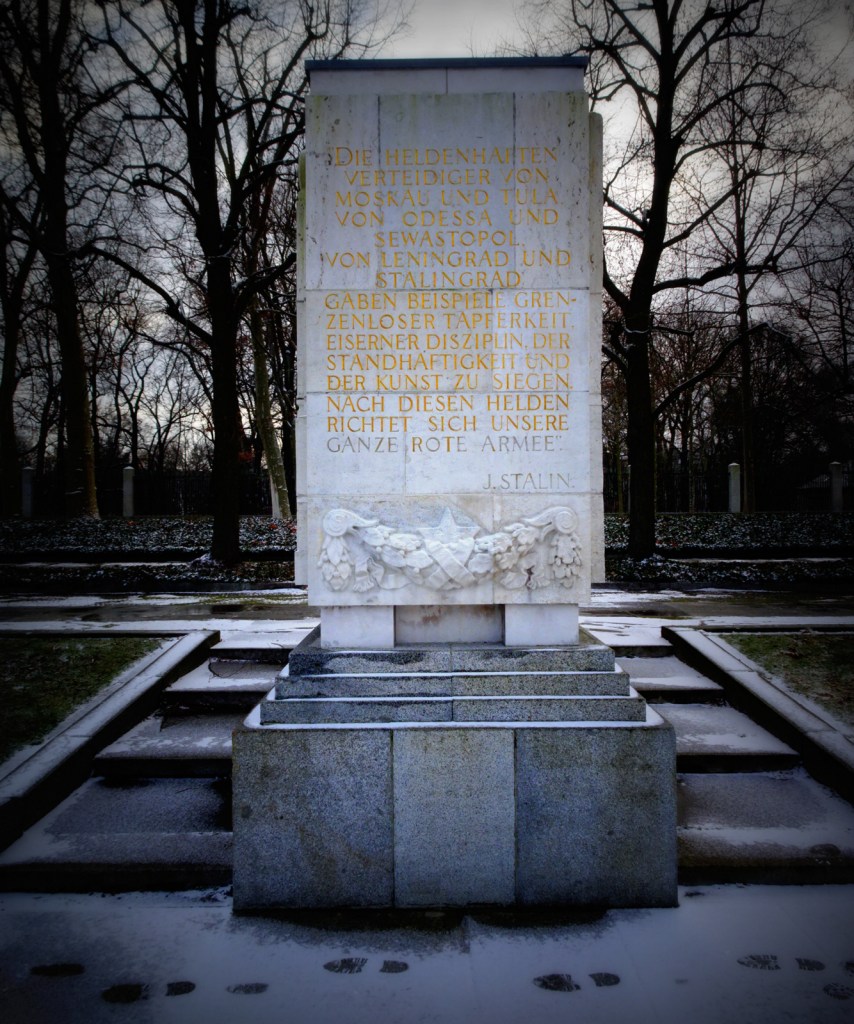
Another inscription mentions “the heroic defenders of Odessa”, sadly topical nowadays.
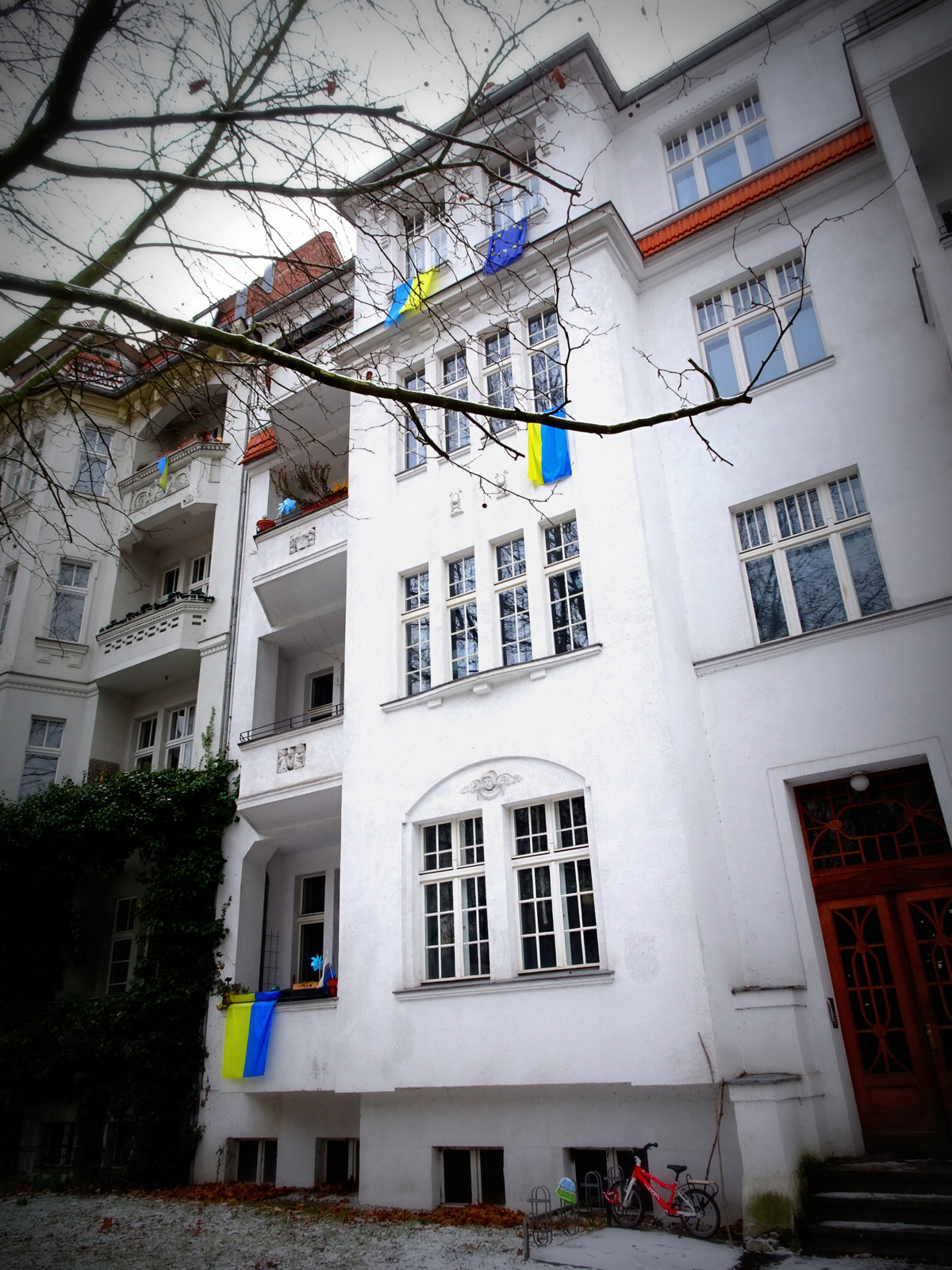
When you leave the site of the Soviet memorial, you will find that many residents living across the street are trying to make exactly that point by flying Ukrainian flags from their windows and balconies.
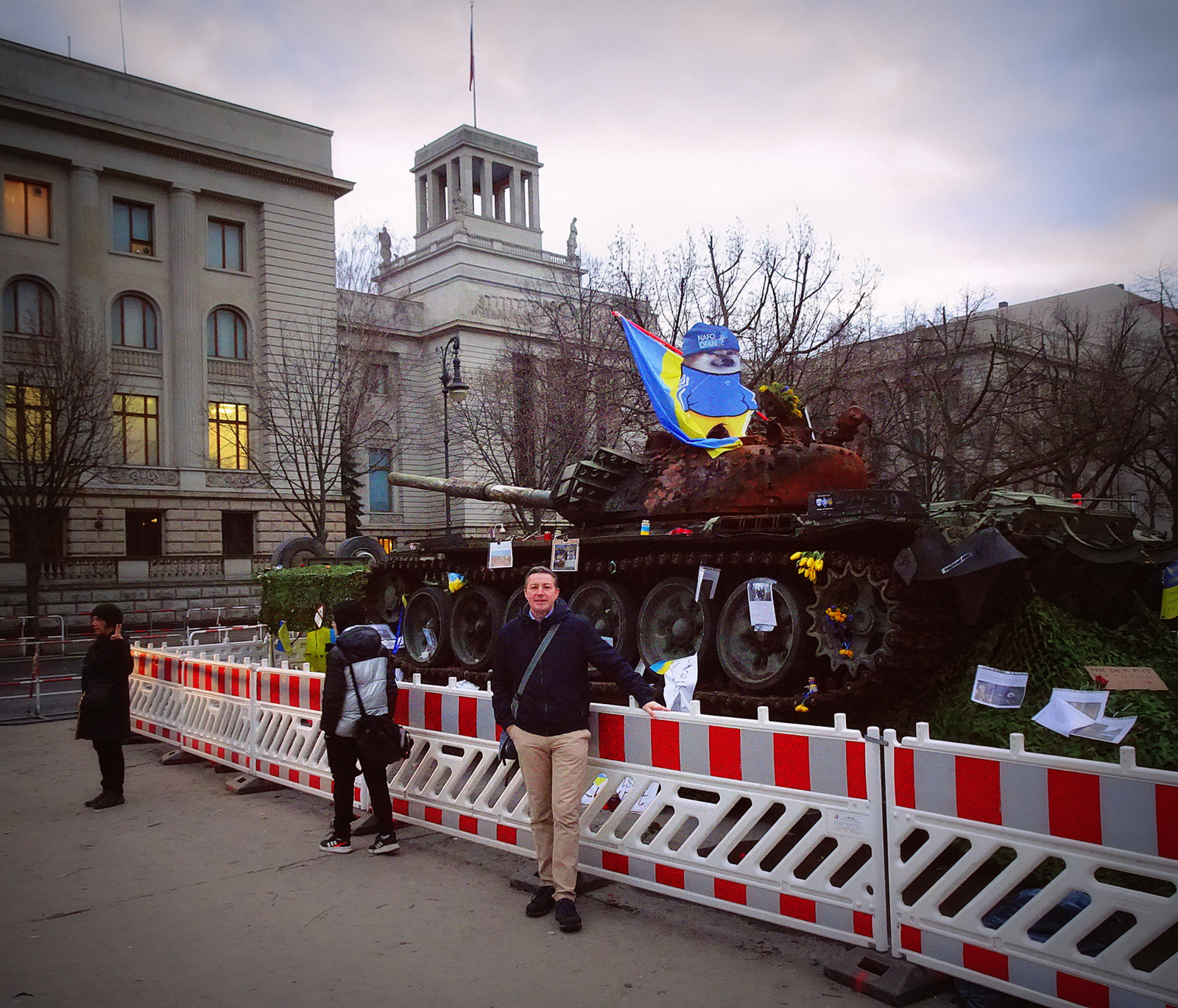
For a short time, there was an additional monument in Berlin, a tank destroyed in the current war waged by Russia against Ukraine. And yes, your sense of architecture has not mislead you, that building in the background used to be the Soviet Embassy.
Links:
For the project “Journey to the Center of Europe”, I am going to visit all the places that have ever laid claim to being the geographical center of Europe or the European Union. And write about them.
I am sure you remember when I launched this series with a daring journey to Ukraine, across rickety wooden bridges and battlefronts, where, amid rocket fire and the thunder of artillery, I sought out this 1887 menhir that supposedly marks the center of Europe.

The inscription – Locus Perennis Dilicentissime cum libella librationis quae est in Austria et Hungaria confecta cum mensura gradum meridionalium et parallelorum quam Europeum – was as mysterious as Arne Saknussemm’s runic writing, which once showed Professor Lidenbrock and his nephew Axel the way to the center of the Earth. Many readers, vaguely remembering little bits of Latin from grammar school, have already given up in despair.
Today – 620 km to the west – we will finally solve the riddle.
Thanks to the comment of a reader, who couldn’t be bothered with easy languages like Latin, but learned Czech right away, I had to realize that my list of central points was incomplete and that there are as many midpoints of Europe on the soil of the Czech Republic as in the rest of Europe combined. One could almost get the impression that the Czechs don’t take my project quite seriously, torpedoing it intentionally with arbitrarily placed points.
I, on the other hand, always take everything far too seriously, which is why one early Easter morning I take the bus from Budějovice/Budweis to Lišov. It is much too early and too cold, or the village is simply too small. Either way, there is nothing going on here. Just a few early risers walking their dogs and frowning suspiciously at the dogless vagrant.
If you live in a similar village, you must know this from the local newspaper. They run reports like: “On Sunday morning, an unknown person was observed on Huntington Drive in Bragg Creek, looking at the houses. The police is asking the population to be extremely vigilant.” People have become so screen-fixated that they find it suspicious when someone is walking around with open eyes, admiring the local woodcarving.


But actually, I’m looking for something else.
A hiking map.
A waymarker.
An information board.
But nothing. I wander around until I find this signpost on a garden fence.

“Středem louky k lesu”: Walk across the meadow and you’ll get to the forest.
Well, what a surprise! I don’t think you would find any meadow in Central Europe, at the other side of which there ain’t no forest. A completely superfluous hint, like carrying wood into the forest, as they say in Czech. Which probably makes more sense than our coals-to-Newcastle saying, because who is aware of the current fossile fuel situation on the river Tyne? I don’t even think they mention that in the Financial Times anymore, because they have all gone bitcoin and bonkers there.
But as I don’t find any other clue, I decide to follow the ominous sign. Across meadows that look like swamps after the incessant rain. Over a secret pipeline project, which is strictly off-limits, but which is not manned with guards, thanks to the Easter holidays. And finally into the promised forest, past suspiciously gloomy witches’ cottages, straight from Hänsel and Gretel. (Please stop robbing that poor boy of his Umlaut!)


Deeper and deeper, I am getting lost in the forest, until suddenly a clearing opens up. It lies a little lower and is perfectly flat, like a pond. It is surrounded by small rocks that look as if the clearing is the result of blasting. Tall trees shield it against prying eyes.
And in the middle of the clearing, there it is, prominently: a menhir, a stele, a monument, an altar.
Three deer are grazing in the meadow, enjoying the lush grass along with the first tender rays of the sun. But as soon as they hear me, they jump into the bushes. (On the first photo you can still see the three white bottoms to the right of the stele.) They don’t seem to be used to visitors. Or only visitors who want to shoot them.


And, even if it has a different color, the connoisseur immediately spots the similarity with the construction in Carpatho-Ukraine. As the decoding of the year MDCCCLXXXIX shows, this monument also dates from the Habsburg period, namely from 1889, making it two years younger than the same marker in Kruhlyj.
Why should the geographical center of Europe have shifted by more than 600 km within two years? No idea. In 1887, France did something in Indochina. In 1888, German colonialism did a bit of fiddling around in Zanzibar and Nauru. (Also in 1888, slavery was abolished in Brazil, but that had more relevance for the geographic center of Brazil.) In 1889, German mountaineers claimed Mount Kilimanjaro as the highest mountain in the German Empire, but the story about the highest mountains of all European countries is a different one.
Fortunately, the inscription on this stele is much better preserved (or repaired) than on the stone placed in the Carpathians.


And so, at last, the mystery is solved. The inscription is identical, but on the stele in Ukraine the last two words are missing: “vocant erectum”. No wonder linguists, historians and geographers have been puzzling and arguing for generations!
The text
Locus perennis diligentisimae cum libella librationis quae est in Austria et Hungaria confecta cum mensura graduum meridionalium et parallelorum quam Europeam vocant erectum.
means something like
This is a permanent location, recorded for eternity for the purpose of leveling, determined during the measurement of European latitudes and longitudes, which was carried out in Austria-Hungary.
There is nothing at all about the center of Europe. It is simply a point for land surveying.
One again, a myth is busted, and a local tourism authority is severely disappointed. That’s why, unlike other travel bloggers, I never get invitations to Caribbean cruises or for the new hiking trail in Bhutan. And now you know why you never read anything critical elsewhere, and why everything is always nice and sunny and wonderful on the travel pages in the newspaper.
And thus, instead of on a sunny island, I find myself standing in a clearing in the woods, wondering what to do with the rest of the day. For such situations, I have a standard solution: I walk to the next road, put my thumb out, and see who will give me a ride.
The “locus perennis” is not far from the E 49, which runs from Magdeburg (in Germany) to Vienna (in Austria), crossing the Czech Republic. The road runs in a straight line for a few kilometers, so it’s easy to see how cars are veering and zigzagging to the left and to the right. Normally, this indicates acute cell phone use, but the cars here all come from Budějovice/Budweis, so it may be the beer. Mobiles and malt, both have murdered millions of motorists. (Maybe fewer, but hey, it’s an alliteration.)
After only 10 minutes, a driver stops. He was just eating his breakfast at about 100 km/h and has to clear the passenger seat of bread, sausage, cheese, a jar of cucumbers, eggs, a salt shaker, mustard and cutlery. This guy is having a better breakfast in his car than I eat at home. The foodie doesn’t even ask where I want to go. Instead, his first question is how long I have been waiting.
“No more than ten minutes,” I say, which I don’t deem too bad. But he is visibly disappointed.
“It’s Easter!” the chauffeur gets angry. “People are driving to church, but leave others standing by the side of the road.”
And then the Czech man, who fortunately speaks a whole array of foreign languages, including German, explains why he, too, wasn’t driving in quite a straight line: “I’ve only slept two hours. And I’ve been doing that for a week. Two hours every night, and then back to work.”
He keeps a rather atypical flextime account, working seven months in a row, and then five months off. His season has just begun. During the spring and summer months, he drives through the Czech Republic and Slovakia, through Germany and Austria, and into Hungary and Italy, collecting pollen.
“I drive up to 1000 km in a day,” he says, and it sounds much more exhausted than proud.
He collects the pollen for a pharmaceutical company. They in turn use it to produce medicine for those who suffer from allergies. He watches the weather forecast and especially the pollen calendar, and then drives toward the sun and away from the rain. Crisscrossing the whole continent, a bit like my search for the geographical center of Europe.
He has probably seen more of these midpoints, or at least driven past them, than I have. And he would have no problem deciphering the Latin inscriptions either, because when we drive past trees, he always refers to them by their Latin names: Betula pendula. Fraxinus excelsior. Salix caprea. He spies these trees from hundreds of feet away, like other people spot a fast-food joint.
So, if you are on antihistamines, think of this poor man climbing trees all over Europe for your medicine.
By the way, I myself no longer have any problems with allergies, ever since an Inca medicine man in South America let me in on a secret: “Against the birch tree’s pollen yoke, the only cure is tobacco smoke.”

The pollen collector prefers wild trees or trees in public parks. But if he sees a magnificent specimen in someone’s garden, he rings the bell and asks for permission to harvest the pollen. If people hesitate, he offers chocolate. If they still hesitate, he offers Czech beer. And in very stubborn cases and for extremely fertile trees, he offers money.
What baffles me the most: Even then, some people refuse.
The next town is Třeboň, where the birch trees stand between the prefabricated buildings at the entrance of the town. Sort of public, that’s perfect. He asks if he shall take me to some castle or something. Very kind! But I think of the pollen and the two hours of sleep and thank him very much.
A few minutes later, I’m already sitting in the park and realize that the blue flowers on the ground fascinate me much more than the fine dust high up in the branches. What can I do, I am such a romantic guy.

Because I didn’t know that I would end up in Třeboň that day, I am wandering around a bit aimlessly.
Thereby, I probably overlook a lot, but at least I find confirmation that the Czech Republic – along with Italy and Portugal – is one of those countries where you can actually go to any small town. No matter where you go, it’s picturesque and pretty.


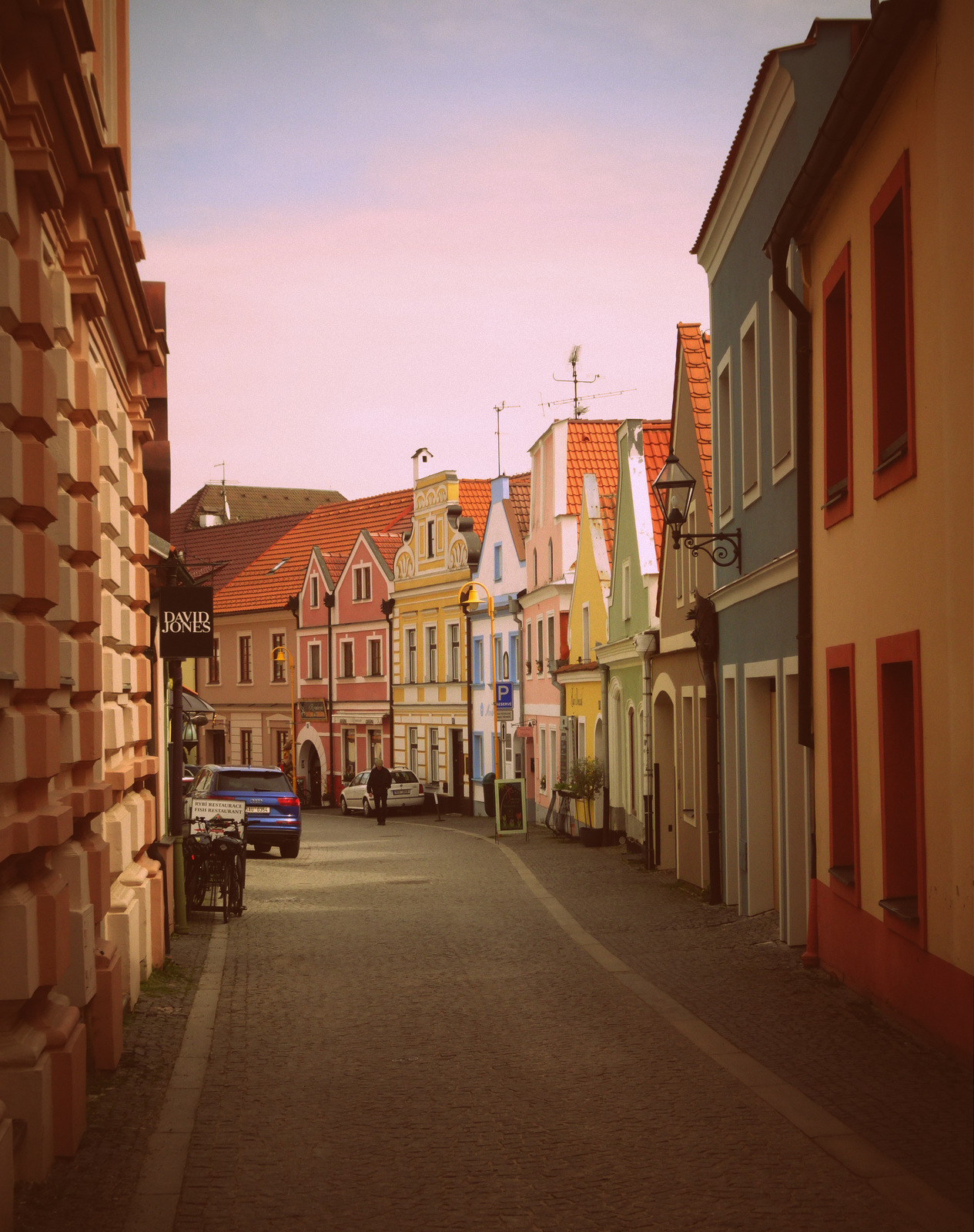
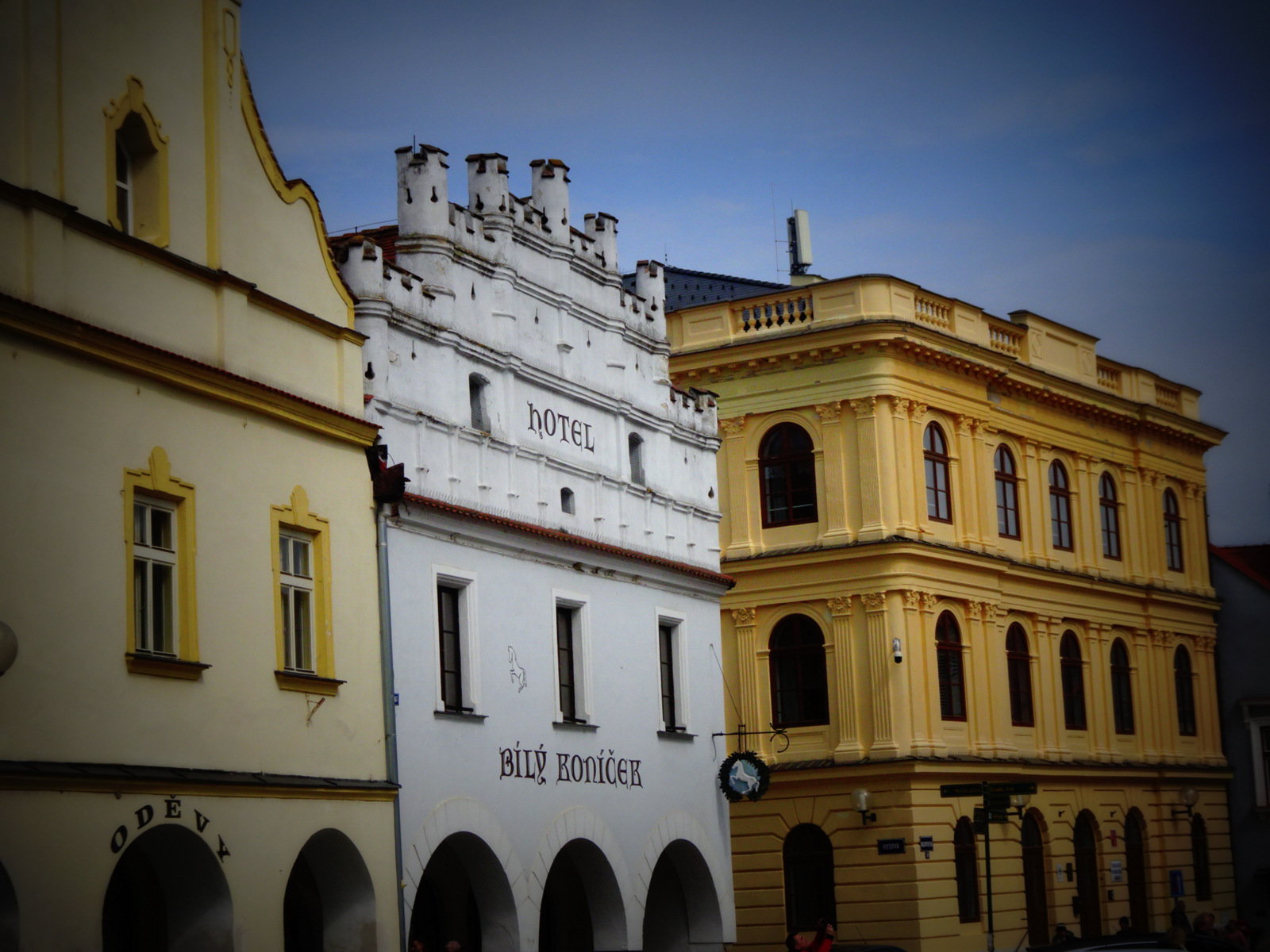
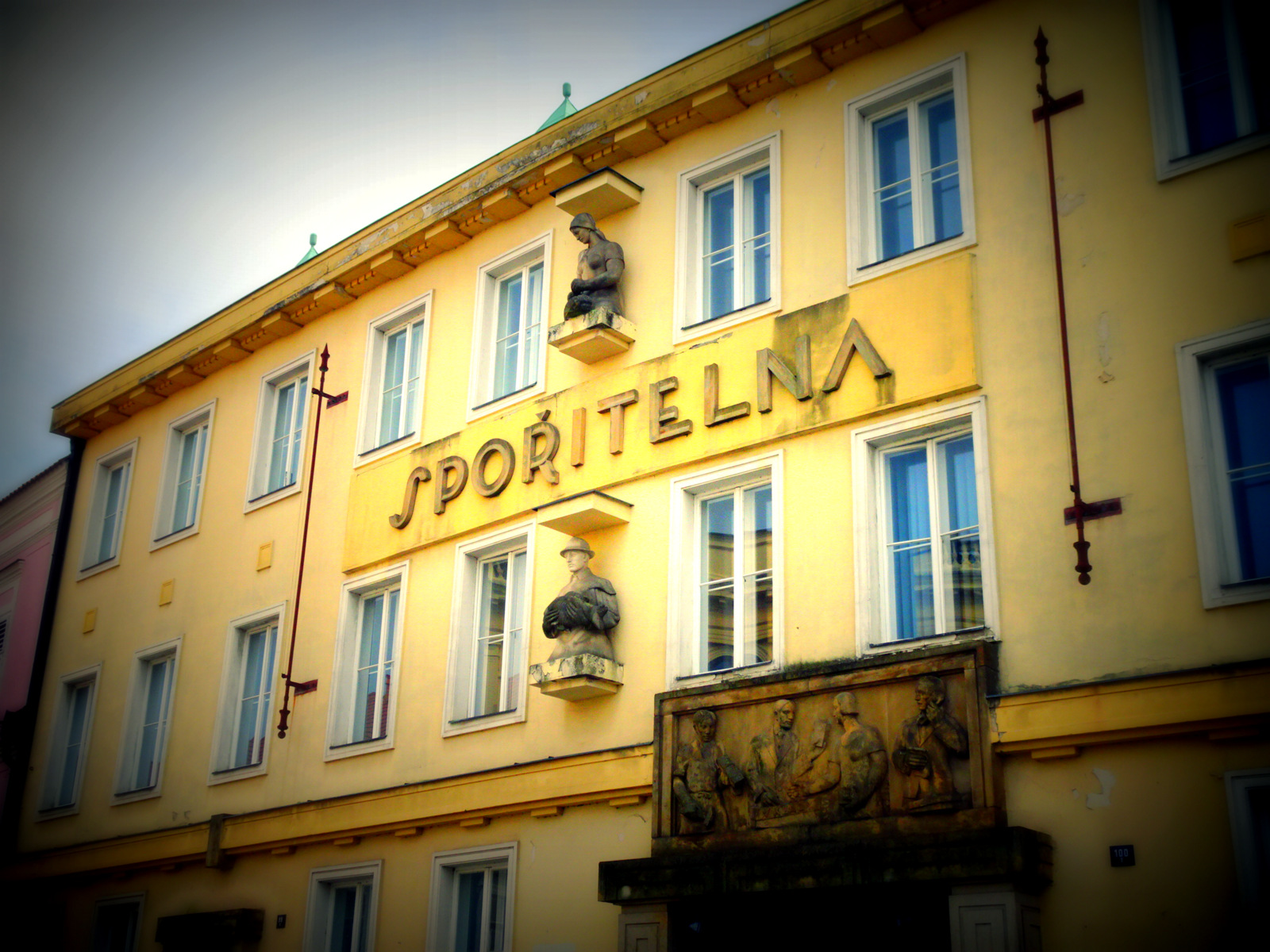


Honestly, I don’t know why all tourists flock to Prague and to Český Krumlov. The latter is pretty, of course, I happened to stop by on this trip as well.

But I don’t understand the people who fly to Prague and then drive 200 km to Krumlov, leaving all the other cities to the left and right. That’s like the tourists who land in Frankfurt and drive straight to Neuschwanstein, past at least 250 other castles that they don’t even look at. Besides, such places need the additional tourism as little as Newcastle needs another barge of coal.
For the return trip from Třeboň to Budějovice/Budweis I take the train. The direct route would be about 25 km, going west, but the train first goes to České Velenice in the southeast, all the way to the border with Austria, where I have to change to another train back west. The detour of about 80 km is necessary because even 100 years after the end of the Habsburg Empire, all railroad lines start from Vienna and extend from there in all directions. – Which could settle the question of where the center of Europe is, I guess.

Despite this indisputable argument for Vienna, I will continue the search for the center of Europe. Until the end of May, I’m still cat-sitting in Markkleeberg (near Leipzig in Germany), but after that comes the summer, perfect for hitchhiking, so there’s nothing standing in the way of exploring all these abstruse points.
Have a look at the map and the list of all the places to be visited. If you live near one of these points, I would be happy to meet you! And the esteemed supporters of this blog will receive a postcard.
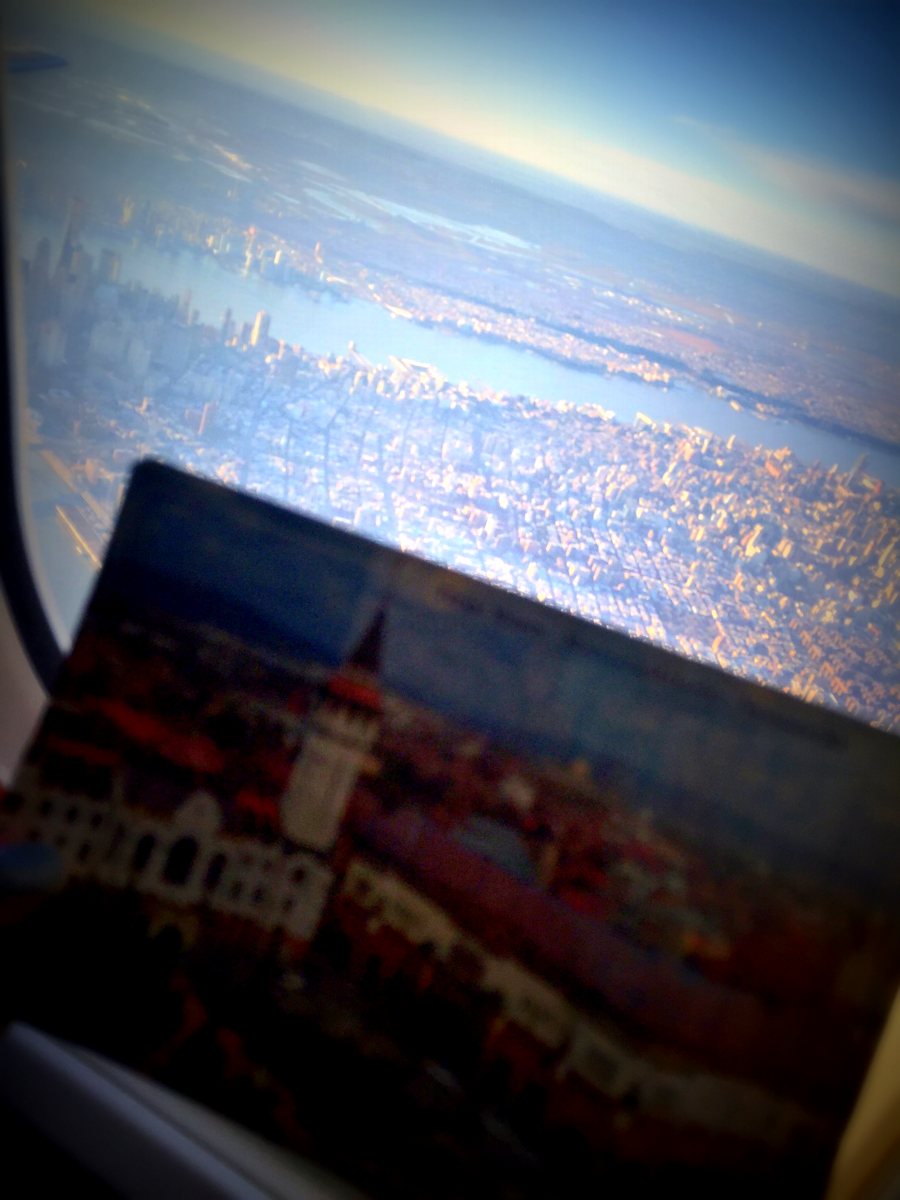
Do you want a posctard?
Actually, you would be surprised how hard it has become to find postcards in some places. But for you, dear reader, I’ll walk the extra miles!
€10.00
Links:
Photographed in Leipzig, Germany.
Birch trees and water.

If you don’t look too closely, you can hardly tell the difference between Lake Baikal and Lake Cospuden.
But because I don’t like to go to a penal colony for 10 years or suffer a fatal fall from a balcony, just because of a misunderstood joke, I prefer to spend the next few weeks in beautiful Markkleeberg in Saxony. On the ground floor. With two cats.
Even the sunsets are like in Siberia.

Not quite a hundred, but still more than thirty years ago, I was in Australia as an exchange student. I don’t think I have ever told stories from that time, because back then, we still took pictures on transparent rolls of film, which I can’t upload here as easily as digital photos. If any of you have a slide-to-digital conversion machine and are interested in my photos from the 1990s, please feel free to contact me. (The more academically inclined among the readers are quick to shout: “Oh no, not more of your personal anecdotes! We want to learn about history. Just like university, but funnier.” We’ll get to that, I promise.)
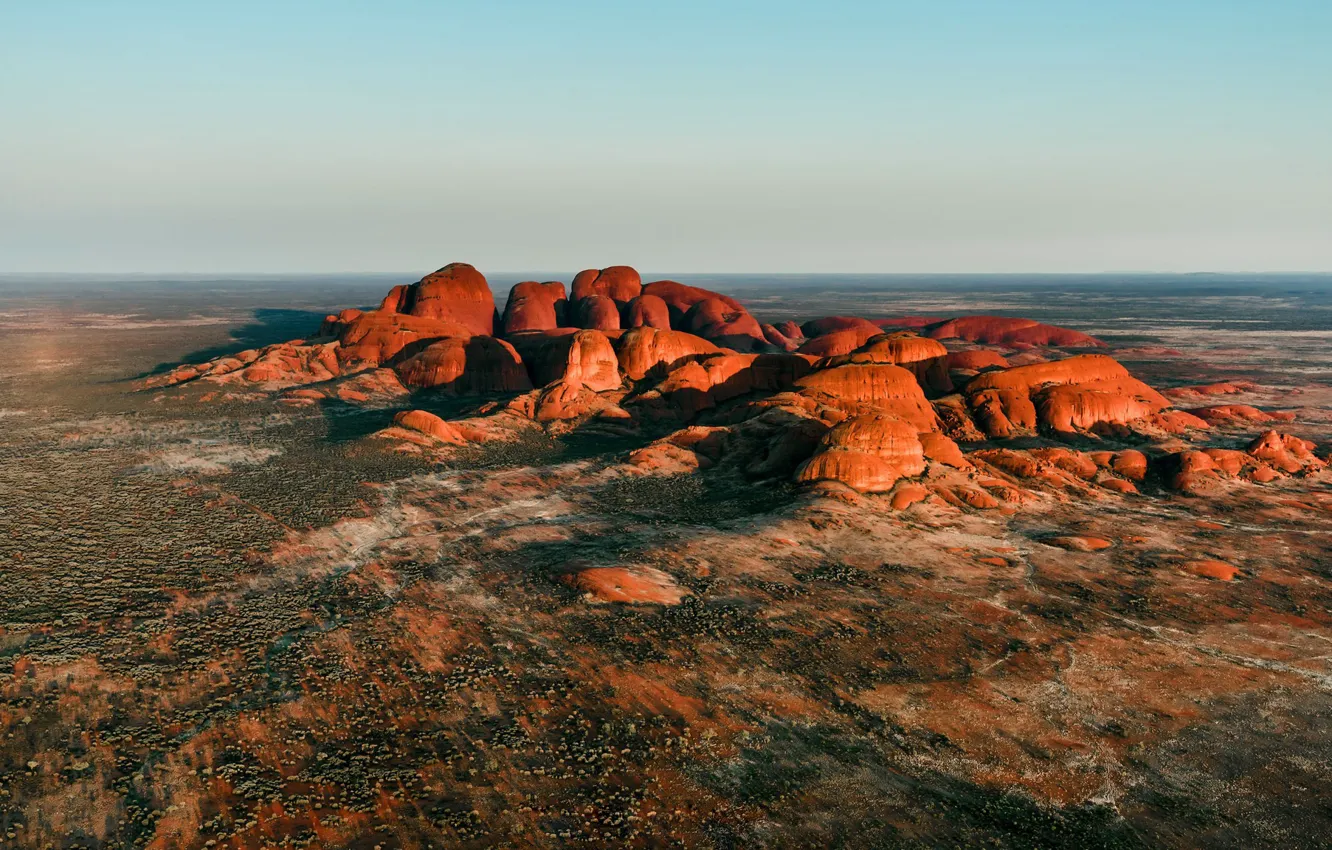
The best roll of film, the one I photographed while jetting over the Olgas in a small plane, unfortunately got torn anyway. This used to happen more often than not, because you had to rewind the films by hand, but not apply too much force. Other common problems were accidental exposure to light, water damage or confiscation by the border police.
This was just after the Second Gulf War. That was the one with Saddam Hussein, Norman Schwarzkopf, Colin Powell and so on, you probably remember. It was about Kuwait or about oil, which may have been the same thing. Some of these small states are nothing more than glorified gas stations, after all.

The Propaganda Minister didn’t actually step onto the scene until the Third Gulf War, but he just brings back such fond chilhood memories. Like Maya the Bee. Or Vicky the Viking. By the way, I was never quite sure if Vicky was a boy or a girl, which today somebody would surely turn into a gender drama and want to ban it from television.
Anyway, at the time, the uncle of my Australian host family explained to me that everything that ever went wrong in the Middle and Far East was the fault of “some stupid fucking pommy.” The latter being an endearing Australian term for British people.
This blog and especially this little history series have been criticized for constantly blaming the Germans for all historical mischief. But today, for once, I am going along with the theory of British collective and total guilt. (But honestly: If the Germans had not defeated the Romans in the Battle of the Teutoburg Forest, Pontius Pilate would never have had such an exaggerated fear of the uprising in Palestine. And Jesus could still be alive!)
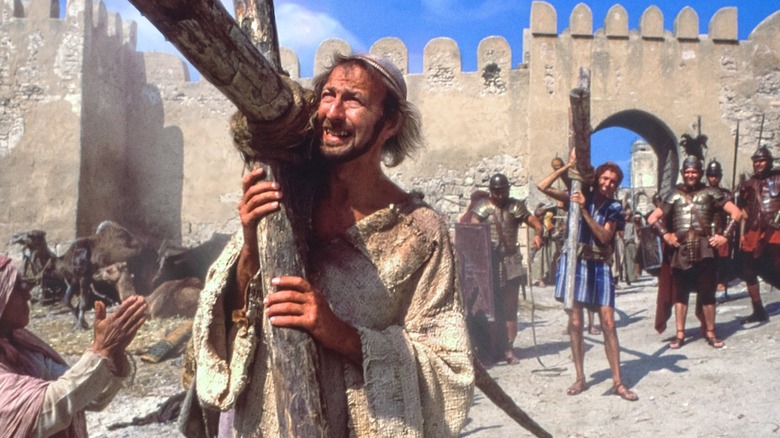
You know what? If I have already stepped into controversial waters here, we might as well stick to Palestine.
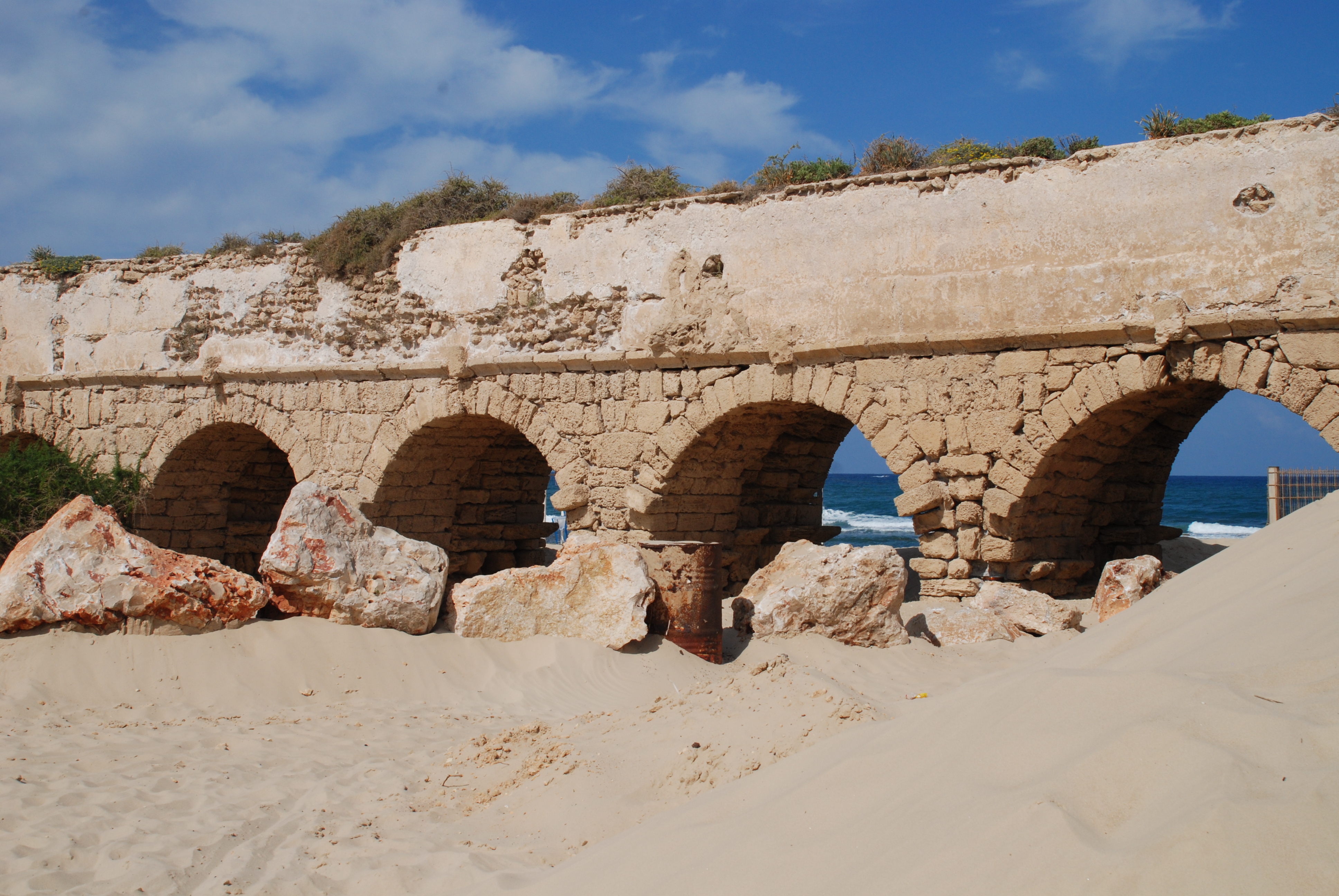
So, originally the area east of the Mediterranean, also called the Levant, was of course Roman. You can see that when you walk along the beach there and come across Roman aqueducts and amphitheaters, for example in Caesarea in what is now Israel.
Perhaps there was someone else before the Romans, but I can’t take that into account. If the Carthaginians, Hellenes, Macedonians, Seleucids, Ptolemies and Phoenicians do not have the decency to use legible Latin script, then they will stay on the sidelines of this story.
There, on the sidelines, we also have to leave the many details that may have occurred in the small time span between King Herod and World War I. To put it crudely: The Roman Empire collapsed and the League of Nations had to reorganize the world. (The League of Nations was the forerunner of the United Nations, only without the Cold War. Instead, it had a few other quirks, but who of us is without flaws?)
From the bankruptcy estate of the former great empires (Austria-Hungary, the Russian Empire and, in this case, the Ottoman Empire), many new countries were founded in this period immediately after World War I. We have already covered examples such as Czechoslovakia, the Free State of Fiume, the Kingdom of Mongolia, Finland, Baranya-Baja and Tannu-Tuva, Hungary and Greater Romania.
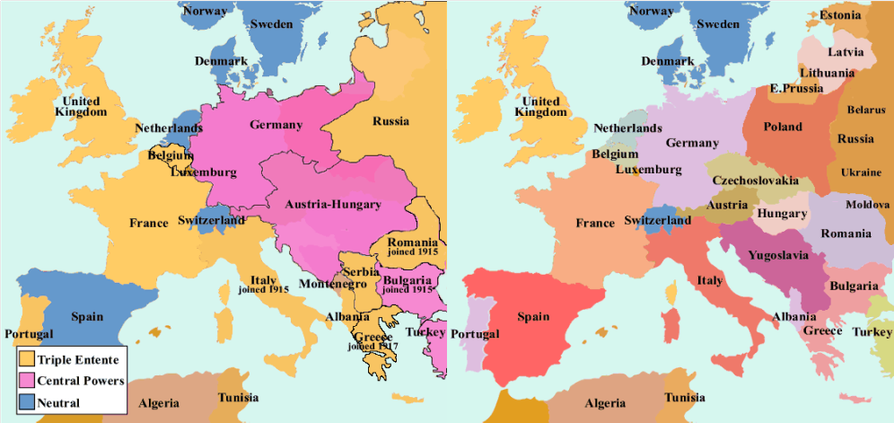
“Self-determination of peoples” was the buzzword of the time, and anyone who wanted to could declare independence. Well, at least every white European. (The Mongols benefited from their collaboration with the Nazis.)
On the other continents, things were slightly more complicated.
For sub-Saharan Africa, the Europeans agreed that such complicated things like independence, countries and administration were not for Africans. “They don’t really want to be bothered with all that,” said the colonial masters, just as today the representatives of the export industry say that one should “not impose Western values on the world.” As if the Chinese would gladly let themselves be tortured and imprisoned so that Volkswagen and Apple can make even higher profits. Cynical nonsense.
In the Middle East, people could not be so easily labeled as subhuman. After all, they had invented mathematics, medicine, agriculture, astronomy, the Bible and beer.
In the Ottoman Empire, they even had railroads already. Many, great, beautiful railroads. To almost every place you’d ever want to visit in your lifetime.

Most likely, you are familiar with the Orient Express, if only from Agatha Christie’s crime novel or one of its many film adaptations.
No wait, sorry, wrong murder on the wrong train! Here is the one:
Less known (and with no film adaptations at all) is the Balkanzug, a German-Imperial competitor train, connecting Berlin with Constantinople exclusively across the territory of allied countries.


But once you go to to the Bosporus, the real fun was just about to start.
Having advanced through the Anatolian mountains to Aleppo (marked on the above map with the Turkish name of the city: Haleb), one could hop on the Baghdad Railway and chug through Mosul to Baghdad, Babylon and Basra on the Persian Gulf. This delighted the beach tourists, albeit a few decades late because construction was repeatedly interrupted.

But then, it was a complicated engineering project. For that reason, the Ottomans handed it over to the Siemens Corporation from Germany. Or maybe that was due to bribes, one of the core competencies of Siemens AG until this day. (When asked which countries are the most corrupt, I don’t know why Germany doesn’t come to people’s mind. At least half of the companies in the main stock market index DAX have been involved in criminal activities.)


For those more interested in prayers than in parties on the beach, you could get the train towards the south from Aleppo, going to Damascus, Haifa, Jerusalem and Medina. The last section to Mecca, which was really the reason for the entire project, was never realized because – well, we are going to get to that later. But you can already guess that the British are to blame.
I have personally been to the old strain stations in Damascus and in Jerusalem, both of which don’t look very active any longer. And they are not even connected with each other anymore. Maybe it’s true when people say that everything used be better in the good old days.


That project, the Hejaz Railway, was also managed by Germans, including Heinrich August Meissner and Paul Levy. The latter suffered a tragic fate. As a railway engineer (rising to the rank of director) of the German Reichsbahn, he was deported to Auschwitz concentration camp by the same German Reichsbahn in 1943. – As I have been telling you many times: Don’t ever think that your employer is your friend.
Now you will understand the historical background when you come across small train stations while hiking in the Arabian desert next weekend, wondering why they look exactly like those in the Neckar Valley or in Franconia. Even with pitched roofs against the snow and chimneys against the harsh winters. You never know with this capricious climate. (This is typicsl of Siemens. They even cheat when building a railroad to the Holy Prophet.)
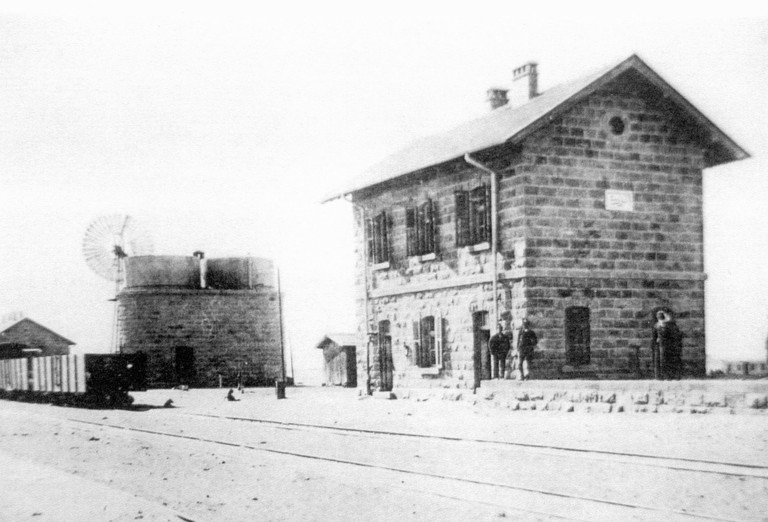
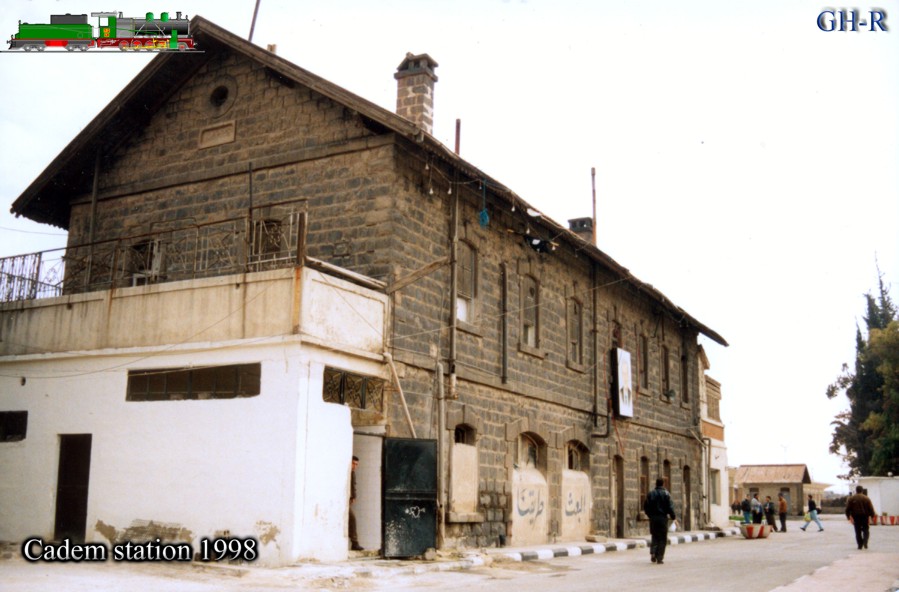
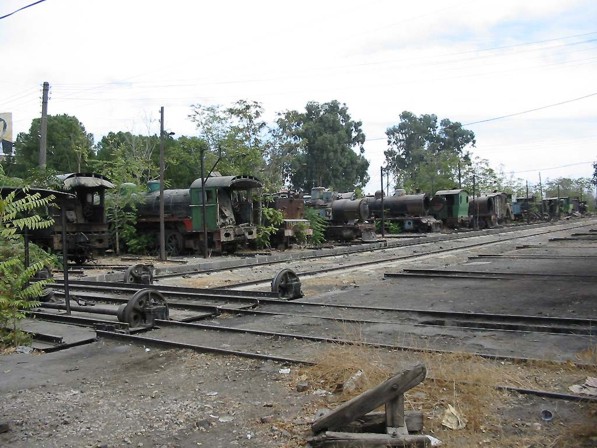
The photos are from this website, which lists all the stations on the route from Damascus to Medina, including the sad railroad cemeteries. (You can really find railroad freaks all over the world, which emphasizes the cosmopolitan and peace-building nature of this mode of transportation.)
Speaking of friendship between the peoples of the world: We had been talking about the division of said world after the Great War, with which, as this series shows month after month, so much
began that has scarcely yet left off beginning. And – that’s actually what the little excursion into the history of the railway was supposed to illustrate – I had just been explaining why the Europeans were not able to subjugate the Arabs quite as obviously as they did the Africans.
The solution was that certain territories were effectively declared minors: They were to be granted independence at some point, in the distant future. But because they were not yet ready, they were declared protectorates or mandates in the meantime. Grown-up states were to be placed at their side, like a guardian.
In the Middle East, France and Great Britain took on this burden. Together, they bent over a map and drew the Sykes-Picot Line. Just like that. “It’s all sand anyway,” the diplomats thought, because they had no idea about Sunnis, Shiites, Druze, Kurds, Zoroastrians, Sufis, Copts, Marsh Arabs, Mandaeans, Alawites, Chaldeans, Nubians, Yazidis, Jews, Arameans, Assyrians, Berbers and the Templars.
That’s what the gentleman from Australia had alluded to.
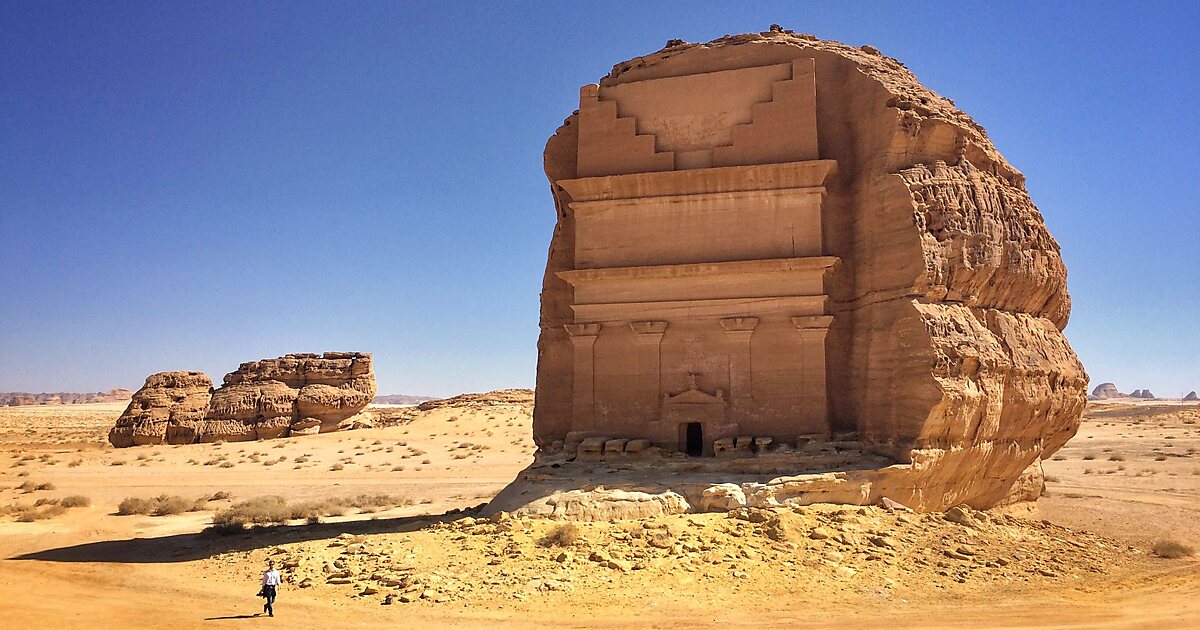
Europeans, who proudly declare every old compost heap to be a Celtic wall, had never heard of places of advanced civilization like Philae, Hegra, Ctesiphon or Hatra. And let’s be honest: Who of us knows any of the places? (The pictures are listed in the sequence of the place names.)



One of these conferences at which Europeans sought to plant the seeds for future Middle East conflicts took place in San Remo, Italy, in April 1920. France took guardianship of the territory that would later become Lebanon and Syria. Great Britain took charge of the area that would later become Israel, Palestine, Jordan, Iraq and Kuwait.
The British territory was larger. In return, France received a quarter of the oil produced in northern Iraq (the province of Mosul). In general, one could almost get the impression that the great powers were more concerned with oil than with the development of statehood, but we don’t want to become cynical here. Surely, they were driven by purely noble intentions. (Besides, France soon invented atomic energy and was thus able to withdraw from the Middle East. For uranium, Africa is much more important.)

Because the conference took place in San Remo and because the Western states divided up the Middle East among themselves like a pizza, “San Remo” is still a popular name for pizza parlors today. And that’s why pizzas – in contravention of the mandatory EU-wide decimal system – may still be cut according to the British-imperial hexal, octal or duodecimal system. (This is part of the popular series “Facts you’re surprised you haven’t noticed yourself”.)
The Kurds did not find this funny at all, because yet again, they had missed out on statehood. But this might be a topic for July 1923, when we deal with the Treaty of Lausanne. The Armenians did not find this funny at all. But most of them were dead. The Jews did not find this funny at all, especially when the Arabs suddenly became best friends with the Nazis. But that’s another story.


There were always problems in the British Mandate for Palestine. The Jews wanted a country. The PLO wanted a country. Hamas did not want a country, but didn’t want the PLO or the Jews to have a country either. The Pope wanted control of Jerusalem. The people from Jerusalem complained that the people from Tel Aviv were partying too loud. The Austrians were getting involved. Yogurt prices were going up. Every day, nothing but problems.
Say what you will about the British, but they do have education. So they remembered the old Roman motto “divide et impera” from Latin class and thought: “We’ll do it like in Ireland or in India. We divide the land and let the people fight each other.” The whole thing was an idea by Winston Churchill, who was British colonial minister at the time. We already got to know him in this role.
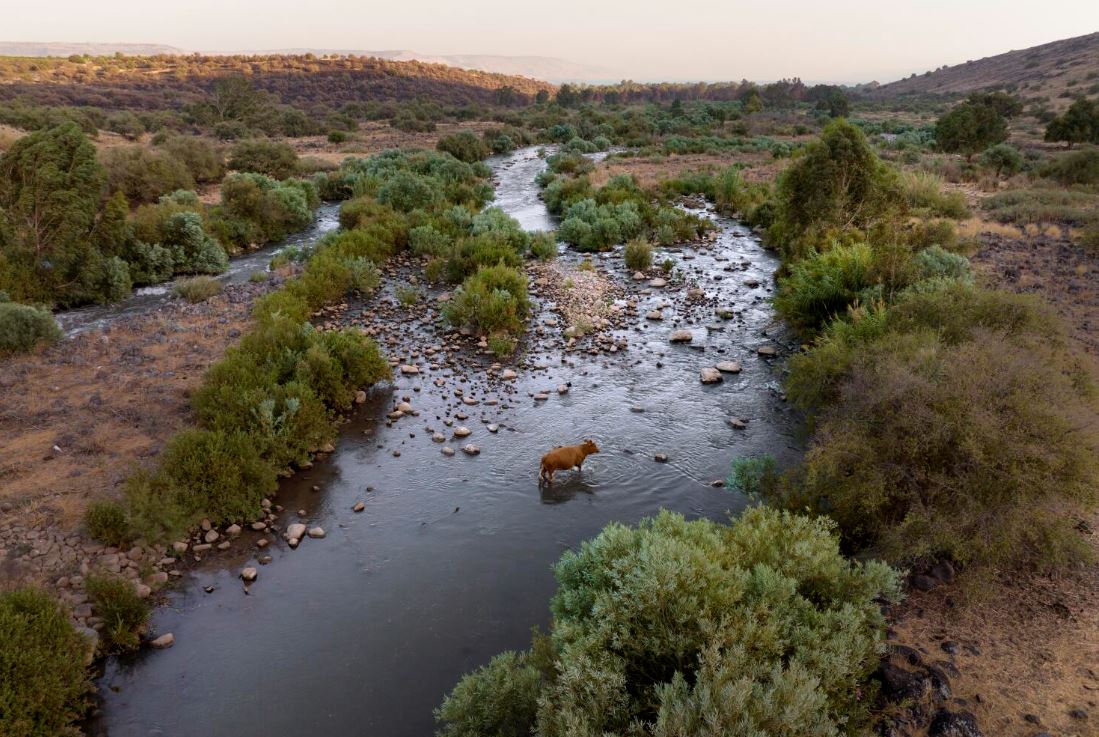
The British divided the Mandate territory of Palestine along the Jordan River into Cisjordan (today’s Israel and Palestine) and Transjordan (today’s Jordan). This river, by the way, is a disappointingly small trickle. You always read about it in the Bible and in the Tanakh, in the Old Testament and in the New Testament. And once you get there, the river is so meager and tepid that you could easily cross it on foot. But you don’t want to suddenly appear like a prophet, just because of some stupid water crossing story. Nobody needs that kind of stress.
Transjordan became an autonomous emirate and was handed to the Hashemite family. They are directly descended from the great-grandfather of the Prophet Muhammad, but if you have ever been to the Orient, you know that everyone is directly descended from the Prophet Muhammad or one of his relatives, friends or companions. Just like in New England, everyone is descended from the Pilgrim Fathers. And in Europe, everyone is descended from Charlemagne.
During World War II, the Jordanian emir supported the Allies against the Nazis. This was quite remarkable, because Iraq, ruled by his Hashemite brother (also installed by the British), was more on the side of the Nazis, at least at times. (This episode is too convoluted even for me, who is generally not afraid of bouncing back and forth all over the timeline and the world map.) Abdallah was promoted to king in 1946, and Transjordan became the independent Kingdom of Jordan.
This seems to have gotten to King Abdallah’s head, and he went on a crazy spree. A few hours after the state of Israel was established, Jordan (along with Egypt, Syria, Lebanon and Iraq) attacked its new neighbor and annexed the West Bank and East Jerusalem. King Abdallah had himself proclaimed “King of all Palestinians,” but was then shot in Jerusalem in 1951. By a Palestinian. From the circle of the Nazi Mufti, whom you saw above having tea with Adolf Hitler. (Perhaps the Germans are to blame for the Middle East conflict after all?) The king bled to death in the arms of an Austrian nurse. (Austria is not as innocent either as it always pretends to be.)
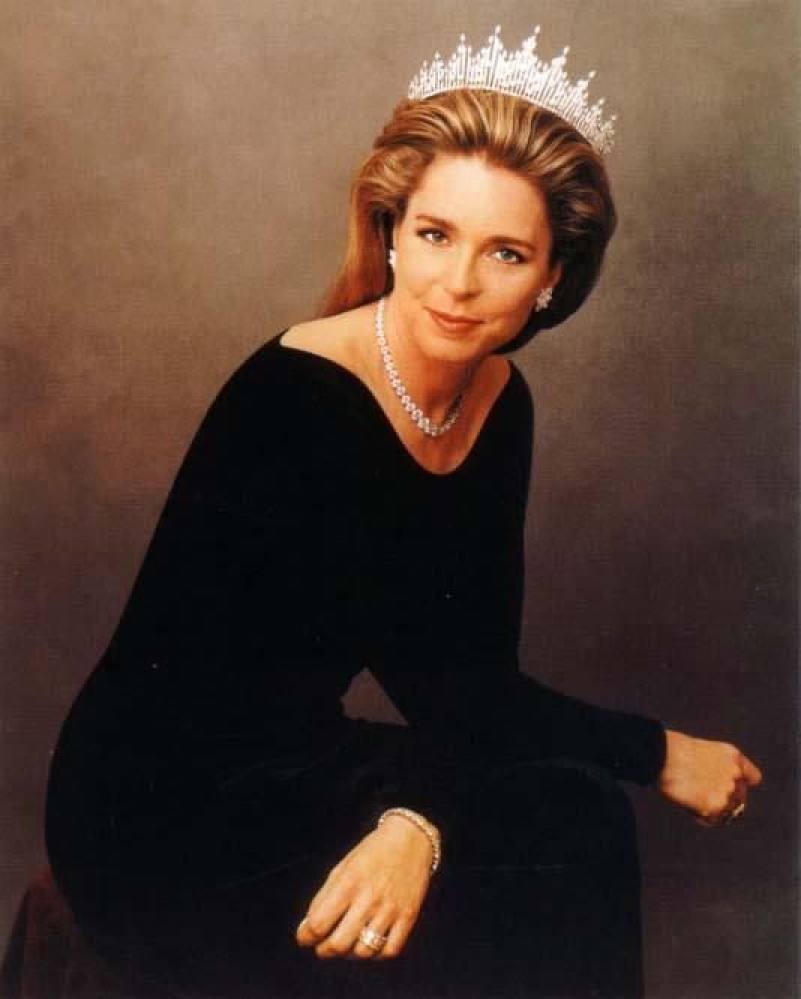
By the way, I once met Queen Noor of Jordan. It was 2009, and I was studying economics at the London School of Economics. I dropped out later because mathematics in English was too difficult. It’s funny, because I was studying philosophy in English at the same time, and I would have been willing to bet that philosophy in a foreign language is more complicated than mathematics. But then, it was rather advanced mathematics. On top of that, they were using these stupid British units of measurement, like ounces and shillings.
Anyway, at LSE there were lectures every evening, often with famous speakers, some of them even interesting. And one evening, there was a talk about the abolition of nuclear weapons. It was November and London, therefore cold and rainy, and I didn’t feel like going back to my little mouse-infested room in Tottenham. (I didn’t want to tell the landlord about the mice after he had killed the first ones and said that the dead mice had to be left in the hallway as a deterrent. They looked like the guinea pigs that people eat in Peru.)
Abolishing nuclear weapons was a topic close to my heart in 2009. Because in April of that year, I had been in Prague to attend Barack Obama’s speech in which he presented his plan for a world free of nuclear weapons. And on the train there – it was a coincidence, I swear – I had met three Iranian lawyers who were also headed to Prague, because they had an appointment with Hillary Clinton. Something about human rights. And two months later, in June 2009, the Green Revolution erupted in Iran (unfortunately just as unsuccessful as the nuclear abolition plan).

As you can tell, I was a bit interested in politics at the time, so I flew to Iran, went to demonstrations, got beaten up by the police, dodged sniper bullets, and was ultimately arrested along with one of the Iranian lawyers.
Naturally, we were detained and interrogated separately. (I didn’t meet him again until years later.) But there’s no point in lying if you can’t assume that the other person is making up exactly the same lie. So I had to tell the truth when asked how we had met:
“On the train from Amberg to Prague.”
“And why did you travel to Prague?”
“I wanted to attend a speech by Barack Obama.”
You should have seen the looks on the faces of the Iranian intelligence officers in the room! Frankly, I didn’t see them myself. I was blindfolded the whole time. Anyway, what followed was a very intense questioning about why the U.S. president had invited me of all people to his speech (it was a public event), what he had said (it was in the newspaper and probably on YouTube), and about my personal opinion on Iran’s nuclear program. The ensuing discussion was so interesting that I am saving it for the book I may one day write about this little episode.
My lawyer and prison friend, Mohammad Mostafaei, has written a book, so far only available in Norwegian. But I have heard that Norwegian is very easy to learn. If the country wasn’t so expensive, I could try studying mathematics there again. But I think I’ll do sociology in Spanish first.
By the way, the first room in which I lived in London was smaller than the cell at Evin prison. That shows you how crazy the real estate market there is. But then, the whole idea of private land ownership is rather crazy.
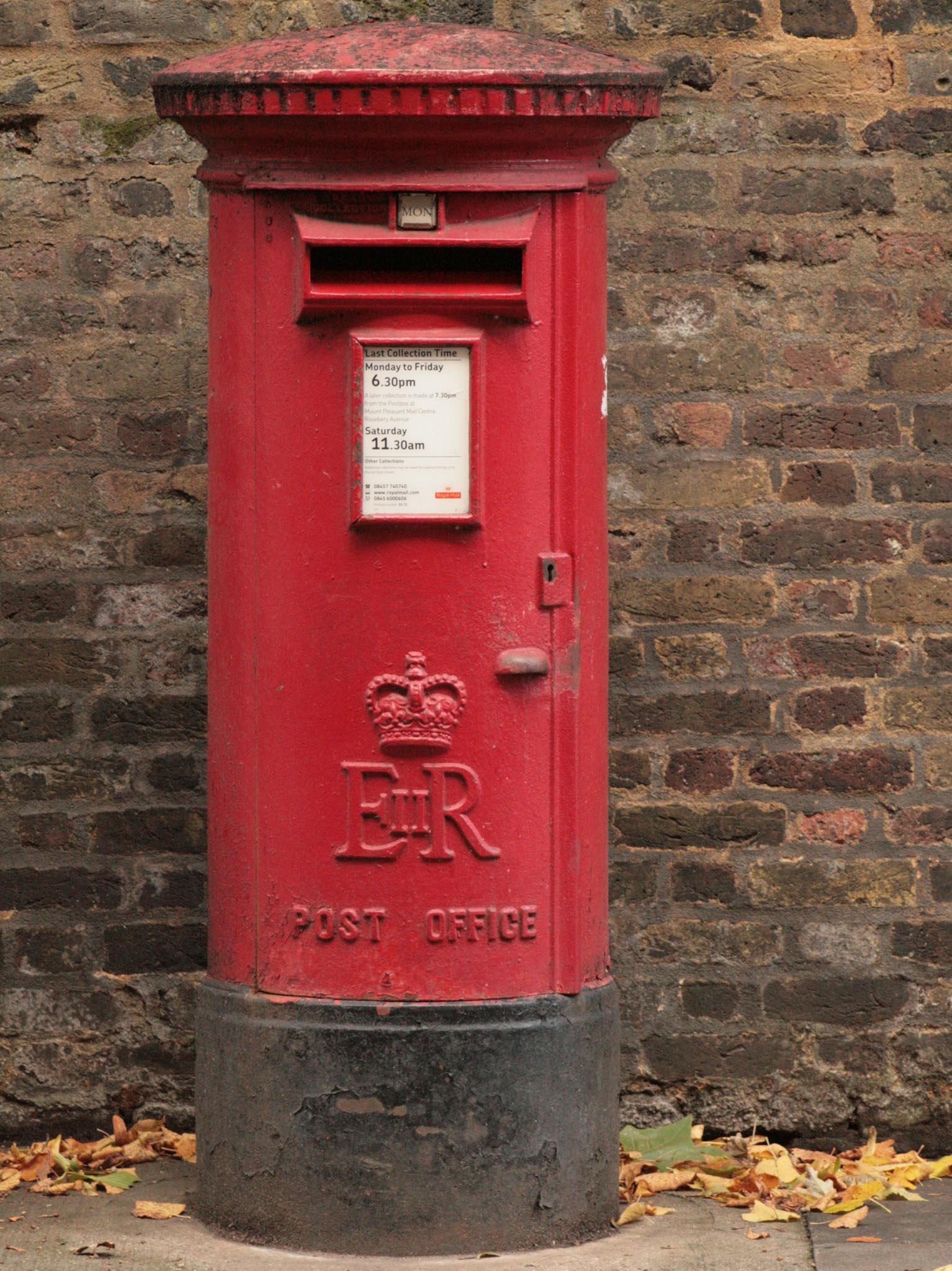
In any case, that’s why I didn’t want to go home that night and stayed at university instead. I was quite puzzled when armed bodyguards were present in the lecture hall. And that a talk about abolishing nuclear weapons drew such a large crowd. And that everyone wanted to get a selfie with one of the speakers. – Especially in the UK, where people get to see a Queen every day. Every time they lick a stamp or hold a banknote in their hand. By the way, all the money and stamps have to be destroyed and reprinted now. And over 100,000 mailboxes in the country have to be replaced because the Queen’s initials are on them, which the new king obviously can’t tolerate.
Whoa, now I really digressed big-time!
Almost like Švejk. But he had the excuse of alcohol, at least.
This little history series is really supposed to be about events that took place exactly 100 years ago. So it is rather fitting that on 25 March 1923, the formal separation of Cis- and Transjordan took place, finally providing us with the date which serves as the pretext for these far-fetched connections. But on this blog, after all, we are always more about the big picture. The context of humanity. The rail tracks on which the train of world history is roaring forward.
If only that train were still going.
Alas, it is lying in the desert sand, rusting instead of roaring. For the last 100 years.
Because the First World War, the end of the Ottoman Empire, the division of the region into new areas, territories and states, all this sealed the end of the railroad.
Ad it was this man’s fault: Thomas Edward Lawrence, a British officer in World War I, later known (and turned into a movie) as “Lawrence of Arabia.” He was an avid motorcyclist and had an almost pathological loathing for railroads.

The railroad, in Lawrence’s view, was an instrument by which the peasantry and the petit bourgeoisie could go on journeys and adventures to which they were not entitled. “Any housewife from Hackney can now visit the holy sites” and “soon, they’ll have Tupperware trips to Tripoli,” he raged, blowing up railroad bridges, embankments, and trains.

The psychopath with the methods of a terrorist had managed to sell his personal crusade against the railway as politically advantageous to the British Crown. The argument went like this: Great Britain was at war with Germany. The Ottoman Empire was allied with Germany. So you hurt Germany by hurting the Ottomans. The Ottomans ruled the entire Middle East, from Cairo to Karbala. So the British would equip the Bedouins living there with weapons and incite guerrilla warfare. The Ottomans would have to send troops into the desert, thus being left with fewer troops to support the Germans at Ypres or Verdun. That’s the short version.
Because Lawrence promised the Bedouins and the Arabs that they would all get their own states and become kings, they played along. Moreover, the Bedouins in the Arabian desert had always been against the railroad, because they used to enjoy a monopoly on pilgrim caravans to Mecca and Medina. They also had a monopoly for transporting goods to cities that could not be reached by ship. So the railroad was bad for their camel business.
The British and French were not only concerned with the war (which would never have been ignited in the Middle East without them in the first place). They were also suspicious of the railroad to the holy sites of Islam because it made it easier for Muslims from their colonies (from Algeria to Kashmir) to make the hajj, the pilgrimage. Islam at that time was different from the one we know now, where mosques wait peacefully in front of the railroad crossing. At that time, mosques were meeting places for the political opposition, for burgeoning liberation movements, even for revolutionaries. The Muslim Brotherhood is probably the best-known example.

And after World War I, oil also began to play a role.
If, like Saudi Arabia, which was established in its current form only in 1932, you live exclusively off petroleum and diesel, you naturally have no interest in rebuilding the railroad.
Not unlike the murder on the Orient Express, the Hejaz and Baghdad Railway died from many stabs, carried out by many hands, for a bewildering array of reasons.
And thus, 100 years after World War I, derailed locomotives are still lying in the desert. The drier the climate, the longer the old stuff lasts. Like in the ghost town in the Atacama Desert, where even decades later it looks as if the population had only left yesterday. I even found a few locomotives there, which provides at least some thematic connection in all this otherwise nonsensical jumping from continent to continent.

With the new countries that emerged after World War I, the memory of the common past, when they had all been part of one large rail network, quickly faded. The countries wanted to create their own national identities; cultural exchange was not desired. Peace was no longer dependent on good relations with neighbors, but on good relations with London or Paris, later with Washington or Moscow. No Arab wanted to take the train through Israel, no Jew wanted to take the train through Syria to Iraq. Most borders were sealed. Hostile minefields instead of generous train station buffets.
And thus disappeared the good old world, when you could buy a ticket to Baghdad at the train station in Bromley, Braunschweig or Brno without any trouble. Try that today! Dunkirk-Diyarbakir-Damascus or Aarhus-Aleppo-Amann are also no longer offered.
Today, if you want to visit the historical sites in Mesopotamia, you have to hitchhike. (Oh yes, that is possible in the Middle East. Example 1, example 2, example 3 and hopefully, some day, example 4 on this blog.)
Among the desert cities listed above, you may have missed one. The only one that is really known all over the world: Petra, the capital of the Nabataeans, in what is now Jordan.
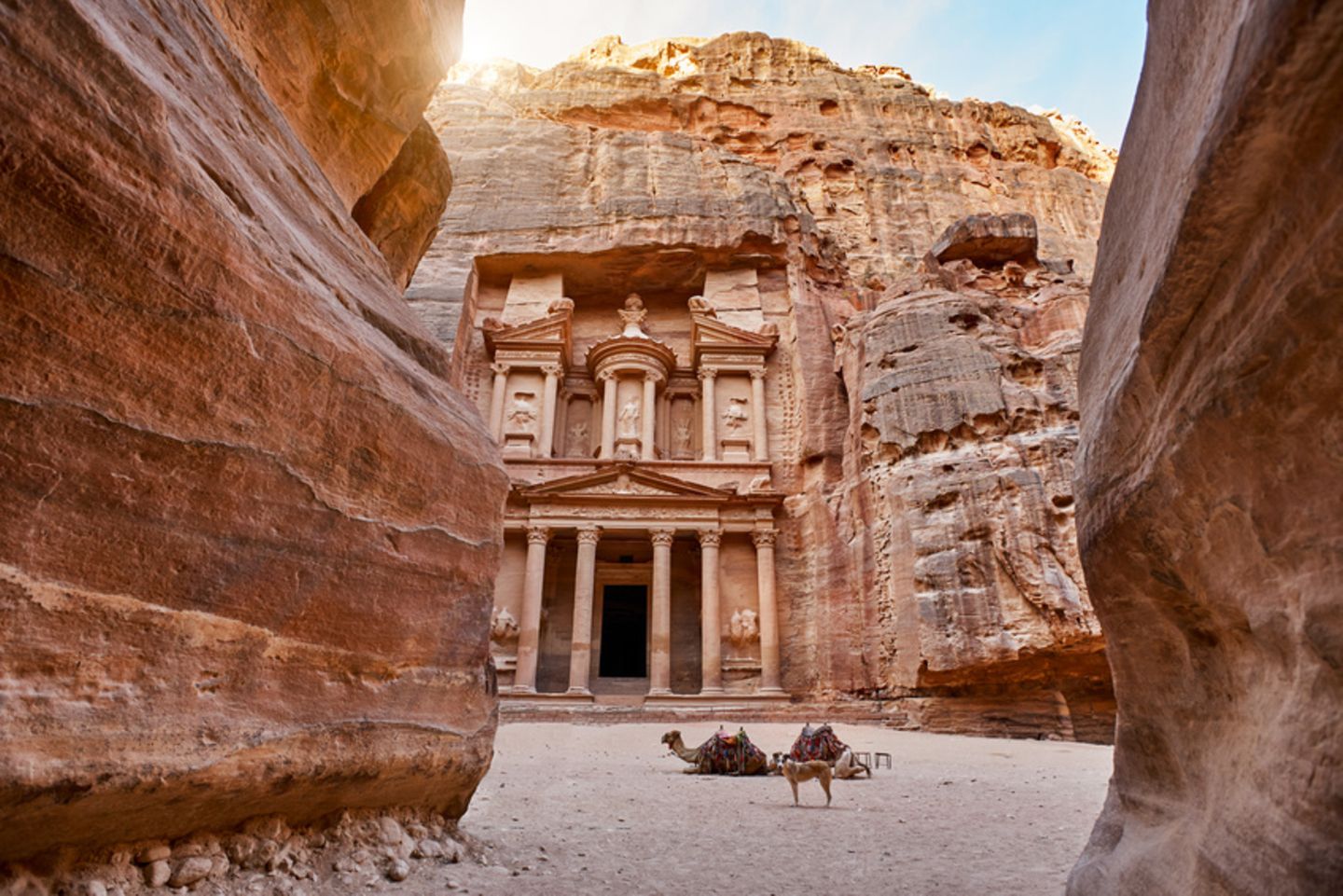
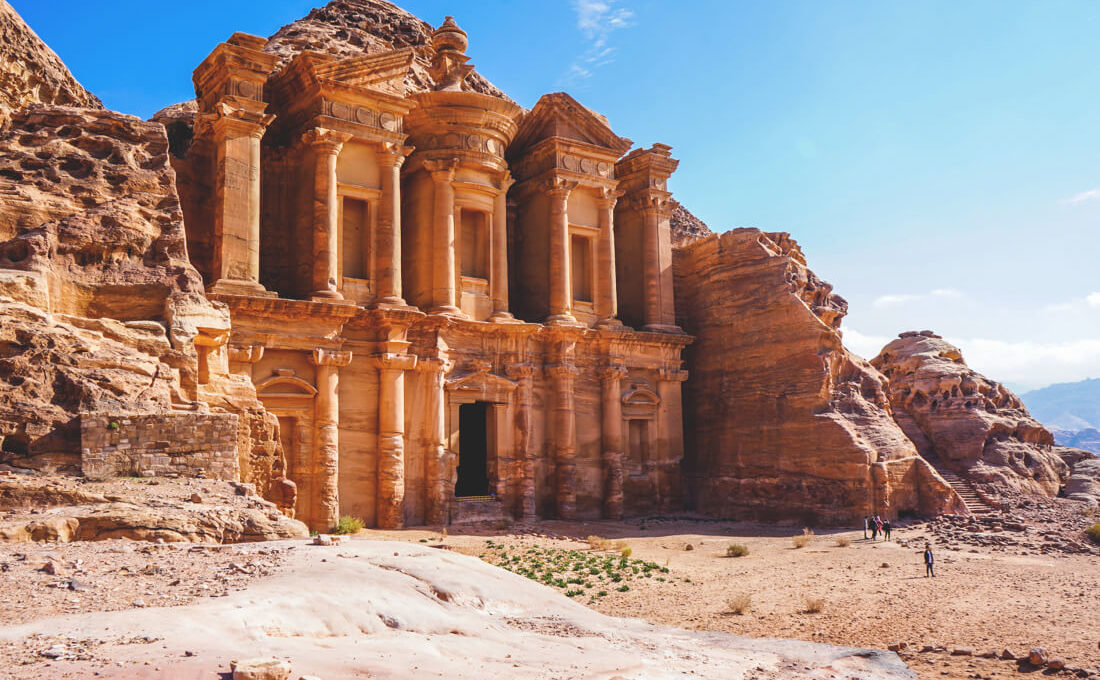

I have even been there myself. It has become a bit touristy since the Hashemites took over from the Nabataeans. But maybe that’s the fault of UNESCO. I mean, these guys are interfering everywhere instead of fighting world hunger. The people of Dresden have something to say about this.
And I have to admit, even if I like to skip tourist highlights and take the routes off the beaten track instead: Petra is absolutely worth the visit. It’s not just the one canyon and the one temple you know from TV. There are dozens of magnificent buildings spread across several valleys. And you can climb around pretty much unsupervised and find a quiet spot on the roof of an ancient palace where, in the setting sun, you can ponder the transience of advanced civilizations.

I went to Petra with two friends. Because all three of us were lawyers, we could even afford a rental car. I was the oldest (which happens to me quite often), so I was supposed to drive and navigate (which happens less and less). I knew we needed to head north from Aqaba, and then surely a sign would point to the World Heritage Site. Easy peasy.
Unfortunately, I took the wrong exit at the very first roundabout and drove onto road no. 65, which goes north very close to the Jordan River. The direction was right, but it was a restricted military area.
Soon, we came to a checkpoint with Jordanian soldiers, who told us in a friendly way that this road was sadly and unfortunately closed to foreigners. But at that time, there was some European or World Soccer Cup, and when they realized that we were from Germany, they only wanted to talk about soccer.
“Where do you want to go?” they asked at one point.
“To Petra.”
“Hm. Wrong road.”
“But this is going north, isn’t it?” I asked, to show that we could talk from professional to expert.
“Yes, but only for military vehicles. Also, there is no road connecting this road and Wadi Musa. So you’re approaching Petra from the wrong side.”
I said nothing.
The soldiers conferred until one said, “If you turn back now, you will lose a lot of time. So we’ll let you through and radio the next checkpoint. Just tell each of the checkpoints that you want to go to Petra. The guys will point you in the right direction.”
No sooner said than done. Two more checkpoints, and at the last one, I received instructions to drive exactly 3 more kilometers after the village of Ar-Rishah, and then turn right onto a desert path that would take us to the correct road after about 20 kilometers.
On the photo you can see the military road in the background, the “desert path” branching off from it (if I had missed that, nobody could blame me, right?), the vehicle not exactly designed for such trips, and me on a hill to explore the area and hopefully spot a route. (This was all in the days before GPS and cell phones and such.)

Most likely, my friends took the photo because they were struck by a sense of impending death and wanted to convey to posterity who was to blame. We almost got stuck in the sand a couple of times. We ran out of water. When I drove through a flock of sheep, the shepherd was not pleased and shot into the air. The car steamed and hissed. But finally we found our way back onto a paved road, road no. 35, the correct, official route to Petra. Great relief! (The friends from back then are still friends, which is really what matters most.)
Anyway, I can tell you that I have rarely been in a country with such friendly and humorous soldiers and border guards. Although we were in Jordan for only one day, I have kept the country in extremely positive memory. I should really visit again, maybe to walk that long hiking trail.
And from Amman, an 80 kilometer long section of the Hejaz Railroad still works. With the original carriages even, it seems.
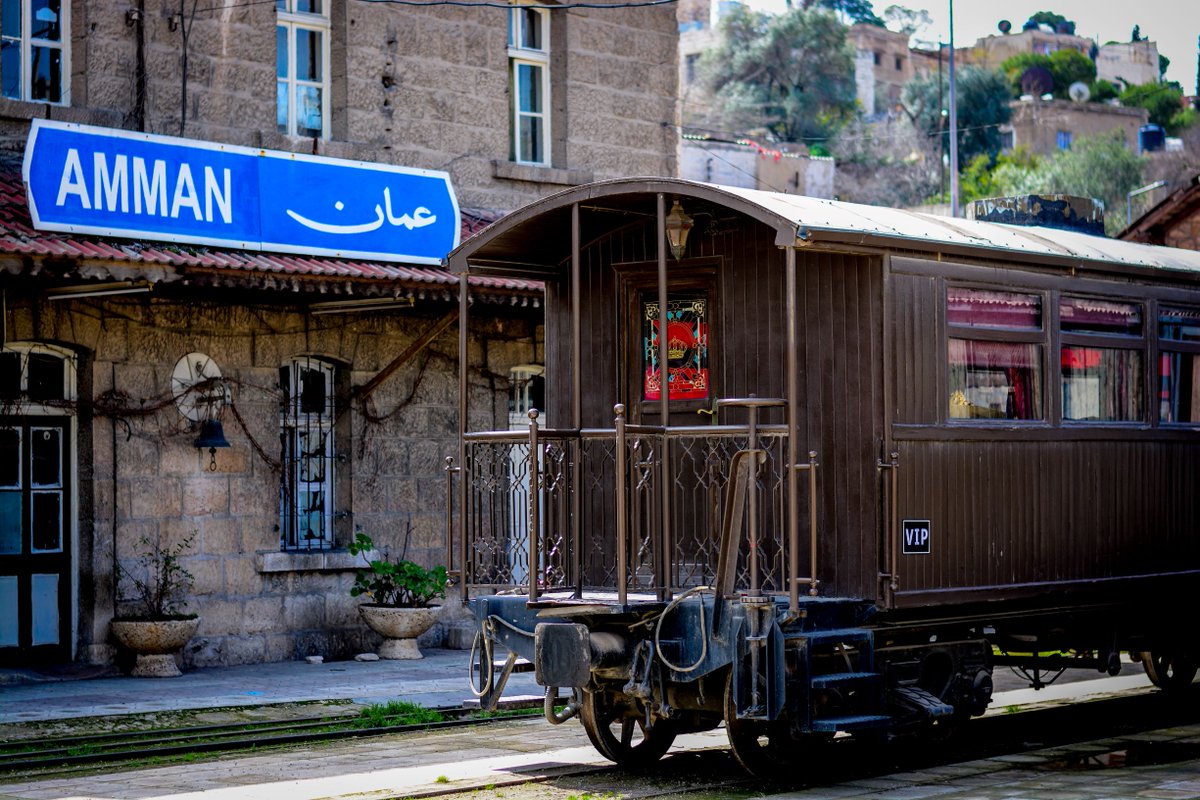
Let’s hope that there won’t be some other mad Englishman wandering by and blowing up this last piece of train history.
Links:
Whatever the weather forecast, the calendar, meteorologists or theologians say – for me, yesterday was the first day of spring.
And so I went for a hike:


As always in this area, plenty of water, requiring large detours on foot for what looks like a short distance on the map. Around here, a boat license is really more useful than a driving license.
But maybe this problem will dissipate when the Tesla factory in Grünheide, the next village, will take out all the groundwater. We really should rely more on ships rather than on cars. After all, we already have all the canals, and on those, you can get to almost anywhere in Europe.
Links:
Writing two blogs, one in German and one in English, is a lot of work. Not quite twice the work as writing one blog, because I can use the same photos twice. But it’s more work than some might think. Because my articles in English cannot be a simple translation of the German original. No, I need to change the links, reinvent the jokes, come up with new metaphors and alliterations, and explain things for one group of readers which another part of the esteemed readership might already know. After all, readers from the Bayou come with a different background than those in Bavaria.
Some articles – or parts thereof – are practically untranslatable. There are things that only work in one language, and not in the other. Knowing two languages very well is also to know the limitations of each and not to try brute force, as machine translation would do.
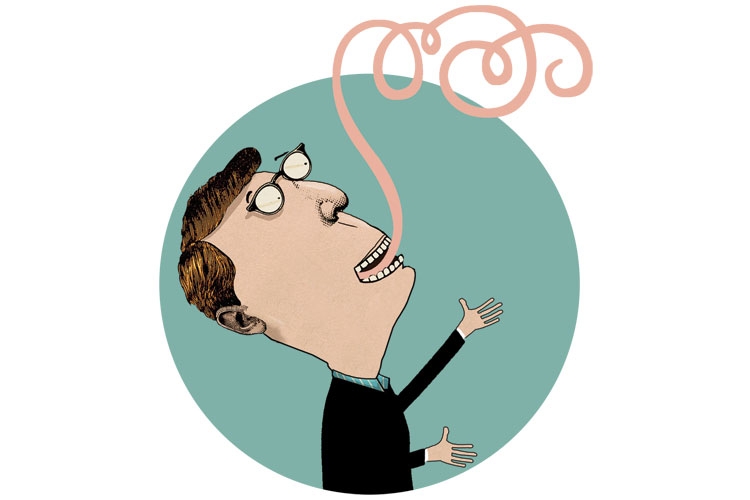
One example is the episode for February 1922, which I wrote on my German blog: one 2,180-word sentence, which would read completely stilted, unnatural and horrible in English, but which in German sounds as melodic as the birdsong of sultry sirens. (The Greek sirens, not air-raid sirens, mind you.) I guess it’s no coincidence that the occasion for it, the Day of the Convoluted Multi-Clause Sentence, celebrated or, I should, in line with readers’ justified expectations regarding this blog, be completely honest, open and forthcoming, mostly ignored on the 25th day of the, for reasons having to do with misgivings between Julius Caesar and Pope Gregory XIII and their respective ways of measuring time, unusually short month of February, hasn’t been adopted worldwide.
Lastly, I often simply lack the time (or energy) to write two versions of the same article. After researching, thinking and writing about a topic for several days, it can feel tedious or tiring to spend another day translating it. Especially when my mind is already toying with ideas for new stories instead.
For these reasons, there has been quite a gap in the English-language episodes of this little history series “One Hundred Years Ago …”. For those of you who either speak German or are not intimidated by the mediocre qualities of machine translation, I shall point you to the episodes that you may have missed in 2022.
In April 1922 (or really in April 2022), I covered the long, slow and arduous history of trying to decriminalize homosexuality in Germany, as ever slightly complicated the existence of quite a number of different Germanys in the past 100 years. Although already debated in 1922 (and before), including in parliament, homosexuality was only decriminalized in West Germany in 1994. (East Germany had long ago legalized it, and reunification talks almost collapsed over this issue. In the end, East Germany negotiated an exception from federal criminal law.)

In May 1922, Germans were outraged not so much about French and Belgian occupation of parts of their country (which would widen in January 1923), but by the occupying powers using – oh, gosh! – African soldiers.

Of course, Germany had also used African soldiers in its colonies and in World War I. But when did logic ever stop racism?
Germans started a nationwide, and indeed international, racist campaign, inventing many of the stereotypes that are still around today: Africans bring disease, Africans rape women, Africans are generally inferior, bla bla bla. Maybe the worst thing about this campaign was that it was not some losers on Facebook, but actual government agencies who orchestrated it. They printed racist pamphlets and newspapers, they ran racist movies, and they tried to rally international opinion. Not quite unsuccessfully, sadly.

And maybe there is a direct line from there to November 1922, when a certain Adolf Hitler made his first appearance. Noticed by the domestic and the international press, he was initially dismissed as a loudmouth, a rabble-rouser, an agitator with no substance, a mere local and passing phenomenon.
How wrong they were, as we know now. Not for the last time, either.

Come to think of it, maybe I didn’t deem it worthwhile to translate these articles, because I thought that German history wouldn’t attract too much interest beyond this little country. (Now considerably littler than in 1922, for reasons not wholly unconnected.) Sadly, though, in the early 1920s, Germany was where the action was. And, naturally, it’s the country that I know most about.
But in December 1922, when I covered the polar expedition of Fridtjof Nansen, there was really no excuse, except that by the end of the year, I had run out of time to translate that article jumping back and forth between Yetis and passports, Mongolia and climate change.

For 1923, I hope to cover more international topics again, of interest to readers on all continents, from Sumatra to Suriname, from Alaska to Australia, from Buenos Aires to Baikonur. – Or machine translation will become so good that I will simply ask you to subscribe to the blog in German. ;-)
Links:
If you can’t afford shopping at the delicatessen store Gastronom No. 1 or if, for political and moral reasons, you don’t want to travel to Moscow right now, I can recommend Gastronom No. 4 in Solotvyno in Ukraine instead.

It’s not quite as fancy as their flagship store, but they really have everything that you need.
I personally like the method of simply numbering shops, restaurants, schools, universities and hospitals, even law firms if you want, instead of some marketing guru having to come up with a semi-creative, but non-descriptive name. This method also boasts greater long-term durability than the strange habit of naming institutions after (more or less) famous people, which, decades later, will often spark a debate about re-naming.
Links:
Staying in Berlin for two months, I get plenty of calls from readers, fans, friends and foes who happen to live in Berlin and want to meet up in person.
“So, where in Berlin are you?” they ask.
“Müggelheim”, I reply.
Most of them have never heard of it.
Then, they look at a map or whatever electric equivalent of maps people use nowadays, and they say “oh, that’s terribly far”. Which is kind of a weird statement, because the concept of “far” is relative, and surely, Müggelheim is closer than Samarkand or Saigon. (Although, I have to admit, the latter two can at least be reached by train. For Müggelheim, you have to take bus no. 169 from Köpenick.)
In any case, the people who called me are suddenly very busy, lose interest or have a family/work/health emergency.
Well, their loss and my gain, because it gives me more time to enjoy a part of Berlin that most Berliners never set foot in. They are missing out on a natural reserve, full of pine and birch forests, dotted with lakes and hills, crisscrossed by canals, and so peaceful, you can’t imagine that you are still in a city with 3.6 million people.
In fact, whenever I leave the house (the forest begins right there), I feel like I am in Sweden or on the Curonian Spit.

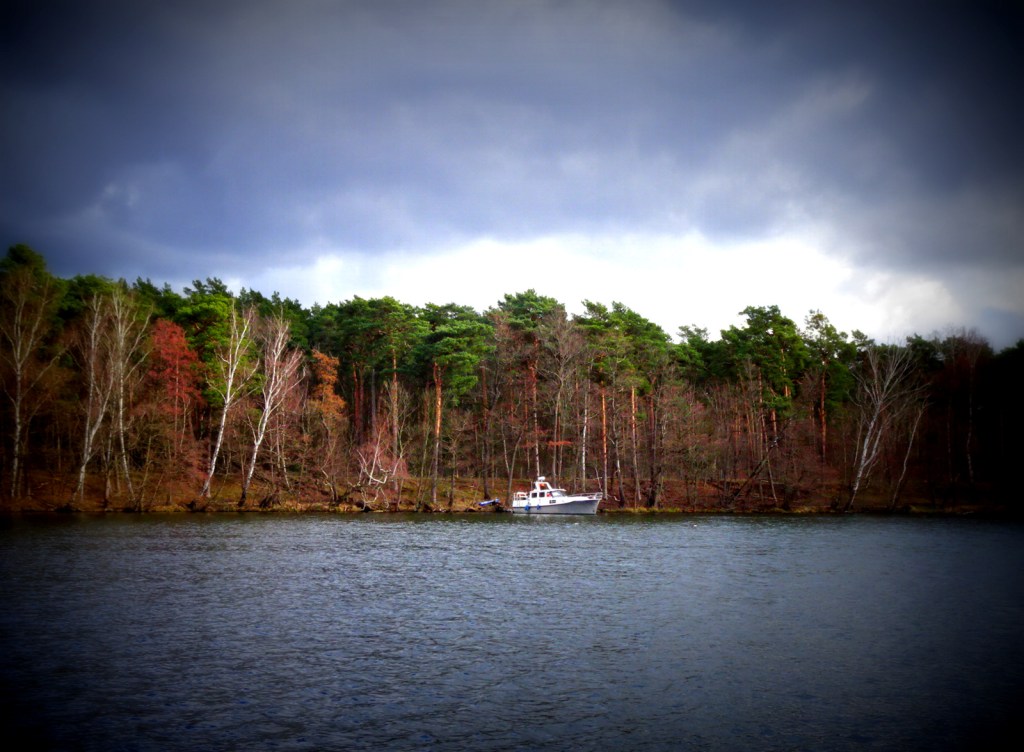

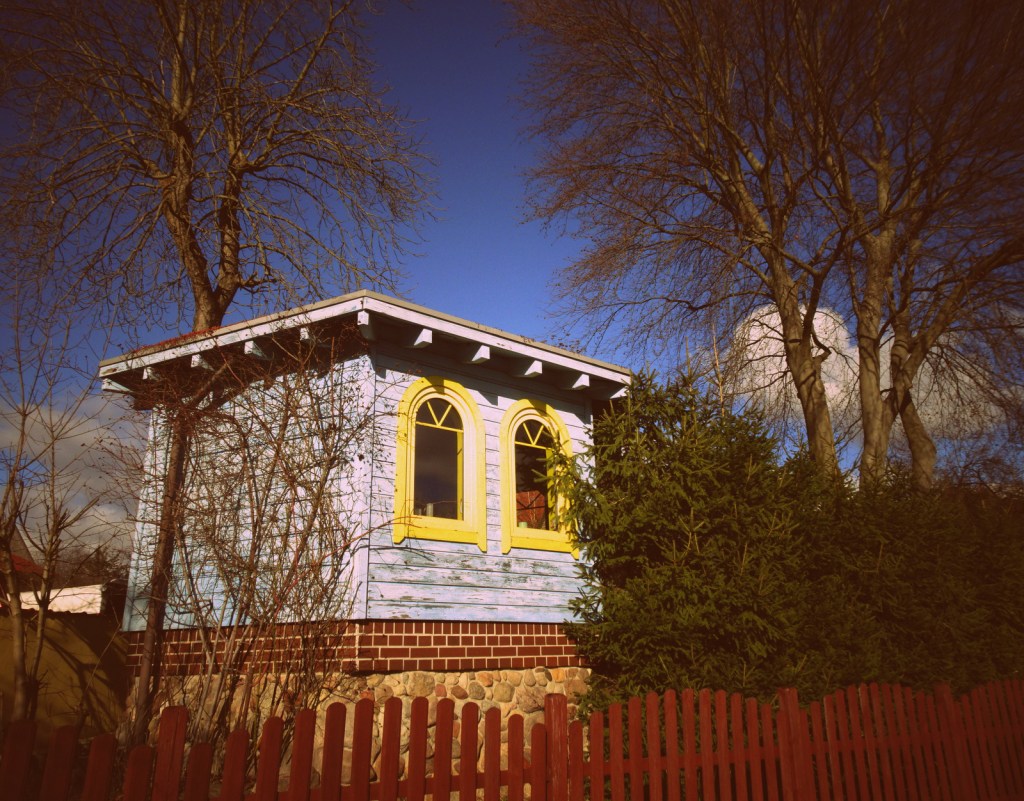

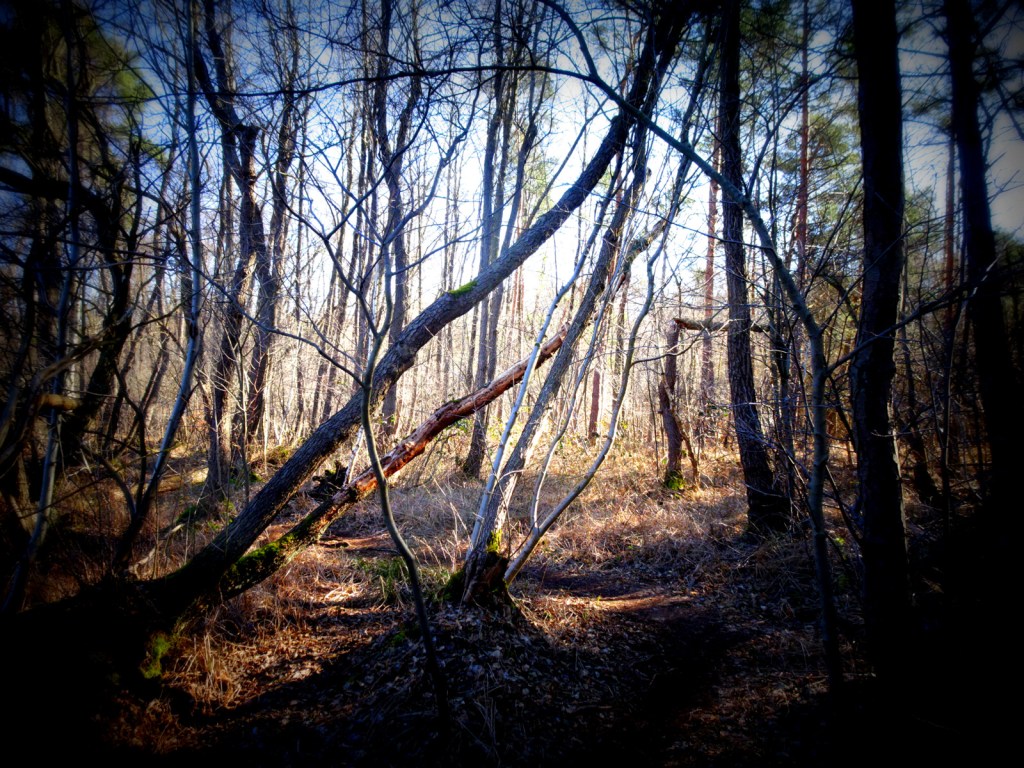

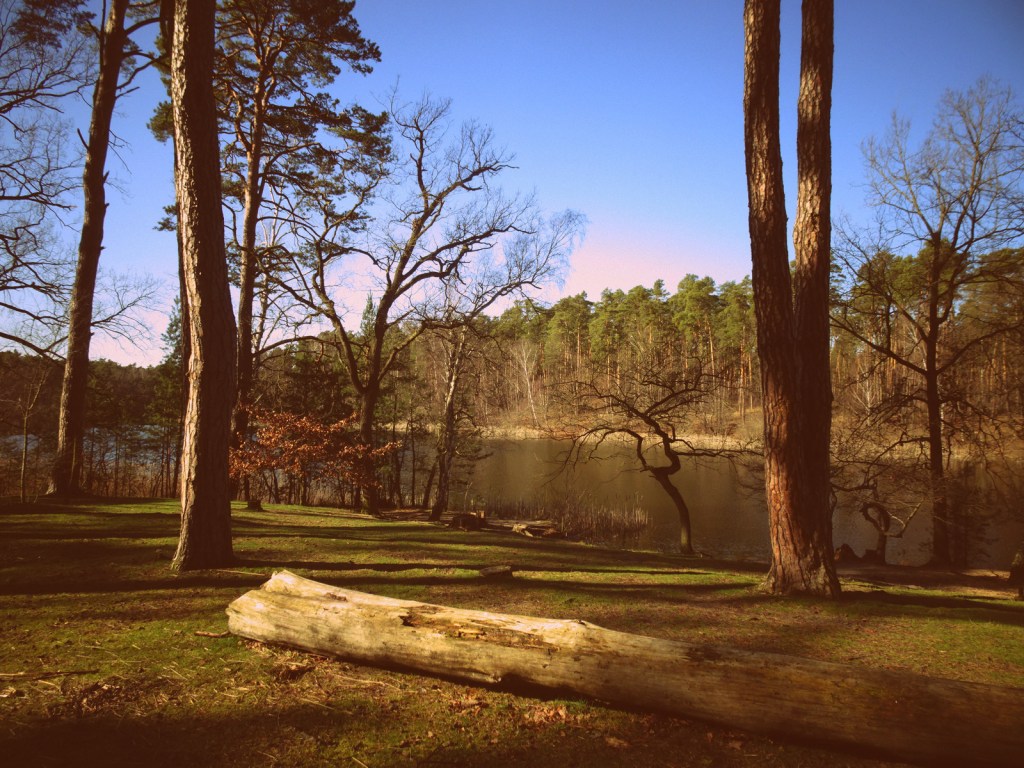
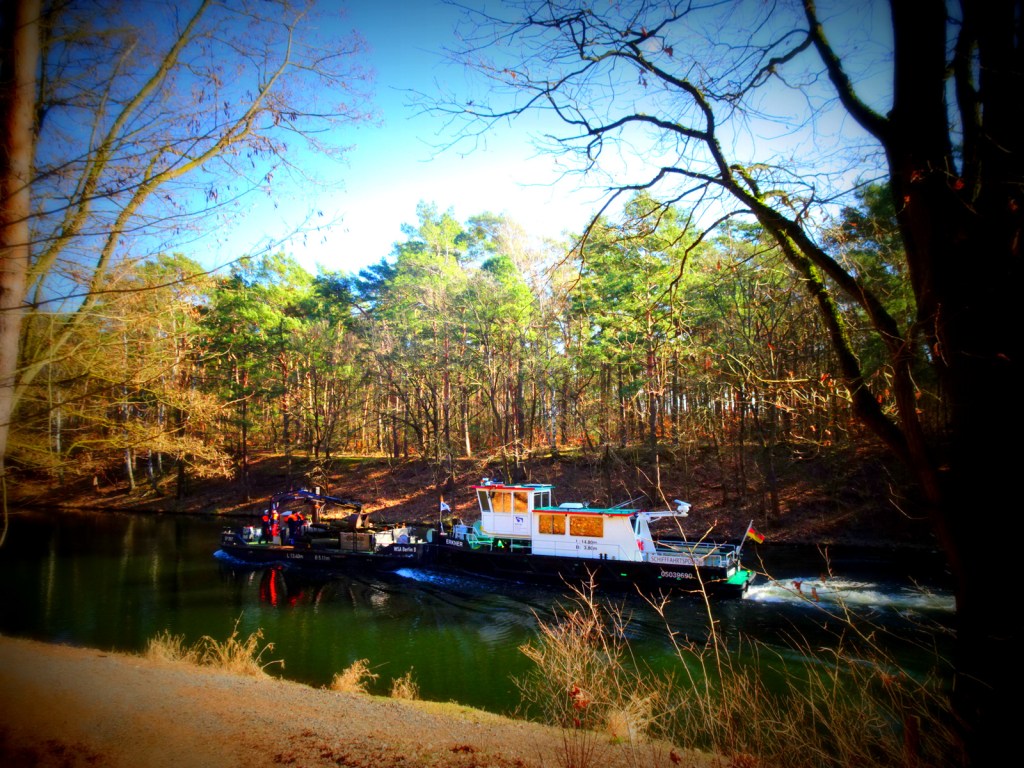
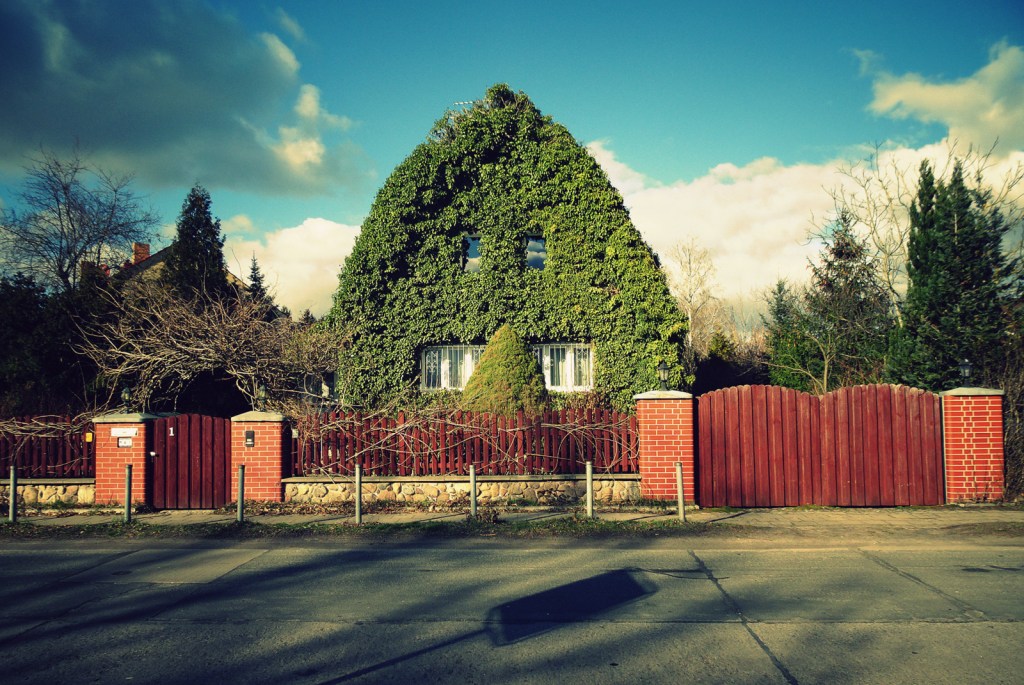


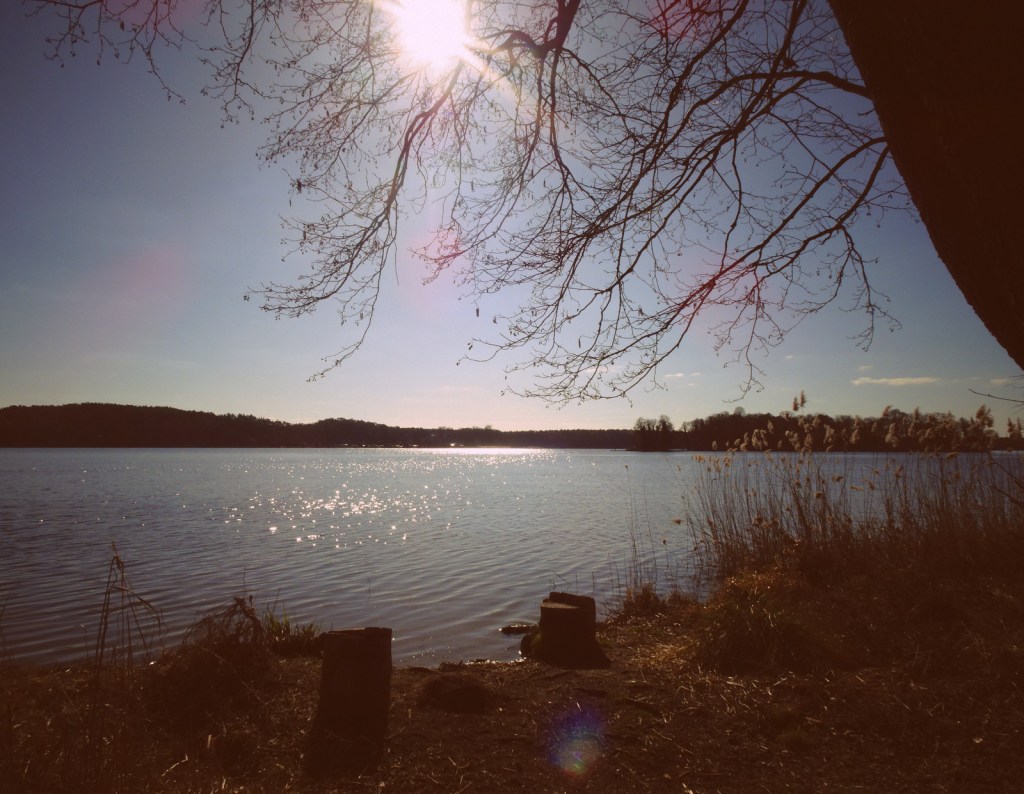
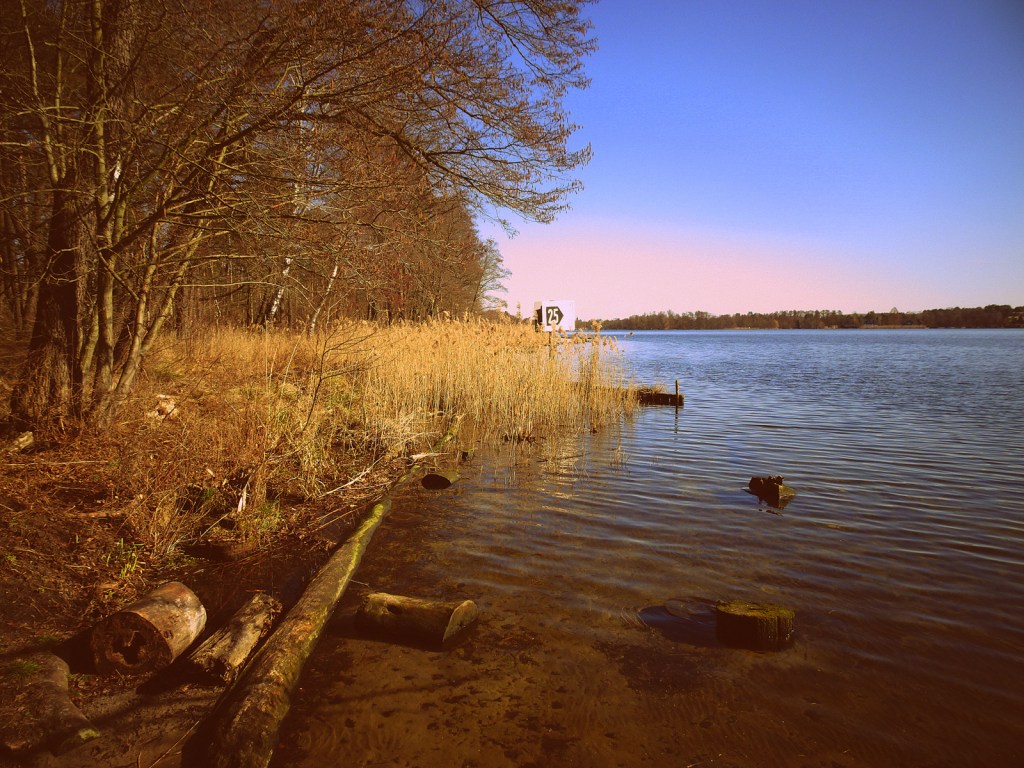

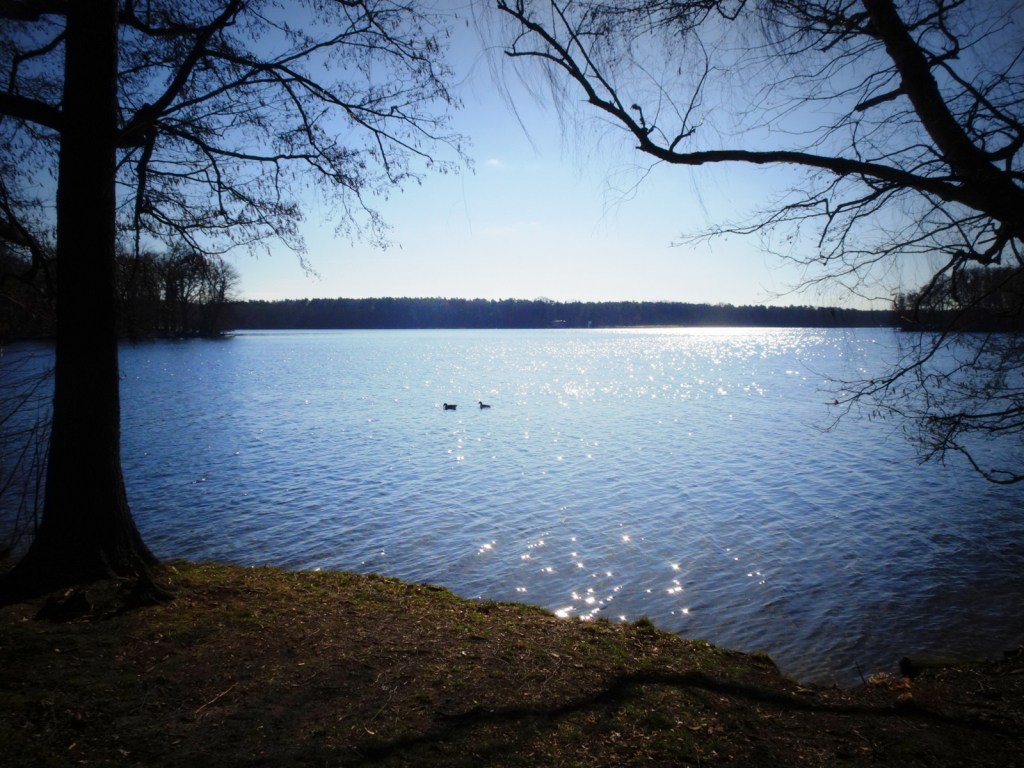

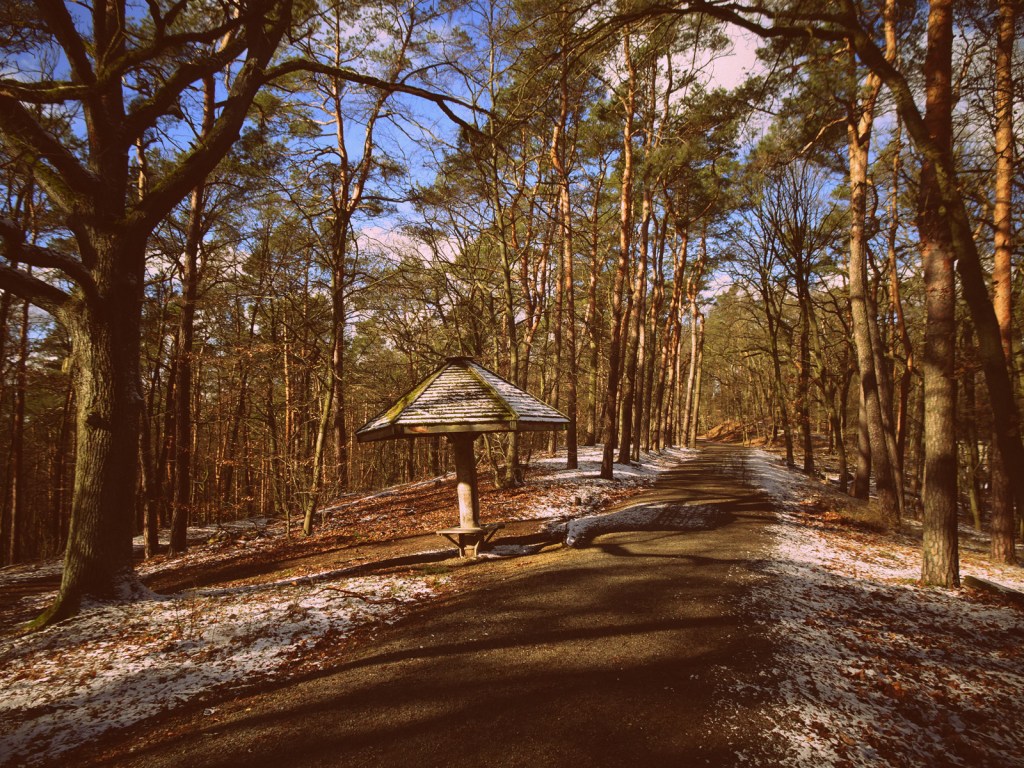

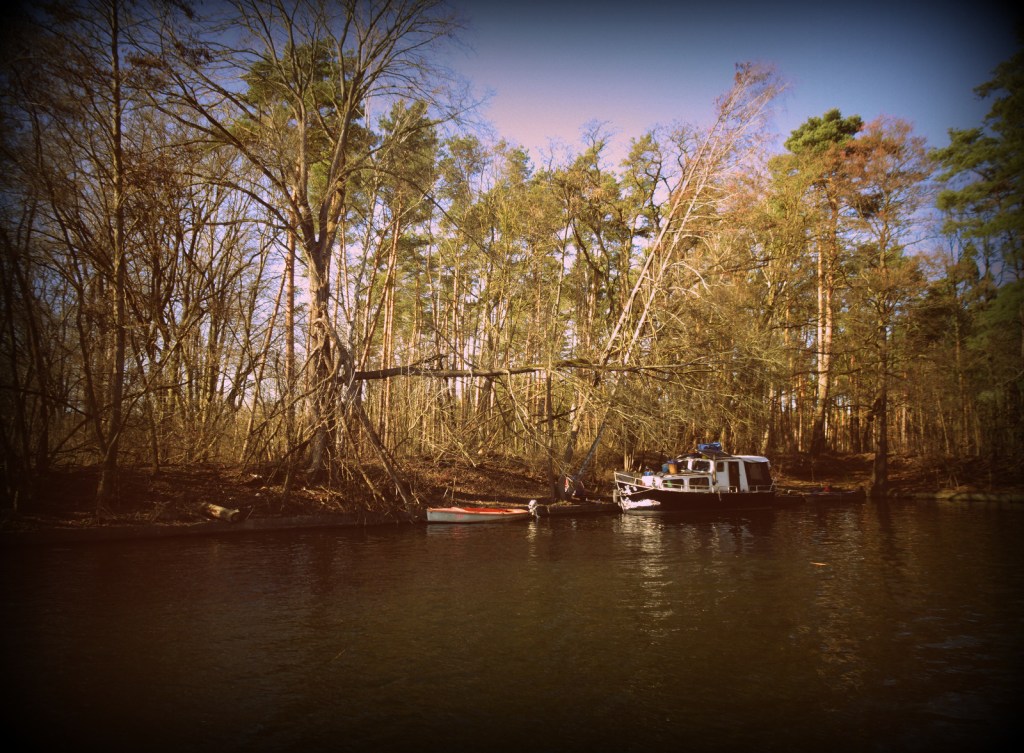
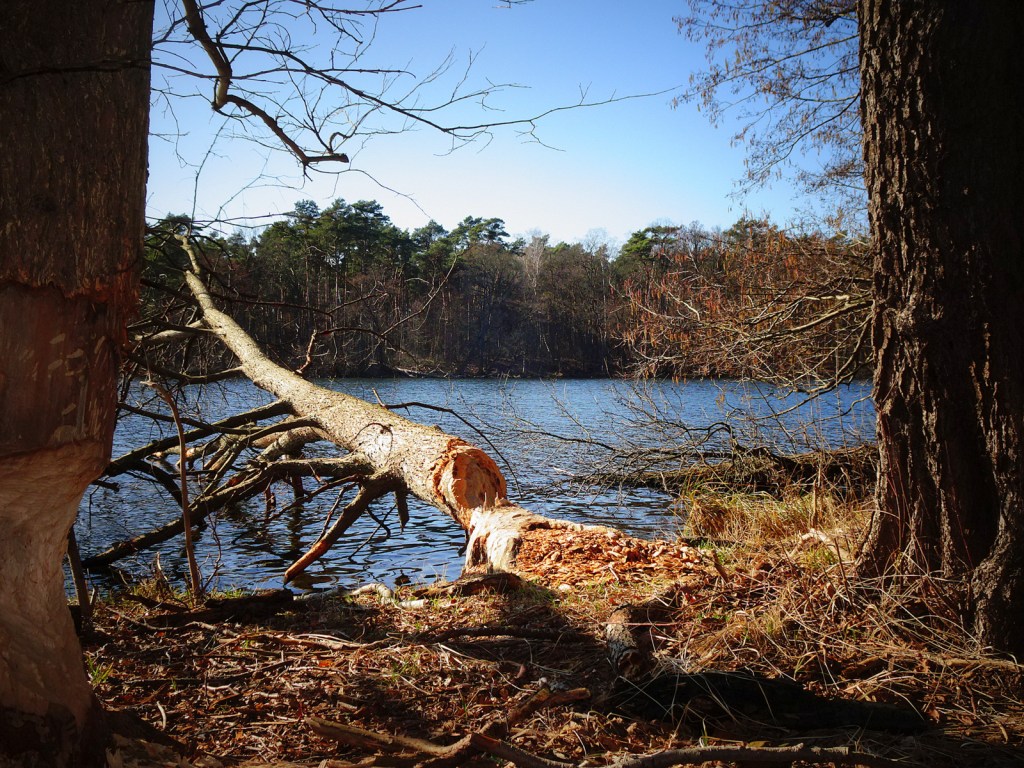


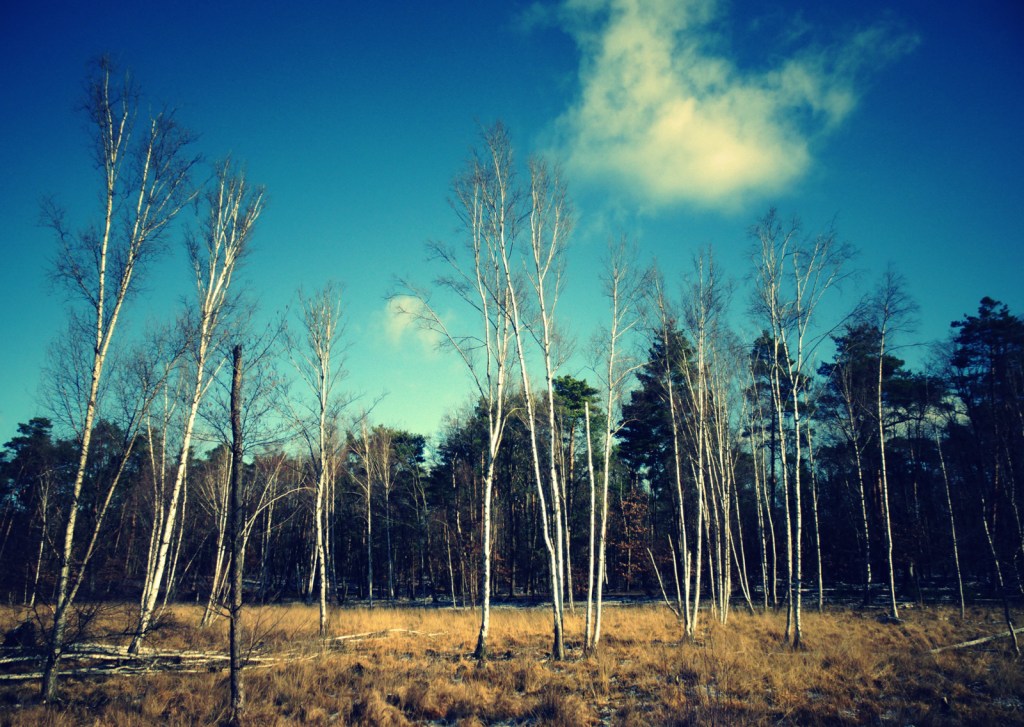

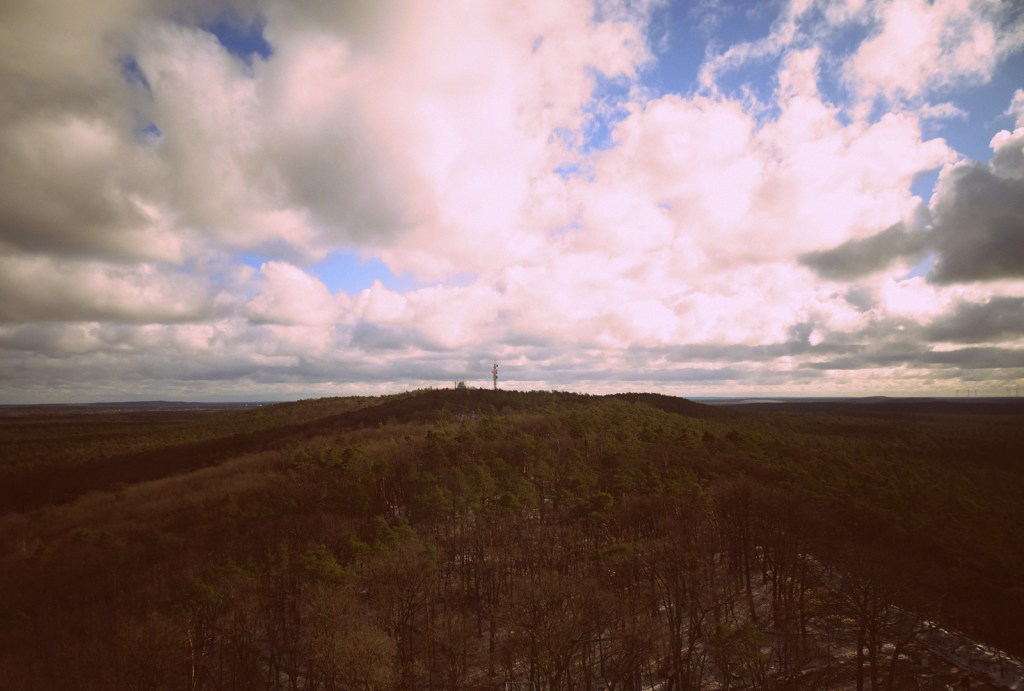


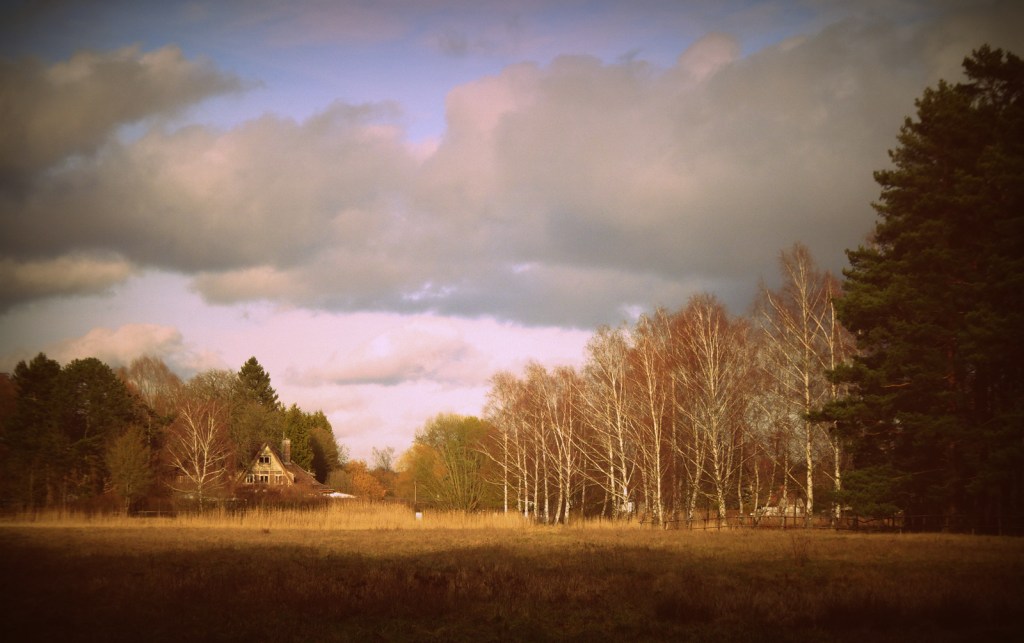


Because of the similarity to the Baltic Sea, there are even Vikings, rowing to ransack Rahnsdorf.


But of course they are no match for the Water Police.

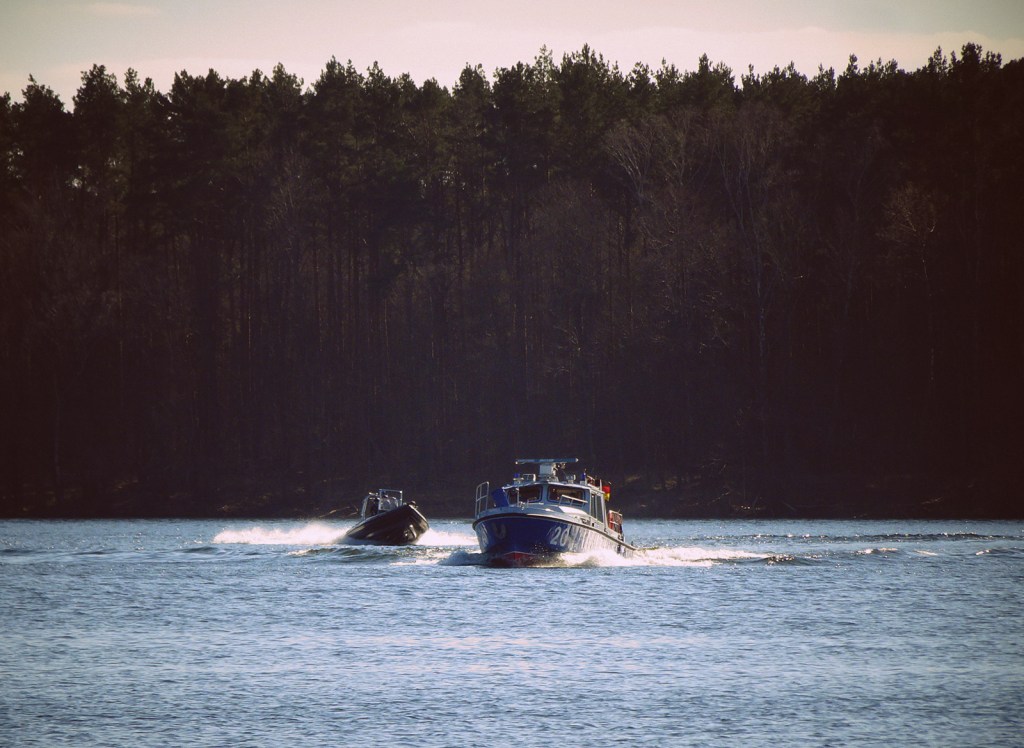

Even the public transport happens by ferry, like in Stockholm.


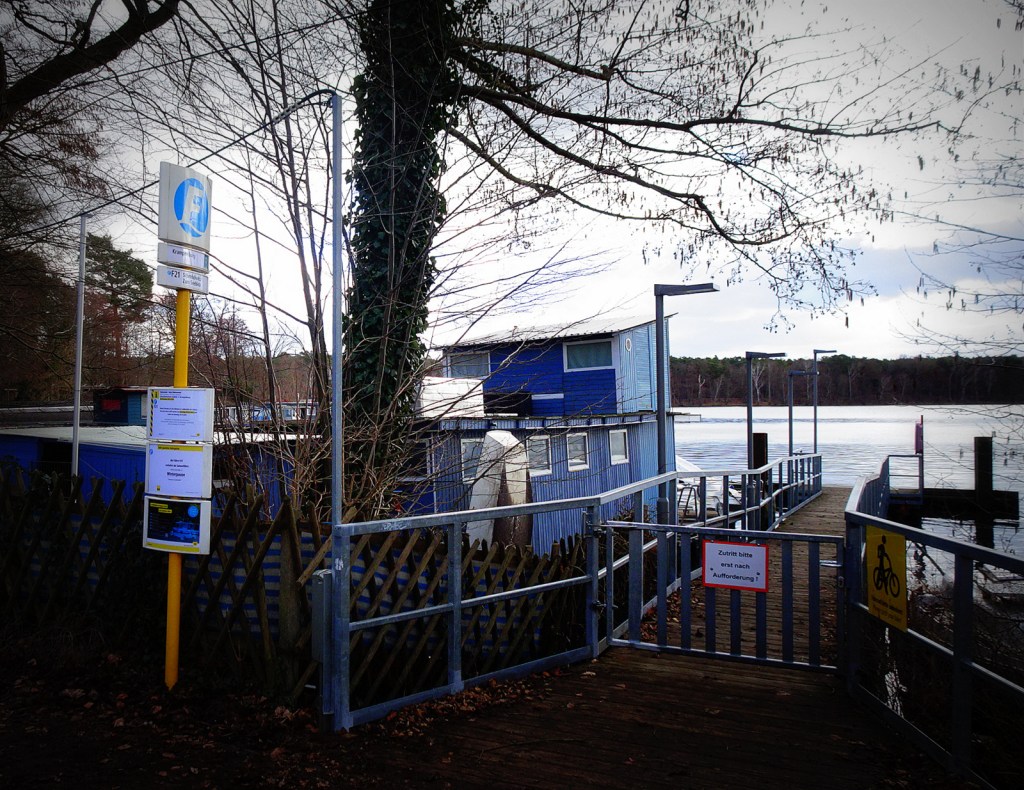
And the best thing? While there is a Water Police, there ain’t no Fashion Police, so you can go about your daily business in jogging pants. Even if it’s a very serious business, like sitting in the forest and reading books.
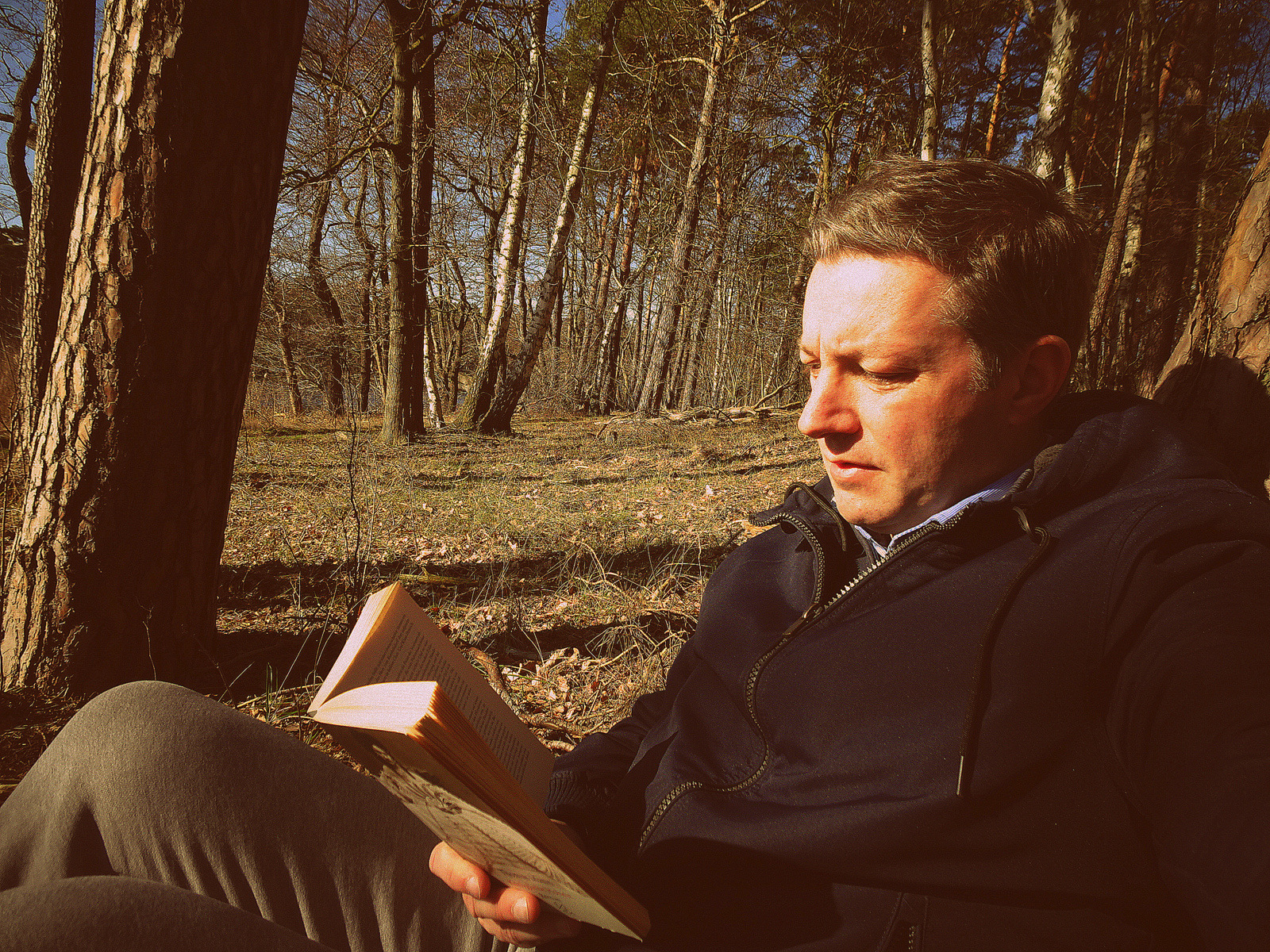
It’s a tough job, but somebody has to do it.
Many people who live in the countryside tell me that they could never live in a city like Berlin, with all its noise and traffic and violence and drugs. I have no idea what they are talking about.

You do have to watch out for sharks in Müggel Lake, though.
Links:


