Today is the 25th birthday of Gilad Shalit. It is the 6th birthday that he has to experience in captivity. When he was kidnapped, he was a boy of 19. Now he is a man, but one who has been deprived of enjoying the prime of his life, these years in which we attend university, have our first job, our first serious relationship, maybe even start a family.
Gilad Shalit is a dual citizen of France and Israel who was doing his compulsory military service in the Israeli Defense Forces (IDF) as a corporal. On 25 June 2006, he was kidnapped by Palestinian militants from the Israeli side of the border near Kerem Shalom. The militants had dug a tunnel underneath the border, ambushed the Israeli patrol on Israeli territory, killed two IDF soldiers and kidnapped Gilad Shalit to Gaza. He has been held in Gaza ever since.
Only after more than three years in captivity, in September 2009, was the first video of Gilad Shalit released by the Al-Qassam Brigades, the military wing of Hamas:
Efforts to negotiate Gilad Shalit’s release have so far not been successful, mainly because the hostage-takers demand the release of more than 1,000 Palestinian prisoners, among them convicted murderers.
I often think of Gilad Shalit when Palestinians, or people who blindly take up anything that is called “the Palestinian cause”, talk about “the occupation of Gaza”. Gilad Shalit is the only Israeli soldier in Gaza. This boy who was a 19-year old corporal at the time is not an occupying force, he is a hostage. At the time of his capture, there was no more Israeli occupation of the Gaza Strip. Israel had withdrawn all its military, its police and even Israeli civilians (many of them against their will) from Gaza in 2005, almost one year before Gilad Shalit’s capture. Gilad Shalit and his unit were on Israeli territory when he was kidnapped.
Gilad Shalit is not a prisoner of war, but a hostage. There was no military confrontation between Hamas and Israel at the time of his capture. Gilad Shalit, his family and his home countries are being denied the basic rights extended to prisoners of war (POW), for example visits by the International Committee of the Red Cross, the right to know the POW’s location or the right to correspondence with his family.
When Gilad Shalit was 11 years old, he wrote a story at school, called “When the Shark and the Fish first met”. It is a story about a shark and a fish who meet and become friends. Part of it reads:
In the evening, the shark returned to his home.
His mother asked:
“How was your day, my dear shark? How many animals did you devour today?”
The shark answered: “Today I didn’t devour any animals, but I played with an animal called FISH”.
“That fish is an animal we eat. Don’t play with it!” said the shark’s mother.
At the home of the fish, the same thing happened. “How are you, little fish? How was it today in the sea?” asked the fish’s mother.
The fish answered: “Today I played with an animal called SHARK.”
“That shark is the animal that devoured your father and your brother. Don’t play with that animal,” answered the mother.
It’s a beautiful story which you can read in full here.
Happy birthday, Gilad! I hope you will be free soon.
Josh Fattal and Shane Bauer, both 28, were travelling through Iraqi Kurdistan and visited the Ahmed Awa waterfall which is on the Iraqi side of the Iran-Iraq border. It is unclear if they accidentally ventured into Iranian territory on their hike or if the Iranian border patrol arrested them in Iraqi territory.
The American hikers are being held at Evin prison in Tehran, where I was imprisoned for one week in the summer of 2009. Because of my own experience, I have special sympathy with Josh Fattal and Shane Bauer. Having been to Evin for one week was the toughest experience of my life; I cannot imagine what it must be like to spend two, let alone eight years there.
It is from this perspective and with this background that I want to answer the following questions:
Can they appeal the court ruling?
Yes, they can. But we must not think of this affair as a judicial proceeding. It is labelled a trial, but it isn’t. Iran does not have an independent judiciary, it is not governed by the rule of law and lawyers who stand up for their clients go to jail themselves. Iran is an autocracy in which laws, courts and judges are just another means of oppression.
We also must not think of the Iranian state as a monolithic entity. There are many different factions, some more religious than others, some more radical than others, some might think that a rapprochement with the US and the West in general is a worthwhile goal, others think that America will always be “the Great Satan”. Even experts have therefore been notoriously unable to explain or predict the moves of the Islamic Republic of Iran.
Why did Josh and Shane travel to Iraq in the first place? Everyone knows it’s dangerous.
This is the question that drives me crazy. It puts the blame on the victims. The three American hikers had been travelling Northern Iraq which had been absolutely safe and had become a tourist destination. They were going to see a waterfall. There is nothing criminal or wrong about this. The fault lies exclusively with the state that captured and imprisoned them.
Unfortunately, many people are quick to comment who are themselves couch potatoes and whose biggest adventure in live has been a weekend in Las Vegas. These people will never understand that in order to gain a real understanding of the Middle East, one has to travel, experience, speak to people.
I feel very sorry for Josh and Shane not only because of their very long imprisonment, but also because I know from my own experience after my release from Evin prison that 95 % of people will tell them “Why on earth did you go there?” (“there” referring to any part of this world that doesn’t have a McDonald’s or where you have to speak another language). Many will think “You got what you deserved”, and some will even say so. – In my experience, it was actually Iranians who had the most understanding, because they know from experience that being arrested in Iran doesn’t mean that you did anything wrong, and who often apologised for their regime.
But how do you know the three US hikers weren’t really spies?
They were definitely not, for at least two reasons:
No country would send spies to Iran that don’t speak Farsi , don’t look Persian, don’t have an Iranian name, don’t have any contact there, and so on. These three hikers would have stood out in Tehran like the proverbial sore thumb, especially because Iran does not attract much Western tourism. If somebody wanted to send spies to Iran, one would recruit from the vast community of Iranian exiles or refugees.
No intelligence agency would ever send three agents to a hostile country together in one group. They would go independently of each other, at different times, using different routes. Ideally, they would not even know each other.
I assume that the Iranian intelligence service already thought that Shane Bauer is a spy because his name is so similar to Jack Bauer of “24”, a series which also has many fans inside Iran.
So what can we do to get them released?
First, let’s be clear about what won’t help: Appeals, letters, press releases. I can already see the many statements “condemning” this verdict and “appealing” for mercy. This is all a waste of time.
Sarah Shourd was released on bail of 500.000 $. Maybe we could also pay ransom for the two remaining hikers, but the price has certainly gone up. You could think of the eight years prison sentence as the price tag which has to be converted into money, arms (remember the Iran-Contra affair?) or political favours.
So what can we do that Iran wants? Not much, if we want to stick to the sanctions. We could stop secretly attacking the Iranian nuclear programme (if we even do that), but if that works, Iran will just hold on to the hostages as security. We could allow Iran more influence in its two neighbouring countries, Iraq and Afghanistan, but as we get ready to pull out soon, Iran will gain this influence anyway.
One contemporary movement in the US certainly angers Iran and we could easily give that up: the campaign to remove the “People’s Mujahedin of Iran” from the list of terrorist organisations. I doubt if this will be enough, but if the US wants to approach the diplomatic route, this will have to be one of the first steps.
There is no (para)military option to liberate and extract the prisoners. The daring attempt by Ross Perot to liberate two of his employees from an Iranian prison in 1979 did not succeed militarily; the prison was stormed during the course of the Islamic Revolution and all inmates were freed. Operation Eagle Claw, the attempt to liberate the US embassy hostages, failed. – Evin prison is located on the very Northern outskirts of Tehran, surrounded by mountains. The closest entry point into Iran to reach Tehran would be through the Caspian
Not an option.
Sea in which we have neither a base, nor any forces. From both Iraq and Afghanistan, it’s too far to fly undetected. Ashgabat in Turkmenistan, is used by the US military as an airport, but is still 670 km away. Even at maximum speed, this means more than two hours of flight time for a Black Hawk helicopter. – And even if you find the two men in the quite large complex of Evin prison (I was driven around by car between several buildings during my stay there) you would still need to get back to safety. Impossible.
This leaves only one option: We need to arrest Iranians abroad whom the Iranian government would want to get freed, and then there will be a prisoner exchange. This suggestion might be inspired by my upbringing during the Cold War, but I think it’s the only strategy that will work. There are plenty of representatives of the Islamic Republic of Iran who do not enjoy diplomatic immunity (trade delegations, Press TV, companies held by the Iranian state).
In Germany, there is an informal rule in political debate: if you have to invoke a Nazi-comparison, you have lost the argument because you have displayed that you have no serious arguments left.
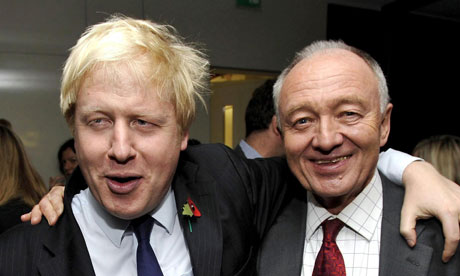
I am less concerned by the effects this outrageous comment will have on Mr Johnson. He’s a politician, he has a tough skin.
I am more enraged because of the trivialization of Adolf Hitler: Comparing a mass-murdering, anti-Semitic, racist dictator who ordered the Holocaust and waged war against half of the world to a freely elected mayor of London is not only wrong and stupid, but it is also an insult against the victims of the Nazi tyranny.
And what are these religious references (“good and evil”, “judgement day”, “Archangel Gabriel”) about? Does Mr Livingstone think he is God’s second son?
At least he seems to think that he is Churchill. That would also explain why he is so obsessed about running for mayor again after he lost to Mr Johnson in 2008. After all, Mr Churchill served as Prime Minister twice (1940-45 and 1951-55).
I am a swing voter somewhat left to the centre and I would usually choose between Labour, Liberal Democrats or the Green Party in any election, based on the respective candidate and the current issues. – But Labour in London have lost my vote for the election of mayor in 2012. In fact, I might be voting Conservative for the first time in my life.
(I contacted Mr Livingstone’s Director of Media Mr Joe Derrett on 18 and on 28 August 2011, asking for the full context in which these remarks fell. I never received a reply.)
I have noticed that I receive many e-mails with the same questions, so I have begun to post the most frequent questions – and of course the answers to them – for everyone to read. For free, can you believe that?! As this section might already answer many of your questions, I invite you to browse these FAQ before you contact me (or any other lawyer) about your case.
Before asking a new question, please read through the many comments which may already answer your questions. And if you find these FAQ useful or if you ask a new question, it would be very nice if you make a donation. Thank you! (After all, if you are on this page, you are about to receive a huge inheritance.)
1. Which law applies in international inheritance cases?
Art. 21 of the EU Succession Regulation sets out the basic rule: The succession shall be governed by the law of the country where the deceased had his/her habitual residence. In cases of several residences or of highly mobile people, you can imagine that this opens up room for interpretation.
And it becomes even more complicated, because there are several exceptions. The most important of them is Art. 22 of the EU Succession Regulation, which allows a person writing a will to choose the law of one of the countries that he/she is a citizen of.
As the inheritance laws of different countries (and sometimes between different jurisdictions in the same country) vary quite a bit, it is imperative to think about which law to choose. If you are a foreign citizen living in Germany, choosing foreign law can pose an enormous benefit, because it is often a way to circumvent the strict German rules on forced heirship (see no. 3 below).
2. Who inherits under German law if I have no will?
That depends on your family situation.
If you only have two children and no other relatives, nor a surviving spouse, both your children will inherit 50%. Easy peasy, lemon squeezy. No lawyer needed.
If on the other hand, you have a surviving spouse, several children from different mothers/fathers, half-siblings, cousins, uncles and aunts of varying degrees, then the whole thing can become a proper mess. Even more so if somebody did something they shouldn’t have done, for example fathering a child with their sister. Is that offspring a child or a nephew? Or both? Will he/she receive 1/17 or 2/17?
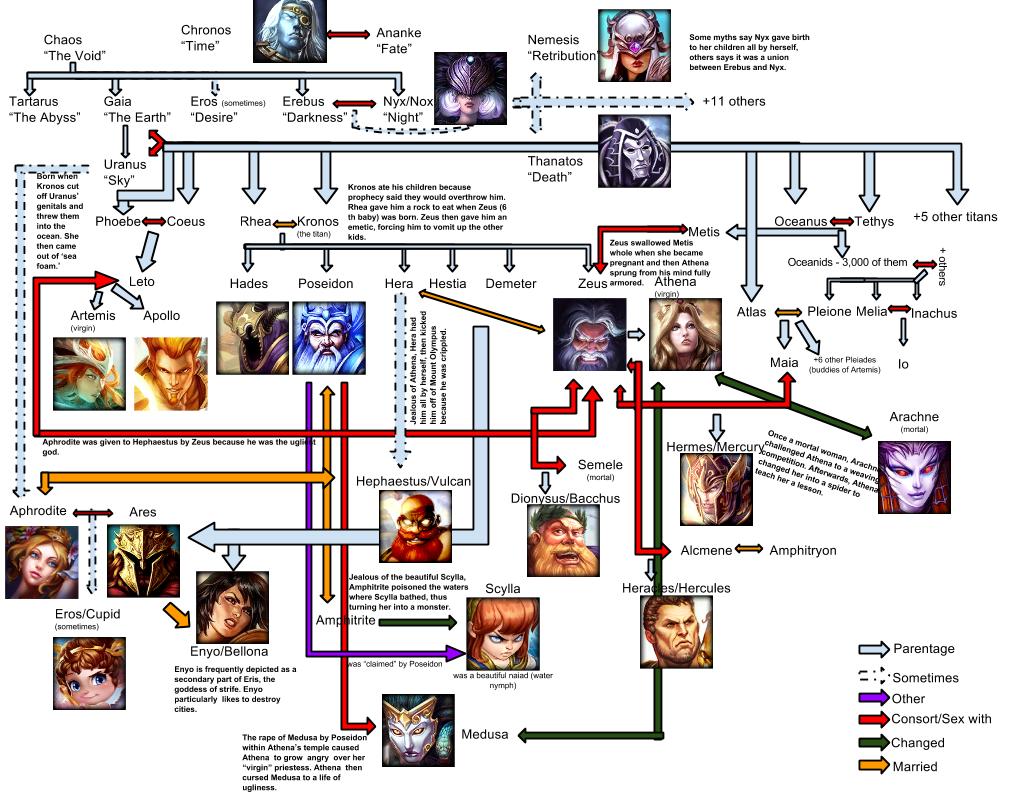
Sometimes, it’s as confusing as those Greek tragedies, where everyone is related with everyone else in the most convoluted ways.
3. I don’t care about my relatives. Can’t I simply decide who gets the house, the car, my books and the dog?
Ehm, it’s not quite that easy.
German law has a system of “forced heirship” (§ 2303 BGB) which means that children, parents and the spouse are entitled to a certain minimum of the estate, even if you have not listed them in your will or – and that’s shocking – even if you have explicitly removed them from your will.
So, while you can disinherit someone in your will, he/she can sue to receive a legal minimum. Only in cases of gross misconduct on the part of the potential heir towards the deceased can they be excluded completely (§ 2333 BGB).
4. And how do I write a will?
The two main forms are the notarized will (which requires a notary public, of course) and the privately written will. They both enjoy equal legal validity.
The privately written will has to be handwritten, signed and dated (§ 2247 BGB). The biggest mistake that people make is to download some form of the internet, print it out, and sign it. It’s void, because the whole document needs to be handwritten. – Why? Because the law dates from 1896 and it says so.
As to the form of the will, Art. 27 of the EU Succession Regulation also gives you plenty more options if you are a foreign citizen or have other ties abroad. As indicated in no. 1 above, if you are in that situation, it’s really worthwhile to look into all the possibilities that you can choose from.
5. Do you have any advice about what to put into a will?
My main advice is: Don’t try to control the future by writing a will.
This is a mistake that many people make. They think they can use a will to exert influence on the lives of others, long after they will have been gone. They set up complicated trusts and appoint executors and administrators, on whom they put onerous conditions and detailed provisions. They limit what their children and surviving spouse can do with the estate. They detail the succession down to the generation of their great-grandchildren, but of course only if they get a college degree.
And then life turns out differently. The son dies before his parents. A picture-perfect couple splits up because the husband wants to hike the length of the Amazon. That lovely daughter-in-law is really an IRS informant. The company, which was all your pride, loses market share and slips into irrelevance.
What I am trying to say: Accept mortality.
When it’s over, it’s over. And if you want somebody to receive your paintings, your books or some money, give it to them now. You don’t need to wait until it will be too late.
6. If I have written a will, can I change it later?
Usually yes.
You do this either by destroying the will (if there is only one copy), or by writing a new one, in which you include the explicit remark that the new will supersedes the old one.
However, if you signed a joint will with your spouse or a contract of inheritance, you may be bound by the will even if you no longer want to be. That’s why you should think really hard before signing any such document.
7. You are right, this whole family business is rather uncertain. Can I leave everything to my dog?
No.
And actually, animals don’t care about money and stuff. Which sometimes makes me believe that they are more advanced than us humans.
You could bequeath your dog to someone, under the condition that they continue to take care of the dog, but this leads to all the problems I alluded to above in no. 5.
8. What if I don’t want to inherit?
If you don’t want to inherit (for example if the estate includes more debts than assets, or because you simply don’t want to deal with any of your relatives), you can refuse to accept the inheritance.
However, you need to explicitly declare that you reject the inheritance within 6 weeks of your knowledge of the inheritance (§ 1944 I, II BGB). If you live outside of Germany, this limitation period is 6 months (§ 1944 III BGB).
9. Does Germany tax inheritance?
You bet.
The tax rate depends on the amount inherited and on how closely related you were to the deceased. As a child, for example, 400.000 EUR are tax free. Above this threshold, the tax rate progresses from 7 % to 30 %. The maximum tax rate (for non-related heirs) is 50 %.
10. How do I decide whom my children will stay with in case of my death?
Although I have never been called to somebody’s deathbed to listen to his or her last words (and I probably would arrive too late anyway), I am absolutely certain that nobody ever died thinking:
The riots in London are still going on and I am in the middle of it all in London. There is too much happening in different parts of London and I cannot be everywhere, so I cannot form an elaborate opinion yet. Probably nobody can do this at this moment, because events are still developing.
Therefore just a few of my thoughts, to which I will add as I learn and analyse more:
It started with the shooting of Mark Duggan (29) by police on 7 August 2001. The exact circumstances are still unclear. An investigation has meanwhile shown that Mr Duggan did not fire on police before being shot in the chest.
Based on previous instances of deaths caused by police in London and their attempted cover-ups (e.g. Jean Charles de Menezes, Ian Tomlinson) it is understandable that this causes shock, especially in communities who are stopped or arrested by the police more often than others.
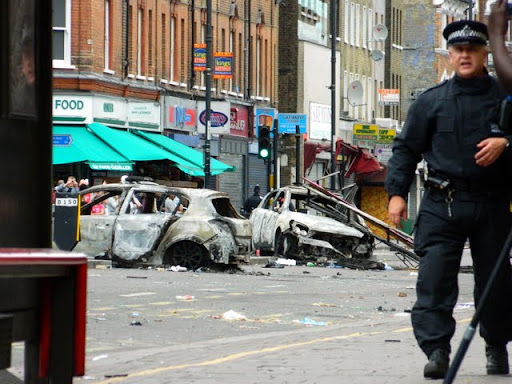
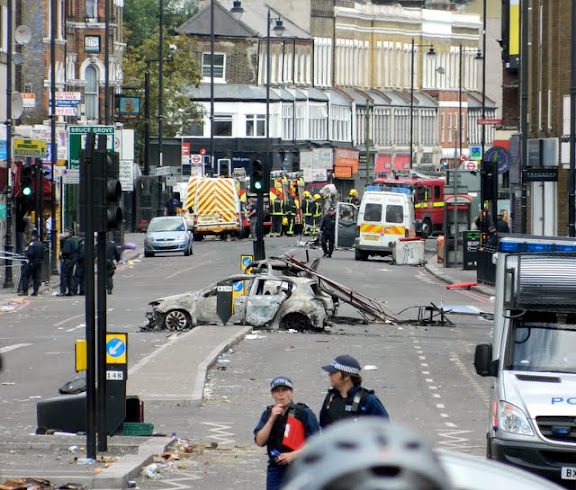
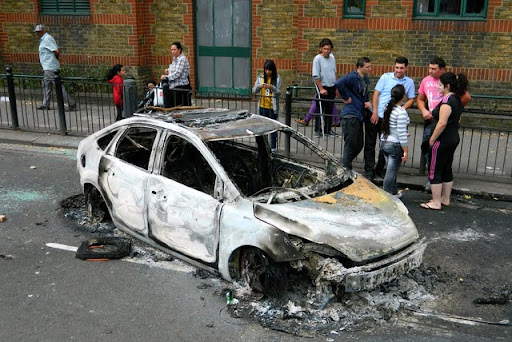
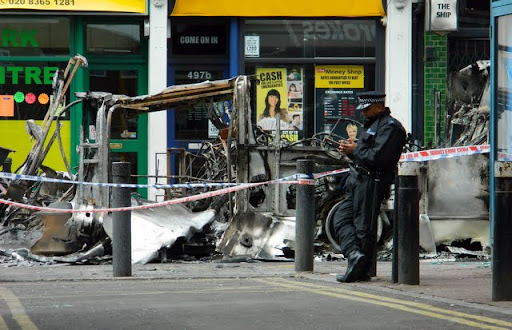
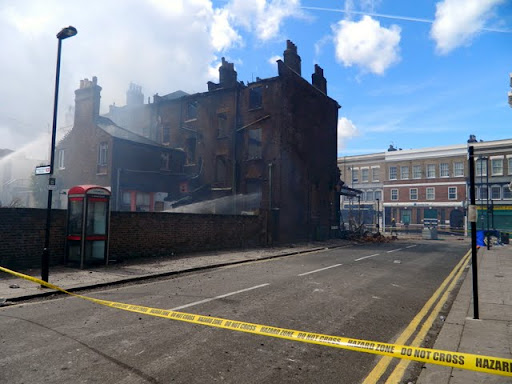
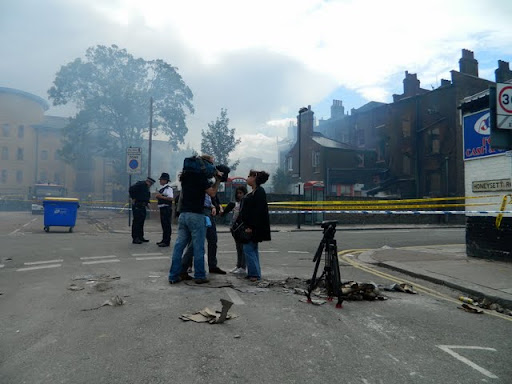
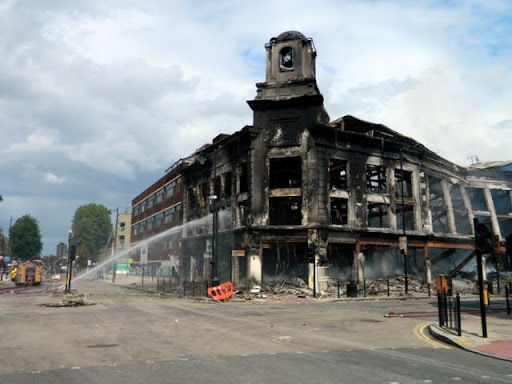
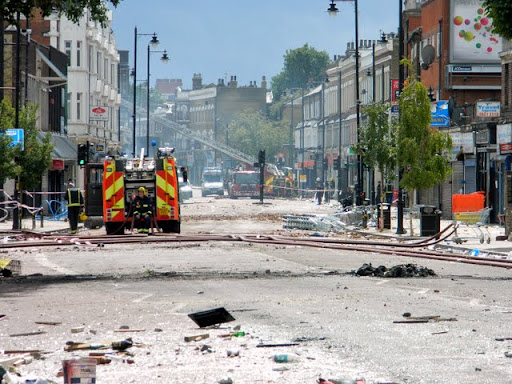
The riots started after a peaceful protest in Tottenham (see my photos of the aftermath of the first night).
The clashes were initially called the Tottenham Riots because I (and others) thought that it would remain local and that it would be over after a day or two. That was wrong.
When I was at Tottenham, I heard several people complain that the police had not protected houses and shops. However, it seems that the police were highly outnumbered. In this scenario, I find it understandable that the police don’t risk more confrontation by trying to protect assets. As bad as it is for the shopkeeper or the resident in question, it might make sense from a policing standpoint to let violent protesters vent some anger instead of trying to seek to arrest everyone who throws a bottle.
I am tired of hearing and reading “it’s like a war zone”. No, it is not! A few houses burnt, a few cars burnt and there was looting. A war is a sustained military operation between two or more armies in which whole cities are destroyed and hundreds or thousands die every day. In Tottenham, there were families looking at the aftermath of the riots with their children in strollers the next day. This is very far from a war.
I was surprised how quickly and broadly the riots spread. By now, almost all parts of London seem to have been affected. This does not seem to be coordinated beyond some coordination at the very local level.
There have been many reports and footage of rioters breaking into shops and looting. They mainly seem to target electronics stores and shops for sporting equipment. This makes me doubt that there is too much of a political background behind most of these riots.
I don’t understand why people burn corner shops when there are plenty of Royal Palaces in London.
I don’t mind if the Mayor or the Prime Minister are in London or not. They deserve a bit of holiday as well and I am sure the fate of a city does not depend on one man. Even Boris Johnson won’t go out personally to arrest looters.
Ken Livingstone is even more annoying than the riots. He still hasn’t gotten over the result of the last election, what a poor old man.
The timing of the riots was quite good because I was just about to begin growing tired of London after having been here for 2 years. Exactly when I started to think about where to move next, this city is becoming interesting again.
The IRA must be jealous about the amount of destruction caused in London.
A city with 8 million people just cannot be policed and protected everywhere at the same time. Some are using these riots to call for more funding for police. How many officers do they want, a million?
These riots show that we are always only one step away from anarchy. Once people think they can steal and loot without a real danger of being caught, enough people will take this opportunity.
On 9 August, most of the shops in the previously affected areas are closed, some are boarded up. There is a very large police presence everywhere, with 3 officers on bikes just outside of my house right now.
As police from the surrounding areas are now flocking to London for support, the rioters just have to go to other parts of Britain. – And this is exactly what seems to have happened in the evening on 9 August.
London was quite calm, many of the shops closed and the streets unusually empty. I went for an evening walk around Peckham (one of the hot spots of the previous days) and almost no one was outside. There were more police than pedestrians.
And after 4 days, it was all over.
As expected, those that want more government spending are calling for more youth workers and those that want harsher sentences are calling for longer prison terms. As if anyone would really know what would work.
I find it ironic that a protest that was initially intended against police violence turned into widespread looting which in turn lead to the police being criticised for failing to respond with a harsh crack-down.
When I first moved to London in August 2009, I actually lived just 300 meters away from Tottenham Police Station. I lived there for about 9 months and I loved the area: it is culturally diverse, lively, colourful, plenty of green space and just a short walk to a canal along which you can jog or ride a bicycle and you’ll be out of London in a few minutes.
This shows that I am good at finding hot spots, but then I displayed terrible timing by moving away too soon. Today I returned to my old neighbourhood to take some photos for you:
This part of London was definitely far more interesting to live at than the areas where I subsequently moved to, first Morden and then Bermondsey.
UPDATE: As the Tottenham Riots become the London Riots, I have recorded my preliminary thoughts here.
For my birthday on 6 July, I went away for a few days. Some hiking and camping, being alone and close to nature. It was beautiful!
Without searching for it, I discovered paradise:
This was the bay at the bottom of the cliff where I slept at one of the nights, to the sound of the waves, under the open sky, admiring the milky way. The bay was secluded and I had it all to myself, with a beautiful sunset in glaring red.
This is one of the most beautiful places I have ever seen. I will reveal details in a few weeks, but you are invited to make guesses about the location in the meantime.
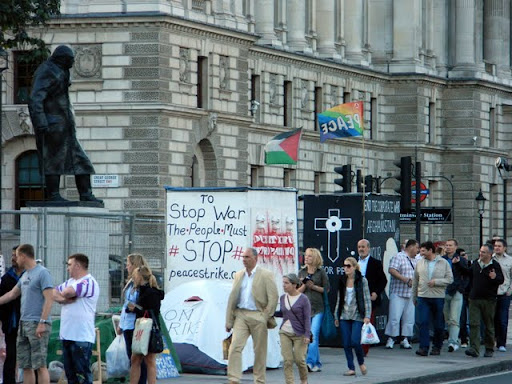
I wonder if the participants of the “Peace Camp” at Parliament Square in London have ever noticed the irony of protesting against all kinds of wars under the amused eyes of Winston Churchill.
(C) Andreas Moser
The “Peace Camp” is a continuous protest for, against and about an unclear litany of foreign policy issues. The camp has been in place outside the Houses of Parliament for more than 10 years now, not having achieved any of its aims, but successful in showing how relaxed the British democracy deals with protests at the doorsteps of its Parliament.
Today at LSE library, I noticed an advertisement at the inside of a toilet door (the location might have been a foreboding) for a company that offers proofreading services: “Less Silly Errors: Proofreaders of Academic Essays”:
Obviously, this company wanted to profit from the aura of somehow being associated with the abbreviation “LSE” but if you are trying to sell your expertise as a proofreader, this is a company name gone badly wrong.
“Less” is used when referring to something that cannot be counted (unless measured in units) or doesn’t have a plural. “Fewer” is used for nouns in the plural.
Examples: I spend less time on the internet than before and have to deal with fewere-mails than I used to. – I have less money now than when I used to work as a lawyer but I also have fewer sleepless nights.
“Errors” can obviously be counted, so it should read “Fewer Silly Errors“. The abbreviation “FSE” wouldn’t associate the company with the London School of Economics, but with Feline Spongiform Encephalopathy, which might be more appropriate.
I recommend this company for a prize for “Maximum Incompetence already displayed in the Company Name“.
If you want serious academic writing, proofreading or editing, you do better to e-mail me for a quote.
In the interest of journalistic fairness, I have contacted “Less Silly Errors” and invited them to comment. They responded by asking me if I want to work for them. I declined.
But three years later, in June 2014, I got this message from “Less Silly Errors”:
Hi Andreas,
It’s been three years now and your post is harming my company’s visibility in search engine result pages.
If you take the name literally then you are correct. I am an American so I don’t follow your literal mindset. You are incorrect in the intended sense. The name is a play on words intended to signify the tutorial feedback provided i.e. logical reasoning, premises, thesis, structure advice. Seriously, it’s the less obvious errors that students make!
It’s a bad name because some lawyer has posted a high ranking post incorrectly attacking the company name without considering that the company is someone’ssole source of income.
I respectfully request that you take this post down, please?
Many Thanks for Your Help,
Matt
Matt
LSE Proofreaders
I assume Matt heard about the ECJ’s ruling on “the right to be forgotten”, not that it applies in this case because he is still using the same company name, so nothing is outdated or obsolete. – In any case, he didn’t make an offer that I couldn’t refuse.


 Josh Fattal






 The Happy Hermit