
Zur deutschen Fassung dieser Geschichte.
Tivat is different from the rest of Montenegro: more glitzy, more shiny, more expensive, more show-off. All the things I don’t like. I only go there regularly because I am trying to visit the Maritime Museum in Tivat. But every time I try to visit, it’s closed.
The last time, when I had a few hours to kill before the bus back to Kotor (on a nice day, you can also walk across Vrmac), I strolled along the waterfront, looking at boats. In Tivat, they don’t have real boats with cranes and containers and sailors and guns and turrets. No, they just have toy boats. Fancy toys, but no match even for the navies of Austria or Bolivia.
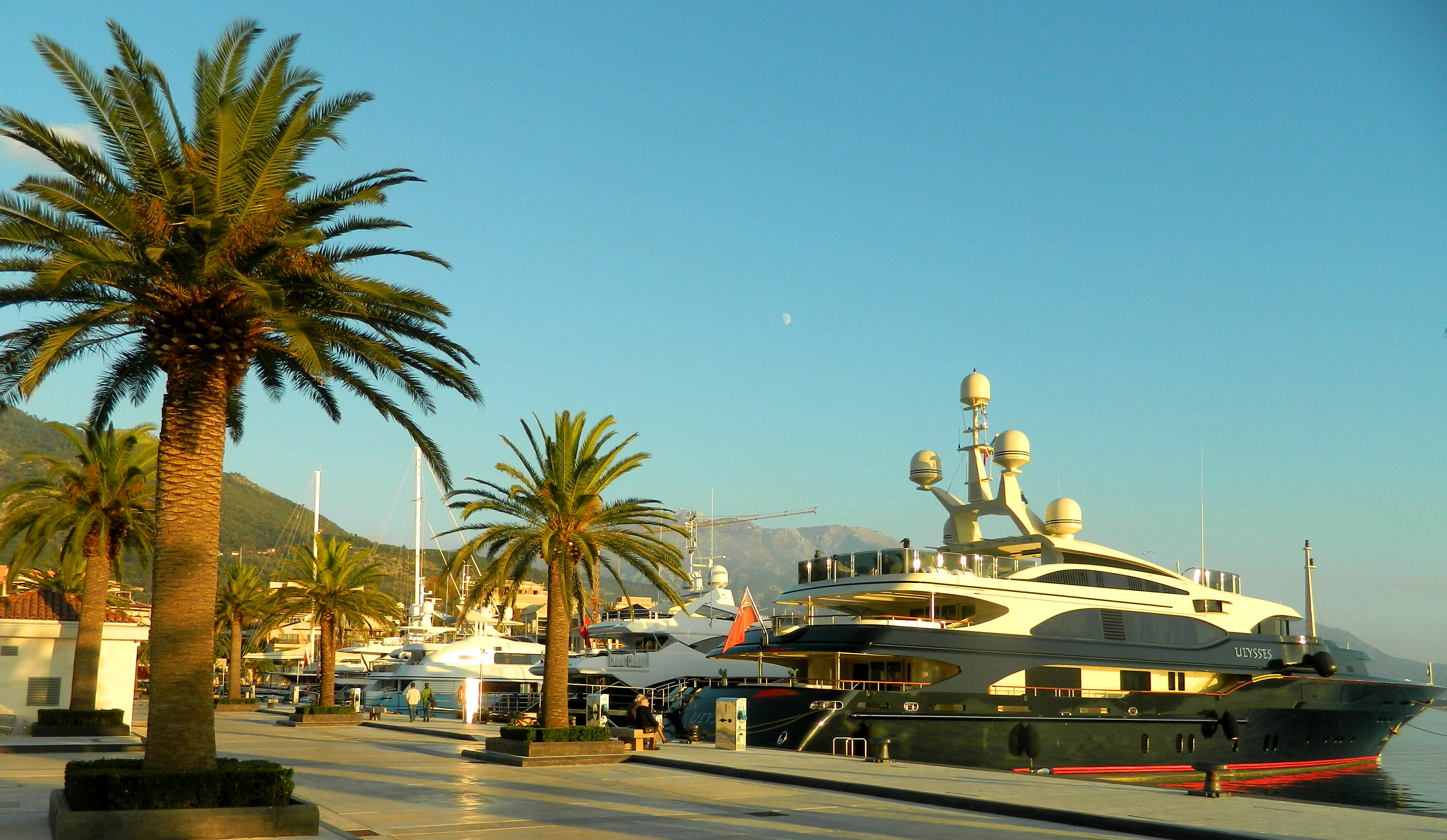
“Who buys such toys?” I wondered, and the answer is the same as for all other toys, like expensive cars, houses, phones and a second handbag: people who have too much money and a boring job. Drug dealers, money launderers, lawyers probably. Then I remembered that I am a lawyer, too, and that having a chat with some of the boats’ owners might be interesting.
Thus, I ventured into one of their bars (again, those in real ports like Monrovia or Dar-es-Salaam are more interesting) and looked for people who look like yacht-owners. Men, their shoes and clothes too white, as if to stress their cultural whiteness, sweaters in burgundy red or navy blue thrown over their shoulders, seemingly captivated by the little screens in their hands, but really bored, because the second I walked through the door, they all looked up simultaneously, hoping to spot an attractive woman. My looks disappointed, I couldn’t help but notice, but I was too quick. Using that split-second chance to build upon the visual connection, I cheerily greeted them: “Good afternoon, gentlemen”.
Two of them looked down on their phones, but the other two were still polite (maybe they had only recently become millionaires), returning a “hello”, even with a smile. Not having thought of a more sophisticated approach, or too occupied by maritime metaphors, I barged right in: “Are those ships outside yours?”, knowing quite well that four guys couldn’t possibly own all 60-or-so boats in the harbor.
“They are indeed,” they replied, not without some pride. Luckily, human beings are simple. If they own stuff, they like to talk about that stuff. So I just needed to ask a few questions, “which one is yours?”, “where do you go with it?”, “how long have you had it?”, “how many people can sleep on it?” and they all got excited enough to tell me everything in exact knots and fathoms and leagues.
I was curious to find out how these guys could afford their boats, so I asked: “What work do you that you can sail around the world all the time?”, although it should later turn out that they mostly sail to Bar or Herceg Novi, which they could more easily reach by bus.
“We are translators,” Marko replied, leaving me stunned, because I am a translator too, and I can’t even afford a bicycle, let alone a yacht. I explained my surprise and Mirko, Marko’s colleague, asked me what languages I translate.
“Only English and German,” I had to admit, ashamed.
They looked at me with pity, as if they were the Berlin Philharmonic Orchestra of 1966 and I was a small girl with a flute, knocking on the door and saying “I want to play music too.”
“So, which languages do you all translate?” I asked, bracing myself for a list of five languages each, from Icelandic to Swahili. But like in a play that they had performed many times before, each of them mentioned just one language, fired like four consecutive and impeccably timed shots.
“Croatian.”
“Serbian.”
“Bosnian.”
“Montenegrin.”
Coinciding with the last syllable of the last language, they all had a broad grin on their faces.
“And English, obviously,” I added, for we had been conversing in that language.
“Oh, we also speak German, French and Italian,” Duško added matter-of-factly, “but that’s really not relevant for our translation business. We only translate between Croatian, Serbian, Bosnian and Montenegrin.”
“But,” I interjected, because I prepared myself and my readers before moving to Montenegro, “that’s all Serbo-Croatian. Everybody who speaks one language understands all the others. Why …”
“Whoa, whoa, whoa!” Now it was Ivo, the Croat, interrupting me. “Each of these languages is a distinct language. Each nation has its own territory, its own people, its own history and its own culture and language. Until not too long ago,” he added dramatically, “people died while fighting for the right to speak their own language.” Even two of his friends were looking a bit uneasy at this. I, thinking that people often choose to die for rather silly things, but not wishing to upset anyone who lost an uncle or a father or a leg in the many Yugoslav wars, was looking a bit lost myself.
Baaaam!
Ivo slammed his flat hand on the table, breaking out in laughter: “Hahaha, just kidding, man! Sit down and we’ll explain it to you.”
Uff! I was relieved as if we all had just signed the Dayton Agreement.
“Do you smoke?” Mirko asked and slid a pack of cigarettes across the table. In Montenegro, you can still smoke in restaurants and bars. “And take a look at the warning label,” he instructed me, as if I should seriously think about the threat of lung cancer before lighting up.

“Pušenje ubija,” it said, “smoking kills”. But in three languages. Or three times in the same language?
The first one is Bosnian, the second Croatian, or maybe the other way round. Nobody knows. Can you see the difference between the two? No, me neither.
The last one is Serbian, written in Cyrillic, but it says exactly the same: “Pušenje ubija.”
“You are old enough to remember the Yugoslav wars?” Duško asked, kindly overlooking my grey hair.
“Yes.”
“Well, then you know that many people died. Many people lost their homes, many lost families, some even split from their wives or husbands because they were Serbian or Croatian and suddenly didn’t get along anymore. Until a year before, they had all been happy Yugoslavs and one day, whoom, everything changed and they destroyed a beautiful country. But in the end,” he continued, the others lowering their gaze and looking somber, “all the borders remained like they had been in Yugoslav times. Nobody had gained anything.”
“Except independence.”
“Yes, but Yugoslavia was finished anyway, just like the Soviet Union or East Germany. It was economics, nobody needed a war for that. But people don’t fight against inflation or for productivity, they don’t care about trade balances or the GDP. People only fight for concepts like fatherland and mother tongue, although their fathers and mothers had built a single nation with all the other fathers and mothers.”
“It all started with Croatia,” Ivo said, almost proud. “We were the first to ditch Serbo-Croatian, or Croato-Serbian as we had always called it. Of course we still spoke as we spoke before, but suddenly we called it Croatian and pretended that it was completely different from Serbian.”
“And there are some minor differences,” Mirko conceded, “regional variations, like you have between British and American English or between Austrian German and German German. They are mutually intelligible, but during the break-up, nationalists suddenly stressed the few words that were different. It would be like someone arguing that Austrian and German are completely different languages because the Austrians say ‘Paradeiser’ where you say ‘Tomate’.”
I had never heard that Austrians have a different word for ‘tomato’, but I knew that in Serbo-Croatian, the vegetable is called ‘paradajz‘, confirming a long-held suspicion that Austria is actually part of the Balkans.

“But if everybody could still understand everybody else, why would anyone need translators?” I asked.
“Because nationalists are so stupid that they believe the nonsense they sprout. So, suddenly, the Croatian government couldn’t read documents or newspapers from Serbia anymore. Soon thereafter, Bosnia-Herzegovina wanted to be independent as well, called its language Bosnian and couldn’t read or write in Serbian or Croatian anymore.”
“And that’s where we came in,” Marko continued. “We came from different parts of Yugoslavia and were studying philology in Nikšić in the 1990s. We were happy to be in Montenegro because this was really the most relaxed part of Yugoslavia, where no Serb would shoot at a Croat, no Croat at a Bosniak, and nobody even at an Albanian. Maybe it was the Nikšić beer that kept everyone peaceful, I don’t know. But we were close to graduation and we sure as hell didn’t want to die for Vukovar or Sarajevo. Out of pure fun, and maybe desperation, we opened our own company of translators, offering to translate Serbian, Croatian and later Bosnian. It was actually meant as a means of protest, to show how silly that linguistic nationalism was.”
“And, did anyone hire you?” I asked, suspecting the answer as I glanced out at the boats moored in the marina.
“Yes!! Like crazy! We couldn’t believe it! Immediately after we sent out offers to government agencies, municipalities, publishing houses and so on, we got more work than we could handle. Nobody in Croatia wanted to read anything in Serbian anymore, so we had to translate laws, announcements, press releases, newspapers. All we had to do was to transcribe the Cyrillic letters into Latin letters. Of course we outsourced all that work to the younger students at the faculty, whom we paid a little bit.”
“And it got even better when the war moved to Bosnia, because there was suddenly a third language, which was in reality basically identical to Croat. Sometimes we just changed some words to justify our invoices.”
“So if the languages are now really different, it’s actually your fault?”, I joked.
“You could say so,” Mirko smiled. “But we have the same excuse as the people who supplied arms and ammunition: If we hadn’t done it, somebody else would have done it.”

“It got even funnier when IFOR and SFOR came to Bosnia-Herzegovina after 1995. We offered our services as interpreters and they always had to pay at least for two of us, because we would say that only one of us spoke Bosnian and the other one Serbian, for example. We got to ride around in Humvees and sometimes even in helicopters, it was great fun.”
“Until we saw the first dead bodies,” Ivo remarked, and the whole table fell silent.
Trying to cheer things up, Duško said: “Remember that one time when there was a Spanish NATO soldier who had been born in Croatia? He didn’t buy our bullshit, of course. But what was worse, he thought we were nationalistic idiots ourselves, refusing to understand the other ‘languages’. We had to tell him that we were just in it for the money.”
“Luckily, he was a cool guy. ‘Well, the more money these new countries here spend on translators, the less they can spend on landmines,’ he said. But we had to pay him off.”
“So you must have been the only people in ex-Yugoslavia who were not happy when the wars were over?”, I tried to joke.
“Believe me, there were many people not happy about it, and they were earning much more than us.” How naive my question had been, how little I knew and how different our lives had been, just because I had been born 1000 km to the north. They had made millions, but lost their country, their innocence and their belief in humanity.
“And the work was actually not over, because all these new countries needed to renegotiate international treaties and wanted translations of the old treaties concluded by Yugoslavia. Then there was the EU accession of Croatia. And then came the internet and every town wanted to have a website. In Bosnia, this is the best business, because they want to have their websites in Bosnian, Croatian, Serbian and sometimes in English. We can charge for three translations.”
“This is an ongoing business,” added Duško. “We have a contract with the City of Mostar, for example. They have one of those quadrilingual websites. They don’t even realize that it’s exactly the same, because the Bosnian mayor only ever looks at the Bosnian version, his Serb colleague only at the Serbian version, and the Croat one only at the Croatian version. But Bosnia-Herzegovina is a messed-up state anyway. Even if they want to plant trees in a park, they will hire three gardeners from the three ethnicities.”

“And thank God for Montenegro!” Marko explained it: “In 2006, Montenegro was the last state to become independent, and in 2009 they added two new letters to the alphabet and called it ‘Montenegrin’. Of course we were the first to apply for all the ‘translations’, and because we had studied in Montenegro, we got that contract. So now, all we do is add diacritical marks to the S and the Z, and the Republic of Montenegro is happy.”
“Thank God also for Croatia!”, Ivo added. “With Serbia, Montenegro and Bosnia applying to enter the EU, guess who insists on all their documents being translated into Croatian? We will have work for years to come.”
“But there is a danger on the horizon!” Mirko sounded worried. “A group of linguists have just published a manifesto, explaining that our four languages are actually just regional variants of one language. They even pointed to the burden of translation costs, directly attacking our business model.”
“And to be honest,” added Marko, “they are right. But luckily for us, such decisions are not made by professors and scientists, but by politicians.”
“Živjeli!” They all raised their glasses, and I was happy about having learned a lot and that at least some of the profiteers of the ex-Yugoslav wars were quite nice guys. But I still didn’t understand what was the point of buying boats if you never used them to go to Fiji or Easter Island. Maybe living in countries that constantly split up makes you worried about being gone for too long.

Links:
- More articles from Montenegro.
- More about languages.
- Because I am not as lucky as the colleagues from Yugoslavia, this blog solely survives on your support. Thank you for that!





 Before we start, let me prepare you for the second disappointment:

 The Happy Hermit