Listening to the conversation between the surgeon and her two assistants today, I overheard some things that got me slightly worried (and thankful for that curtain between my head and the part that I was operated on).
“Oh my god! Have you ever seen that?”
“We may have to use the electricity,” was another sentence that I never expected to hear while on the operating table. They brought some belts which looked like the ones from the electric chair.
“Get me a bucket!” (For the blood, apparently.)
At one point, one of the assistants asked “are you OK?”, upon which I reassured her that I felt absolutely fine. “Oh,” she explained, “I was talking to my colleague.” The bloodbath had made her queasy.
Anesthesia is a nice thing. But why don’t patients receive earphones that play Smetana’s Vltava or something similarly soothing?
There is no need to worry about me, by the way!
As long as someone is writing about his visits to the doctor, he isn’t really in any serious condition.
It had been storming and thunderstorming the whole night. That was good, because the air was clear and it was ten degrees cooler than the oppressive July average. Perfect for hiking.
On the other hand, there were still dark clouds above Vienna, which could go off aquatically or electrically any minute. Warnings had been issued about severe storms and thunderstorms. Less good for hiking.
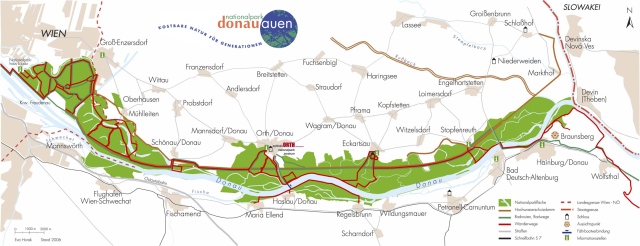
But none of this mattered, because the decision was not based on the meteorological situation, but on the calendar. My birthday is on 6th of July, and by tradition, I will travel to a new country on that day, preferably alone. As I am spending the summer in Vienna, Slovakia is the only nearby country that I didn’t know yet. There are trains, buses and ships to Bratislava, but those options I would retain for the return journey. Encouraged by a recently completed 24-hour hike, I briefly glanced at the map (Bratislava is just to the right of the map below) and thought: “I think I can actually walk that.” By doing so, I would also get to know the Danube Wetlands National Park.
This decision-making process began on 5th of July, in the evening, because oddly enough, the birthday had come quite as a surprise this year. To rule out the possibility of changing my mind the next morning and opting for a comfortable birthday in the rocking chair, enjoying a novel and some liquor, I immediately published the plan on Facebook. The rest of the preparation consisted in packing bread, salami, cheese, carrots and cigars.
On the 6th day of the 7th month at exactly 6:07 hours in the morning, I manage to leave the house, without enough sleep, but proud at being up so early. In the tram and the metro (because first I need to get to the right side, i.e. the north-eastern side, of Vienna), I realize that millions of people are already up and running, too. On the way to work, to the airport, to university or to the United Nations. And the national park would be so close. Isn’t it a daily temptation to leave the desk or the factory floor, to turn off the phone and to walk around the forest all day long? Apparently not.
The national park has mainly spread out along the northern shore of the Danube, and thus I choose that side. I want to walk through nature and not next to a road where – worst-case scenario – somebody nice could stop and offer me a ride, destroying my ambitious plan. The path starts on top of a dike, built to protect the hinterland from flooding. Here, I should be safe, even if it will be raining all day. Walking along such a dike is actually quite agreeable: there is no need to worry about orientation, there are no cars crossing the way and the elevation means more of a breeze and fewer mosquitoes.
And to me, as a Bavarian, anti-floodwater dikes even have something exotic about them. Coming from the region of Europe that is the farthest away from the sea, we only have potato fields, no levees offering views on ocean steamships.
Also along this dike runs the Danube Cycleway. Except today it doesn’t, because today it is being repaired and reconstructed, improved and impregnated. The floods are becoming ever higher (for example in 2013), not least because all the people whom I saw in the metro in the morning prefer to build ever more houses and parking spaces, rather than national parks. Thanks, you real-estate-loving petit-bourgeois philistines! Due to you, the construction workers now have to beaver away like crazy.
The first hurdle on my path appears after Schönau. It could be an indicator that I should turn around or give up, but that’s no longer an option, now that I have gotten up early. Also, the restoration of the dam might take years, and I am only in Vienna this summer.
“Well, where are you heading to?”
“To Bratislava.”
The two k. & k. land surveyors aren’t as surprised as I would have expected them to be. But then, it’s only a two-day march at most. And my backpack legitimizes me as a hiker, not as a saboteur of flood-protection works.
“The cycling path is closed for 30 km. You would need to walk a detour, on the road. But to be honest, that’s not as nice for a hike.”
“I really would have loved to walk through the national park,” I try to beg, not least because I notice that the civil engineer is rather understanding and nice. (On average, Austrians are nicer than Germans.)
“Oh well, then keep walking! But don’t run into any of our machines and don’t break a leg.”
With genuine thanks, I promise to stay safe and say goodbye. After a few kilometers, I even find a path that leads me from the cycling dike and into the forest. This particular national park is actually not very practical because there are hardly any useful hiking paths. Most of its paths are dead ends, leading the hiker astray and to his death.
Yes, death. I am not overly dramatizing. Close to the water and approaching the midday heat, flora, fauna and climate are like in the Amazon, with all the dangers of the Amazon: swamps,
quicksand, snakes, holes from which yet more snakes will jump out,
man-eating plants,
rats,
cockroaches, poisonous bugs,
and tarantulas.
Again and again, the path ends in the jungle or one step from the torrential Danube, throwing myself into which is a tempting thought in light of the swarms of mosquitoes. But I don’t know how to swim.
Finally, I spot a signpost. Civilization, at last! But as I get closer, I recognize the trap at the very last second: all three arrows point to the same town. That’s the kind of Indian trap that Karl May warned against! The careless hiker is supposed to be lured into an ambush, where he will be speared and barbecued.
I am too smart, of course, and choose the fourth direction, straight through the jungle. After a further hour of sweating and swearing, I reach the shore of the Danube again, this time even with remnants of a settlement. I am as jubilant as if I had reached Fordlandia after several days of marching.
The residents are all dead or have moved on, but they left behind the maximum of luxury that I could dream of for my birthday: a hammock.
Time for the first break. To Bratislava it’s about 60 km. I should be able to do that in 24 hours, actually. But if I want to walk through the night, I need to sleep a little during the day. I generally prefer this rhythm on multi-day hikes. That way, I need neither a tent, nor a sleeping bag. When it’s cold, I will keep moving to prevent freezing. During the day, I will sleep a few hours in a warm meadow, in the park or in a hammock. I am replenishing energy and warmth – and happiness and contentment along with it. You should give it a try!
Close to Orth, a small ferry beckons that would take me to Haslau on the south bank. A look on the map reveals that this is the only possibility to cross the river before the bridge in the very far east of the national park. Should I walk the next 15 or 20 km along the northern or the southern shore? I hadn’t planned that far. (Planning spoils adventure.) But because the cycling path is closed and because of the Amazon mugginess, I am already sick of the north. It’s time for something new.
“Are you the ferryman?” I ask the Hemingway standing beside the boat.
He confirms, ignites first a cigarette and then the engine. With 115 horsepower, he crosses just ahead of the steamer “Korsika”, sailing under a Lithuanian flag, drawing on the cigarette as unperturbed as if his little sloop could actually stop the huge freighter. The fun alone is worth the ride. “You ain’t seen nothing yet,” the captain replies. “In the bay over there, I got a 500-horsepower boat.”
By the way, if you are planning a hike in the Danube Wetlands National Park, the ferry goes every day until 18 hours, costs 4 € and can be called at 0664-421-0058 if you are stranded on the south shore and want to continue towards Orth. For me, it should remain the last motorized help on this hike.
Shipping traffic on the Danube is busy and international. The “Зеленодольск” from Ukraine is carrying steel. The “Rossini” is carrying passengers. Belgian, Romanian, Estonian flags are gliding past as if it was the Eurovision Song Contest. Downriver they are faster, obviously, but in both directions the ships are faster than I would have thought. My Atlantic-crossing cruises were lame ducks by comparison.
The south is indeed more civilized than the north. At times, I am walking on a path which almost looks like a Roman road. Could it be that this was once the frontier of the Roman Empire, with the Danube as a natural limes?
I am walking past several little houses standing on flood-protection stilts. Again, a clear Roman influence, copied from Venice.
Nobody is living in these houses, which seem to be used only on the weekends, for fishing and barbecuing. As a house-, home- and today even shelterless person, I find such weekend houses an injustice of epic proportions and a waste of living space. I always get the same feeling when my walks lead me through allotment-garden areas. There are houses which appear to me as absolutely adequate by size, facilities, comfort and location, often even beautiful. But while my vagabond colleagues and I are freezing to death under bridges or on top of railway freight cars, the bourgeoisie keeps a second palace warm for their orgies. That revolution, of which we are celebrating the centenary this year, apparently didn’t go far enough. But today, I am not in a revolutionary mood either and thus I walk past the huts without trespassing. In any case, it’s not raining, so I don’t need any shelter.
And life is more fun without a house and many other possessions. Wherever I like it, I stay. If I don’t like it anymore, I move on. Sometimes, people ask me if I don’t miss having a “home”, and I hardly understand the question. I have hundreds, thousands, almost unlimited homes in all the forests and on all the meadows and mountains of this world, from Lake Titicaca to the Carpathian Mountains. And all of that without realtors, mortgages and rental contracts.
The Roman road, temporary reason of hope for faster progress, sooner or later ends in the green hell again. Between Regelsbrunn and Wildungsmauer the path gets completely lost in the thicket. That’s what we get from these environmental and national-park ideas. If only the Romans would still rule here!
After Wildungsmauer, I give up and walk along the road until the landscape corresponds to the name of the village (“Mauer” is German for wall). For about one kilometer, I am dragging myself along a wall that reminds me of hikes in Great Britain. Could it be that Emperor Hadrian also did some construction work here?
Why is there a theater in the middle of the cornfield?
And what are the Tuscan poplars doing here?
I have indeed reached a Roman city, Carnuntum. Meanwhile, the city got married, though, and has one of those annoying double names. It’s now called Petronell-Carnuntum.
The amphitheater already looks perfect for spending a night. The wonderfully soft grass feels like velvet under the bare feet. Beautiful flowers instead of crazy jungle animals. An elevated point with a cooling breeze, but with protective pits for the night. And the rustling of the poplars.
Inside of the amphitheater, there is even a large tent, in case it should rain. It’s big enough to provide shelter even if other hobos should turn up. But then I realize that I haven’t seen any colleague all day. Ain’t nobody working as a vagrant no more? And the amphitheater could host 12,000, 13,000 or 15,000 people, depending on which of the information boards at the site to believe.
It’s just a bit beyond 6 pm, but dark clouds are pushing in front of the sun, as if in that exact moment, the Roman climatic optimum were to capsize into the climatic pessimum of the Migration period.
Here, I could fall asleep happily, but then I would be awake by midnight. Well, let’s first have dinner at this beautiful place! (A box of carrots may be cheap and healthy, but they make for a boring meal.)
As I am pondering my next steps, I can hear thunder. From afar, but now I understand why the wind has such a strong cooling effect: there is a storm coming up. I guess I better get moving again.
And that, esteemed ladies and gentlemen, was a mistake.
Having become wiser though experience, I can now give this advice: if you have found a dry and protected place, stay there, even if it’s too early in the day to sleep. You won’t find anything better!
But on the map, I had seen a few caves near Bad Deutsch-Altenburg, the next town, only about 3 km away. That’s where I wanted to seek shelter. Thus, I run through Petronell-Carnuntum far too fast and cursorily, past Roman museums, Romanesque churches and castles that are unfortunately closed.
On his hike, Patrick Leigh Fermor got invited into such palaces, and I shall not rest until I experience the same luck one day.
In the later afternoon I knocked on the gate of Schloss Deutsch-Altenburg – a wooded castle on the Danube’s bank. Friends in Vienna had asked the owner to put me up for the night and old Graf Ludwigstorff, after a kind welcome, handed me over to his pretty daughter Maritschi.
The rain is getting stronger, and I am getting faster to reach the forest at the shore of the Danube. There, I will always walk eastward along the river, hopefully without macerating, without falling into the Danube, and without being attacked by wild boar.
But then, something else happens. Something which comes as a complete shock!
You remember the plan to rest during daytime and to walk during nighttime, to cheat the cold? A smart plan, admittedly. I just hadn’t thought of one issue: at night, it gets dark.
“But of course it does,” you may now say, but it really isn’t that obvious. When you live in a large city for longer, you can easily forget about this because there are lights everywhere, even at night. In Vienna, you can sit in the park at night and read a book, that’s how bright everything is illuminated. But now, I am far away from Vienna, far away from parks, and far away from lamps. The big, round floodlight up there is suffering from lunar eclipse at the moment, and thus the sky turns grey at first, then dark green, dark brown and ultimately black. Pitch-black. And rain is pouring down like crazy. You remember the warning about thunderstorms? The meteorologists had been right. A gush, interspersed with lightning. The millisecond of light shows me how dangerously close to the river I am. A boar, a fox, even a rabbit that would scare me, all that could mean the end. When thunder and lightning strike simultaneously, I know that the celestial monsters are directly above me, as if they have been searching for the only soul who dared to venture into the dark forest that night. And at the back of my head, there is always the danger of flooding. One wrong step, and the birthday would become the day of death.
Some smarty-pants reading this on their couch is going to ask: “Why is this guy too stupid to pack a flashlight?” Well, I did have a lamp with me, but when you are walking through the forest alone, using a lamp makes you even more of a target for snipers. (After all, I was walking towards an external NATO border.) I only used the light once, to record this video. Watch out for the lightning just before I turn on the flashlight.
As I reach Bad Deutsch-Altenburg, the downpour gets even more intense. And it doesn’t stop anymore. For half an hour, I am hiding under the biggest and most protective tree in the park, but then the raindrops have worked their way through the foliage. Without my magic hat, rain simply isn’t enjoyable.
I am running through the main street. A restaurant and guesthouse is just about to close, with the staff hoovering. I inquire if there is still a free room. “Unfortunately not.” The gentleman and the lady see how soaking wet I am, they see that the storm won’t end soon, but they don’t think of inviting me to sleep on one of the benches in the bar parlor. In Montenegro or in Iran, this wouldn’t have happened, and I even would have gotten rakija or tea to warm up.
I keep walking through the old-German village, because the way to the caves is too dark, too wet and and too dangerous now, but at 10 pm, all the guesthouses are closed, all the windows dark. One hotel has a “we are there for you 24 hours” phone number, but nobody answers. This town really is the most useless hick town in Austria. I propose that it be designated for testing bombs and other ordnance.
Then I spot a lifesaver: a telephone booth. I am surprised that they still exist! But as I enter, I realize right away that its purpose is no longer telecommunication, but the breeding of venomous spiders (the very big ones with a cross). Not ideal for a long night. Rather wet and cold than paralyzed or dead.
The last resort is the train station. There is a small glass house on the platform, with a door even, thus protecting me against wind and water. One last train will pass by tonight, the S7 to Wolfsthal at 23:22. That would even be on my way and temptingly close to Bratislava. But first, that would be against the rules. Second, I don’t know if they have such a nifty glass house there, too. Third, I would miss the most beautiful part of the hike (insofar as I interpreted the map correctly). And there won’t be less rain in Wolfsthal either, maybe even more wolves. If it is still raining like in Noah’s story tomorrow morning, I will have to terminate this little excursion anyway.
After the S7 has left, the waiting room remains opened and illuminated. Thank you, Austrian Railways! So, that’s the way I am spending my birthday. Wet and cold, I don’t even feel like lighting one of the cigars. And there is nothing to drink in hicksville, either.
Around midnight, the rain is getting even stronger (it’s now at monsoon-level). If I had still been outside, I might have experienced a flood. Then I would only need an earthquake, and it would have been the perfect birthday.
Oh, the next train is already announced on the board: the S7 to Vienna at 6:11. Why are there no trains going at night, although the tracks are available around the clock? (For ideas like these, I should be rewarded with the Österreichcard.)
So what am I going to do all night? The seats aren’t made for lying down, and it will get colder every hour. A whole night without sleep was normal when I was a student or an attorney, but now my body finds this almost impossible. Luckily, I’ve got a book with me. Six hours of Habsburg history, that’s going to be tough.
Soon, however, fatigue prevails. I simply lie down on the concrete floor, with the backpack serving as a pillow. And I fall asleep immediately. It can’t be as uncomfortable as it sounds, because I wake up for the first time at 2:30 a.m. And I notice that it has stopped raining. Wonderful! But on the hard ground and without a blanket, I feel as comfy as in a bed, and I fall back back to sleep.
At 3:50 a.m., I feel more energetic. Or maybe I simply want to get away from this place. The birds are already chirping. I pack my backpack and step outside, into the dark.
The darkness is still treacherous. Next to this church, for example, I wanted to walk across the field. It looks like a shortcut, don’t you think?
Thank God, there was a fence, forcing me to walk around. Because when I reached the other side, I realized that there was a steep cliff just behind the church (maybe also built by the Romans, like the cliffs of Dover). With this perfidious plot, the little church is probably filling up the plots in its graveyard.
How many dangerous spots may I have stumbled past unknowingly last night in the dark? With my degree of luck, my next hike should go through a minefield.
Now, I can inform you that in Central Europe, the sun rises at 4:30 a.m. in summer and that you are wasting the best time of your life with each hour that you sleep beyond that. Especially today, which looks like it’s going to be a beautiful day!
At 6 o’clock I am already in Hainburg. Except for the nice views onto the Danube and to some castles on hilltops, I don’t get anything out of my early arrival because the stores haven’t opened yet. This is the last stop before Bratislava and I really cannot walk the last part of the way without a few liters of water. Looking for a petrol station, a supermarket or a highly motivated 24-hour fast-food place, I am walking around town. To no avail. Lidl and Hofer will open at 7:40, Penny at 7:30, so I still have another one and a half hours.
Well, let me take a closer look at Hainburg then. Between the three supermarkets, there is a plague cross, commemorating the plague of 1679. Probably, the black death could only spread because the markets were closed and nobody could buy medicine, vaccines or soap.
A building is entitled “Old Monastery”, although it looks more like the barracks for a whole infantry division. Generally, it is quite an imposing town which oozes the air of an erstwhile important garrison.
They also have an ingenious solution to protect the railroad from floods: the tracks are running on top of the old city fortification walls.
In front of the church, I finally find a fountain with drinking water. But unfortunately, I have already discarded my empty bottles. A grave mistake, costing me a few hours. Like a stupid rookie, how embarrassing.
The Penny supermarket really seems to benefit from the opening hours which are 10 minutes more generous than those of its competitors, because there is already a crowd of hungry people waiting outside. An old lady who keeps railing at her mini-dog and about last night’s rain (a matter on which I don’t object), doesn’t want to believe that I am hiking alone. “Isn’t that dangerous?” No, just wet.
I will need to be very careful once I get to Bratislava, she warns me: “The people there steal everything. You cannot even go outside at night, or you will be slain.” In the face of such dramatic prophecies, I cannot hide my amused disbelief. “Really, believe me,” the apocalypticist insists, “my daughter-in-law is Slovak.”
The supermarket opens, and the Austrian lady who is so afraid of her near neighbors puts her dog into the shopping bag. “I have to hide it, because the supermarket doesn’t allow dogs inside.”
Three liters of water and one bar of chocolate must be enough for the rest of the trip. Otherwise the budget would be blown.
As I am about to leave Hainburg, walking close to the Danube again, an older gentleman with his dog is waiting for me. He argues neither with his dog, nor rants about anything else, but greets me in a very friendly manner: “We have already seen you from afar and were curious.” I tell him where I am going and he is happy for me: “You have got a beautiful path ahead of you, although still quite a distance,” he smiles encouragingly. “But once you are in Bratislava, you can rest.“
I have experienced this phenomenon again and again: people who are generally more fearful, pessimistic or negative are also afraid of other people or foreign countries. People who are more positively, optimistically or happily inclined are rather excited by the new and the foreign. Sometimes, I have the impression that this general approach to life says more about someone’s opinion towards foreigners or refugees, for example, than their political leanings.
As expected, the happy man is right and the grumpy woman is not. Walking by myself is still not dangerous, but the path is the nicest section of the whole weekend. Far away from the road, from villages, from traffic, little paths are wiggling through broad-leaved forests, through passages hewn into the rock, and through a sea of dozens of shades of green.
And then there is a view compensating for all the stresses and strains, for the hard night, for stomping through the rain, for thirst and despair.
Here, I shall rest!
On the opposite river bank, that is already Slovakia, namely Devín castle. Here are – if you want to believe a story of kitschy nationalism – the roots of the Slovak nation. For centuries, Devín was a place of pilgrimage and projection for Slovak rebels and poets, who were working on the identity of the yet-to-be created state here.
In any case, the capital city should actually be here, not in Bratislava. But it isn’t. And thus, I still have a few hours ahead of me, less because of the distance (7 or 8 km), but because I am tired and the hot midday is approaching quickly and without remorse.
The border will disappoint all those who believe that borders are an essential thing (there are more people like that in Austria nowadays, except when it’s their turn to go on holidays). Here, I simply walk through the forest, without a fence, without barbed wire, without dogs, without border guards, without a passport, without a stamp, without a turnpike, without anyone shooting. The Slovak sign is still in the trees, the Austrian one has already been removed.
“What a scandal! Masses of immigrants can overrun us like that,” the angry woman in front of the supermarket would probably say. And the friendly man by the river would reply how beautiful it is that we are all Europeans now and that nobody gets shot anymore or has to drown in the Danube. Not even the rabbits are afraid of dying in crossfire.
On the Slovak side, I do actually spot some real border fortifications. But these couldn’t stop the German invasion in 1938.
Even the mightiest concrete bunker had no chance against the Munich Agreement. (If you want to see more of those bunkers, there is the Czechoslovak Fortification Museum.) Well, if only the Germans had been more patient and waited for two generations. Now, everyone who wants can walk to Slovakia, move there, settle there, and all of it without war and genocide. In the time between, for two generations, here was the end of Western Europe or Eastern Europe, respectively, an almost impenetrable border. Such serious thoughts are going around my mind when Bratislava appears for the first time, still farther away than my feet had hoped.
Such a hike is like a marathon. The last kilometers are the hardest. I should have stayed across from Devín castle all day long, under the shadow of the trees, watching the ships, sleeping a bit, reading and smoking, and only continued the walk in the evening when the heat has cooled down. But so close to the finish line, the Slovak capital works like a magnet.
And I don’t even know what to expect there. I run towards the first bench in a park next to the Danube. In a combination of exhaustion and pride, I am sitting in the shade with no energy left. The joggers, cyclists and skaters whizzing past must be wondering what type of sport I am doing that I am so knocked out. If only they knew that just the day before, I had left walking in the capital city of the neighboring country. Who on earth manages to walk from capital to capital in only two days? I challenge my readers in London, Paris and Rome to do something like that!
I notice that I am too kaput to enjoy Bratislava. Because I can always come here by bus or train in an hour, I am postponing exploring this city to a later point, and prioritize a trip straight to my bed. At speeds of up to 70 km/h, the Twin City Liner takes me back upstream in only 90 minutes. An expensive joyride (35 €), and almost too fast after hiking, but the cooling wind on deck keeps me awake, at least. And as I see all the shores and bays, the castles and forests from the center of the river in reverse order, it’s like the film of the hike is being rewound.
By the way: I was only in Bratislava for a few hours, but it didn’t look as if one would need to fear for life or safety there. The fearful lady could benefit from a bit of traveling. She wouldn’t even need to walk the whole way.
As we were cruising in her Volkswagen Golf, stopping at green lights and crossing red ones, she asked a straightforward question: “So, what do you want to do next in life?”
“Survive this evening without an accident,” I thought, but decided to answer in earnest.
Her eyes were getting tired, I noticed, and she was driving, so I stopped mid-sentence. “And you?”, I asked with an encouraging smile.
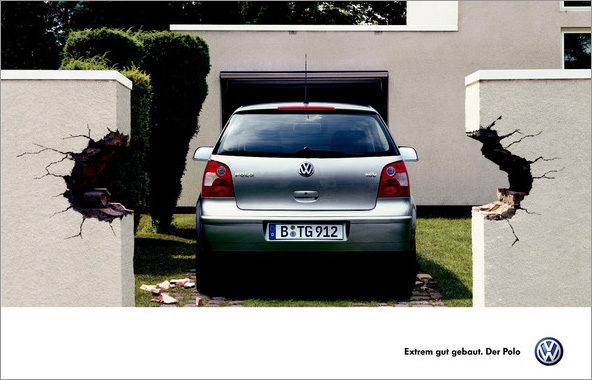
“I am looking for a job where I can earn more money, so I can rent a bigger apartment. And I would like to buy a Volkswagen Polo. The new one.” And, as if that would explain her choice: “In white!”
People sometimes ask me what would happen to society if everyone lived like me, not working a regular job and indeed working as little as possible.
They really needn’t worry. Because in my experience, the large majority of people are happy to sell their time and energy, in other words most of their life, to earn, spend and buy more, making corporations, employers and landlords richer and richer and richer.
For a perfect life, you also need one of those really ugly houses.
Apparently, studying at a distance-education university does not only mean that I can study from anywhere, but also that they are taking me on trips. As part of my studies in history, I’ll be going on a field trip to Poland, starting tomorrow. And of course we picked the Polish city steeped in history the most: Krakow.
The four-day workshop is called “Policies of memory and history in a Polish metropolis from 1900 to 1970”, encompassing anything from cultural history with art nouveau, Polski Jazz and a visit of the Wyspianski Museum as well as Jewish artists, the example of Socialist city planning Nova Huta, student protests and anti-Semitism in Poland after 1945. But I am not even sure if we are still allowed to discuss that topic in Poland now. In any case, the current debate just makes the seminar even more timely.
A large part will of course be taken up by the German occupation from 1939 on and by the Holocaust. We will visit both the city of Auschwitz and the former concentration camp Auschwitz-Birkenau. The former ghetto in Podgórze and the camp for forced laborers in Plaszów are topics as well, as is Oskar Schindler. As always, I got stuck with a legal topic, so I will present my thoughts on the question whether claims for compensation are a path or a hindrance to reconciliation.
In a way, I am surprised that I haven’t been to Poland yet. After all, it’s a neighboring country. – And even my grandfathers already visited or rather invaded it in 1939, trying to create Lebensraum for Germans, not having the slightest clue that only two generations later, their families would die out with me anyway. (And trust me, even the largest living space thinkable wouldn’t convince me to produce any offspring.) But I have always been curious about Poland, hence I am using this academic trip to stay in Krakow for five additional days, until 20 June. If I like it, I will return to explore more of Poland.
There is only one thing that worries me. When I find myself in places of mass murder, which is hard to avoid in Eastern Europe if you travel with open eyes, I prefer to be alone. I like to take my time there, reflecting and sitting in the forest or the grass for a few hours. That’s obviously not an option when I am part of a group of well-prepared students. We will see how that goes.
As always when I go on a trip, if you want a postcard from Krakow, just send me an e-mail.
Food is a big part of travel. For some people, it’s the most exciting part.
Unfortunately, food is the part of life in which I am least adventurous. I wish I was open to try anything once, but if somethings looks weird (seafood), if it is made from weird parts of the animal (boiled heads of sheep) or if it’s an animal that I never associated with eating (guinea pigs), I won’t even try it. I don’t think anyone is following my blog for its food section.
But there were two food shows on TV that I enjoyed watching: No Reservations and Parts Unknown, both with Anthony Bourdain.
From a food perspective, I liked his focus on simple dishes and on street food.
Because I don’t want to spend too much money and time on food, I often just sit by the side of the road and order a plate of whatever is steaming in a huge pot. Thus, I discovered falafel in Israel, arancini in Sicily and trancapechos in Bolivia. Each of them a better dish than what you get in fancy restaurants.
But what I really liked about Anthony Bourdain’s shows is that they went beyond the food and were actually far more serious than most other travel shows. He never annoyed viewers with the 100th show about the Eiffel Tower or the Louvre, but he went into the side streets, meeting up with people and always hoped that he would be invited to their home.
Yet, he managed to address serious issues, too, bringing them to an audience that might initially only have been interested in food. Like my blog, in a way, that strives to be far more than a travel blog.
Anthony Bourdain tried with all his might to teach people that the world is, first of all, not dangerous, but interesting, including the countries that often have a dangerous ring to them. I hope that message won’t be lost with the loss of Anthony Bourdain.
Because everybody seems to assume that his death was a suicide (or was it Russia, once again?), I should add some thoughts on that.
I am surprised by the number of people expressing their surprise. “He always seemed so full of life.” Actually, I always saw someone more thoughtful and somber. But even if someone was always outwardly happy and energetic, what do people expect? Do you think anyone who is fed up with life, or maybe just bored by it, has to sit in a corner, crying?
Another reaction that pisses me off is the jump to a “mental health issue”, often insinuating that he should have sought “help” and if he had done so, he would still be alive. It’s nobody’s bloody business if someone else wants to be alive or not. It’s their decision and their decision alone. The reason may not necessarily be a troubling psychological issue. The decision to end one’s life at a time and in a manner of one’s own choosing can be perfectly rational. I actually have a lot of respect for people who make that ultimate decision.
As always, people are looking for signs. “How could we have spotted it?”, apparently believing there is one tell-tale sign for someone harboring thoughts of suicide. There isn’t, and until people understand that not everyone thinks like them, they won’t ever be ready to spot those signs. If it’s possible at all. Because where someone sees a fulfilled life, someone else doesn’t. Where someone sees a point in living, someone else is bored. Where someone is afraid of death, someone else knows that suicide is the one decision you will never regret.
And don’t ever be distracted by someone’s “adventurous attitude” to life. After all, seeking out adventures (and eating crazy food) is a way of gambling with death every day and every dish. Sometimes, I have the feeling as if suicide by adventure is the only socially accepted form of suicide.
You agree on the monthly rent, the landlord gives you the key, you move in and pay the rent every month. If there is an issue, you call each other and talk about it.
Rental contracts in Germany:
Even for a small apartment, you need to apply with a CV, with references, with bank account statements, with your employment contract, with a credit check and a criminal background check. The landlord will still want two other people, preferably your rich parents, to co-sign as guarantors.
The landlord will only give you the key after you have paid a deposit of three months’ rent, the rent for the first month, a down payment for water, gas, electricity, garbage collection, road-cleaning fees, and will additionally request a power of attorney for your bank account.
There won’t be any furniture in the apartment, probably not even light bulbs. (If there is already a toilet, you hit the jackpot.)
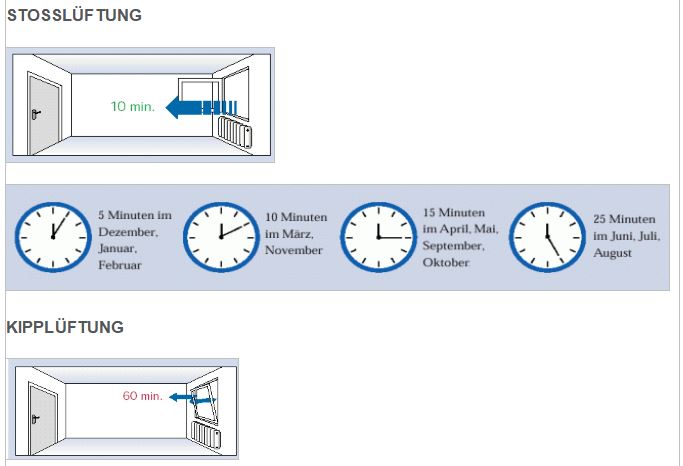
The rental contract will govern every step of your life. You think I am over-dramatizing? Trust me, I am legal translator for German and English and I often translate lease agreements. Today, I came across a section, in which the landlord gives unambiguous instructions about how often, how long and how far the windows should be opened.
And you can count on the landlord walking past the house every day to check on you. If you don’t meet the schedule, you’ll find a letter in your mailbox the next day, probably from an attorney at law, sent by registered mail.
Seriously, even if I could afford to rent something in Germany, I wouldn’t want to.
Finally, the General Data Protection Regulation (GDPR) has come into effect, and there is panic all over the continent, as if there hadn’t been any data protection laws in force until now. And it seems like everyone slept through the two-year preparation period.
I shouldn’t really be complaining, because as a lawyer and a translator for German and English, the GDPR is giving me work until late at night. On the other hand, I don’t really like work that much, because it keeps me from more important things. And I do find the whole situation very sad, with everyone lying to everyone else on the internet now: companies pretend that they care about your privacy and will protect your data. And users click on “Yes, I have read and understood the terms and conditions of this website/app”. Nobody has ever read those!
But what would you expect from people who put up gadgets in their bedrooms to record every spoken word (and other sounds) and to transmit these recordings to a company? People even pay for that! Or they buy overpriced watches to not only constantly transfer all of their private data, their current location at any time, but also their blood, pulse and liver scores to a corporation. Actually, it would be wrong to call that spy device a watch, because something that doesn’t work for 24 hours without the battery going dead doesn’t fulfill the most basic function of a watch. And you can’t imagine how many super-important business negotiations I could already listen to and how many Excel spreadsheets I could read on the train, because people with cell phones and laptops don’t ever seem to be able to wait until they get home.
Which of your data do I collect?
None. Why should I?
Of course you may/should post comments and those comments will be saved and displayed. That’s the point of comments. But I bet you already were aware of that before.
Very rarely, somebody has asked me to delete a comment they had previously written. Then, I usually only delete their name, but leave the comment there. Comments are like letters to the editor. If you change your mind after three years, the publisher won’t destroy all old papers.
Statistics
WordPress allows me to see how many people from what countries have clicked on my articles (hence the interesting list of countries/flags on the right). But I cannot attribute this information to certain individuals. Thus, I don’t know who of you is really reading my blog and who is not. (I usually learn that when people cease contact with me.)
In any case, I don’t check the statistics very often because they are rather depressing.
Cookies and Plugins
Oh yes, I probably have cookies and plugins too, because these buggers are all over the internet now. If you want to know what they do, you have to check with WordPress, Facebook, Twitter and YouTube.
In any case, I recommend to get vaccinated.
Objection
I hereby object to all comments and messages that are stupid, boring or trivial as well as those which disrespect the generally accepted grammar principles.
Noncompliance may lead to blocking, ignoring and loss of respect.
E-Mails
I don’t believe that A sending an e-mail to B puts any obligation unto B to respond to said e-mail.
It’s nothing personal at all (and how could it be, for I often don’t read them), but I simply don’t have the time to read all e-mails, let alone reply to them. But when I do reply, I want to take the time for a well-crafted letter, which is why you may sometimes be waiting for half a year. I recommend that you use the time for books and long walks.
Material for the Blog
Whoever interacts with me by e-mail, in person or otherwise, or walks into my metaphorical field of vision, even if unintentionally, or attracts my curiosity, has to be aware that they may find themselves as the object of an article on this blog or – inshallah, one day – a book.
That’s all?
Yes. Data protection is like buying a car or getting married: if someones hands you a contract of 20 pages at the last moment, you can be sure that they want to rip you off. I actually think that terms and conditions and privacy policies should be limited by law to two pages. Or users should be required to read out loud the whole text (but not on the train, please) in order to confirm that they have really read it.
A disorderly desk is the best data protection strategy.
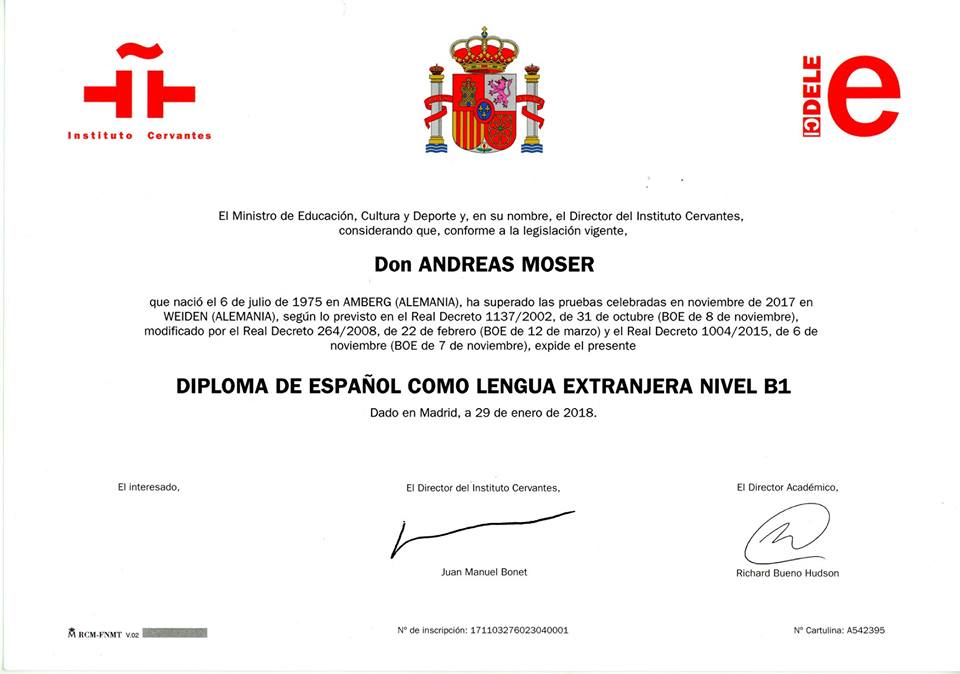
So, it seems I can speak Spanish now. At least at the intermediate B1 level. But considering that you only need A2 to obtain Spanish citizenship, that’s not too bad.
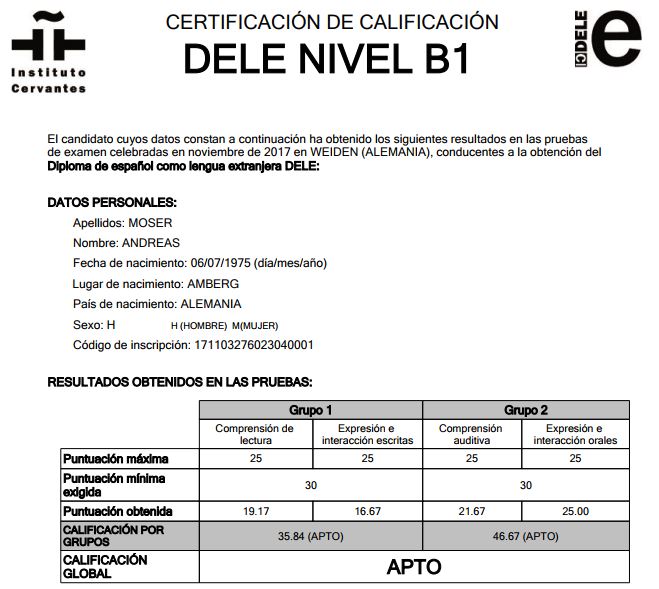
I was disappointed that I almost failed the written part. Maybe I completely missed the topic and rambled on about something else. But it may also reflect the way I learned Spanish: mostly by speaking and talking, not in any formal setting, although I did use the Assimil book.
That I got higher marks for talking than listening shouldn’t come as a surprise to anyone who has met me. ;-) Maybe I just got the full score because there was no other way to shut me up. Or the Instituo Cervantes recognized that I spoke with a Bolivian accent and thought: “How beautiful to listen to Spanish in its purest and most perfect form!”
But the B1 level is not yet enough to study at a Spanish-speaking university, so I have to continue. If only there were better TV programs in Spanish than those damn telenovelas…











 The Happy Hermit