Szerelmemhez
After the Lithuanian, Spanish and Romanian translations of my Valentine’s Day poem, I can now add a Hungarian translation, thanks to Judit Gábris.
…
A kérdés, hogy az igaz szerelem a véletlen műve e
avagy felkutatható
soha nem zavart minket,
mert mi egyik kategóriába sem tartozunk.
A mi történetünk teljesen más.
…
Úgy érzem, örökké ismerlek,
mégis még mindig újabb mélységeket látok benned
minden nap.
…
Te is ugyanúgy tudod
hogy bárki, aki azt mondja valakinek
“tökéletes vagy”,
hazudik,
vagy nagyon alacsoyra teszi a mércét,
és bárki, aki ezt el is hiszi,
bolond.
Egyik sem igaz,
és te sem vagy tökéletes.
…
De minden együtt töltött évvel,
ahogy együtt élünk,
együtt utazunk,
együtt nevetünk,
együtt tanulunk,
és birkózunk egymással,
Egyre mélyebben érzem, hogy nem a legfontosabb ember vagy az életemben,
Hanem az egyetlen.
…
Ezzel a kijelentéssel
Azt a tényt sem fogom tovább elhallgatni,
amit egyébkénk már mindketten úgy is rég jól tudunk,
hogy elég soká vagyunk együtt,
hogy néha el-elkalandozzon a figyelmem
egy-két másik nő felé.
Be kell ismernem, hogy 7 milliárd ember között
Akad néha egy-egy vonzó és érdekes példány.
…
De ha visszanézek,
e kalandok legtöbbje
csak időpazarlás volt,
túl soká húzódott,
Vagy eleve halálra volt ítélve.
Egyikük sem tudott igazán elválasztani minket.
…
Boldog vagyok
Hogy újra együtt vagyunk.
Boldog vagyok
hogy immár senki sem zavar minket.
Amikor egyedül vagyok önmagammal,
az egyetlen lénnyel vagyok, akivel igazán otthon érzem magam,
azzal az emberrel, aki megért,
Az egyetlennel, akinek társasága mindig öröm.
…
Andreas Moser

Breakfast Table
Every day the internet gets congested because millions of people upload photos of their breakfast: freshly pressed orange juice or coffee in which the chocolate powder forms a satanic sign. A healthy muesli or a swordfish filet. Eggs and bacon. Pizza and doughnuts.

I recognize five potential motives behind this prevalent habit:
- Some people’s lives are not very exciting or fulfilled, and breakfast may indeed be the highlight of their existence. Sad, but comprehensible.
- Some want to show off how healthy or how little (diet) they eat. But the healthiest breakfast is pointless if you get into the car instead of on the bicycle to get to work afterwards.
- Others, particularly recent arrivals to the middle class, want to show off how much food they have. Understandable after years of deprivation in the slum or the refugee camp.
- Single women taking a photo of an overladen breakfast table do so in order to signal: “Look, guys, I would have enough food to support a man.” Desperate and sad, the bad ending is foreseeable (short affair, accidental pregnancy, et cetera).
- Children, teenagers and young adults (up to their second university degree) post such photos to avoid their mother calling every day, asking “Have you already had a proper breakfast?”
When I see these photos, I always scream out in horror: “But where is the newspaper?” As far back as I can remember, the Washington Post or the Economist was a more important part of breakfast than oatmeal. All you breakfast photographers, don’t you read anything in the morning? What an uninformed start into the day! After all, the perusal of printed matter is what differentiates humans from animals.
Just as an example, this is how my breakfast table looked yesterday:
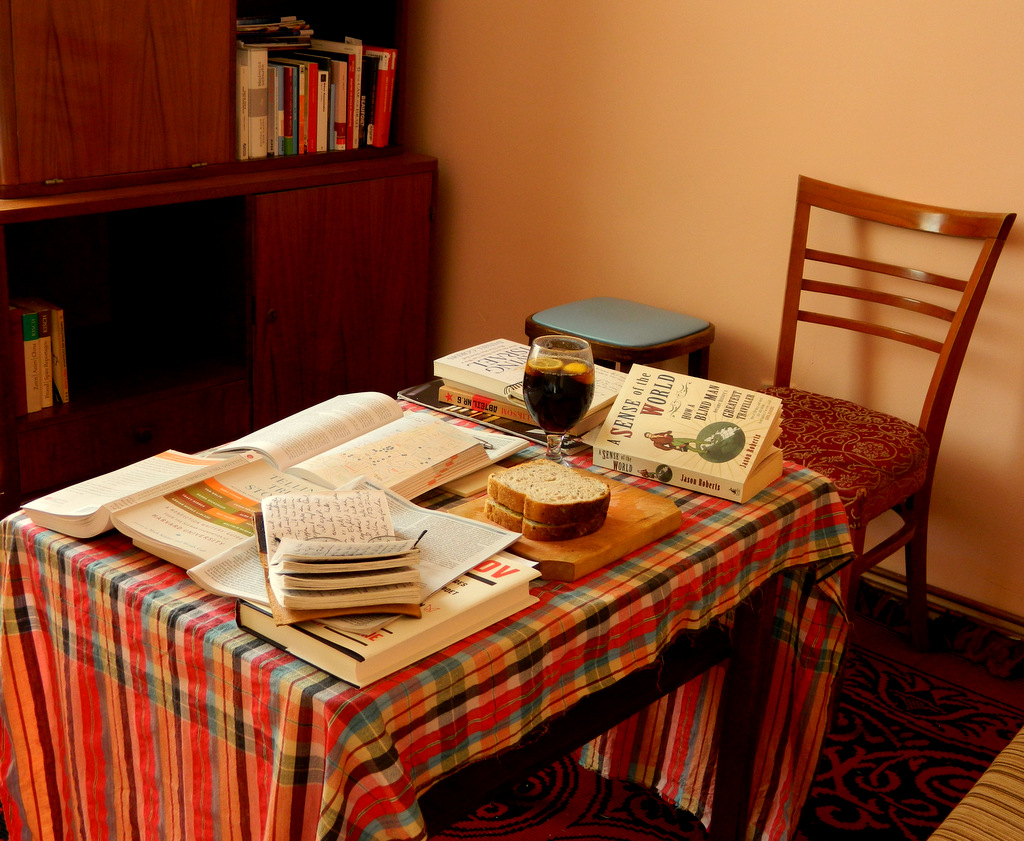

Rich in vitamins (hot pepper in the sandwich), refreshing (cola), but also intellectually nourishing. With a few hours of reading for breakfast, you will approach your day with much more creativity and filled with new ideas.
Enjoy your breakfast!
Snowplow Train
It snowed all night and several feet of snow threaten to paralyze train traffic?No problem: you dispatch the snowplow train and after it crossed the country once, all the other trains are good to go to work as well.

 (Photographed in Gheorgheni, Romania.)
Pentru iubirea vieții mele
After the Lithuanian and Spanish translations of my Valentine’s Day poem, I can now add a Romanian translation, thanks to Cristiana Boicu.
…
Controversa conform căreia iubirea este rezultatul purei întâmplări
sau chiar poate fi găsită
nu a rezonat niciodată în cazul nostru,
pentru ca noi nu ne încadrăm în niciuna dintre aceste categorii.
Povestea noastra este una complet diferită.
…
Știi la fel de bine ca și mine
că oricine spune altcuiva
„ești perfect”
minte
sau are standarde foarte modeste
și că oricine crede asta
este naiv.
Noi nu suntem nici una, nici alta
și nici tu nu ești perfect.
…
Dar cu fiecare an pe care îl petrecem împreună,
pe care îl trăim împreună,
în care călătorim împreună,
în care râdem împreună,
în care învățăm împreună,
în care ne luptăm unul cu altul,
îmi dau seama și mai mult ca tu nu ești cea mai importantă persoană din viața mea –
tu ești singura persoană importantă din viața mea.
…
Făcând această declarație,
nu trebuie să ascund faptul,
de care suntem amândoi dureros de conștienți,
că suntem împreună de suficient timp
pentru ca eu să fi fost distras
de o femeie sau de alta din când în când.
Ce-i drept, într-o lume în care trăiesc 7 miliarde de oameni,
se găsesc câteva atrăgătoare și interesante.
…
Dar, privind în urmă,
cele mai multe dintre aceste legături
au fost o pierdere de vreme,
au durat prea mult timp
sau au fost sortite eșecului încă de la început.
Niciuna dintre ele nu a putut să ne despartă cu adevărat.
…
Mă bucur
că suntem din nou împreună.
Mă bucur
că nimeni nu ne mai tulbură
atunci când sunt singur cu mine însumi,
singura persoană cu care mă simt cu adevărat tihnit,
singura care mă înțelege,
singura de care nu mă satur niciodată.
…
Andreas Moser
Para El Amor de Mi Vida
My Valentine’s Day poem has been translated into Spanish – by a translator who wishes to remain anonymous. Thank you very much!
…
El debate sobre si el amor verdadero es resultado del azar
o si puede buscarse
nunca nos afectó,
porque no estamos dentro de ninguna de estas categorías.
Nuestra historia es del todo diferente.
…
Siento que te conozco desde siempre,
y, sin embargo, aún sigo comprendiéndote mejor
cada día.
…
Sabes tan bien como yo
que el que le diga al otro
“eres perfecto”
miente
o se pone el listón muy bajo,
y que cualquiera que se lo crea
es estúpido.
Ni somos nada de lo anterior
ni tú eres un ser perfecto.
…
Pero con cada año que pasamos juntos,
que vivimos juntos,
que viajamos juntos,
que reímos juntos,
que aprendemos juntos,
que luchamos con el otro,
me doy cuenta de que no eres la persona más importante de mi vida –
eres la única persona importante de mi vida.
…
Y aún mientras declaro lo anterior,
no debo obviar el hecho
del que ambos somos tristemente conscientes:
que llevamos juntos el tiempo suficiente
como para que yo me haya distraído
con una u otra mujer de vez en cuando.
Ciertamente, en un mundo de 7 billones de personas,
existen unas cuantas que son atractivas e interesantes.
…
Pero, echando la vista atrás,
la mayoría de estas historias
fueron una pérdida de tiempo,
duraron demasiado
o estaban condenadas desde el comienzo.
Ninguna de ellas realmente logró separarnos.
…
Me alegra
que estemos de nuevo juntos.
Me alegra
que nadie más nos vuelva a molestar
cuando estoy solo conmigo mismo,
la única persona con la que de verdad me siento cómodo,
la única que me entiende,
la única de la que nunca jamás me canso.
…
Andreas Moser, 14 de febrero de 2015
Hungarian Runes
As if Romanian and Hungarian wouldn’t be hard enough already, I have discovered a third alphabet, hitherto unknown to me, on street signs in the Szeklerland in Romania.
 The writing directly above the arrow is in Old Hungarian script, also called Hungarian runes or Szekler script.
This script, which consists of 45 characters, is read from right to left. It is believed to originate from Turkish or Siberian runic script and dates back to the 8th century. Because this runic script has a character for each of the Hungarian sounds which are unpronounceable to the rest of the world, it is actually better suited for Hungarian than the Latin alphabet. Hence there are indeed voices which seek to reintroduce this ancient script for current use. The translators at the European Union institutions will be happy.
Here is the complete alphabet, just in time for the next trip to Hungary:
 (I took the photo in Gheorgheni in Romania. – Hier gibt es diesen Beitrag auf Deutsch.)
Spring with a Cat
The internet is asking for photos of cats. Cats you shall receive.
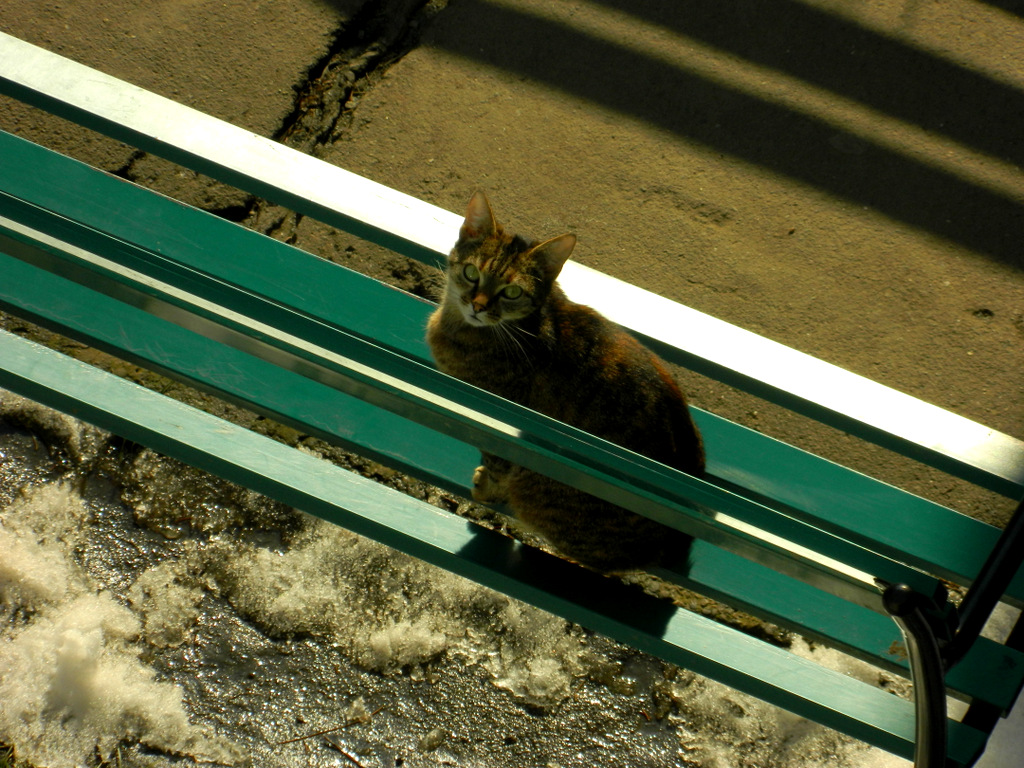
The snow is melting. It is sunny and warm enough already to spend at least the noon and the afternoon parts of the day outside, reading a book. This cat thought the same, minus the literature part, and made itself comfortable below my balcony.

Once the cat realized that I had taken a photo, it didn’t look away for a few minutes.
Necropolis – the City of the Dead
Cities in Europe are becoming more and more similar. The same shops, the same fashion, the same films in cinemas, the same restaurants, the same music, the same food.
To escape this mishmash, I like to visit cemeteries, where time trails 50 or 100 years behind and each country still has its own traditions. In Bari I discovered a cemetery which was larger than some towns I had lived in before. A veritable city of the dead. And that is exactly what it said on the sign next to the splendid entrance: Necropoli.


And the cemetery is indeed divided like a city. Tree-lined boulevards and roads crisscross the realm of the distant past.
In the center, there are pompous buildings and palaces, with graves that are nicer and larger than the apartments of some of our fellow citizens who are still alive.


This is contrasted by the rows of prefabricated houses. Here, the dead are piled on each other in five rows, each of them in a stone tomb of exactly the same size. Probably a project suggested by the Socialist or Communist Party.

In these parts of town, you even have to share the stairs with the whole neighborhood.
 Meanwhile space is becoming scarce, so that the city of the dead needs to accept multi-storey buildings as well. From the outside, these houses look like regular apartment blocks, but if you dare to glimpse through the window, you see the corpses piled up to four floors high.

Conveniently with chairs for visitors who are waiting for one of the apartments to be become ready to move in.
 Even in the basement you won’t find bicycles or collections of comic books, but – you may guess it already – the ancestors who have left us.
 There is clearly a trend towards the individual grave though, at least among those who can afford it. Please take note of the crane in the background as evidence of ongoing expansion.

The photos posted on the graves which you can see in this newly developing area are no new trend however. In Italy this was already done 100 years ago, although the old photos have more style and are more favorable towards the deceased. It shows that people used to hire a photographer instead of simply snapping a selfie with a mobile phone.
 Sculptors also used to be more busy.


Like in any other city, there is the odd neighbor whose lapse of taste provides fodder for conversation and who makes it easy to describe to friends how to find your place. (“Turn right after the ugly pink glasshouse.”)

Speaking of finding your way: everything is most organized. Signs indicate in which section and in which sector you are and which apartment numbers you can find in the building in front of you. Cities with numbered streets like Manhattan and Mannheim probably got the idea from this cemetery in Bari.
 And if you ever get lost, you simply ask for the police station, where you will gladly be helped (although everyone was dead when I stopped by).

The old (not only) Italian tradition of forcing Jews to live in a ghetto is also applied after their demise.

Here the tombstones are significantly smaller, which must come as a disappointment to the Jews-control-all-the-financial-institutions-of-the-world conspiracy theorists.

And even a Pharaoh is buried in Bari.
 Some of the more immobile inhabitants may deem the sign pointing to the exit as cynical, but to me it indicated the path back into the present after hours of promenading through this city which was, particularly for Italian circumstances, singularly calm and devoid of traffic.

 The city of the dead seemed to have everything, until my stomach told me what was missing: a pizza place.
To the Love of my Life
A very personal revelation for Valentine’s Day:
…
The debate whether real love is a result of chance
or whether it can be sought
never resonated with us,
because we fall in neither of these categories.
Our story is a completely different one.
…
I feel like I have known you forever,
yet I am still getting to know you better
every day.
…
You know as well as me
that anyone who tells someone else
“you are perfect”
is lying
or has very low standards,
and that anyone who believes it
is stupid.
We are neither
and nor are you perfect.
…
But with each year that we spend together,
that we live together,
that we travel together,
that we laugh together,
that we learn together,
that we struggle with each other,
I realize more that you are not the most important person in my life –
you are the only important person in my life.
…
In making this declaration,
I should not withhold the fact,
of which we are both painfully well aware,
that we have been together long enough
for me to have been distracted
by one or the other woman from time to time.
Admittedly, in a world of 7 billion people,
there are a few attractive and interesting ones.
…
But in retrospect,
most of these affairs
were a waste of time,
went on too long
or were doomed from the beginning.
None of them could really separate us.
…
I am glad
that we are back together.
I am glad
that no one else disturbs us anymore
when I am alone with myself,
the only person with whom I feel really comfortable,
the only one who understands me,
the only one of whom I never grow tired.
…
Andreas Moser, 14 February 2015

 The Happy Hermit