
In Sicily, even the graffiti sprayers are religious.

In Sicily, even the graffiti sprayers are religious.

Quite a number of readers have come to this blog through AllExperts, where I have been answering questions on German law for a decade. With more than a thousand thoroughly answered questions, my profile there was a great source of information on all aspects of German law.
But it ain’t no more.
Why? I don’t know. All I got was this e-mail with a few days’ advance warning that the site would be shut down.

No explanation was provided, even when I asked for it. Stupidly and annoyingly, AllExperts even made all previous answers inaccessible, proving my point that one should never rely on a free service like Facebook or Google for business communication. At the whim of a madman, everything can be taken offline. Come to think of it, maybe I should stop blogging and only write books from now on.
For those who still have questions, I point you to my ever-expanding list of FAQ:

If there is anything else of particular interest to you, legal or otherwise, please let me know in the comment section below. If I notice a lot of demand for one particular subject, I will prioritize it, so get your friends to weigh in, too.
Bogotá is actually quite green for a large city, but I wanted only nature, without the city. So I rented a little house north of Colombia’s capital, which I reached on smaller and smaller roads, shared with a surprising number of cyclists, past gentle hills and meadows with cows. The last kilometer went straight uphill, like to a mountain hut.


It is situated between Tenjo and Chía, both towns 6 km away, or, as the owner said “one hour and twenty minutes on foot”. And you better don’t come home too late, for there is no light in the whole valley after 6 p.m.
Also, at an altitude of more than 2700 m, it may get cold at night.
But when I spotted the literary corner, I was excited.

And what an impressive selection awaits me in this remote cabin: Immanuel Kant, Sigmund Freud, Hermann Hesse, William Shakespeare, Jean-Paul Sartre, Robert Musil, Viktor Frankl, Mahatma Gandhi and of course the Colombian Gabriel Garcia Marquez. Most of the books are beautifully bound editions from the 1930s to the 1950s. There must have been an intellectual hiding in the mountains at that time.

There is even a comprehensive history about the Gestapo,

bookmarked between pages 368 and 369 by the ticket for a bullfight on 3 February 1968.

Somewhat more unsettling was the Spanish translation of Joseph Goebbels’ diary,

the reading of which was however already aborted on page 46, judging by the bookmark.

The bookmarks are receipts issued by Remington Rand, one of the first computer manufacturers, and dated 1955. What was going on in the Colombian mountains back then? Very mysterious.
On my desk, please note the sufficient stock of cigars on the right. When cigars cost only 0.17 dollars a piece, you don’t need to hold back.


“What about the pistol next to the computer?” you are wondering. That came with the house, too. The ammo is stored under the staircase.

But the first evening came to a peaceful end, overlooking the valley. The green colors had been intensified by recent rainfall and were glistening in the setting sun.

The Freakonomics podcast “Is college worth it?” was sadly centered on the economic returns of studying and on US colleges, but one student of economics and philosophy had this universally applicable answer:
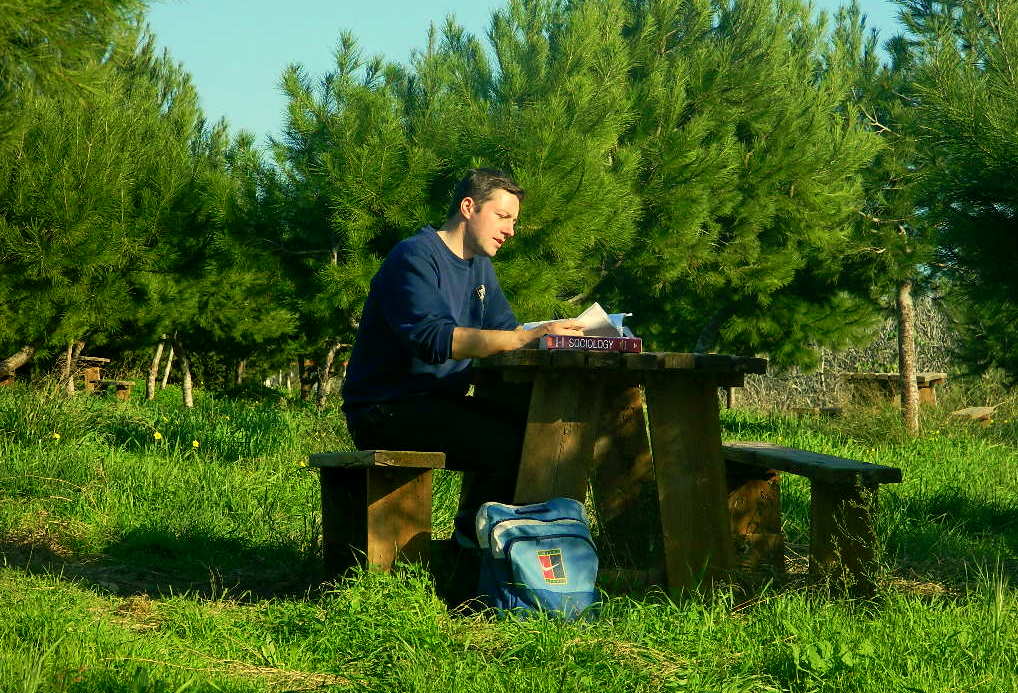
If a bunch of people from the community sat in a park every day for three months straight and just exchanged books and had lectures, we’d learn much more than we had in three years here.
That’s a very good answer. Of course it depends on the university, the specific degree, the professor, but this student has a valid point.
Sure, you will know more after studying for three or four years than you knew before, but the real question is if you learned more than you would have learned on your own – or by other means – in the same time. I dare to say that most universities probably fail that test.
“If the forest grows, the motherland will prosper” or something similar is written on this sign in Transnistria.

Breaking into this house does not even require the skills of John Robie aka “The Cat” in the Hitchcock film To Catch a Thief.

(Spotted in Trani, Apulia, Italy. The exact address will be shared for a stake in the loot.)
I don’t really need a million dollars. I wouldn’t know what to do with it, so used to my thrifty lifestyle have I gotten.
But if I ever need to earn $ 1,000,000, I will do it exactly like this:
Zur deutschen Fassung der frohen Osterbotschaft.
My recent article about South America contained a passage that was critical of religion. Some of my religious readers may have thought: “Well, that’s the atheist exaggerating again.”
But in no way and never do I exaggerate.
To underline my point, all I had to do was to leave the house on Saturday afternoon. I had already endured three hours of singing, drumming, dancing and trumpeting, but the procession passing by just wouldn’t stop.
The Easter march was in full swing. In the few minutes alone which I dared to place myself in the stream of people apparently possessed by the devil, thousands of people clad in white where whizzing past me.

In the three hours before, there must have been tens of thousands. I mention this because after reading the following descriptions of a few of the absurdities I witnessed, some will want to assuage: “But that’s only a small minority.” No, it is not.
The hats said “Cristo viene pronto“, “Jesus will come soon”.
Theologians among my readers sometimes criticize me for using a rather simple image of God and prayer, which is then easy to criticize. Well, what am I supposed to do when millions of devout Christians (and their pastors!) believe in and preach exactly that simple image?
But let the Christians speak for themselves.

This gentleman expresses his gratitude because Jesus paid off his debts of 7000 dollars and gave him a car. He also proclaims publicly that his whole family is looking forward to the “glorious rapture of Jesus”. He did however misspell “rapto“, giving further credence to my argument that education and religiosity don’t go together well.
Whether the other people in the crowd were disappointed that Jesus hadn’t given them a car too, I couldn’t find out, for the ladies, gentlemen and children were just shouting “Jesus lives” and “Jesus is coming soon” all the time.

This lady thanks Jesus for having operated her head and for being fine now.
The next lady remains similarly vague, but in addition to migraine recounts rheumatism, stomach pain and a messed-up family, all of which God put in order.

That claim I found rather fabricated. After all, stomachache is often cured by a night of sleep, coca tea, Coca Cola, a cigar or the evacuation of the bowels. Unfortunately, constipation in the brain cannot be removed that easily.

This gentlemen thanks Jesus because his spine is in order again, which was oddly incongruent with his vehicle of choice. But logic was not widespread that day.
If you don’t know more than I used to know, you also stumbled across the term “rapture” above. As far as I understood, this is an act by which God and/or Jesus rips people from their lives and transports them to heaven. Physically. Apparently, this is connected to the fact that Jesus is coming soon.
I was handed a pamphlet with the headline “WARNING!!!”, according to which Jesus, “the king of kings” will come soon. It also asked me whether I was prepared for that.

For those who are, like me, totally unprepared for this heavenly event, there are further instructions on the back which are “URGENT!!!”.

It further says that “millions of people will soon disappear from the face of the Earth” and that this process has been going on since June 2015. Since then “many paranormal things are happening and the Lord has prophesied to many people that Jesus will come soon”. As a non-local, I also found the information helpful that this would “not only happen in La Paz, not even only in Bolivia, but in the whole world”.
The eerie thing is that there are indeed a lot of people disappearing in Bolivia, but that’s not what the Christians mean. Instead, they point to lame people who can walk, blind who can see, cured terminal illnesses, those liberated from “dirty spirits” as well as “restored homes”. Then they draw our attention to the church-owned TV and radio stations. (Thanks to the donors from overseas who think they are supporting an orphanage.)
But at the end of the pamphlet, even the Bolivian Christians prove that they have the Bolivian sense of humor. “NOTE: We do not know on what day and at what time the rapture will take place.” Not that Bolivians would be punctual, even if they knew the exact rapture hour.
Talking about humor, there was one odd guy in the sea of millions of people in Klan colors.

People praying and screaming themselves into a trance, all of them in white, proclaiming that they are ready for God removing them from this Earth as soon as possible remind me of ISIS and other jihadists. Maybe it’s the lack of jihadism in South America that makes Christians fill this void.

In the evening, all of them got together for an Easter show in front of the cathedral that was so crazy that it gave me the creeps.
Links:
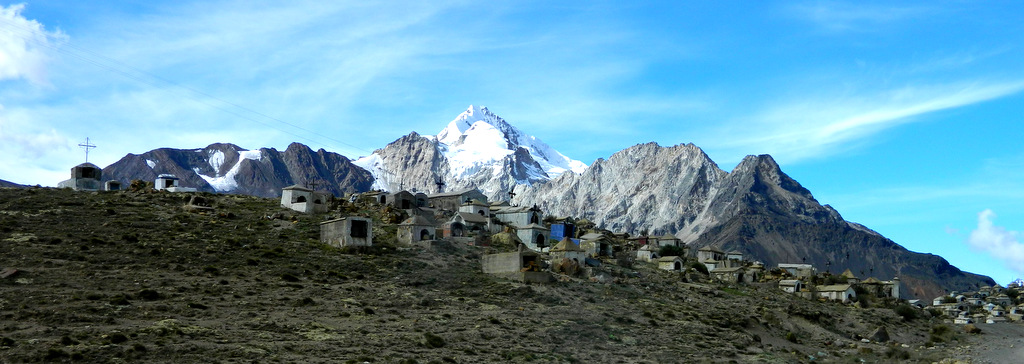
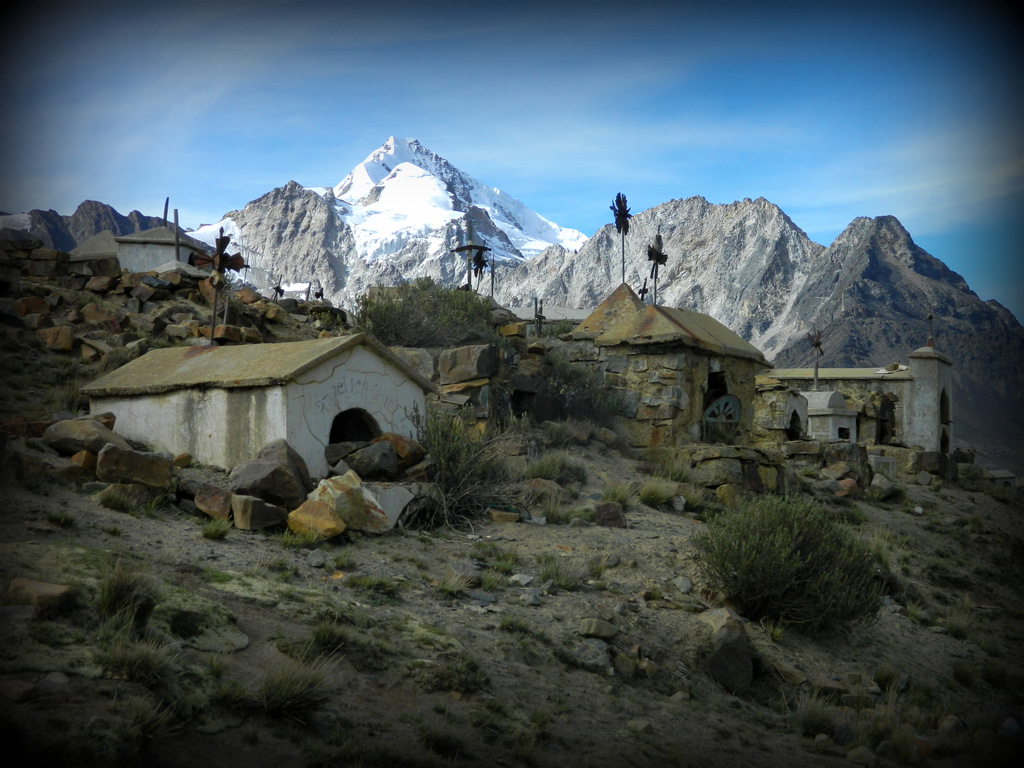
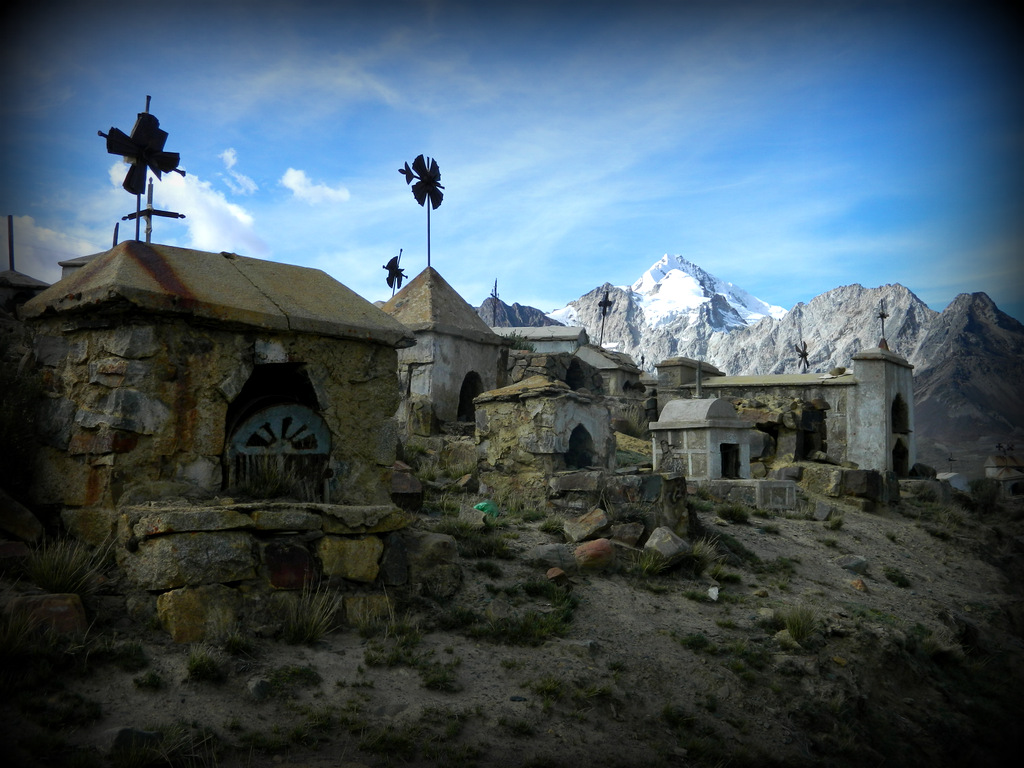
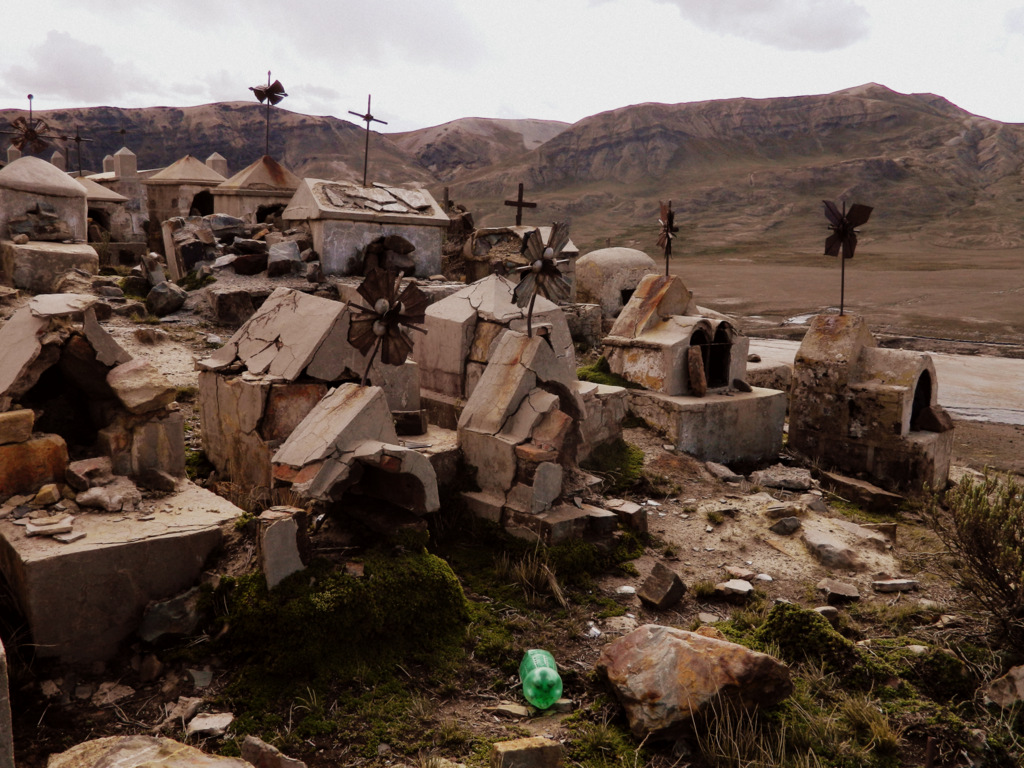
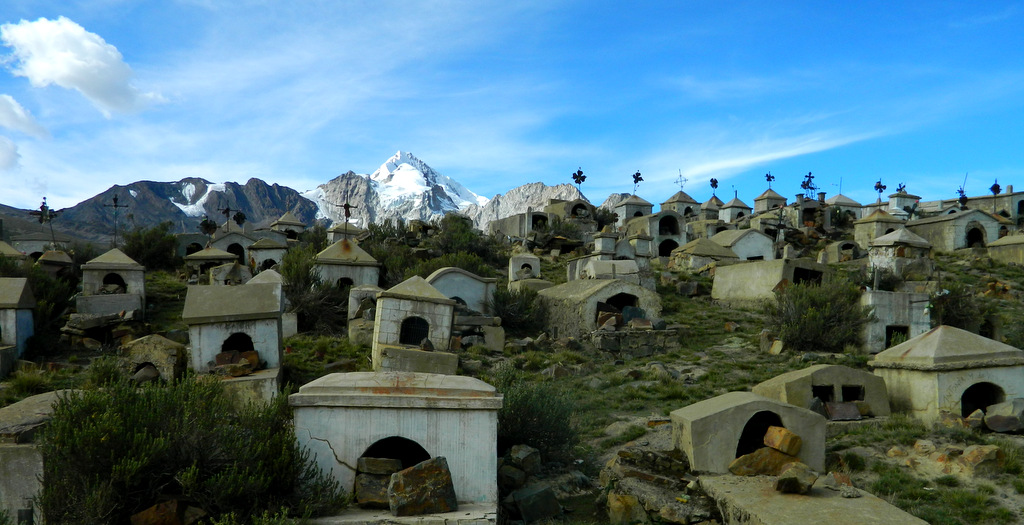
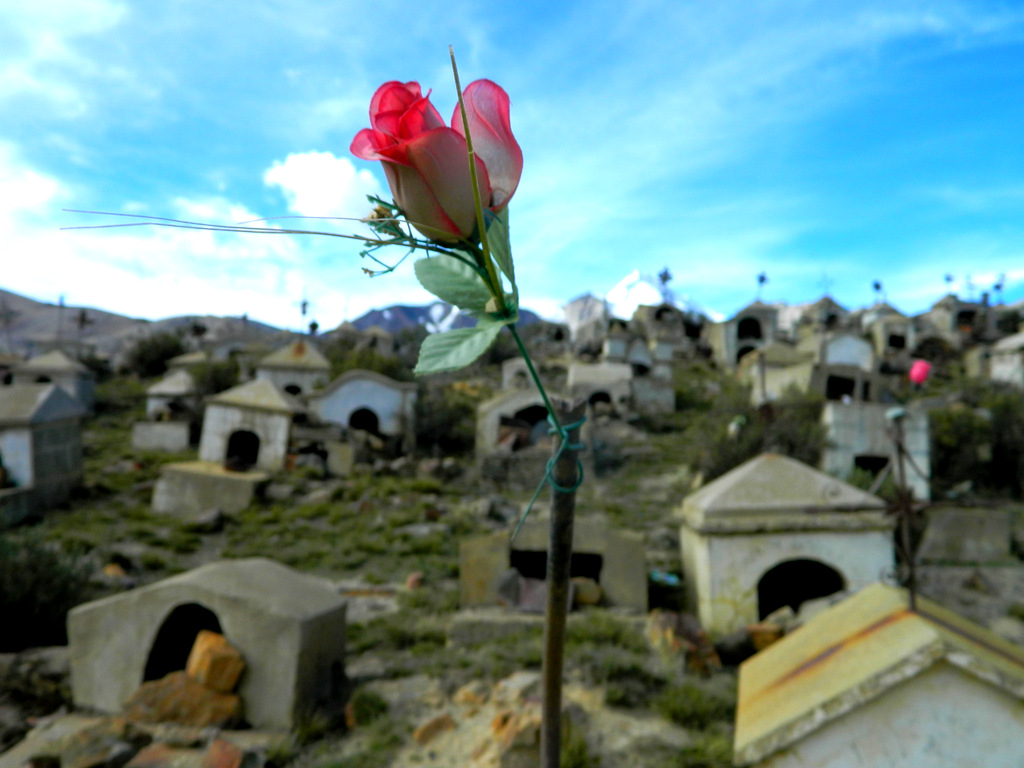
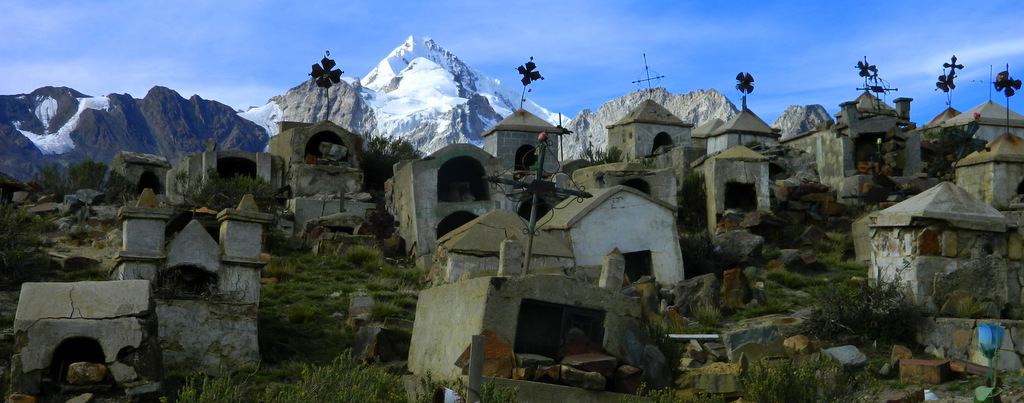
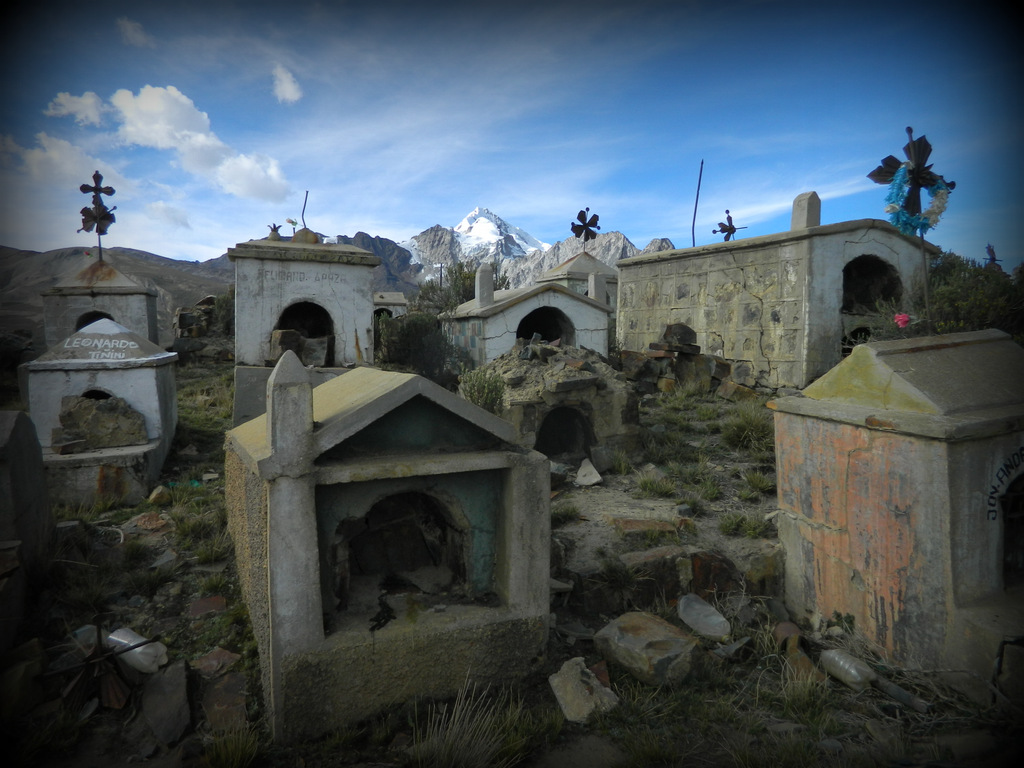
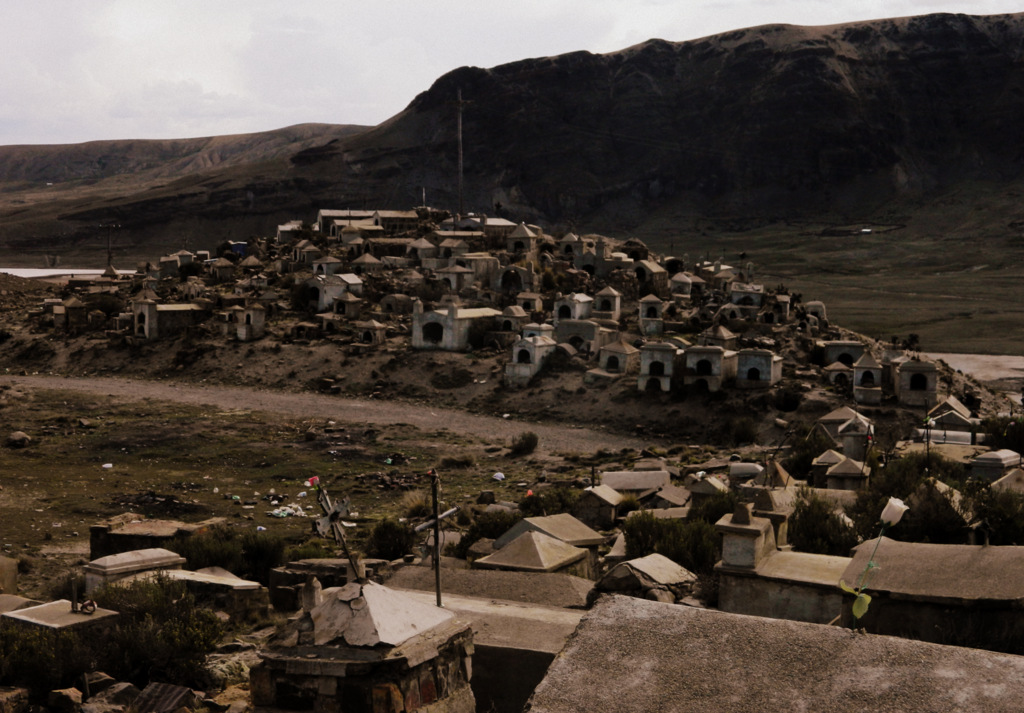
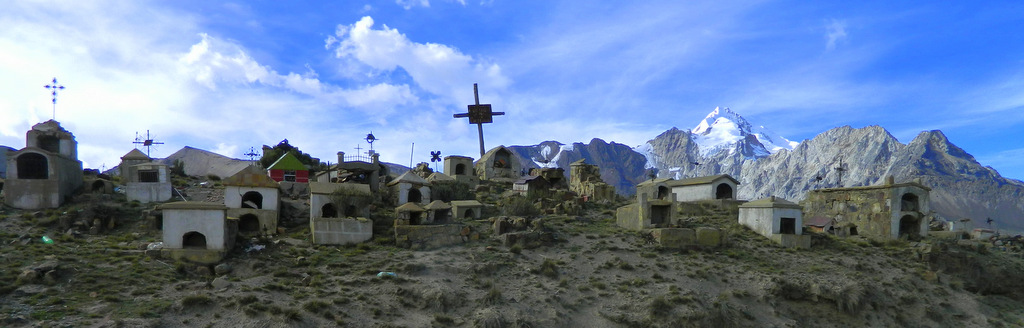
In my article about Chacaltaya, I mentioned the cemetery I found at the foot of Huayna Potosí and made the offhand remark that the whole village of Milluni had died.

It turns out that this was right, but that the true story is even more brutal. In 1965, miners were on strike and they had established something like an opposition base against the Bolivian government, even operating a radio station that broadcast to nearby La Paz. The government (it was one of the many military dictatorships in that country’s history) sent in troops, tanks and bombers, perpetrating the “Massacre of Milluni” on 24 May 1965.

So, even though this cemetery is a beautiful place, keep the history in mind when looking at more of the photos I took there.
Addendum:
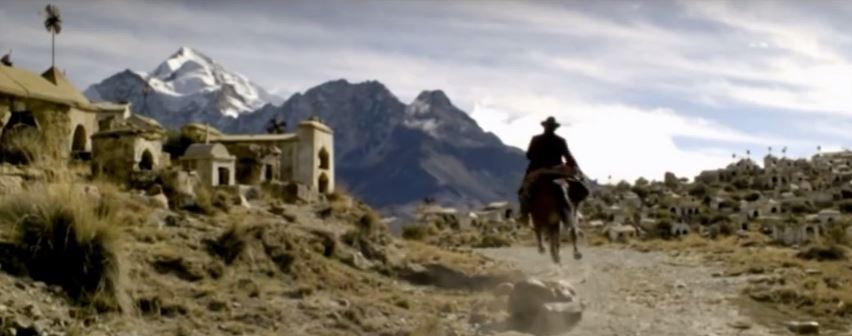
This eerie cemetery is one of the locations in Blackthorn, a Western movie filmed in Bolivia.

 The Happy Hermit