Less or Fewer? A Company Name gone Wrong

Today at LSE library, I noticed an advertisement at the inside of a toilet door (the location might have been a foreboding) for a company that offers proofreading services: “Less Silly Errors: Proofreaders of Academic Essays”:

Obviously, this company wanted to profit from the aura of somehow being associated with the abbreviation “LSE” but if you are trying to sell your expertise as a proofreader, this is a company name gone badly wrong.

“Less” is used when referring to something that cannot be counted (unless measured in units) or doesn’t have a plural. “Fewer” is used for nouns in the plural.

Examples: I spend less time on the internet than before and have to deal with  fewer e-mails than I used to. – I have less money now than when I used to work as a lawyer but I also have fewer sleepless nights.

“Errors” can obviously be counted, so it should read “Fewer Silly Errors“. The abbreviation “FSE” wouldn’t associate the company with the London School of Economics, but with Feline Spongiform Encephalopathy, which might be more appropriate.

I recommend this company for a prize for “Maximum Incompetence already displayed in the Company Name“.

If you want serious academic writing, proofreading or editing, you do better to e-mail me for a quote.

In the interest of journalistic fairness, I have contacted “Less Silly Errors” and invited them to comment. They responded by asking me if I want to work for them. I declined.

But three years later, in June 2014, I got this message from “Less Silly Errors”:

Hi Andreas,

It’s been three years now and your post is harming my company’s visibility in search engine result pages.
 
 
If you take the name literally then you are correct. I am an American so I don’t follow your literal mindset. You are incorrect in the intended sense. The name is a play on words intended to signify the tutorial feedback provided i.e. logical reasoning, premises, thesis, structure advice. Seriously, it’s the less obvious errors that students make!
 
It’s a bad name because some lawyer has posted a high ranking post incorrectly attacking the company name without considering that the company is someone’s sole source of income.
I respectfully request that you take this post down, please?
 
Many Thanks for Your Help,
Matt
Matt
LSE Proofreaders

I assume Matt heard about the ECJ’s ruling on “the right to be forgotten”, not that it applies in this case because he is still using the same company name, so nothing is outdated or obsolete. – In any case, he didn’t make an offer that I couldn’t refuse.

Posted in Language | Tagged , , | 8 Comments

Hadrian’s Wall Path – My Advice

After having walked the Hadrian’s Wall Path in June 2011, I have some practical advice for anyone who is thinking about doing the same, especially fellow wild campers:

  1. Take as little as possible with you. This is the single most important advice. One extra kilogram to carry might not sound much, but 1 kg to carry for 135 km is a lot.
  2. I would strongly advise against taking too much food with you. I made that mistake and it was a big contributor to the (superfluous) weight. I ended up throwing some cans away because I was fed up with carrying something every day that I would use in 3 or 4 days. If you are camping wild, you have to take a bit of food with you because in some stretches, pubs are rare, but don’t take heavy food like cans. Take bread and sausages or chocolate for which you don’t need a stove.
  3. If you are camping, do however take warm clothes. Even in summer, it was terribly cold at night. The highest point of the Hadrian’s Wall Path is 345 m and the winds up there can be fierce.
  4. I used the guidebook from the Trailblazer series which has very detailed and helpful maps, information on all the places to eat and sleep, and even bus timetables if you don’t want to walk every stretch.
  5. If you do not plan to camp wild, this is enough. If you do want to camp wild, you’ll need to leave the immediate stretch of the Hadrian’s Wall Path and you might find the OS Explorer maps 85 through 88 useful.
  6. Don’t try to set a record. It took me 4 days to walk the whole 135 km, but I got up and started walking at 0300 on one day and walked until 2300. That’s not exactly a holiday. Also, don’t overdo it on the first day, you will regret it in the following days. I met one guy who had once done the walk in 3 days, but he only slept 2-3 hours every night.
  7. If you don’t have that much time, just concentrate on the middle section of the trail where there is actually some of Hadrian’s Wall left and the scenery is more spectacular. You can cut out Newcastle and anything west of Carlisle if you are very short on time.
  8. There is surprisingly few forest, so you’ll have a hard time to find a good campsite that is protected from wind and rain. If you find something in the early evening, set up your camp even if you are still fit enough to walk for a few hours. A good place to sleep is worth a lot. You can get up and get cracking early to make up for the time.
  9. Think about water. Especially in the middle section, you sometimes walk for half a day without going through a village, so take enough water. Fill up at every possible stop! There are no public taps or water pumps or anything similar, although there are some creeks and lakes which you could use in emergencies, I guess.
  10. Contemplate walking from West to East. This way, you won’t have to fight against the prevailing winds.

Enjoy!


Posted in Travel, UK | Tagged , , , , , , | 17 Comments

Walking along Hadrian’s Wall

“My shoulders are aching from the weight of the backpack, the sun is burning, the wind is blowing me backwards, I am running out of water already and I still have 125 km to go.” This was the entry in my travel diary penned down after walking for only 2 or 3 hours. No, this was no joy, this was no holiday, it was a struggle. A struggle against pain, fatigue and the temptation to give up.

I had set out to walk across England along the Hadrian’s Wall, a Roman fortification in Northern England. It was built after 122 AD to mark the northernmost border of the Roman Empire and to defend it against possible rebellions from the far North of England and from Scotland. The route of Hadrian’s Wall stretches from Wallsend in Newcastle to Bowness-on-Solway in the West.

I left Newcastle on the beautiful sunny morning of 6 June 2011, walking westwards and following the well-signposted Hadrian’s Wall Path which meanders along the original route of the Wall for around 84 miles = 135 km. Newcastle looked like an interesting city, but I rushed out of it because I couldn’t wait to get to the nature and away from the bustle of traffic, commerce and people.

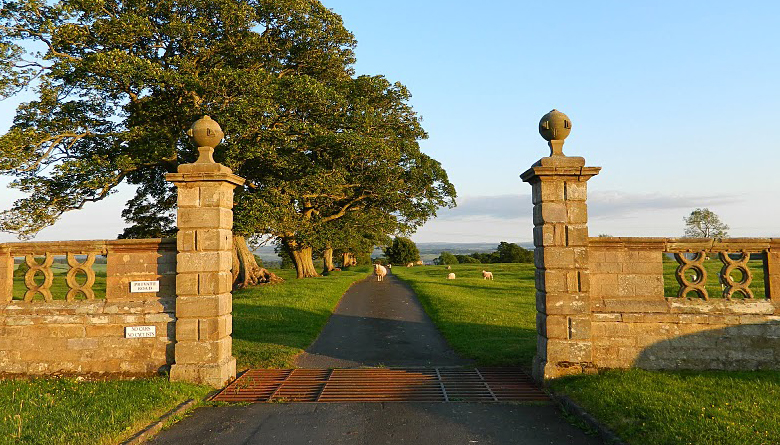
After leaving Newcastle, the route becomes quite beautiful, through forests and parks, along golf courses and across meadows. But no sign of Hadrian’s Wall yet until Heddon-on-the-Wall, a cute little village that I reached via an unforgiving steep and long ascent. But once that climb was mastered, I was finally rewarded with the first piece of Hadrian’s Wall.
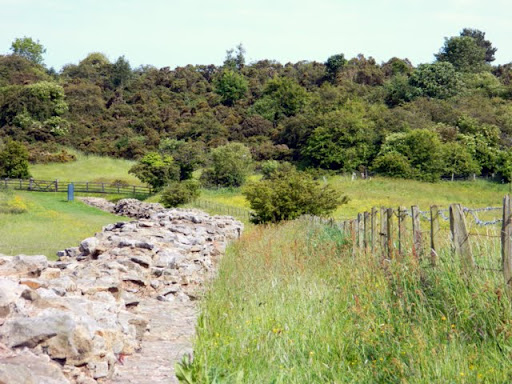
And one more to show you how happy I was to finally have reached the first evidence of this Roman structure:
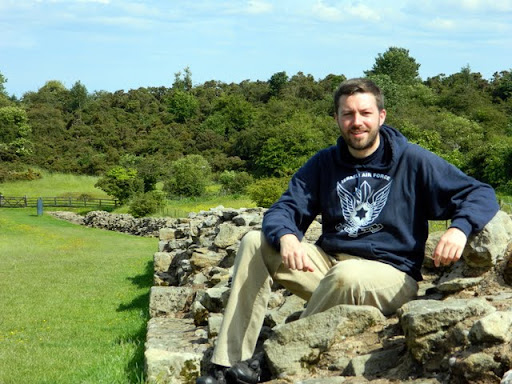
The day continued to be sunny and hot, the walk continued to be strenuous. The intervals between my rests became shorter. Each time I fell down in the grass, I was so exhausted that I could have fallen asleep better than in the most comfortable bed.

But I had to carry on. Not that I had a specific waypoint in mind; I had simply given myself a bit more than 5 days to complete the whole journey across the country. But especially on the first day, I wanted to walk as far as a I possibly could.

Luckily, from time to time there were funny sights that interrupted the monotony of walking:
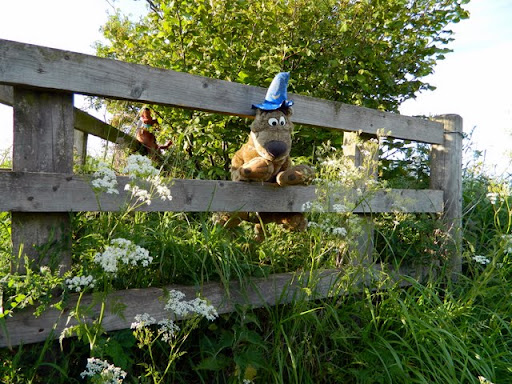
And then of course there were the sheep, thousands of sheep:
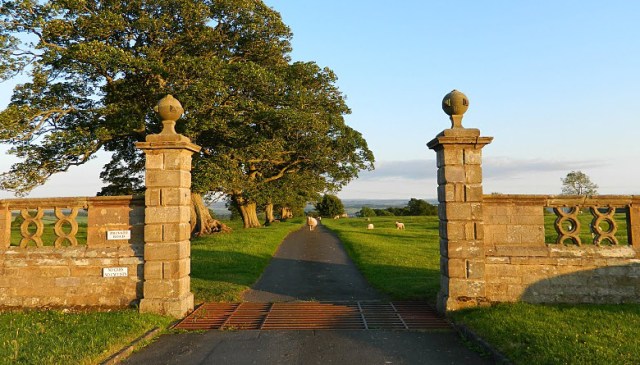
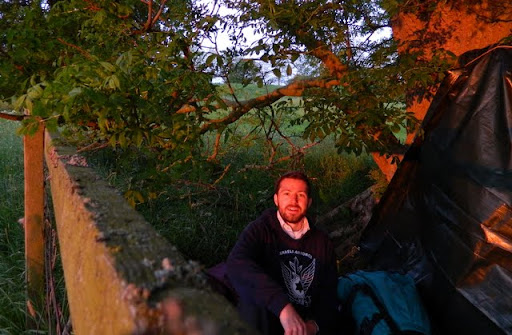
One interesting phenomenon was how long it was light in the evening (and how early it would become light the next morning). This far up in the North, it was light until around 2245. Even long after the sun had set behind the horizon, there was still enough light for a long time to search for an appropriate campsite. I had vowed not to sleep in any man-made housing and not even to use official campsites, but wanted to camp wild. I settled down for the night under a row of trees between two fields close to Portgate.

Not having bothered to carry a tent, I had to attach a tarpaulin to a tree to protect me a bit from the fierce wind. It was still cold, despite sleeping bag, bivouac sack and almost the whole range of clothes that I had with me.
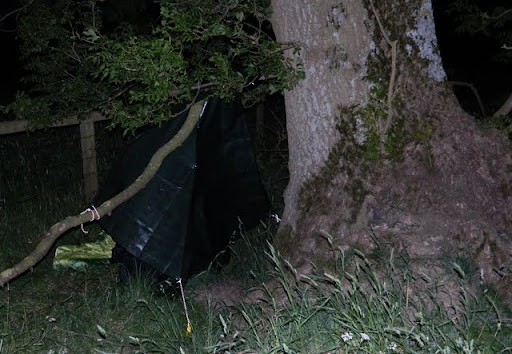
It was an uncomfortable, windy, sometimes rainy night that ended early with the sun rising at shortly after 0300:
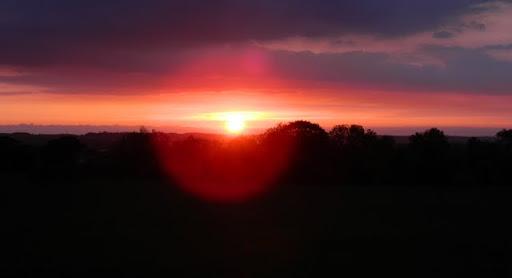
I hadn’t had a pleasant or comfortable night, but being woken by the sun put me in an upbeat and positive mood nonetheless. I packed up quickly and got walking again.
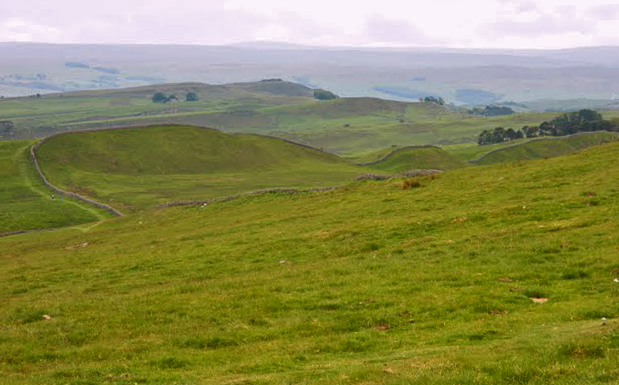
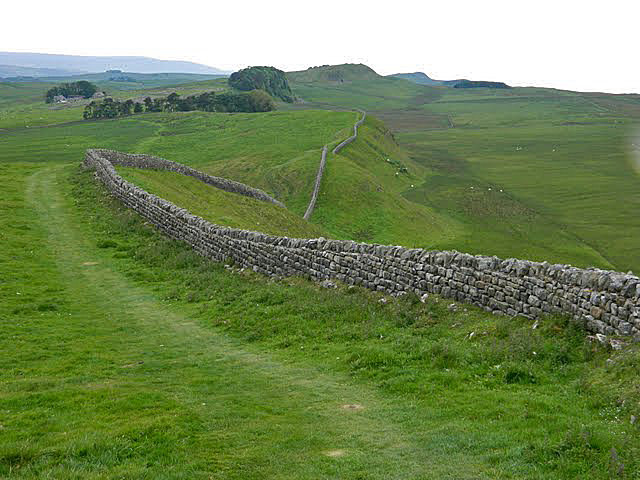
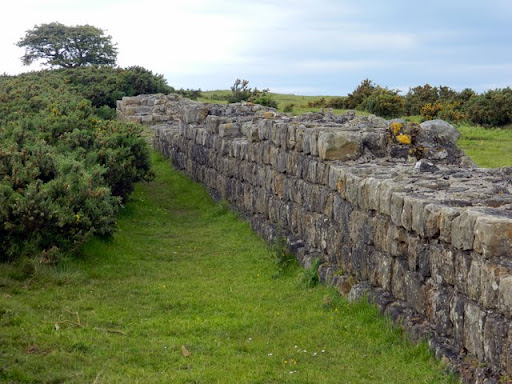
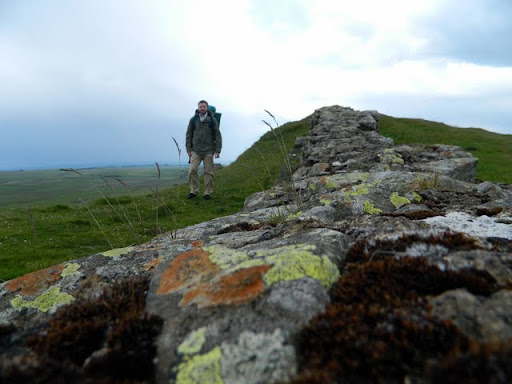
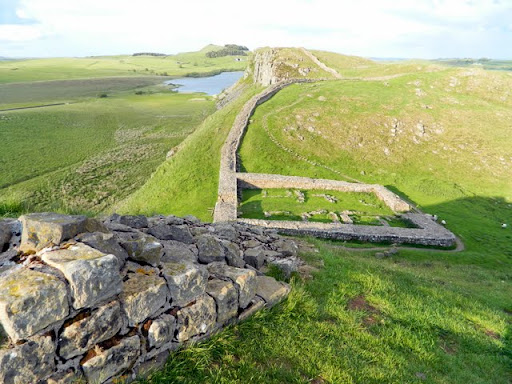
On the second and third day, more and more parts of Hadrian’s Wall became visible:
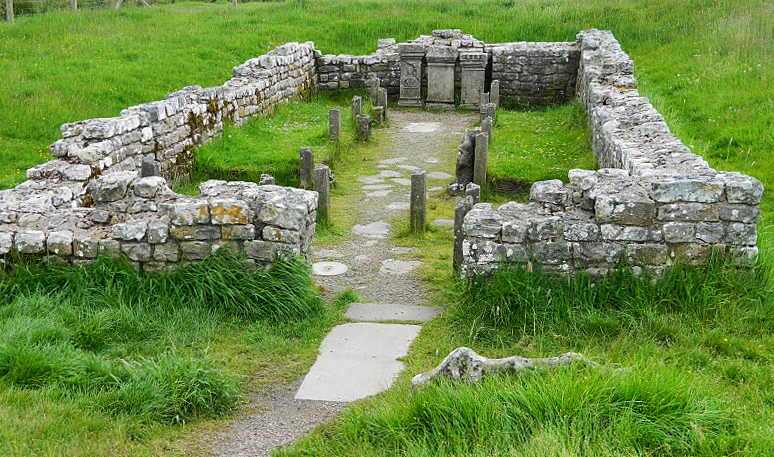
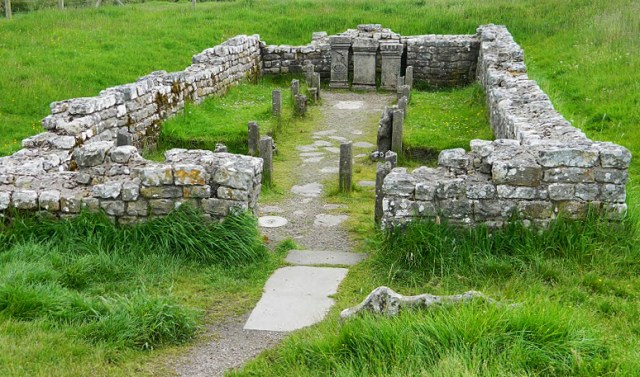
And not only the wall itself, but also some other remnants of Roman civilisation, like this Mithraic temple at Brocolitia
or the fort at Vercovicium:
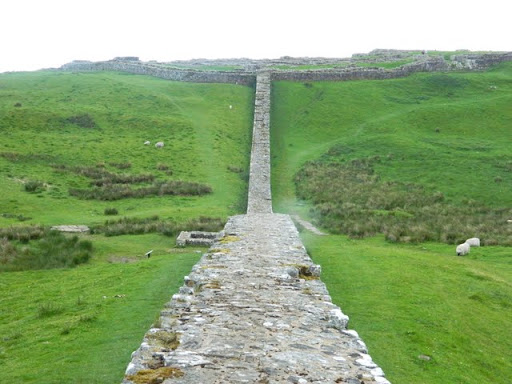
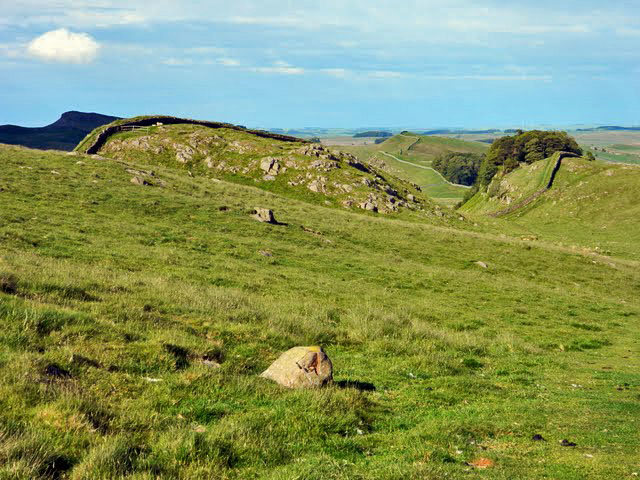
Living in London, I always thought England was rather flat. But up north, it’s actually quite hilly, as I became painfully aware, having to conquer one hill after another, all the time the view of more threatening hills on the horizon.
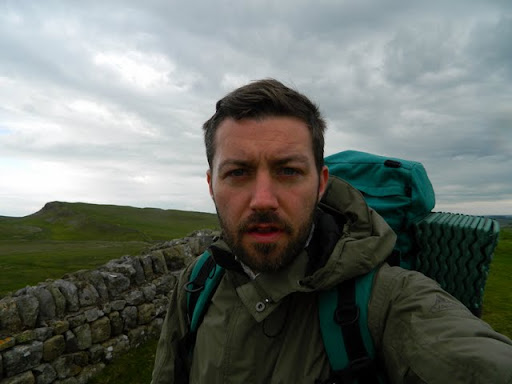
I guess my exhaustion is visible:
In the middle section of this walk, England is extremely empty. Sometimes, I don’t see villages for several hours, something which is very rare for this densely populated island. There are however a few other hikers, most of them not walking alone but as a couple or with friends. People are very friendly and often start a chat or walk together with me for a while.

But it’s not only people that this part of England is empty of, it’s also only sparsely vegetated. This poses a problem when looking for a place to sleep for the night. Where do you put up your camp in an environment like this:
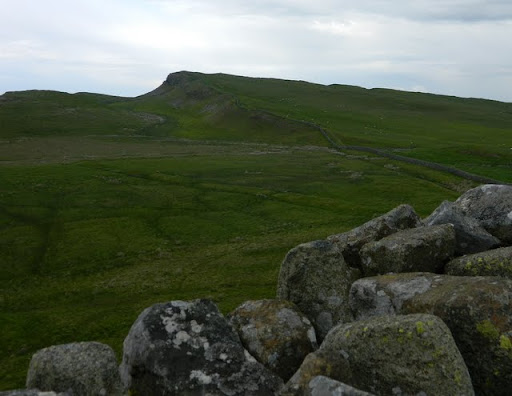
For the second night, I had to sleep under the open sky in a field with sheep, only using a wall between two fields (not the Hadrian’s Wall) as a slight protection against the wind. It was a shorter night even than the first one.

But getting up very early had the advantage that I was already up on Hadrian’s Wall when the sun rose.
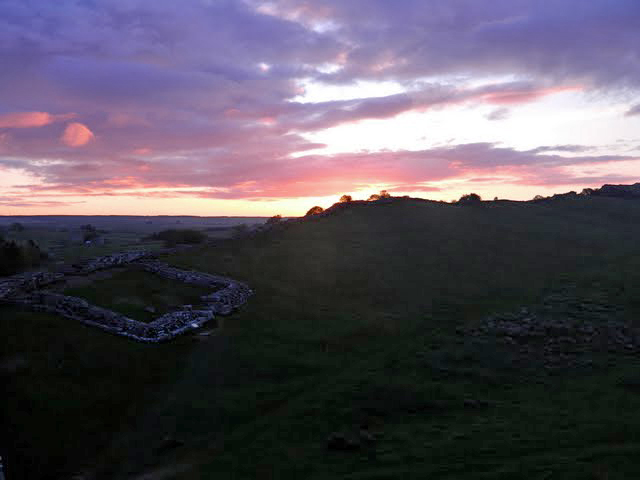
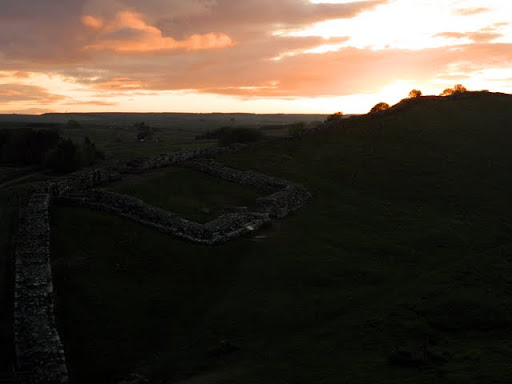
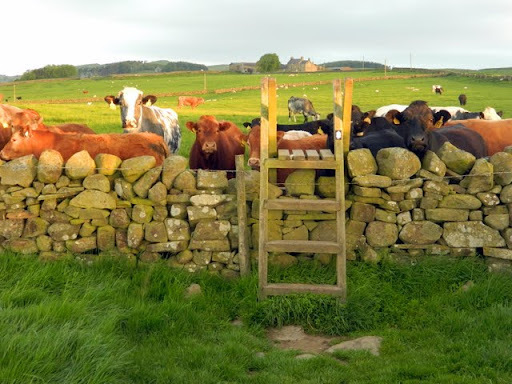
I didn’t see another living being for another few hours until I came across these cows which blocked my path so vehemently that I had to take a rather long detour.
By day 3, the walk had become an ordeal. I was slow and every step hurt. It had turned out that my biggest mistake had been to take all the food supplies with me that I would need for 5 days. This made my backpack extremely heavy, hurt my shoulders, slowed me down, demotivated me, and worst of all deprived me of the food in some of the pubs on the way which was most likely better than anything that I could cook. At one point I took the decision to discard 4 remaining cans of food for the sake of decreased load weight. (At first I felt stupid for taking all my food with me when the other hikers enjoyed burgers in a pub but then I came across another guy who had done exactly the same, and had also thrown away some of his food.)

At the end of day 3, my morale was very low. It had been raining, I was cold, I was deprived of sleep, I was dirty, every part of my body ached. When I realised that I could still reach Carlisle on that day (not because I had been fast but because I had started to walk at 0300), I decided to make a reservation for a slightly different kind of camp for this night. I deviated from my original plan and checked into the County Hotel in Carlisle. Because I was quite ahead of my original schedule, I didn’t feel bad about taking a long shower and sleeping in the next morning.

On day 4, I was therefore refreshed and could go for the final stretch from Carlisle to Bowness-on-Solway, a trip of about 22 km. This was much less than I had covered on any of the previous days and it was over very flat territory, so it was a rather relaxing end of the tour so that I reached the coast after a few hours and finally smoked a cigar as a reward. Actually, I smoked even two.
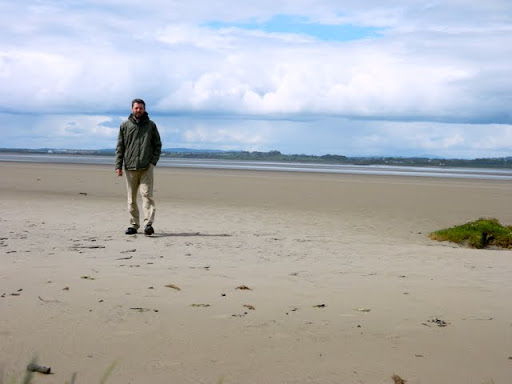
Overall, it was a really tough trip, stretches of which were a bit monotonous. But there was also some striking scenery and natural beauty. The best thing is the relative solitude, especially in the middle section of the walk. It was an interesting experience to walk for 4 days without any internet, newspaper or radio and with almost no interaction with other people. I realised again how much I prefer nature over civilisation.

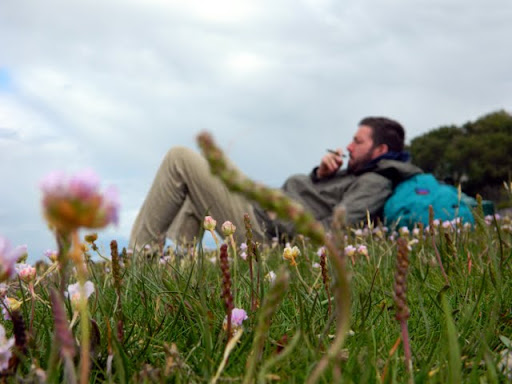
The moments I enjoyed most were the rests, when I fell down on the grass after walking for 2 or 3 hours, totally exhausted, enjoying the sun and the countless shades of green around me, listening to the sheep’s concert, my head resting on my backpack. Maybe it is only the preceding effort that makes the rest so fulfilling; but maybe lying in the middle of nature is also a beautiful experience without any physical effort. I’ll have to try that once.

If you have not been dissuaded by this account, please read my advice for walking the Hadrian’s Wall Path.

Posted in Photography, Travel, UK | Tagged , , , , , , | 38 Comments

Babies are (not) taboo

I am not one of those people who does something just because it is illegal or socially not accepted. Nor do I like provocation for provocation’s sake. But of the many things that I like to do, some include activities that overstep the boundaries of the social norm a bit; just to show that I am an individual and not merely an exchangeable member of society.

For example, I take off my shoes when I am in a library. (Not because I regard libraries as sacred places, but because it’s comfortable.) Or I read a book when I am in a concert of classical music because I can listen and read at the same time. Or I give up my job from one day to the next to become a student again. Also, I like to talk back to people who speak into their mobile phones so loudly that I can reasonably claim that I thought they were addressing me.

If you want to experience the feeling of breaking a taboo, I recommend that you start with what is the biggest taboo for most people: their children.

Nobody would have called ME ugly.

When travelling on public transport, I sometimes do the following: If there is a baby around whose physiognomy warrants it, I look at the baby for more than the normal duration of a stare, frown and state with a clearly audible voice “What an ugly baby.” Not in an aggressive way, just as a declaration of fact, before turning to my newspaper again.

Let me know how it went.

Posted in Life | Tagged , , , , | 16 Comments

How Osama bin Laden was really found

That the most-wanted terrorist, Osama bin Laden, was finally tracked down after a manhunt that lasted decades has caused admiration for the US intelligence and military (including by me in my post about the killing of Mr bin Laden) as well as for the leadership of the Obama administration. It has also raised yet unanswered questions about the complicity of some in Pakistan.

But looking at the evidence that we have so far, I am confident that I can reveal how Osama bin Laden was really found:

He had been living in his house in Abbottabad, Pakistan for 5 years, without any chance to go out or travel. He had to share the house with three wives, two elder Saudi women (Khairiah Husain Sabir, 62 years old and Siham Abdula bin Husain, 54 years old) and his latest wife, the 28-year-old Amal Ahmed al-Sadah from Yemen. As happens in polygamous marriages, the elder wives didn’t like the new, young wife very much.

osama bin laden bored

“I am bored.”

And what do men and women do when they are limited to one house without much outdoor activities? Exactly, they breed. The house was full of children from the different marriages. The youngest wife had just given birth to twins last year.

Now if you imagine sitting in a house with three bickering wives and plenty of noisy children around, without any friends coming to visit, it’s normal that you go mad. – If you were in that situation, wouldn’t you also want someone to come by and kill you? And that’s exactly what Osama bin Laden did. He tipped off the US military and hoped for a quick end.

One more reason not to get married.

Posted in Afghanistan, Military, Politics, Terrorism | Tagged | 5 Comments

My neighbourhood in London

In preparation for my walk across England, I finally bought a camera: a Nikon Coolpix L120. Henceforth you will be able to read more blog posts with my own photographs.

Not very creatively, I start with a walk around my neighbourhood in London for prospective visitors to look forward to their stay and for my family in Germany to understand why I left that small village in Bavaria to move to beautiful London.

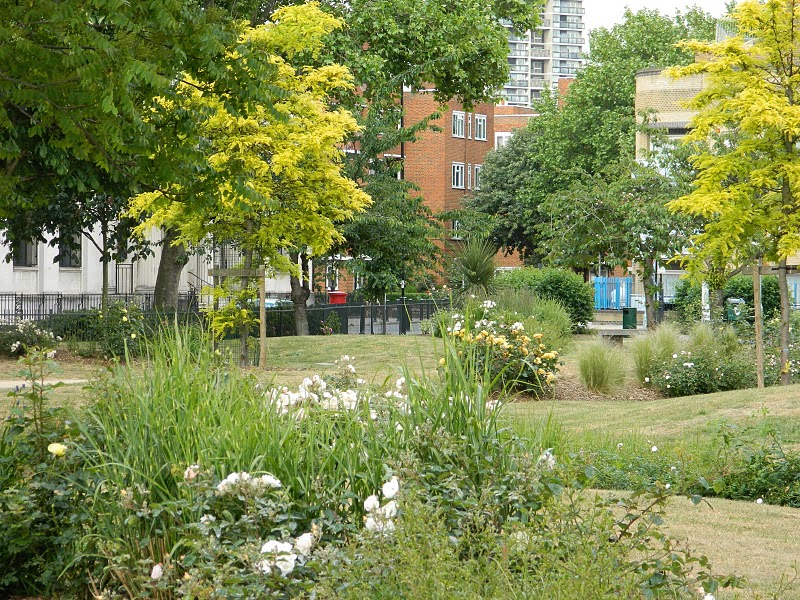
So this is where I live, in one of the red brick houses in the back. Although it is quite central, in the borough of Southwark, you can already see that it is a green area. Bermondsey Spa Gardens Park is just outside my house and a perfect place for a quick run, to eat dinner outside or to enjoy the sun.

London is generally much greener than people (who haven’t visited yet) think. The following are a few images from Southwark Park, the largest park (25 hectares) in my vicinity. It would be a great place to go running if it wasn’t for the many dogs there.

By now you must think that I live in the countryside and not in a city of 8 million people. So we’ll leave the park and walk back home. This short walk leads past St James Church.

From another perspective, St James Church offers a striking contrast to the modern buildings recently built around it.

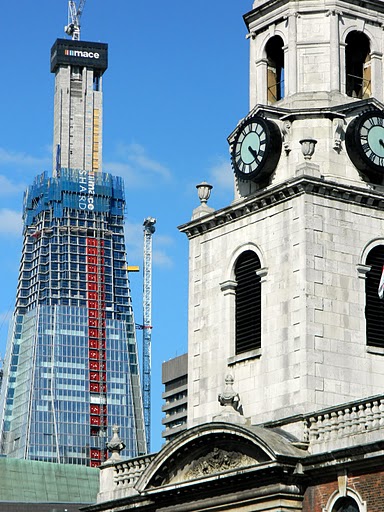
This effect of old versus new, and unfortunately too often: old dwarfed by new, can be seen at a few other locations as well. Another example is the church of St George the Martyr in Borough which is now overshadowed by the skeleton of the Shard Tower being built:

The Shard Tower being built in the background will be a glass-clad skyscraper with 72 floors. It will be the tallest building in Europe. residents argue whether it is ugly or beautiful, I just find it convenient because wherever in London I am, it shows me the direction I have to walk to reach home.

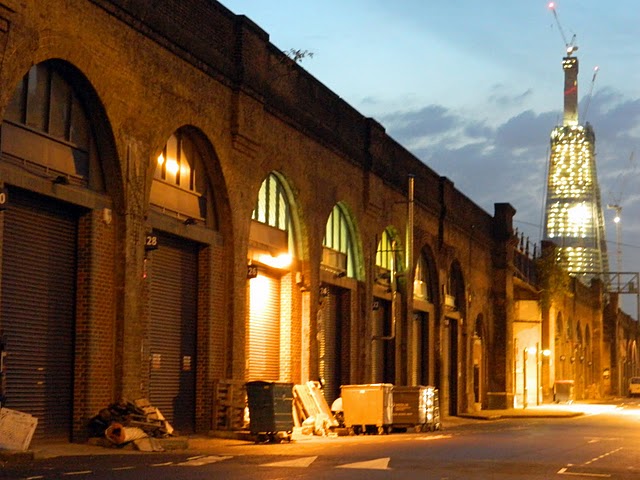
But it is certainly a dominating structure, especially at night when it is lit.

But at night, there are more beautiful sights. Just a few minutes north from where I live, I can enjoy this view on my evening walks: the famous Tower Bridge.

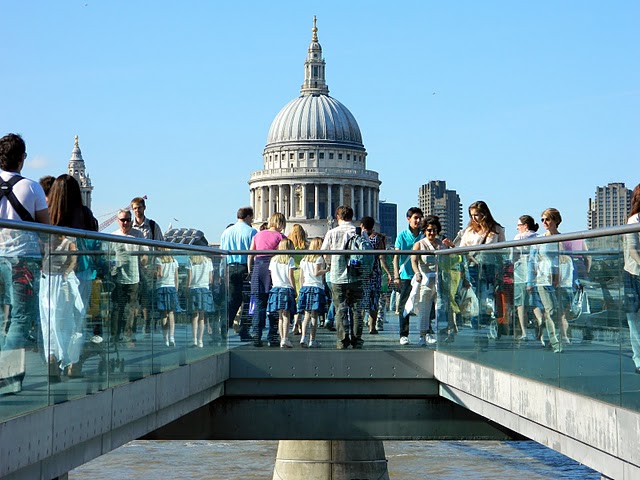
Walking westwards along the Thames, you will see more monuments that you easily recognise, like St Paul’s Cathedral, photographed here from under the bridge that leads to it from the Tate Modern Gallery.

But one of the better things in London is that you are always surprised by unexpected attractions, such as this man with an invisible head. (Note that he has the box for the money chained to his leg for fear of thieves.)

Continuing westwards, we reach the Palace of Westminster, the seat of Parliament since 1295 and a beautiful complex of buildings.

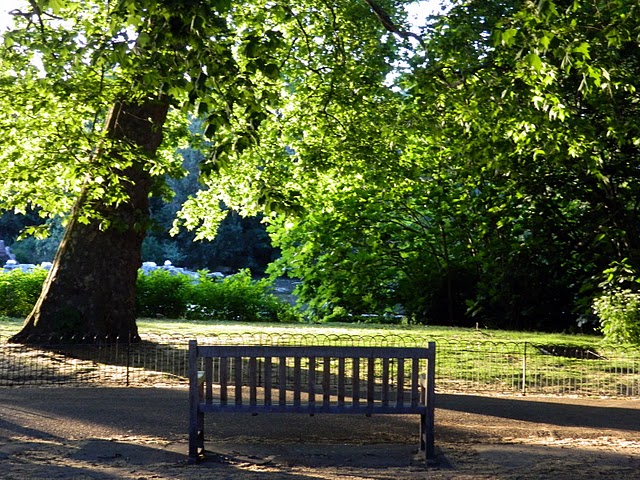
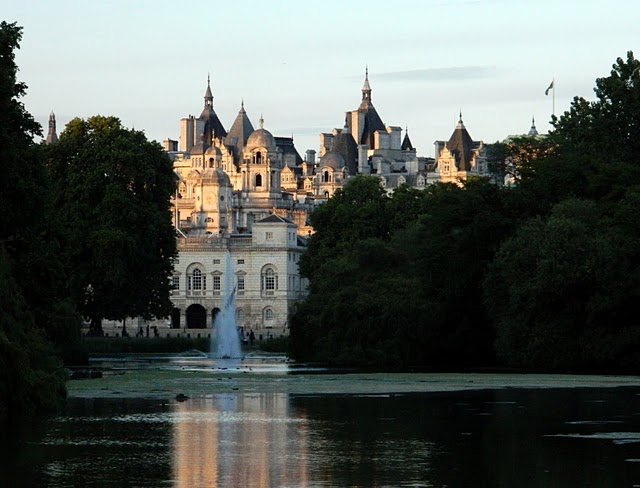
When you’ve had enough of old buildings, history and the political system of a country that survives without a written constitution, I recommend a rest in nearby St James’s Park which provides you with a place to rest and beautiful views.

As the sun begins to set, it’s time to head back to the Thames to have another look at Westminster Palace, this time at dusk.

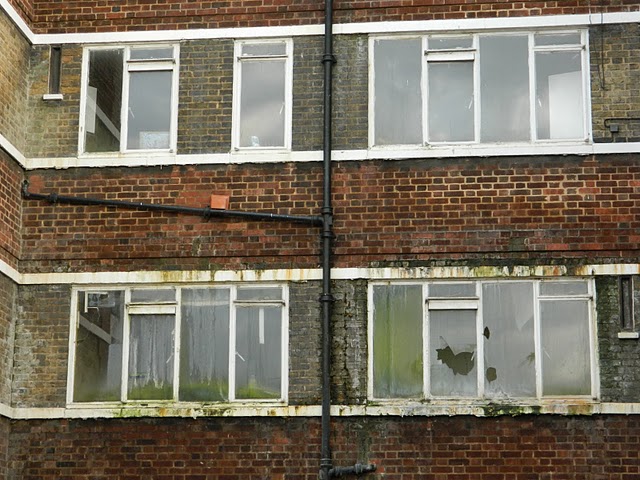
Walking back home, I should be honest and lay open that not all spots in London are as beautiful as the ones that you have seen. As any large city, London has striking contrasts between beautiful and ugly, well-maintained and forgotten, rich and poor parts.

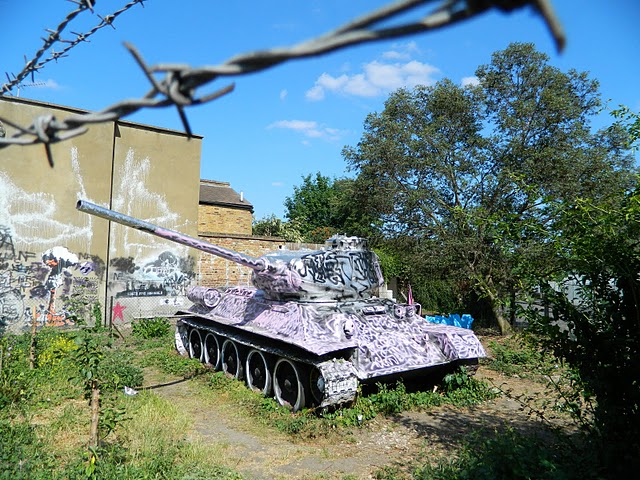
One neighbour in Mandela Way apparently thinks that the area is even dangerous enough to warrant putting a T-34 tank into his yard:

I hope that this doesn’t scare you off and that I will see you in London soon.

(All photos (C) by Andreas Moser)
Posted in London, Photography, Travel, UK | Tagged , , , , , , , , , , , , , , , , , , , , , , , , , , , | 19 Comments

Dominique Strauss-Kahn at Rikers Island

To those who think that the imprisonment of Dominique Strauss-Kahn, the head of International Monetary Fund, at Rikers Island prison in New York is a bit harsh, I would suggest that it rather demonstrates an ironic homage to the literature of Mr Strauss-Kahn’s home country France.

It took Edmond Dantès 14 years to escape from Château d’If, so we must not expect any developments soon. But time will tell if Mr Strauss-Kahn has read (and learnt from) Alexandre Dumas’ novel “The Count of Monte Cristo“.

Don’t be surprised if he will be back in disguise in 2025, find a hidden treasure in the IMF castle, return to Paris, become the star of the political scene, take revenge on President Sarkozy and the traitors in the Socialist Party, be challenged to a duel by the yet unborn child of Mr Sarkozy and Carla Bruni and finally reveal who really is the father of that child.

Posted in Books, France, Law, Politics, USA | Tagged , , , , , , , , , , , | 11 Comments

Globalisation is a Myth

Globalisation, this concept that everyone writes about and that many people blame for their woes or use as an excuse for their policies, is in large parts a myth.

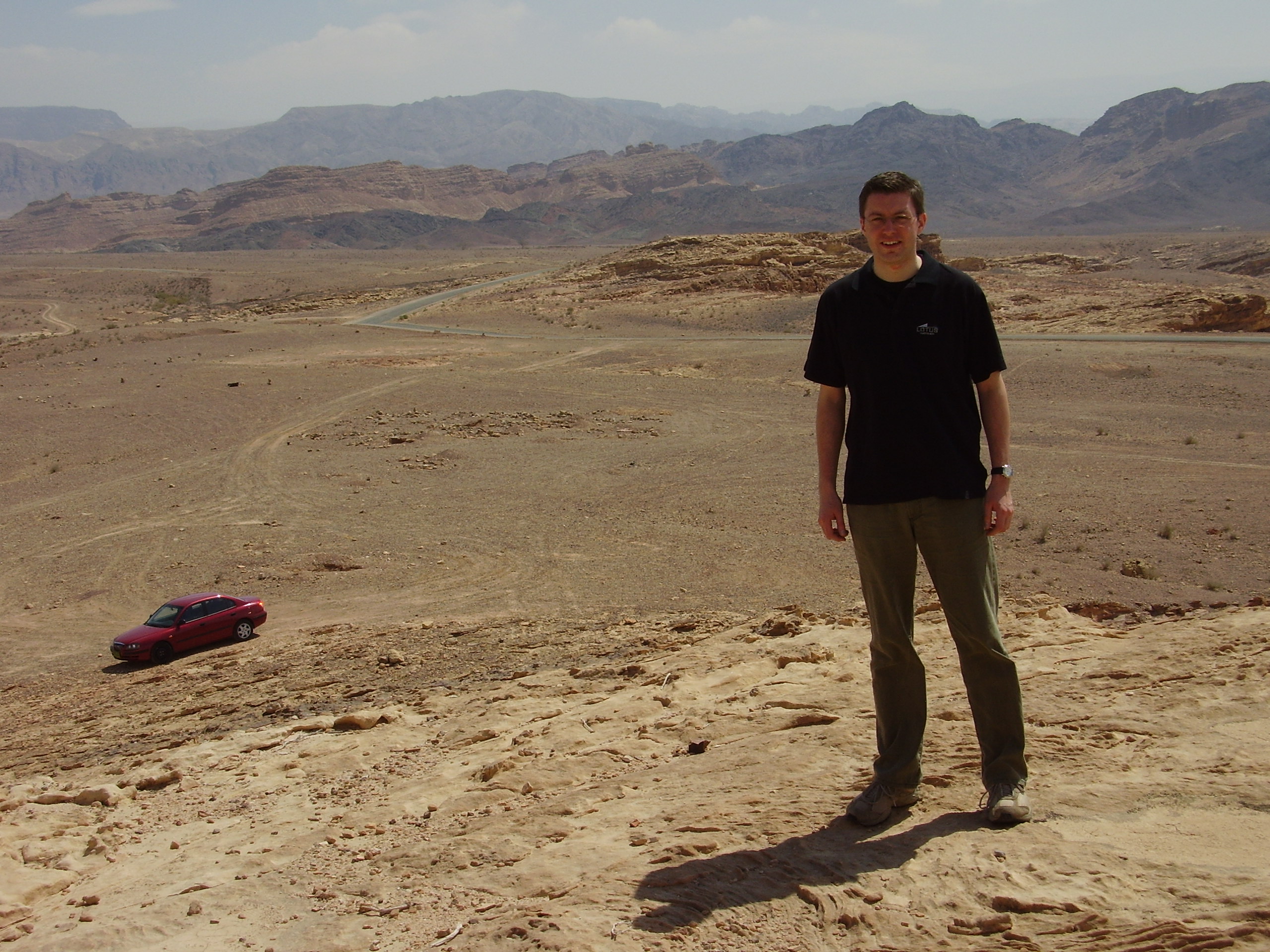
Who am I to claim this? Having grown up in a small village in rural Bavaria, I had been to Australia through a student exchange programme, to Israel in the course of another youth exchange, and to France with the Scouts, all by the age of 16. I later did internships in the United States, worked in Germany again as a lawyer with a specialisation in international family law for clients from around the world, and now I live and study in Britain. So far, I have visited 32 countries. – You would think that my life is proof of globalisation. But it might be more of an exception.
  • One problem is that most people who write and talk about globalisation have a similar background to mine, and this might be true for most of my readers: you are university-educated, speak one or two foreign languages quite well, have travelled at an early age, done part of your studies abroad, work for an international company. Chances are that with this background you live in your country’s capital city or a main economic centre.
  • But people like us are not representative of the world, and not even of our countries. If you live in London, Berlin or New York, you will indeed think that this is a mighty globalised world. But if you just go out of this cocoon for only 50 km (far less than a day-trip) to Winchester, Rathenowor Quakertown, you will find a completely different part of your country, one that is far less international and still very homogeneous.

    The more global you go, the less people will follow.

  • Yet the people living in rural areas and small towns make up the majority of most countries: Across Europe, only 29 % of the population live in cities with over 150,000 people (and 150,000 is not really large by the standards of London, Moscow or Tehran). The percentage for the UK is 51 % (12 % of Britons live in London alone), for Germany 26 % and in France only 11 % live in large cities. And these rural folks are on average much less globalised.
  • Although 215 million people live outside their country of birth, this is only 3 % of the world population. And even of these 3 %, many only move to the country next door or to a country that shares their mother tongue, they move only temporarily or they live in “cultural ghettos”, marrying a partner and being around friends almost exclusively from their home country.
  • Even among the young of this world, the numbers are no more impressive: Only 1.8 % of students attend universities outside their home country. And this number would be much lower were it not for relatively high numbers from Sub-Saharan Africa (students escaping poverty and wars) and China and Iran (students escaping dictatorships).
  • International trade continues to rise which would indicate that globalisation is pushing ahead. Yet, most trade occurs between neighbouring countries (the two most important trading partners of the US are Canada and Mexico; 67 % of all exports by EU members are into other EU states). Physical proximity, a shared language and/or past are still very relevant factors for the amount of trade between two countries.

No protests along the Silk Road.

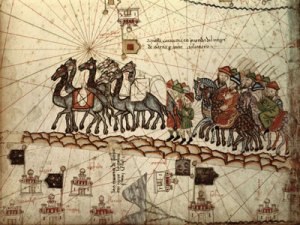
While there is certainly a level of globalisation, it is not the dominating factor for the world economy that it is often made out to be. Traditional economies are quite resilient against opening up – as are people. On the other hand, (a bit of) globalisation is also nothing shockingly new: Marco Polo established a trade route between Europe and China in the 13th century.

Posted in China, Economics, Politics, Travel | Tagged , , , , , , , | 6 Comments

Where have all the Thunderstorms gone?

Last night, the weather was sticky with sweltering heat and humidity. I left the windows open throughout the night, hoping to be awoken by a thunderstorm. Yes, I love thunderstorms. Actually I like all kind of storms. But a light rain was all I got this morning.

I haven’t seen a thunderstorm in many years now. This is all the more puzzling because I remember experiencing many thunderstorms when I was a child. Waking up at night and running downstairs into my parents’ bedroom was a regular occurrence. I also remember many a times when a thunderstorm caught me playing in the forest and forced me to seek cover, hoping that the tree I was hiding next to would not be the one struck by lightning. Later, I always cherished the amazing beauty of driving along a highway towards the darkened sky being criss-crossed by lightning on the horizon.

But in the past years, I haven’t seen any thunderstorm. None, zero, zilch. I might overestimate the frequency of thunderstorms in my early childhood because of the initial traumatic nature (until I began to cherish this extreme weather), but I am sure there were much more than zero.

Research suggests that the number of thunderstorms remains pretty constant over time. So where have all the thunderstorms gone?

The following map shows the lightning frequencies in different parts of the world:

To satisfy my lust for thunderstorms, it seems I should move to Congo, or more generally closer to the equator.

What is your experience? Do you see more or less thunderstorms than in the past? And where have you seen the most, the best, the strongest?

Posted in Travel | Tagged , , , , , , | 66 Comments

May we celebrate somebody’s death?

I admit it: when I woke up this morning to the headline “Osama Bin Laden Killed“, I reacted with surprise (about the manhunt still being actively pursued) and jubilation, as well as admiration at the execution of the operation by US intelligence and the US military.

But is it morally permissible to celebrate somebody’s death?

  1. Let’s first get religion out of the way because I don’t believe in any: Some religious people say that only god and not man may take lives. Other religious people say that god is omnipotent, so that we must assume that men who kill are controlled by him. After all, he can’t kill everyone by lightning. So, as always, religion gives no clear guidance at all.
  2. Law is no guidance either because
    1.  it is similar to religion in its contentiousness,
    2. most people who will immediately tell you that “the killing of Osama Bin Laden was clearly illegal” won’t even be able to tell you which domestic or international law applies,
    3. law mainly deals with the act of the killing, not with the subsequent death, and
    4. we don’t know the circumstances of the death. We don’t know if it was a targeted killing or Mr Bin Laden died while trying to resist arrest or in a fire fight. Without knowing the facts, nobody can apply the law to them. (Although I would argue that it was most likely not a targeted killing because that could have been carried out with much less risk by a drone strike or a bombing raid.)
  3. This leads to an important distinction: the one between the killing and the death. Although one results in the other, we can separate them. This becomes apparent if you imagine the case of Mr Bin Laden dying from measles or from old age. Our reactions and evaluation might be quite different.
  4.  Any premature death means a life cut short. Most deaths will result in sorrow for family members and friends, or in this case followers. Children have lost their father today.
  5. What if the death of one person saves other lives? This is uncertain, because although Mr Bin Laden has admitted (in his taped messages) the responsibility for the murder of thousands, we don’t know if he has still been actively involved in terrorism. As to Mr Bin Laden inspiring radicalism, his death might not bring this to an end. But the moral problem remains, because the burden of saving other people’s lives cannot be put on one person against that person’s will.
  6. And on this subject, the deceased’s will, it is that we have to return to the circumstances leading to his death: It was Mr Bin Laden himself, a confessed mass-murderer who not only prompted the 10-year long manhunt for him, but who chose to live a life of battle, conflict and war. This choice doesn’t necessarily ask for death, but it increases the chances of it dramatically. One could even argue that by resisting arrest, Mr Bin Laden in effect committed suicide through the hands of the US military, something which would be in line with his rants about martyrdom.

Every lost life – even that of the most heinous criminal – brings sorrow over people who have not deserved it. The death of no one warrants the public jubilation that we have seen being sparked by news of Mr Bin Laden’s death. But there are cases where I can understand – and even share – a certain sense of happiness and satisfaction. This case is one of them.

Posted in Law, Philosophy, Politics | Tagged , , , , , | 7 Comments