If you have been thinking about climbing a mountain higher than 6,000 meters, but you still need some push towards getting your ass off the couch, this might motivate you.
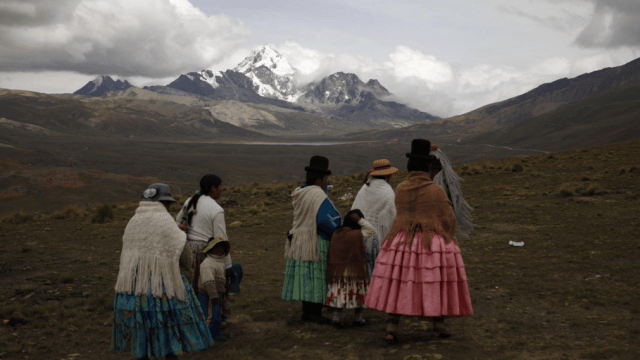
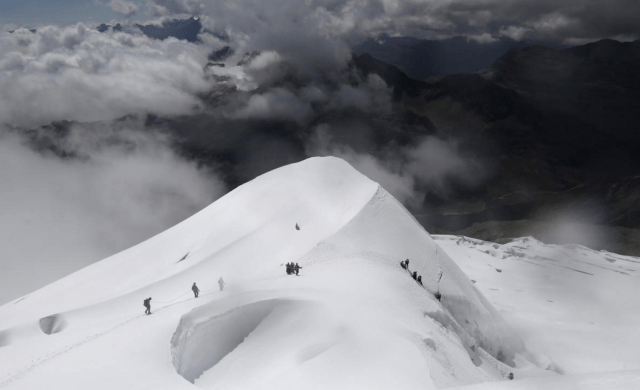
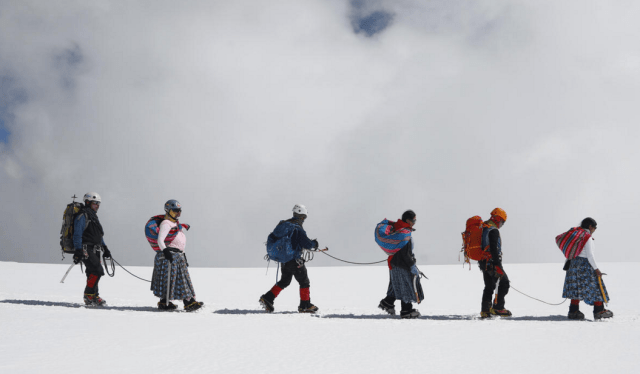
These eleven ladies, aged between 20 and 50, climbed Huayna Potosí (6,088 m) in December 2015.
They are the wives of mountain guides and have been working as carriers for food and climbing equipment up to the base camp at 5,130 m altitude and as cooks. When more and more mountaineers asked the ladies what it’s like at the top, they thought “well, guess we finally have to check that out,” convinced their husbands to take take them, and went in their regular dresses. I particularly love the simple, colorful backpacks which consist of a piece of cloth which is folded on one’s back and gets tied at a knot in front of the chest. This is how cholitas go shopping in the markets, how they carry the merchandise they sell and how they carry children. And what’s good enough for carrying a child is good enough to climb a snowy peak. No reason to buy any fancy equipment. Too bad they had to take off their traditional hats at the summit because of the strong wind.
And even if you don’t want to climb a mountain yourself, you can use this story as a response when some of your friends are showing off about having climbed the Matterhorn (4,478 m) or Kilimanjaro (5,895 m): “Yeah, I saw some chubby, old Bolivian women, they climbed much higher. They didn’t try to make a big deal out of it.”
The hotel at which I stayed in San José de Chiquitos (I didn’t find any Couchsurfing host there) banned not only the indoor use of dogs, cats and cigarettes, but also of coca leaves.
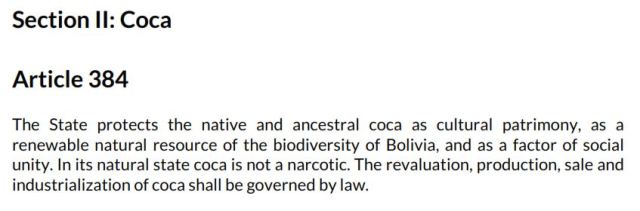
This prohibition surprised me because coca leaves enjoy a special status under the Bolivian Constitution, whose Articles 33, 34 and 380-392 not only protect the environment as a whole, but whose Art. 384 protects one plant in particular. (Actually, Art. 392 para. 2 also grants special protection to the rubber tree and to the chestnut tree, if I translated that correctly. Heck, I am a lawyer, not a botanist.)
It sounds strange how sentence 2 of that article tries to equip a scientific fact (of which I don’t know how undisputed it is) with unassailable constitutional backing. Sentence 3 lets the truth shine through: It’s not about protecting the plant, but the business and the jobs derived from growing and harvesting coca. Maybe the constitution was, like so many other things in Bolivia, sponsored by Coca Cola.
I am generally skeptical of overburdening a state’s founding or governing document with too many details. This is often an attempt by a large parliamentary majority (usually 2/3) to enshrine in the constitution what should really belong in regular laws to protect it from being changed once that side loses their super-majority. In other words, it’s an attempt to govern beyond one’s elected term.
Not only in constitutions, but regarding regular laws and contracts, I am very skeptical when it comes to verbose language that is hard to nail down. When my clients want to insert some lofty principles or ideas into contracts, I always ask them: “How do you want to enforce that?”
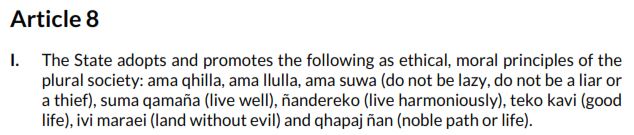
The Bolivian Constitution with its 411 articles is a bad example of such useless verbosity, which helps no one, except law students searching for the topic of an equally verbose and useless PhD thesis. Take Art. 8 para. 1 for example:
So I don’t have the right to be lazy? Or does this only concern the state itself? But then what happens if its highest representatives turn out to be liars? In reality, nothing happens. Good law-drafting is like good writing: if it doesn’t add anything useful, take it out.
Reading on, it seems that Bolivia is indeed opposed to laziness. I personally cherish laziness, so I am happy that Art. 108 no. 5 only applies to Bolivian citizens.
It’s tough enough that working is an obligation, but the phrase “according to one’s physical and intellectual capacity” is a huge burden to people with my range of talents and skills. “According to my physical ability,” does this mean I have to become a movie star? Or a special forces sniper? No, because Art. 108 no. 4 says that I have to “encourage a culture of peace”. But wait, Art. 108 no. 12 says that boys have to serve in the army, although Art. 10 para. 1 states that “Bolivia is a pacifist state”.
Wow, this constitution is a mess. Someone must have been on more than coca leaves when they wrote that. And we haven’t even started to discuss my “intellectual capacity,” which obviously would lie in constitutional law, among a million other things. What if I am qualified to work as a lawyer, but I prefer to write a weekly funny column for the newspaper? Or plant potatoes? Would I fall short of using my “intellectual capacity”? Who decides? What would be the consequences? How could anyone force me to be “productive”? Who determines what is “socially useful”?
This part of the constitution is made scarier yet because of its eerie resemblance to Art. 12 of the Soviet Union’s Constitution of 1936: “In the U.S.S.R. work is a duty and a matter of honor for every able-bodied citizen, in accordance with the principle: ‘He who does not work, neither shall he eat.’ The principle applied in the U.S.S.R. is that of socialism: ‘From each according to his ability, to each according to his work.’ ” Coincidence?
Art. 108 no. 6 which I have included above is also cute. An obligation to go to university and obtain a degree, well, that’s a perfect excuse for all these farming and mining children who are forced by their parents to contribute to the family income. “I am sorry, Dad, I know we need the bread, but it is my duty to study anthropology for four years.”
Anyway, now you see why I don’t have friends: We started talking about drugs, which caught your interest, but I ended up discussing political philosophy and constitutional law. Well, I better go to La Cancha market now and get a bag of coca leaves. – But we all know that I will end up at the library instead.
“Eat your vegetables!” (How could I forget to put this into the constitution? Another referendum, quick!)
Long-term readers are already aware of it: the railroad is my favorite means of transport.
So you can imagine my excitement when I read that Bolivia has an Orient Express: the Expreso Oriental from Santa Cruz to Quijarro on the border with Brazil. The excitement grew as I read that the train offers a Super-Pullman class. Usually, I travel as cheaply as possible, but as a train fanatic I couldn’t resist, went on a splurge and bought that luxury ticket.
The engine trudges slowly out of the station, so slowly that one could draw portraits of the people who stand at the railway crossings and admire this marvel of technology. The landscape is not particularly spectacular, but wins me over by being increasingly devoid of people. Dry and dusty at times, green and overgrown at other times, but always with a sun glowing so hot that I want to keep my hat on even inside the air-conditioned train. I would also like some protection against the TV in my carriage which shows concerts with Brazilian pop music. There ain’t no worse music in the world. After an hour or so, the movie program starts: not quite current Hollywood productions with subtitles in Spanish, very practical for language learners like myself. The ringing of a mobile phone is subtitled with triin triiin triiin, an aircraft’s jet engine with fuuiiiii!
I focus on the scenery instead.
We are moving through the outskirts of Gran Chaco National Park, one of the last large areas of untouched scrubland and dry tropical forest. On a protected area larger than Belgium (and elsewhere farmers complain when 20 acres are to be declared a conservation area) there live jaguars, pumas, tapirs, pekaris, ocelots and a whole lot of other animals which as a European without degrees in biology or zoology I have never heard of. From the train, I only spot grey herons with fishes in their long beaks.
Within the national park, there live the Izoceño, Chiquitano and Ayorea peoples, but from the train I only catch glimpses of another interesting ethnic group: the Mennonites, originally emigrants from Germany, all of them wearing the same farmers’ bib overalls and still speaking German. But – as I will find out a few days later – Low German, listening to which I get the same feeling as when I listen to Dutch or Afrikaans. I recognize the common roots, but I don’t understand more than 5% of it. So if I, as a German in Bolivia, meet a tall man with blonde hair, blue eyes and a family name like Giesbrecht or Schellenberg, then I will – to the amusement of the Bolivians around us – smatter with him in broken Spanish. And I purposefully mention only men, because it’s almost impossible to strike up a conversation with the Mennonite fräuleins. German immigrants in South America are not exactly world champions in integration.
But this shall be the subject of another story once I manage to infiltrate that community. Today you want to hear about the famous Orient Express. Well, the way to San José de Chiquitos was quite nice. For the return to Santa Cruz a few days later, I choose the night train. Actually, the verb “choose” implies a selection between several options which I don’t really have. Because it takes the train 17 hours to cover the roughly 640 km from Santa Cruz to Quijarro (making it slightly faster than trains in Romania, but still oddly slow for a completely straight and flat track) and because there is only one train, mathematics dictates that the train can’t come to every town every day. From San José de Chiquitos you can return to Santa Cruz on Tuesdays, Thursdays and every Sunday, at 23:04 hours respectively. I am looking forward to a relaxing, comfortable night in a Pullman sleeper wagon.
But somebody must have removed an essential part of the train. The carriage is shaking from left to right more ferociously than the ship with which I crossed the Atlantic Ocean to reach South America. At the same time, it bucks and jerks back and forth so crazily that my head hits the seat in front of me several times. And the wagon moves up and down as if we were crossing the epicenter of an earthquake. All of this at a speed of no more than 30 km/h. I can’t understand how a train can cause so much havoc at such a low speed on a straight track.
When I recorded this video, I really tried to hold still:
And the noise! The subtitles to the movie would read something like kkkrrrhhhhccchzz kkkkrrrccchhhzzz gghhhrrrtttt. The Bolivian and Mennonite passengers pretend that they are able to sleep in this apocalypse on wheels.
What should I do? Well, luckily I am on the Orient Express. There must be a dining car where I can ask for a steak, have a bourbon and smoke a cigar. So I get up, looking for the carriage which I imagine to look like this:
Between the cars, there are these old transitions with two sheets of metal sliding above each other, without any guardrail to the left or the right. The train is still shaking so wildly that I almost fall down.
And indeed, at the center of the long train, I find the dining car. The view is sobering for heart and stomach.
The restaurant is empty. The bar is empty. The kitchen is empty, except for a plastic bottle with yellow washing-up liquid. There is no fridge. The side doors look like this was the mail car which has been haphazardly turned into a dining car. I sit down at the bar and decide to wait for Hercule Poirot, Dr Constantine or Princess Dragomiroff. But they all seem to have missed the train.
Now if you are wondering how you are supposed to survive such a long train journey without food and beverages, I can tell you: Don’t despair! Bolivia is a service paradise and the well-being of guests is the paramount concern everywhere and at all times. During the day an employee of the railroad company serves snacks and drinks. On the night train, children have assumed this responsibility, unfortunately without a valid ticket, so they are thrown off the train after a few stops. I don’t know if they sit there for two days, waiting for the next train, or if they walk back home through the jaguar- and puma-infested swamps. (At the station in Santa Cruz, there are about 60 posters with photos of missing people, most of them children and teenagers, and these are only the ones who have been reported as lost in the last three months.)
Practical advice:
As I didn’t experience any problems on the outward journey, I hope that the bumpy ride was an exception. Still, I would not recommend to travel the whole 640 km in one go. San José de Chiquitos and Roboré are the towns along the route that offer the best infrastructure.
Besides the Expreso Oriental there is a Ferrobus traveling on the same route. Because ironbus doesn’t sound as good as Orient Express, I made the choice described above. The Ferrobus costs more than twice though, so it may be (even) more comfortable. On the other hand, this may just be a marketing gag, which I am far too clever and stingy to fall for.
On the Expreso Oriental the ride for the whole distance of 640 km costs only 100 bolivianos, that’s around 13 euros or 15 dollars.
You can pre-order tickets online, but I bought mine the same day at the respective station and there were enough seats available. No reason to worry about this. If the train arrives at a station in the middle of the night, that ticket counter will open around an hour before arrival time. (I wish train companies in other countries would replicate this excellent service!)
When departing in Santa Cruz, you will need a platform ticket in addition to your train ticket. It only costs 3 bolivianos, but of course you need to go to a different counter for that. And of course nobody tells you about it when you buy your train ticket.
Oddly, when you leave Santa Cruz, you undergo a passport check and a luggage check with sniffer dogs, but when you return to Santa Cruz, no such checks are carried out. Apparently, Bolivia is the only country where drugs are produced in the city and then smuggled to the farmers in the countryside. Or no police officer wants to work in the villages.
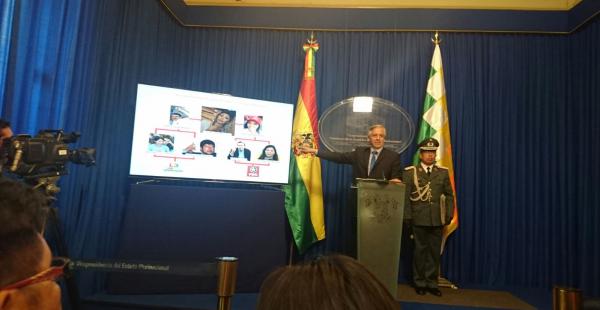
In most countries, the job of Vice President is limited to sitting around and waiting for the President to die.
In Bolivia, the Vice President’s job includes explaining the cast of the country’s leading telenovela. Which is a tough job, because there is a new episode every day.
I’ve been meaning to write about the gripping saga of Evo Morales and his family, which turns out to be larger than we thought, but with new developments every day, I haven’t found the time yet. In short, it’s about love affairs, corruption, a child who was declared dead but turns up alive 8 years later, the miraculous career of a young woman who had a child with the President when she was 18, Bolivian-Chinese business deals, a President who allegedly didn’t recognize his (ex-)girlfriend when she posed for a photo with him, family feuds and much more. In typical South American fashion, President Morales blames all of this on a foreign conspiracy (as of now, he hasn’t implicated me personally yet).
Stay tuned! It’s rare that you can watch live as a President dismantles his own achievements and his legacy, day by day.
Tomorrow, you will receive a precious gift: an extra day.
Because 2016 is a leap year, you will have 24 hours more in your year. Even those of you who pretend that they don’t have enough time, have no more excuse not to do what they want to do.
Make use of this rare opportunity! Don’t go to work! (You can blame it on not knowing about this oddity or on operating on last year’s calendar.)
Instead, use this unexpected extra day to do what you have always wanted to do:
Around the office in Cochabamba, where I have to go every month to extend my Bolivian visa, there are all kinds of merchants and service providers: food, drinks, copies, foreign currencies, pens, flight tickets, you can get anything here.
And for those who forgot to bring a passport photo, there is a studio:
A mirror, a white screen, a chair, why would one need more?
Even I, as someone who is very interested in politics, have stopped watching these debates. There is nothing new to be learned from them, there is nothing of substance. My main criticism is not even directed at the candidates, as embarrassing as some of them may be, but at the moderators:
If someone doesn’t answer your question, interrupt them, and ask them to answer the question. If someone makes outrageous claims and statements, follow up right away. If someone lies, call them out right away. If someone promises to “repeal” laws, ask them how this is the President’s authority. But that would mean that journalists actually had to study the issues themselves, not just report poll numbers and re-play soundbites.
How primary debates (in both parties) should be carried out:
Or maybe it would already help to cool tempers if candidates were given a chair, so that they don’t need to stand for 90 minutes.















 The Happy Hermit