
Sadly, that bar ain’t never been open since I’ve been here.
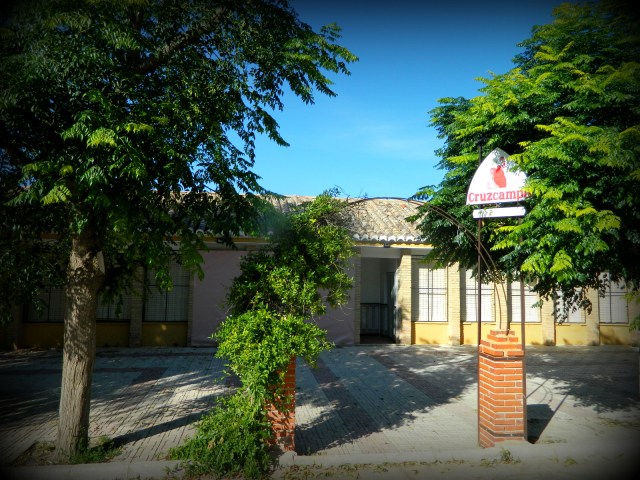
Sadly, that bar ain’t never been open since I’ve been here.
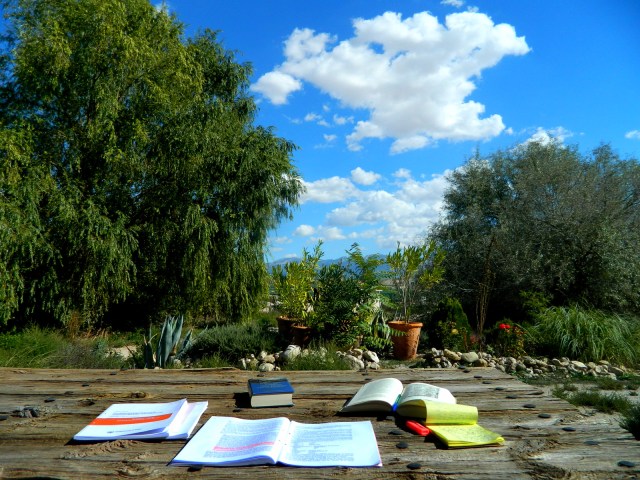
With not many people around, this is actually the perfect place to study.
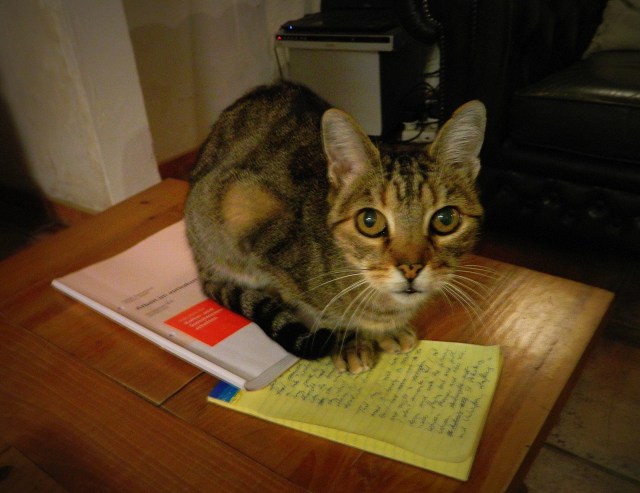
Only the cat sometimes doesn’t approve of it.
My next house- and cat-sitting job will take me to Calgary in Canada during the deepest winter, from December to March. I knew that it would be cold and full of snow, of course, and it’s actually what I have been looking forward to. Because cold winters are good for productivity, as I can’t go for long walks and sit in the park all day. So, you, dear readers, should expect many more articles this winter.
But then, a friend from Cochrane, close to Calgary, sent this photo taken on October 2nd and I got slightly worried.
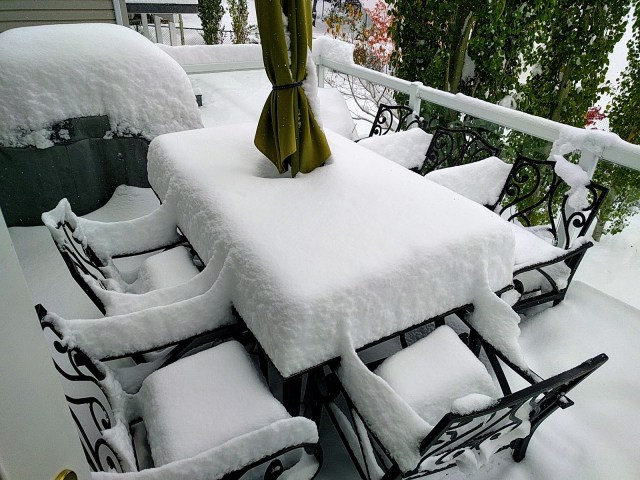
If this is the beginning of autumn, I wonder what real winter will look – and feel – like in Canada.
Why are there chimneys and antennas rising from the ground?
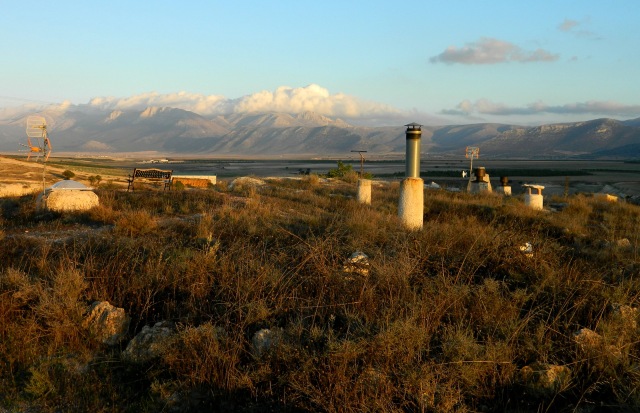
That’s simple. Because people are living under the ground. Like hobbits.
I shall attempt to get acquainted with someone living in such a cave and to obtain an invitation, so that I can report on how the Flintstones live. It doesn’t even seem to be so unusual here, because the real estate agents in the region advertise caves just like houses.
With many of the places around here, I am really not sure if anybody lives there.
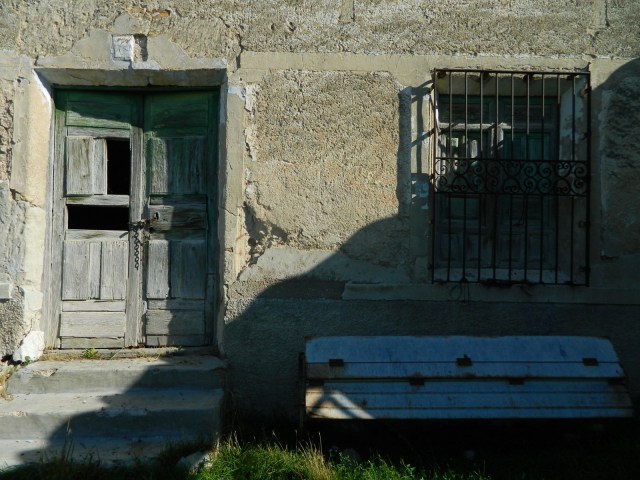


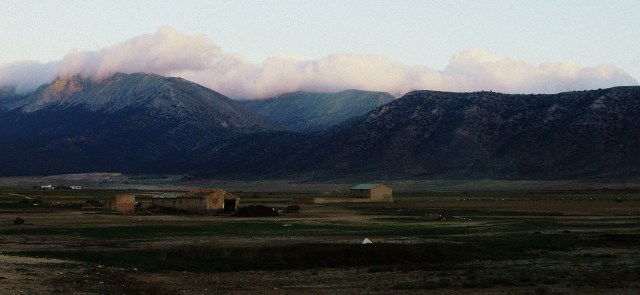

But whenever I approach too closely, dogs are barking or shots are fired.

You must have already noticed it in the photos of the last two weeks: the mountain range of the Sierra de María at the eastern end of the valley of Venta Micena. From the first day I laid eyes on them, these mountains were more irresistible than chocolate cake.


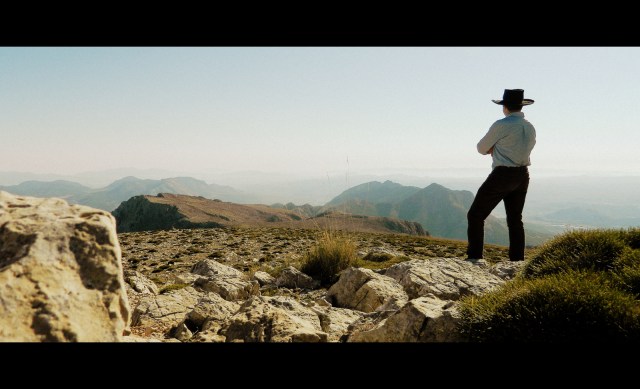
Thus, early today, I will embark on a hike, attempting to climb the highest peak (2,045 m = 6,709 ft) and then going for a leisurely stroll along the top of the ridge.
As always, I am super-prepared. But if I won’t be back by nightfall, please go looking for me.
Based on the photos you have seen thus far, you can probably imagine the heat in Andalusia. And there aren’t many trees providing shade.
Without my hat, bought from a Roma family in Transylvania, I would long have had a heatstroke and withered away.
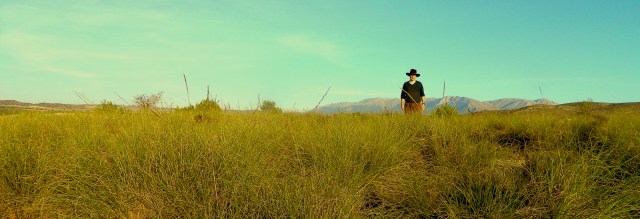
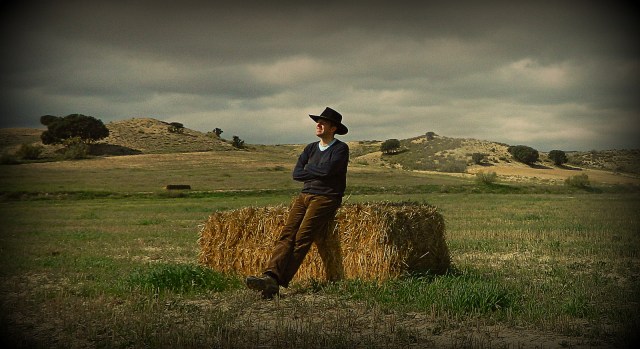
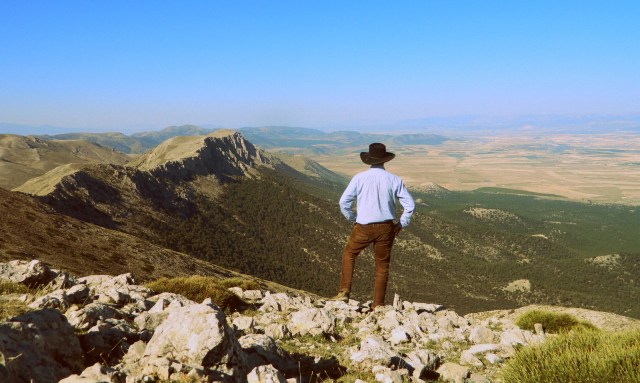
And with the hat, I feel even more as if I am in a Western movie.

Oak trees in Andalusia look different from the ones I knew.


The headline is not universally true, of course, but merely a reference to my own limited experience. But let me tell you how I came to it.
Last winter, when I lived in Montenegro, I met a woman who was either old enough or educated enough to know that until recently, there had been two Germanys. While we were walking through the port in Budva, she asked how reunification was going and if there were still differences between eastern and western Germany.
I appreciated the question, because it was a new one, and was about to begin a monologue about population trends, economic figures, infrastructure, election results, etc., all of it based on knowledge obtained by reading the newspapers. It is quite dangerous to pose an open-ended question to me, I should warn anyone who has yet to encounter me in person. But that evening, I interrupted myself after a few seconds, puzzled by what I had realized:
“If I am honest, I know less about eastern Germany than I do about Montenegro.”
I had been born in West Germany in 1975 and hadn’t been to the GDR once. Before I became of traveling age, communist/socialist East Germany had the audacity to cease existing. But worse and entirely my own fault, even since, I hadn’t really been to eastern Germany.
Granted, I have been to Berlin a few times. But our preppy and well-organized capital somehow defies the dichotomy of East and West and sees itself more in a league with New York and New Delhi. Apart from Berlin, I have only been to eastern Germany twice, in Hohenstein-Ernstthal and in Rostock, each time for a court date.
But back then, my life was dominated by work, deadlines and stress, and thus I just quickly popped by and returned home, or to the next court date in another part of Germany, once the job was done. I remember thinking, in both cities: “Quite pretty, but where are all the people?” Maybe they had all gone to listen to Bruce Springsteen or another communist rally.
By the way, my lack of knowledge about eastern Germany is not at all based on some resentment of anything eastern, which I unfortunately detect in many western Germans and indeed western Europeans. Quite the contrary, I find eastern Europe more fascinating than western Europe. I simply haven’t found the opportunity yet, probably because I have been busy exploring other continents. There are even some western German states that I have never set foot in.
But for a politically and historically interested person, living in the 28th year after German reunification, it seems a culpable negligence not to have explored the other half of one’s country, which does after all have quite a different history from the half one is used to. Isn’t it weird that I have more first-hand knowledge of countries like Transnistria and Abkhazia or of far-away isles like Easter Island than of eastern Germany? Until now, I have even spent more nights at Evin prison in Tehran than in the five new German states taken together.
Today, on the anniversary of reunification, I vow to rectify this deficit. And I am not talking about a few days in Leipzig or Dresden, but I am thinking of an extensive and well-researched tour of the parts of Germany yet unknown (to me). The same way I do it with foreign lands.

Eastern Germany must not be reduced to the history of the GDR, of course. After all, a whole generation has passed since. But as a student of history, I am naturally more interested in the past than in the future.
It was actually at the University of Hagen, in a seminar about “the GDR’s short-lived summer in 1965“, that I realized how little we West Germans and now pan-Germans, I guess, know about the history of East Germany. We know nothing, except uprising in 1953, construction of wall in 1961 and opening of wall in 1989. Next to me, there sat a student who had grown up in the GDR and who told me how surreal the experience was for her: “The professor is lecturing about the GDR as if it was a far-away country or ancient Egypt. But there are people in this room who have lived there. Why is nobody talking to us about it?”
For us Germans socialized in the West, that wouldn’t be a bad idea, particularly on this holiday. If you have any friends or colleagues from eastern Germany, just ask them to tell their story.
(This story was also published by Medium. – Zur deutschen Originalfassung.)

 The Happy Hermit