
Oak trees in Andalusia look different from the ones I knew.
-
Recent Posts
-
Join 3,468 other subscribers
Oak trees in Andalusia look different from the ones I knew.


The headline is not universally true, of course, but merely a reference to my own limited experience. But let me tell you how I came to it.
Last winter, when I lived in Montenegro, I met a woman who was either old enough or educated enough to know that until recently, there had been two Germanys. While we were walking through the port in Budva, she asked how reunification was going and if there were still differences between eastern and western Germany.
I appreciated the question, because it was a new one, and was about to begin a monologue about population trends, economic figures, infrastructure, election results, etc., all of it based on knowledge obtained by reading the newspapers. It is quite dangerous to pose an open-ended question to me, I should warn anyone who has yet to encounter me in person. But that evening, I interrupted myself after a few seconds, puzzled by what I had realized:
“If I am honest, I know less about eastern Germany than I do about Montenegro.”
I had been born in West Germany in 1975 and hadn’t been to the GDR once. Before I became of traveling age, communist/socialist East Germany had the audacity to cease existing. But worse and entirely my own fault, even since, I hadn’t really been to eastern Germany.
Granted, I have been to Berlin a few times. But our preppy and well-organized capital somehow defies the dichotomy of East and West and sees itself more in a league with New York and New Delhi. Apart from Berlin, I have only been to eastern Germany twice, in Hohenstein-Ernstthal and in Rostock, each time for a court date.
But back then, my life was dominated by work, deadlines and stress, and thus I just quickly popped by and returned home, or to the next court date in another part of Germany, once the job was done. I remember thinking, in both cities: “Quite pretty, but where are all the people?” Maybe they had all gone to listen to Bruce Springsteen or another communist rally.
By the way, my lack of knowledge about eastern Germany is not at all based on some resentment of anything eastern, which I unfortunately detect in many western Germans and indeed western Europeans. Quite the contrary, I find eastern Europe more fascinating than western Europe. I simply haven’t found the opportunity yet, probably because I have been busy exploring other continents. There are even some western German states that I have never set foot in.
But for a politically and historically interested person, living in the 28th year after German reunification, it seems a culpable negligence not to have explored the other half of one’s country, which does after all have quite a different history from the half one is used to. Isn’t it weird that I have more first-hand knowledge of countries like Transnistria and Abkhazia or of far-away isles like Easter Island than of eastern Germany? Until now, I have even spent more nights at Evin prison in Tehran than in the five new German states taken together.
Today, on the anniversary of reunification, I vow to rectify this deficit. And I am not talking about a few days in Leipzig or Dresden, but I am thinking of an extensive and well-researched tour of the parts of Germany yet unknown (to me). The same way I do it with foreign lands.

Eastern Germany must not be reduced to the history of the GDR, of course. After all, a whole generation has passed since. But as a student of history, I am naturally more interested in the past than in the future.
It was actually at the University of Hagen, in a seminar about “the GDR’s short-lived summer in 1965“, that I realized how little we West Germans and now pan-Germans, I guess, know about the history of East Germany. We know nothing, except uprising in 1953, construction of wall in 1961 and opening of wall in 1989. Next to me, there sat a student who had grown up in the GDR and who told me how surreal the experience was for her: “The professor is lecturing about the GDR as if it was a far-away country or ancient Egypt. But there are people in this room who have lived there. Why is nobody talking to us about it?”
For us Germans socialized in the West, that wouldn’t be a bad idea, particularly on this holiday. If you have any friends or colleagues from eastern Germany, just ask them to tell their story.
(This story was also published by Medium. – Zur deutschen Originalfassung.)
Some of the photos have been surprisingly green. There has been some rain and the fields are being irrigated.
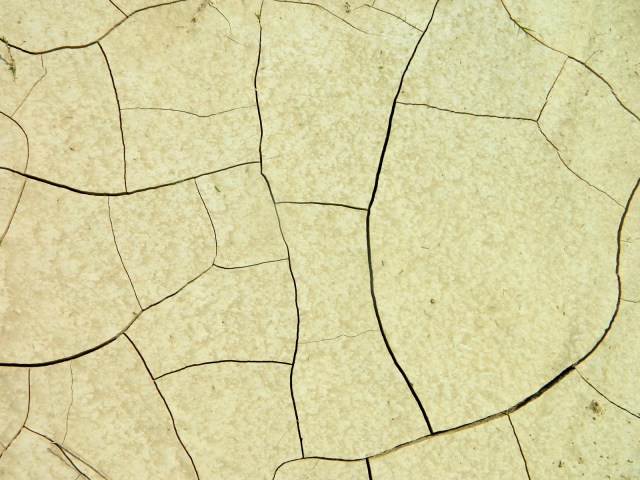
But the ground reveals the lack of water.


Sometimes, buried deep in a pile of paper with other things I once deemed interesting or noteworthy, I find a sheet with my own handwriting. It usually has a crisp headline, underlined, followed by a first paragraph of what should have become a story, but which, for lack of time or energy or peace at the time, remained a skeleton. A skeleton, which, unlike most other skeletons, never had the joy of walking or swimming or flying. Because I, the creator, never finished the birthing process.
Sometimes, there are a few notes about how the action would have progressed, who could have said what, who should have died and who should have lived. Or there are notes about the intention of the story or, to be precise and honest, the intended intention of the intended story.
Sometimes, after only a few paragraphs of cursory notes, there is already the final sentence, like a pediment planned, commissioned and constructed before one has even bought the piece of land for the library to be built on.
Sometimes, these notes provide an idea about my former self, about my way of thinking at another time, in another place, under other circumstances, always younger, but often only arithmetically so.
And sometimes, I can’t make sense of what I once deemed putdownworthy, try as I might. Then I am wondering, “What the hell was I thinking back then?”, and throw what was once the short-if-at-all-lived zygote of a story into the wastebasket. The one with paper, of course, which I shall take to the recycling container in town the next time I feel like having kebab or cake.
Now, if I was a painter and found a similarly undeveloped and sketchy draft that made no more sense to me today than an accident, I would probably take it to a gallery and sell it.
Now I know where everyone has been hiding.


Two countries walk into a bar, because there was an offer for any couple whose names start with the same letter.
Says Yugoslavia: “I was so unlucky that my wars already took place in the early 1990s. A few years later, and the internet would have saved us. My people could have alerted the world about the massacres and the threat of genocide via Twitter and Facebook. Surely, the global community would have come to our help. And if that hadn’t worked, we would have held our children and cats into the camera and uploaded the videos on YouTube. That might seem a bit desperate, even cheesy, but nobody would have remained untouched. Too bad that these social media came too late. We could still be alive.”
Answers Yemen: “Oh, you naive …”
They are interrupted by the sound of bombs, explosions, screams for help. Analog, digital, multimedia.
But nobody listens. The world is watching football and twittering photos of beaches, burritos and bikinis.

“Quick, find the router! If we are offline, nobody will care about us.”
I had already become skeptical, with all the praise heaped on Granada. “Most beautiful city in Spain, best example of Moorish architecture anywhere in the world, breathtaking, fascinating, spectacular, unique, and so on.”
But when I got there, well, see for yourself.
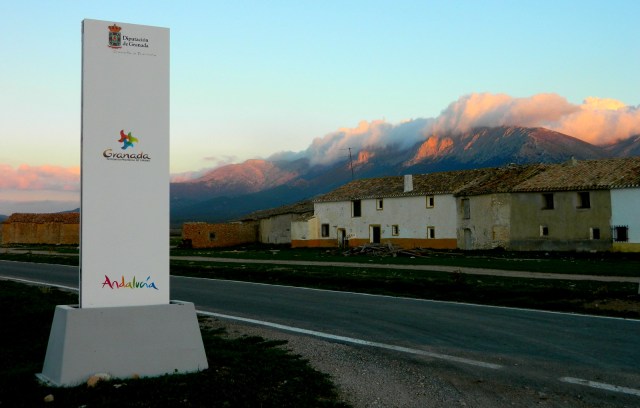
Granted, the mountains in the back looked great, reflecting the last rays of the setting sun. But it was by far not as grand as I had expected.
I couldn’t even find a hotel.
When the owners of the house in Venta Micena moved here 15 years ago, they thought: “This place needs a forest.”
And thus they planted one. A beautiful one, looking quite natural and wild. It even has its own temperate microclimate.


It also has a practical use because of the fruit trees. Each day before I depart for a walk, I take a few apples with me. And I have never tasted yummier apples before.


The apples also make the forest attractive for foxes and wild boar, but so far, I haven’t spotted anything more ferocious than a cat.
When you saw the remote village and the old farmhouse where I am staying, you were probably wondering if I even had access to water. But you needn’t have worried.
There is even a private swimming pool behind the house.
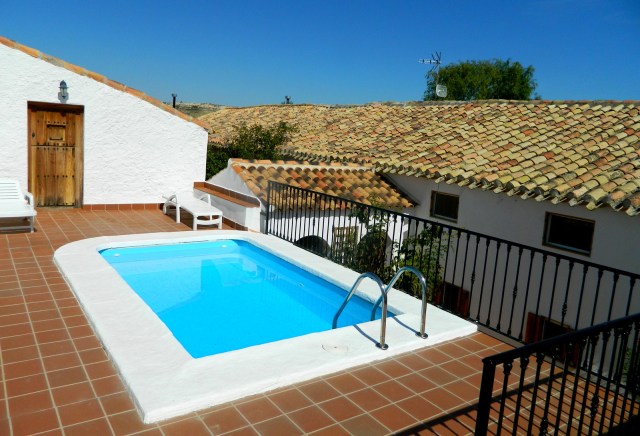
No reason to get jealous, though, because I don’t really know how to swim.
If you ever want to come here for holiday, the house is available on Booking and on AirBnB. If it will be your first time using AirBnB, you may sign up via this link to receive 25 € in credit. On Booking, you receive 15 € if you sign up via this link.
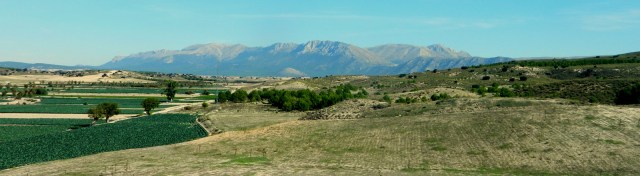
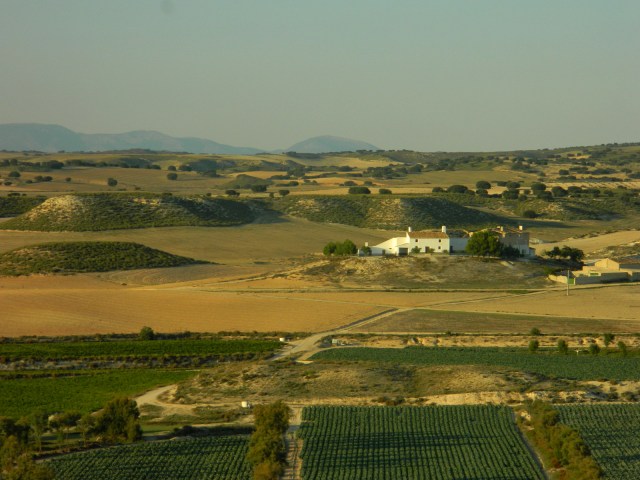
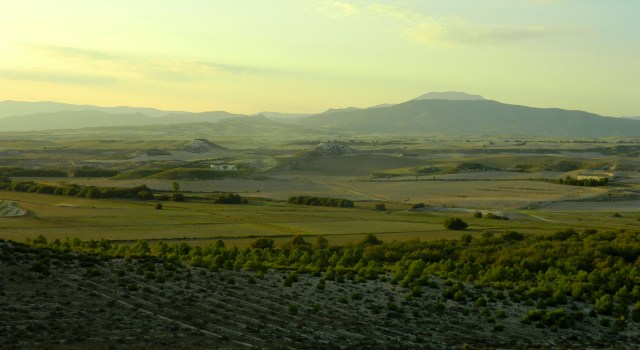
So, you already got a first impression of the village, the house and the cat. But the surrounding landscape is quite beautiful, too. Here are some views from my first walk.


 The Happy Hermit