
Signs of the Civil War are everywhere in Spain.

Signs of the Civil War are everywhere in Spain.
As if I had known how beautiful it would be in Venta Micena, Andalusia, I brought a book about a similarly beautiful valley to read during my stay: The Pastures of Heaven by John Steinbeck.
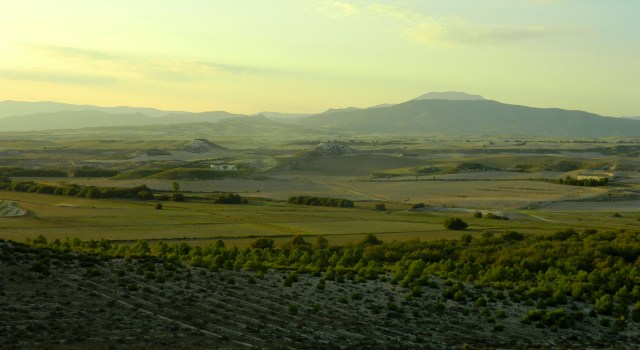
In this early work, first published in 1932, Steinbeck already displayed many of the skills that led to great works like The Grapes of Wrath, Of Mice and Men or Tortilla Flat – and to the Nobel Prize in Literature. There are twelve short stories, loosely connected by some recurring characters, but all connected by place: a valley in California, the beauty of which nobody can deny and which is the book’s real main character.
The protagonists are mostly normal people, farmers, store owners, housewives, teachers, likable too, yet memorable. Steinbeck only needs a paragraph or a few sentences about something they do, they say or even what they don’t say to let the characters come to life.
 As with most books by Steinbeck, not all ends well, but it is far less heart-breaking than some of his later works. And even when a story ended on a sad note (not all don’t), the feeling for me as a reader was one of melancholy more than of sadness, and it was overshadowed by how marvellously the story had been told. As I sat on the porch, I closed the book after each chapter, for I had to reflect on the people whose lives had been presented to me. With each of them, I had the sensation of wanting to meet them, although I am usually not a very social person. Even when a character has a negative trait, like the farmer who constantly brags about his wealth, you feel more sorry for him, rather than rush to judgment.
Maybe individual fates were less important, knowing that the valley was still there, in the book and in real life, and the valley would continue to be good to its people.
My personal favorite of all the people is Junius Maltby.
The people of the valley told many stories about Junius. Sometimes they hated him with the loathing busy people have for lazy ones, and sometimes they envied his laziness; but often they pitied him because he blundered so. No one in the valley ever realized that he was happy.

Whether you want a short introduction to Steinbeck or whether you have already read his better-known novels, I don’t think you will be disappointed by The Pastures of Heaven. Steinbeck’s books always leave me with the feeling as if I have learned a lot about humanity.
(Many thanks to Jacqueline Danson, a loyal reader of this blog, for sending me this book and several others. If you, too, want to support my blog, here is my wishlist. My North American readers, who have hitherto relented in the face of prohibitive postage fees, will be delighted to read that I shall move to Canada in December. And for that hard winter, I’ll really need some good books.)
At one time, the frontier between Arab/Moorish al-Andalus and the Kingdom of Murcia ran close to Venta Micena. That explains the Arab watchtowers on some of the hills around here.

Sometimes, people send a donation to support this fabulous, entertaining, helpful and inspiring blog. Any donation will be rewarded with a personal postcard.
Because there is no post office in Venta Micena, I will even walk 7 km to the next town, Orce, although the path leads through a scary canyon.
Maybe not so scary at first, when it’s still lush and green.

But soon, it dries up and the walls become ever more imposing.

Because all the arms of the canyon look the same, it’s also easy to get lost. In such terrain, getting lost means certain death, of course.

Speaking of death, the last part takes me past a really spooky cemetery.
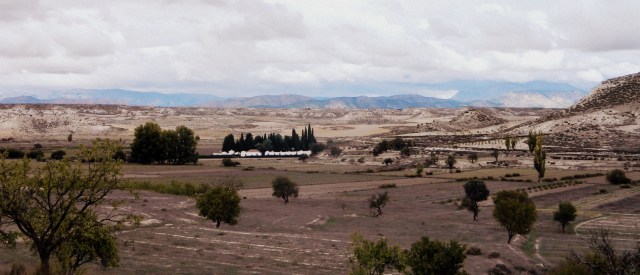
But for my readers, I walk this path (and back) at least once every week.
One early morning, on the way to climb the Sierra de María, I saw this table-topped mountain.
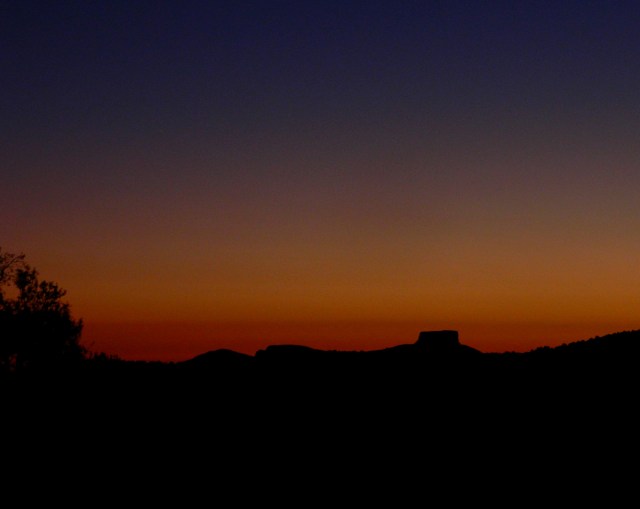
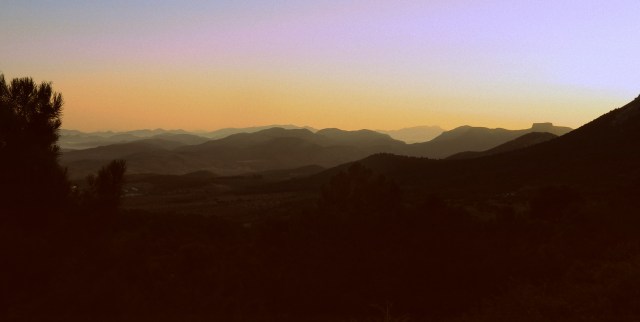
Tonight, it walked into the photo again.

I jumped into the car to chase it down, managed to stop it near Velez Blanco, but the mountain refused to provide its name.
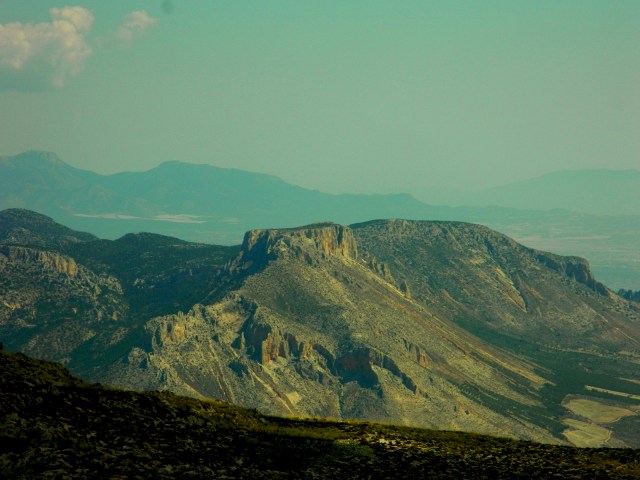

I wonder if there is a hiking path to the summit. From afar, it looks too tricky/steep/dangerous.
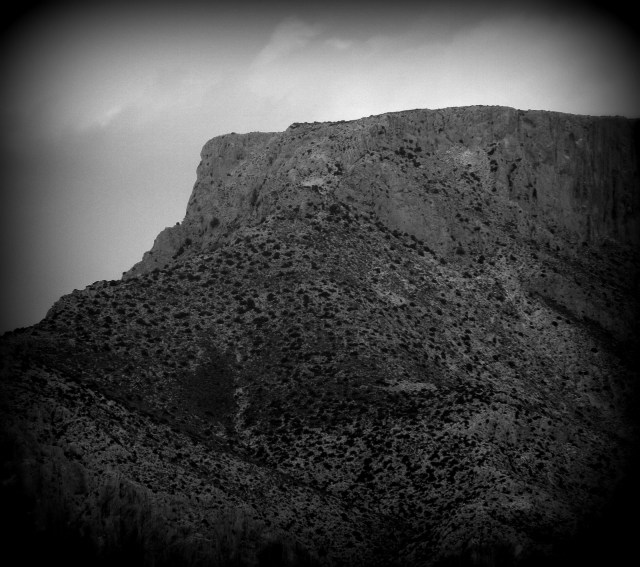
This one mountain mightily adds to the Western-feeling in Andalusia.
In the countryside, we go to bed early and we rise early. The latter isn’t that hard when sunrises like this one expect you almost every day.


When I spoke of people shooting at me, nobody believed me.
So, I ventured outside again and took photos of the many bullet casings lying around.


Also, I noticed someone following me with a drone.

And then, most cunning of all the attempts on my life, I have narrowly avoided such holes, again and again. They are dug on the paths that I normally walk along, dangerously also at night. They are so deep that it’s impossible to see all the way to the bottom. The walls are so steep that there wouldn’t be any chance of climbing out. And, of course, nobody would ever find me there.

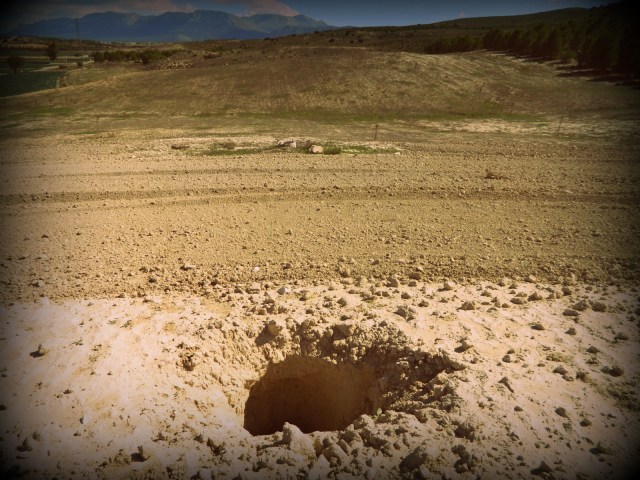
I am dreading the thought of how many skeletons are down there.
Why anyone would want me dead or disappeared so badly, I really have no idea. Maybe it’s just like John Steinbeck wrote in The Pastures of Heaven:
It is a difficult thing and one requiring great tact quickly to become accepted in a rural community.
I had gone to Huéscar for market day, thinking I might as well look for my favorite Spanish newspaper, El Pais. It would find it at the tobacco shop, I was told.
As I entered the store, just around the corner from the cathedral of Santa María la Mayor, the old owner, in a plaid shirt with a few buttons too many unbuttoned, didn’t bother to look up from his own newspaper. But the cigar which he held between his lips, early in the morning, gave me another idea.
“Sir,” I announced my presence, “you wouldn’t happen to have any Toscano cigars?”
He raised his head slowly and squinted at me, as if trying to ascertain if I had spoken in earnest or in jest. “What?”, he asked.
“Toscano cigars. The ones from Italy.”
“From Italy?”, he repeated, his expression unchanged, as if we were playing a game of high-stakes poker. “Well, what do they look like, son?”
“They are about 10 cm long and you break them into two parts.”
While this may sound strange to anyone not familiar with cigars, it spurred the old man into slow motion. “Wait here,” he commanded with a pointed finger, stepping down the stairs below his shop. Something was creaking terribly, and I couldn’t make out if it was the wooden planks or his bones.
After what seemed like eternity, he came back up with an old cardboard box. I could see that he had just removed the dust of decades, for cobwebs clung to his right sleeve.
“When you spoke about breaking them into two parts, I remembered something,” he said, clinging to the closed treasure chest. “We used to have one customer, just that one, who ordered large quantities of these cigars. He came up once a month and bought whatever stock we had.”
The gentleman was still puffing on his cigar, throwing the ash on the ground, as he continued: “He was a tall, handsome fellow, like you. I was only a boy back then, working with my father, so it must have been in the 60s.”
“So, do you still have some?”, I inquired.
When he opened the box, there were six packages of the finest Toscano cigars, untouched. “He didn’t pick up the last order and I never saw him again. Got no idea who the fellow was and what became of him.”
Sensing the opportunity of a bargain, I proposed to buy the whole lot.
After the transaction was completed and I was just one step away from entering in to the fresh air, which I could now pollute with pleasure, the owner called after me: “You know, I seem to remember that the fellow had a hat just like yours.”
“What a coincidence,” I said nonchalantly, but with a mischievous smile. I almost knew for certain whose cigars I had bought. In 1964, 1965 and 1966, the movies A Fistful of Dollars, For a Few Dollars More and The Good, The Bad and the Ugly were filmed in Andalusia.
As I got home to Venta Micena, I stepped out of the house (we house-sitters never smoke inside) to enjoy one of the cigars, and I felt like I was traveling back in time. Or maybe the cigars had somehow gotten stronger while stowed away for half a century.



 The Happy Hermit