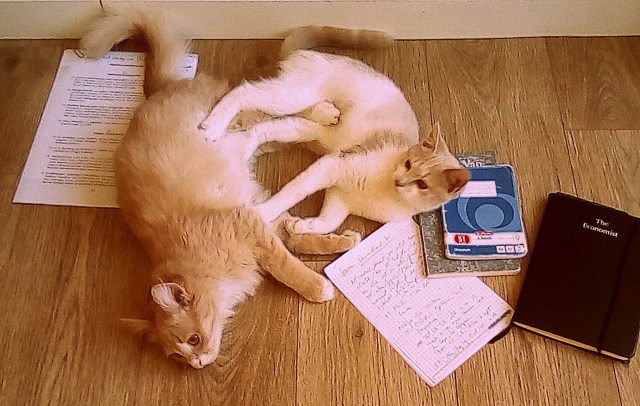
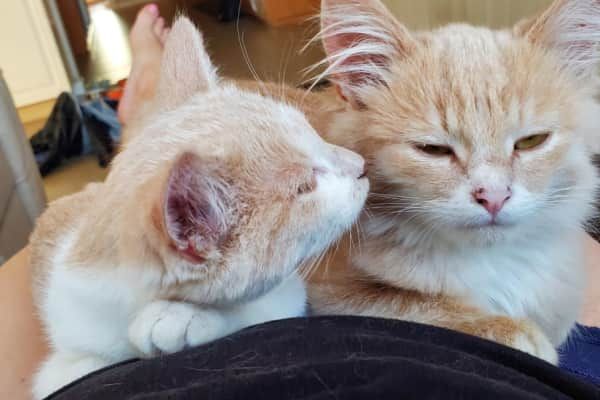
The reason for my stay in Kyiv are two young kittens, Stella and Stuart, about half a year old. They are full of energy, very sweet, always ready to play, but equally interested in my work.
And when I am still at the desk by 10 pm, the cats are already waiting in bed, reminding me that there are more important things in life than work.
And by 6 am at the latest, the rest is over. The cats are hungry and if I don’t get up voluntarily, they will gently bite my toe or arm.
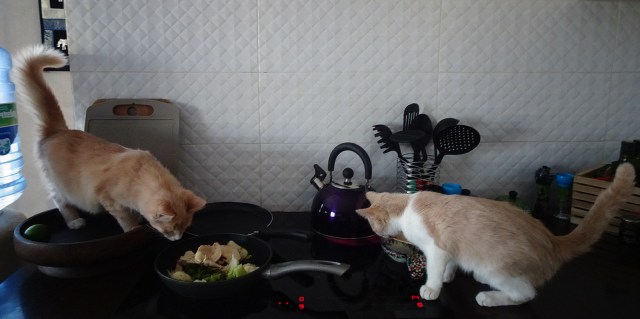
Overall, food is very important to them. As soon as I come home with a shopping bag, open the fridge or begin to cook, they want to be part of the action.
I can only eat with one hand because I need the other one to fend off the two kittens. Probably, I will eat out more often. But I simply can’t be mad at them, they are just too cute.
During the following three weeks in Kyiv, I will probably gather so much material that the resulting article, should it ever materialize, will be too long for most of you to read. For those more interested in my travels and less in my endless ramblings about 20th century European history, I will publish a daily photo from the Ukrainian capital instead. Like Instagraph, basically.
Let’s start with the view from the apartment which I am sitting and which comes with two cute kittens.
Arriving in the evening, it can actually look rather gloomy at this time of year.
I am staying in the far west of the city, about 10 km from the center, but perfectly connected by a fast metro. Lots of skyscrapers, but between them there is the odd historical building or a church.
And as soon as the sun comes out, you see the advantage of Soviet city planning: whichever direction I look from the 19th floor, I see green spaces, parks and tree-lined avenues. Which makes way more sense than selling a plot of back garden to every petit-bourgeois family, thereby artificially creating a shortage of land and raising its price, although the gardens ultimately won’t be used for 99% of the time. Here, on the other hand, everyone can enjoy green spaces close to their home for strolling, jogging, playing chess, making pull-ups, walking the dog and feeding squirrels.
And this is in December when most trees have shed their leaves. Just imagine what this will look like in friendlier seasons!
If you know Kyiv, I’d be happy to hear your recommendations. If not, I am looking forward to your questions.
We still have to wait until 3 April 2020 for the new James Bond film No Time to Die to be released, but here is the first trailer:
My worst fears have materialized.
The writers still have absolutely no novel ideas and thus simply continue the non-story line of Spectre, the worst James Bond film ever. Why Christoph Waltz and Léa Seydoux were hired again after their lackluster performances, nobody knows.
Every scene in the trailer is a copy from previous films, the dialogues are flat, Daniel Craig hasn’t picked up a third facial expression, and women are still mostly meat packaged in tight dresses, it seems. You’d think that the producers put the best bits into the trailer, but this is terrible.
The film is called No Time to Die, but maybe it is time to die for Mr Bond, after all. Especially as we have seen how well plot-driven spy movies work, for example in The Americans, The Night Manager and Deutschland 83. If you have watched anything of similar quality, I would be happy to hear about it.
Truth is the first victim of war, one could sum up the film Donbass, which confused me more than it educated me. But it did so in a memorable, partly unsettling, partly amusing way.
In 13 episodes, Sergei Loznitsa portrays life in embattled Eastern Ukraine. Or his imagination of life there. Or how the separatists portray life there. Or an image of the separatists that Ukraine wants us to have of them. Or even more complicated. Again and again, there are false flags and blatant lies.
If you haven’t read anything about the war in Ukraine, you won’t understand much from watching this film. But the one thing one is reminded of starkly: a country in Europe has been experiencing war since 2014. The fact that the rest of Europe, and the world, needs to be reminded thereof is part of the problem.
The film is not for those of delicate disposition, as some episodes are rather brutal, like the lynching or the massacre in the make-up salon. But then, others are very funny, like the checkpoint where soldiers hope to take some lard of grandmothers on the bus. Or the men in prison, all desperate on their phones.
Throughout the film, the actors are very good. You never know if they are professional actors, extras hired on the spot, or if they are just themselves, not even noticing the camera.
I haven’t been to Ukraine yet – a shortcoming that shall be rectified soon -, but I feel like I have met many of the characters in Donbass over the years of living and traveling in Eastern Europe. Including the Russians greeting me with “Hitler kaputt” upon learning that I am from Germany:
Do you have other film recommendations for my upcoming trip to Ukraine?
Recently, I stayed with my father in Bavaria, where life is informal and one can put the feet on the table and smoke inside the house. We were both preoccupied with reading, my father with the newspaper and me with a book about the end of the Soviet Union, when I took a cigar from the casket on the living-room table.
It is a wooden box, elaborately ornamented, with amber intarsia, or so I had always thought, until I noticed upon closer inspection that it was straw. The treasure trove has clearly been in use for a long time, but it is still recognizable as the result of a love affair between creativity and craftsmanship.
“Nice box,” I say appreciatively, because I really like it and because parents like to hear that some of the household objects for whose acquisition they once toiled on the assembly line are appreciated by subsequent generations instead of being taken to the recycling centre or handed over to the aunt, who sells estates at the flea market, immediately after the demise of the original purchaser.
“Dimitri made it,” my father says cryptically. We do have carpenters and other wood artisans in the family, but I have never heard of any Dimitri. Having noticed my questioning look, he continues: “He was a Soviet prisoner of war, living on my grandparents’ farm in the Bavarian Forest.”
It sounds a bit like someone having a nice time in the countryside, but I am not that easily deceived: “A forced labourer, then?”
“In a way,” my father admits. Unlike other members of his generation, at least he is not into historical revisionism.
We both talk ourselves into believing that it was not the family’s fault, because prisoners of war were probably allocated as forced labourers, and that Dimitri, of whom we know nothing else, must have had a better time on the farm near Kötzting than in a mine, an armament factory or a concentration camp. Still, I am shocked. If even a small farming family with a few cows had a forced labourer during World War II, how many other families and companies in Germany had them? The cookie princess is probably not alone in her ignorance.
And as always when it comes to the Nazis: the more you read about a topic, the more horrible it becomes. First, it was not only prisoners of war who were forced into labour, but millions of Eastern European civilians were abducted to the Reich as well.
Second, Germany continued the racially motivated war of annihilation even against Soviet prisoners of war. They were systematically under-nourished and were treated much worse than Western European or North American prisoners. About half of them died during their captivity in Germany.
Third, the surviving Soviet POWs were then stigmatized in the Soviet Union after 1945, being regarded as traitors and collaborators. Often, they were directly sent to another labour camp. Internment in Germany was a life-long stain and a taboo, both in public as well as within families.
And fourth, the successor countries of the Third Reich denied any compensation to civilian forced labourers until the 1990es. Only in 2000, the Foundation “Remembrance, Responsibility and Future” was established for that purpose. By then, most of the victims had passed away. The prisoners of war never received any compensation at all.
After spending last winter in Canada, I could have been forgiven to choose a warmer place this year, like Barbados or Morocco. (Although Alice, the cat in Calgary, will remain in my heart as the loveliest and most affectionate cat I ever cared for.) But then I got a call from two kittens in Ukraine who were too irresistible.
Stella and Stuart are just five months old, so this is a much bigger responsibility than caring for mature cats. They are still in their formative months, and I will have to be a good example regarding moral values, a healthy diet, studying hard and going to bed early.
I am especially happy about this assignment because there rarely are house sitting offers in Eastern Europe, my favorite part of the world. And I have never been to Ukraine before, so everything will be new and exciting!
From 14 December to 5 January, I will be in Kyiv, and after that I hope to have time to explore a bit more of Ukraine. On the way to Kyiv, I will also stop in Lviv for a few days, as I will be traveling by train or hitchhiking.
For those who know Kyiv, I’ll be staying close to Zhytomyrska metro station. I will be quite busy with the cats and writing and studying, but of course I want to get to know the city a bit. So if you live in Kyiv, I would love to hear from you!
I have already discovered that the area is relatively close to Babi Yar, which is an eerie thought. But then, I am studying history with a focus on 20th century history, so I should be used to what one can never get used to. If you live in Kyiv and are interested in history, politics and other social issues, I am even more eager to hear from you!
“Ever since I was a little girl, I had been dreaming of having a boyfriend who is writing,” she said, and I was happy. And she was happy with me writing instead of selling my time to some company and wasting life in an office. She didn’t seem to mind that this meant eternal poverty (for me, not for her). She even cleared the table in her bedroom, so I could use it as a writing desk.
When we first went on a trip together, I wrote about it, naturally, for I had deemed it a wonderful experience. She was not happy. “I want you to remove my photo.” I did. “I don’t want you to write that I am hot.” We negotiated that “attractive” was a more adequate epithet.
“I love the way you write,” she said, “it’s wonderful.”
The next day, she woke up, saying that she couldn’t sleep all night because of my story, that I was abusing her for entertainment and that she wanted to be taken out of the story. I rewrote it.
A week later, she had found a new grievance: “Why do you write about other people?” I explained that I write about people whom I meet on my travels and in life, on the train and in parks. “I don’t want you to write about other women,” she tried to censor me.
“Honey, half the world are women. I can’t write all-male stories as if we were living in a Taliban dream world.”
“I want to do everything to support you as a writer,” she said every day.
On the next trip, a long-time reader wanted to meet up in person and show me his city. He was male, so I didn’t see any problem. Oh, how naive of me. “I don’t want our romantic trip to be turned into a business trip.” I pointed out that he was going to give us a tour of the town, that this was not business, not least because I hardly earn anything with this little blog, and that I didn’t even know in advance if I could turn the trip into a story. I almost never know this in advance. Still, “I can’t enjoy our holiday like this. It’s too much stress.” I asked what she wanted to do instead. “Just walk around and meet nice people,” she said and I said nothing, but thought “????”
I’ll cut the next 24 hours short, but they included everything from “I don’t want to be in the way”, “I absolutely support your writing”, “why don’t you go alone?”, “but I love you!” to “I am so confused,” which was finally something I could agree with.
“Why are you taking a notebook and a pen?”, she asked one evening as we went into town. “To possibly jot down some observations. It won’t be about you.” Again, she complained that I didn’t separate writing and romance. “I will only take out the notebook while you are in the bathroom.” She was in bathrooms a lot. But she didn’t find it funny. I left the notebook at home, wondering how a girlfriend could have failed to notice my memory.
She took her camera, of course, and I had to pose for photos. She loved Instagraph.
The following month, we went to some rainy island. I didn’t take a notebook, no camera, I even tried not to memorize too much. I wanted to focus on us, enjoying the time together with no distractions at all. After the trip, she said: “You could write a wonderful story about this island!” And she was disappointed that I didn’t produce something out of thin air.
On the last day of the statutory three-month trial period, she terminated the relationship. In writing, of all ironies! Maybe she was angry that I could write better drama than she could produce, try as she might.
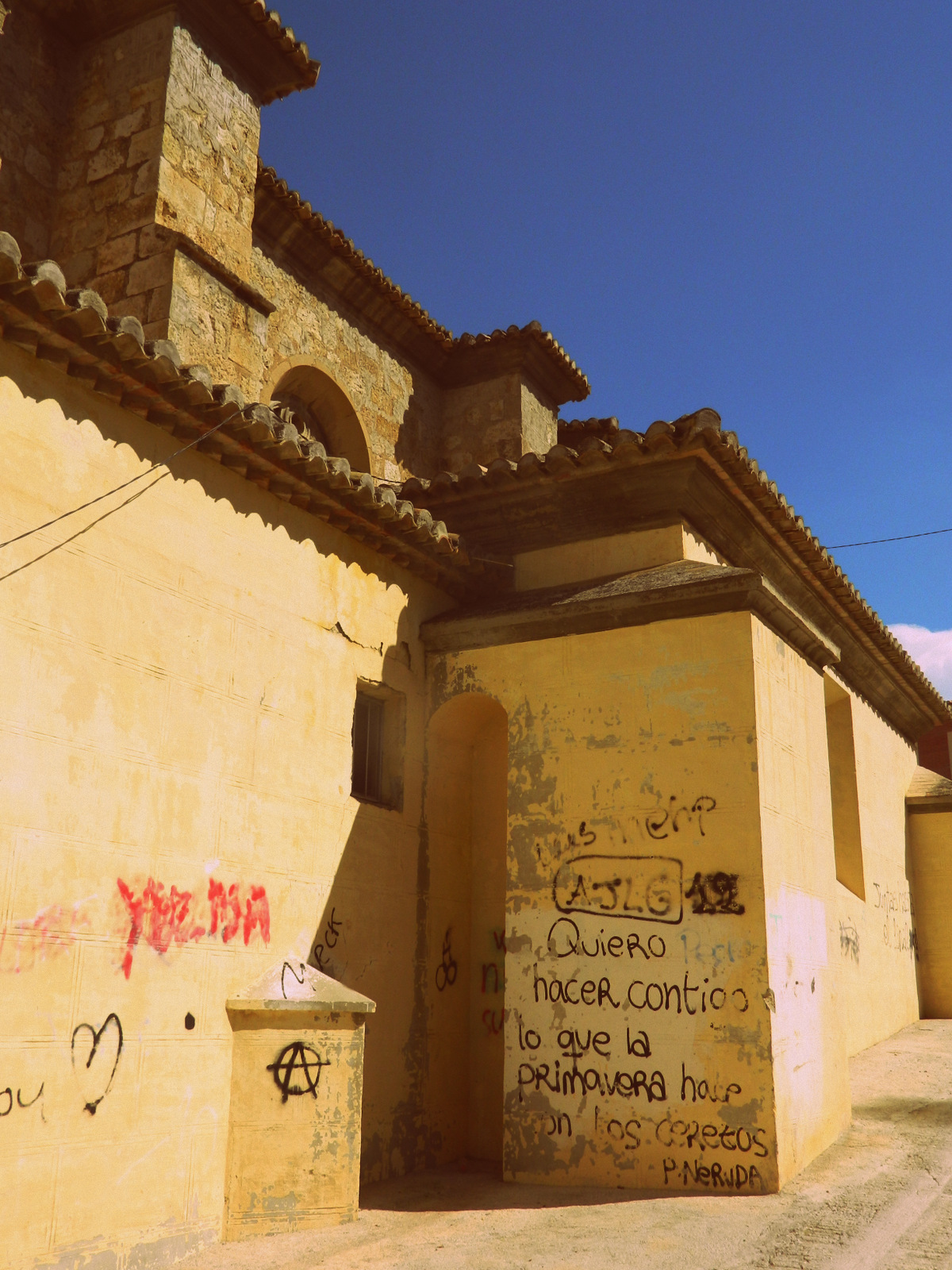
“I want to do to you what spring does to the cherry trees,” wrote Pablo Neruda on the wall of the cathedral in Baza, defying the wrath not only of God, but also of municipal anti-graffiti enforcers. But then, if you are constantly on the run and living in hiding, one more search warrant won’t make you lose any sleep.
Under the bewildered eyes of those going to warm offices, schools and shops, I am the only one to exit the bus at Signal de Botrange. Because the clock went crazy the last weekend, the sun isn’t quite sure whether to get up already or whether to hit the snooze button one more time. Behind the clouds, it is wafting in some interim state.
694 meters don’t sound like much, but I am at the highest point in Belgium. Therefore, it’s not only ice-cold, but also extremely windy. In spring, I had cockily left behind the winter coat, hat and gloves in Canada, thinking that it would never be as cold in Europe. And now I am shivering as if I was at the North Pole. My hands are turning red, my fingers are freezing stiff, and I can hardly grasp the pen, let alone write legibly.
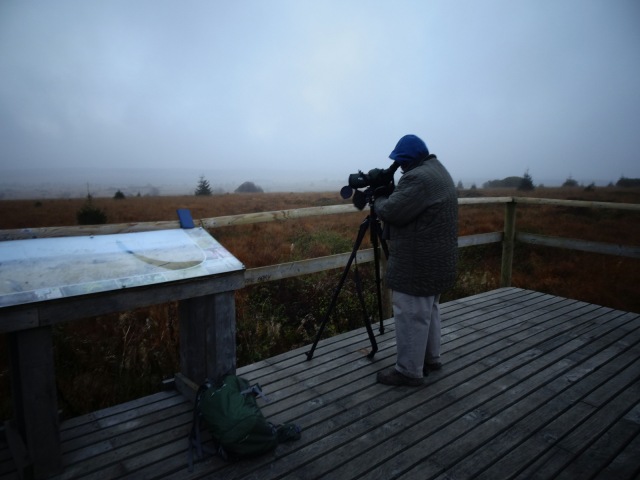
On a viewing platform, there is a gentleman who is visibly better equipped and wrapped in wool, looking for birds. Even his binoculars are better protected against the wind than I am.
“Today is not a good day,” he explains. A bad omen. “There were too many westerly winds in the last days. Now the birds are taking the route across the Eifel. But on Thursday, we saw 12,000 cranes here. ” Because the birds are smarter, they are moving south now.
As the ornithologist learns that it is my first visit to the High Fens, he walks with me to a hiking map on a wooden board, even taking the risk of missing thousands of birds. He recommends that I walk around the core area of the High Fens. “You look like you can walk a lot,” he appraises me correctly, generously ignoring the insufficient protection against the biting cold.
I had actually planned to walk in a completely different direction, but: “On that way, you will get the best impression of the Fens.” I don’t really know the difference between fens, marshes and bogs, but the High Fens are obviously raised swamps. As everyone knows, those are much more dangerous than low swamps, just as falling from a cliff is deadlier than tripping over the curb.
Because the birdman seems to be here regularly, I ask him for the best time for hiking. “Now it’s actually the prettiest,” he answers, while I am looking over fog-covered meadows, shivering from the cold. “In spring, too many paths are closed. In summer, there is the threat of wildfires. Now, in late fall, the Fens look like are supposed to look.”
I change my plan for the day because if someone knows how many birds are flying to where on what day, he surely knows the best hiking trails too.
The lack of colors in the landscape makes me suspect that the birds are moving to Sicily or Morocco mainly out of boredom.
But the vultures might as well stay behind. Again and again, I find crosses reporting of hikers that froze to death, got shot, or whose skeletons are still stuck in the swamp.
The last cross was erected for the young couple Maria Solheid and François Reiff, recently engaged, who ignored all warnings in January 1871 and left to cross the High Fens with insufficient clothes. That plan sounds familiar. Their corpses were only found in March 1871, after the snow had melted.
Next to the lovers’ cross, there is an information panel: “In case of emergency, call 112. To convey your exact position, mention RVP number 430007.” Very well organized and thought out, but the mobile phone has no signal.
I am unsure whether to believe the lovers’ story because the cross is suspiciously close to boundary stone no. 151, displaying a large B for Belgium on one side and a large P for Prussia on the other. Maybe they were smugglers? Or spies?
The almost completely uninhabited landscape was always a good area for borderlands, between the principalities of Liège and Stavelot-Malmedy, between the duchies of Luxembourg, Limburg and Jülich, between the Netherlands and Prussia, then between Belgium and Prussia, and ultimately between Belgium and Germany.
Thanks to the European Customs Union, there is no more smuggling, but you can still die a gruesome death in the moor.
I try to pay a bit more attention than I usually do, looking more on the ground than into the grey sky. The most treacherous parts are covered with wooden planks, flanked by previous paths already sinking and decaying. Two workers are repairing the current pathway and tell me that a great many trails were destroyed in the great fire of April 2011. Good that I don’t have a cigar in my mouth as I encounter them, or they might blame me.
The hiking trails are not the only thing being worked on. The whole landscape was remodeled to make it swampy (again). From 2007 to 2012, around 7400 acres were renaturalized. Spruce trees were cut down. The top soil was removed, allowing moorland herbs to grow again. Old moors were made wet again. You feel a bit like on a construction site, not in nature. But then, what is nature really? 2000 years ago, the area was covered with forest, and only since the Middle Ages did agropastoral cultivation lead to a heathland. The marshland thus created was later cleared of the water to cut peat. Renaturation is thus just the creation of an erstwhile state, arbitrarily chosen from time, but definitely not the recreation of the original natural state.
The walk takes several hours, but remains uneventful. No bog mummies. No jack-o’-lanterns. And the hound of the Baskervilles has been barred anyway.
Hiking itself has not been banned altogether, but the wooden planks really dictate the path. This may be helpful for people who tend to struggle with orientation. But for me, who likes to roam freely, it feels too much like I am being guided, led, like a train on tracks.
Thus, without having any other choice, I reach Baraque Michel, again on the main road through the High Fens. But the house is much older than the road. Back then, the High Fens were really dangerous. In 1794, Michael Schmitz almost sank and made a vow. In case of survival, seeming quite improbable at the time, he wanted to dedicate his life to save other victims of the moor. He did survive and built a simple structure, called Baraque Michel. His children continued the work and over time, more than a hundred people were saved. Donations of survivors made the house grow bigger, and with money, compassion was replaced by capitalism. Nowadays, lost hikers are no longer rescued, but are charged 28 € for a flambéed fawn steak in cognac and cream sauce.
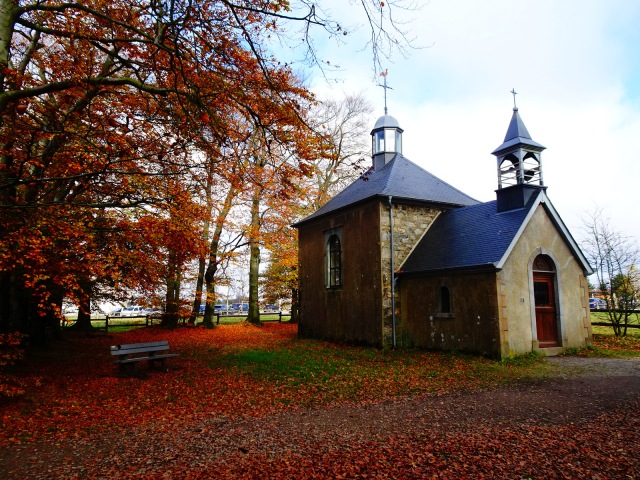
At Fischbach Chapel, you can still see that it has a bell tower and a lighthouse, both once intended to aid orientation.
Less optimistic or hardship-resistant hikers would now conclude the day. It is cold, it is grey, it’s lunchtime, and one could catch the bus back to Eupen from here. But for me, it’s time to unpack the original plan of exploring the western half of the nature park, hiking in a somewhat southerly direction, towards Malmedy.
And what happens? The sun is coming out. It’s getting warm. The colors are turning green and blue and red and yellow. The creeks are bubbling cheerfully. The cigar glows happily. Rabbits and deer are dancing in the fields. The author jumps from stone to stone to avoid drowning.
All of this I would have missed, had I thrown in the towel after the miserable morning. You are welcome to draw some lesson from this, if you insist.
Somewhere in the forest, there is a weather-beaten wooden sign pointing to Reinhardstein Castle. I have no idea if I am still walking towards Malmedy anyway, so I spontaneously discover my enthusiasm about the prospect of a castle. Walking along an overgrown creek, I walk higher and higher, until I have to climb up a hillside which is so steep and cleared from trees that one wrong step would send me rolling back down into the creek. I can’t see any castle.
Exhausted, I sit down on a stump, light a cigar and soak up sunshine and tobacco. And there I see it, on the other side of the canyon: Reinhardstein Castle, first built in 1354. Majestically, it sits on a natural throne, wearing a dress of autumn-colored leaves.
I would like to take a closer look at the castle, knowing of the readers’ curiosity, but the closer I get, the more screams I hear. Each of them shriekier than the other. And even worse: they are the screams of children! Probably the four sons of Aymon, still hiding from the bailiffs of Charles the Gruesome.
I am scurrying away through the dark undergrowth, in full panic mode. But at least I know the most beautiful spots in the High Fens now. I shall keep the secret as the moor keeps its.
Practical advice:
From Eupen, TEC bus 394 is going through the High Fens. Baraque Michel or Signal de Botrange are good spots to get off. One ride costs 3.50 €.
For cyclists, the Vennbahn cycling route might be of interest. It leads 125 km along an old railway line and also through the High Fens. You can cycle all the way from Aachen across Belgium to Luxembourg.












 The Happy Hermit