“Wow, already 28 likes and three comments,” she thought, proud of having run five miles in less than 45 minutes for the first time. But still only 291 Instagraph followers, she checked to her disappointment, for the fifth time that day.
Stepping off bus number 247 and onto Radford Road, she was still looking at the screen of her new I-phone 11, when she was hit by a 12-ton truck.
I had been walking for three days, from Nazareth via Sepphoris, Cana, Kibbutz Lavi, the Horns of Hattin and Mount Arbel to Tiberias. There, I had upgraded to a bicycle to circle the Sea of Galilee.
The sun is burning relentlessly, although it is only March. I am still completely exhausted from the half marathon I ran in Jerusalem, just before the hike. And there is almost no water to be found along the trail. Except in the lake, of course. But I mean water that’s clean, without some prophet having put his feet into.
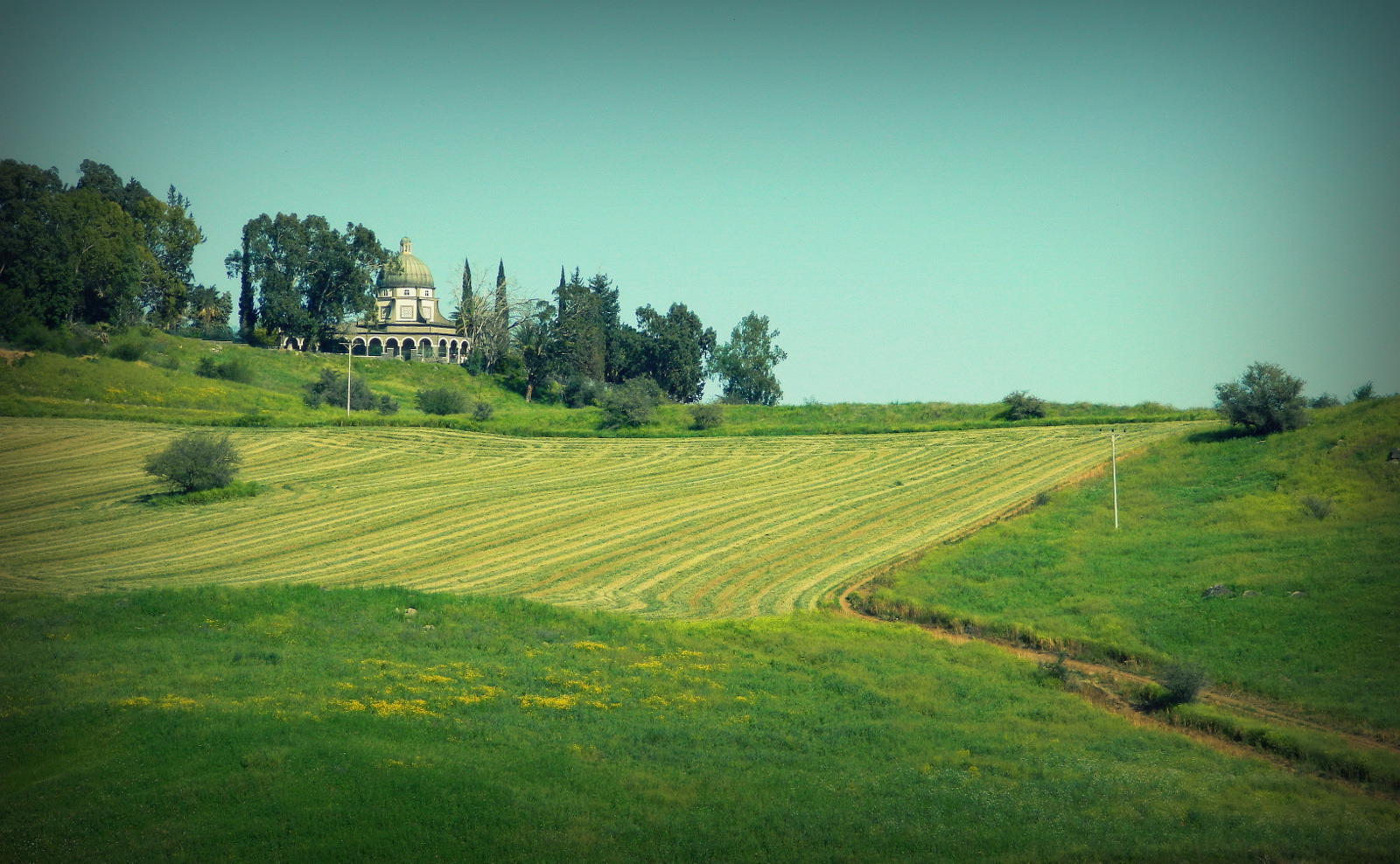
A church on top of a hill catches my eye. The beautiful view can already be imagined from below, the toll it will take to get there not. I have to dismount and push the bike. The hill turns out to be a mountain. Which is logical, because this is where Jesus delivered the Sermon on the Mount. The most important place of Christianity is not in Rome, not in Bethlehem, not in Jerusalem. No, it was on this mountain one Friday night that Christianity was founded. With this speech, Jesus turned from a Jewish rebel into the founder of a new religion. (Many Christian readers will be shocked now: “What do you mean, Jesus was Jewish?”)
My hopes rest on Jesus as well. Especially on sura 7 sentence 37 from the Gospel of John:
Let anyone who is thirsty come to me and drink.
And indeed, in the garden in front of the enormous church, the interior of which reminds me of the train stations built during Italian fascism, a fountain gushes, as promised by the master. Palm trees grow around the water hole. The sound of the water feels like an oasis in the desert.
In front of the pond, the above Bible verse is quoted. And next to it a secular sign: “water not for drink”.
After the stellar and promising start of the new series “One Hundred Years Ago …”, I am now under pressure to deliver a funny story every month. The problem: History is not always funny.
The whole month, I’ve been pondering whether (a) to use the Paris Conference on reparations to be paid by Germany to address the myth of the stab-in-the-back legend as well as of Germany’s financial overstretch by the Versailles Treaties, or (b) to use the Leipzig Trials to recall German war crimes in World War I and draw a connection to the Nuremberg Trials.
I find both very fascinating, but I am probably alone in this. So I choose (c) cats.
A hundred years ago, people were still environmentally conscious, which is why hardy anyone traveled by plane (and if they did, it was for dubious purposes). Railroads, long walks to Italy and ships were popular alternatives.
The latter is what we are going to talk about today.
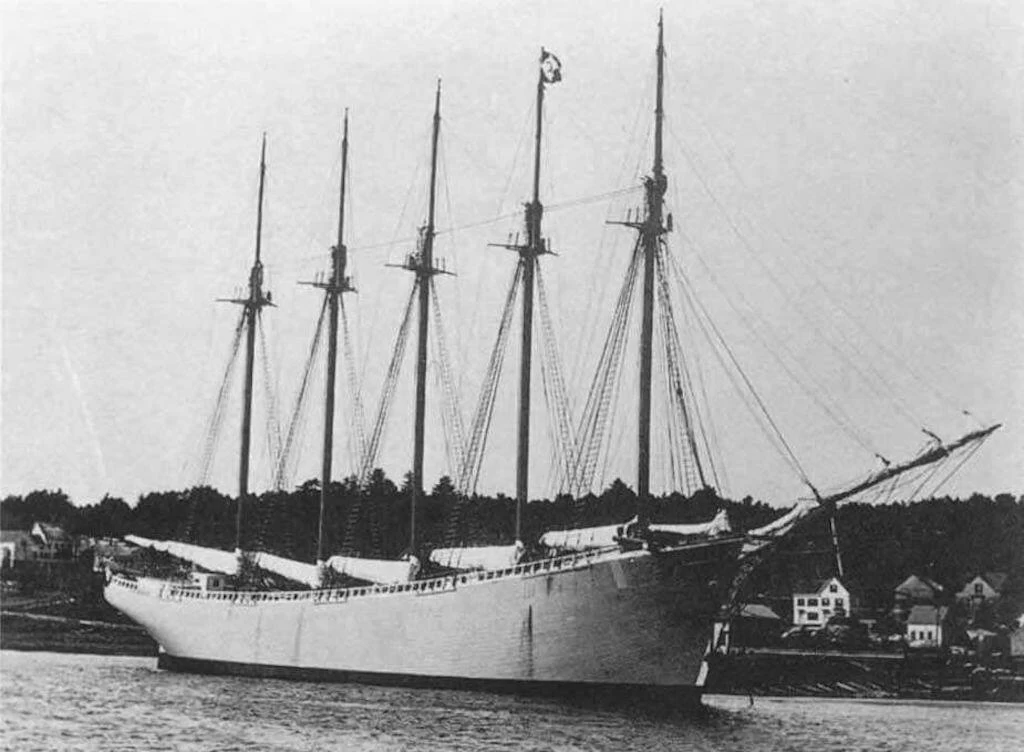
About a particular five-masted gaff schooner, as we sailors call it. A sailing ship, that is. A wonderfully elegant sailing ship, made entirely of wood, but used to transport coal. It was the Carroll A. Deering, named after the daughter of the shipowner.
Since 1919, the ship sailed back and forth between its home port in Virginia, Puerto Rico, Brazil and Spain, which was more dangerous than it sounds. Because this is exactly the spot marked by the Bermuda warning triangle, which was supposed to be avoided at all costs.
But costs are what shipowners hate, and thus, the captain was ordered to sail right through.
On 9 January 1921, the ship left the Caribbean island of Barbados, after the captain had bailed out his first officer from prison.
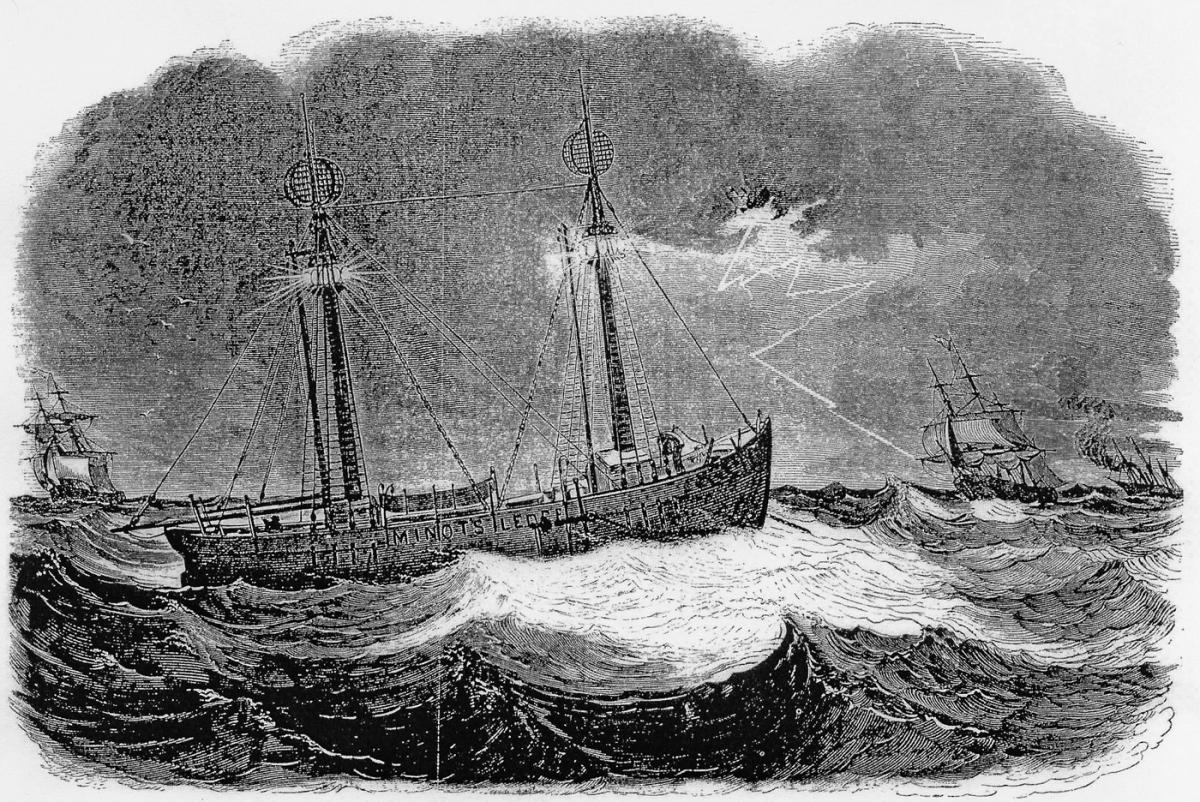
The destination of the voyage was Virginia, although I’m not sure whether it was on a direct course or a rum-induced lurching course. Because the first sighting of the Carroll A. Deering off the US coast was not until 29 January 1921, when our sailing vessel passed a lightship off the coast of North Carolina and made contact by megaphone.
Oh yes, a lightship is something like a floating lighthouse that is firmly anchored and ideally marked on nautical charts. Please don’t ask “what for?”, you landlubbers. Or read the book by Siegfried Lenz.
So a crewmember from the Carroll A. Deering called over to the lightship, informing it that they had lost their anchors in the storm and asking it to convey the message to the shipping company by telegraph. In his log, the lightship captain noted with astonishment that the call was not made by the captain, nor by the first officer, but by an ordinary sailor. He also noted that he could not spot any of the officers on board.
Mysterious. But the Carroll A. Deering was already sailing on again, heading for Cape Hatteras.
There, she was next sighted on 31 January 1921. Now, not only the captain and the officers were invisible, but the entire crew had turned into ghosts. The Carroll A. Deering had run aground on a sandbar. The sails were set, the lifeboats were gone.
Because of a raging and roaring storm, it took four days for the brave men and women from the Coast Guard, who were probably only men at the time, to finally board the Carroll A. Deering.
They encountered nobody. Not a human soul. No message left behind. No log book.
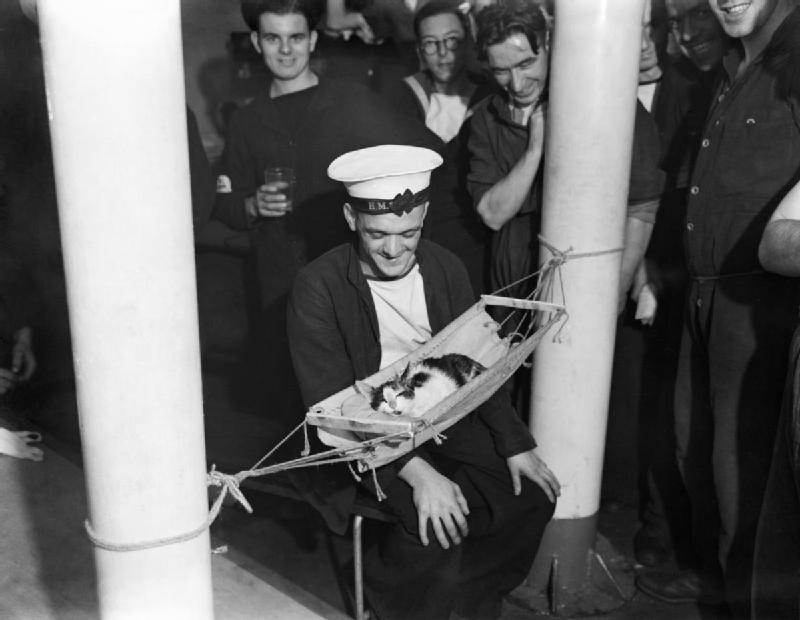
Only a cat.
The Coast Guard searched the waters for another month and a half, but found no trace of the rescue boats or crew. No one ever saw them again. No one ever heard from them again.
There were many theories:
Mutiny, not least because the lightship had not seen an officer aboard the Carroll A. Deering.
Alcohol smuggling, because Prohibition had been in effect in the US for a year, and the ship came from the Caribbean (rum, mojito, daiquiri). But then why would no one from the crew ever be seen again?
Abandoning ship because of the storm. But why would anyone do that? There was much less chance of survival in the small lifeboats. The ship itself was not destroyed.
Maybe a pirate attack. But there were no traces of a fight.
The wildest theory: The ship had been captured by Communists who wanted to take it to Russia. In fact, a search of the United Russian Workers Party headquarters in New York unveiled such plans. In 1920, German Communist Franz Jung had hijacked a steamer to sail to Murmansk to pay Lenin a visit, which, had this series begun a bit earlier, would surely have been honored in a separate episode.
The cat, the only one to know the truth, kept suspiciously silent.
“What is a cat doing on a ship?” you are wondering, and now the educational part begins:
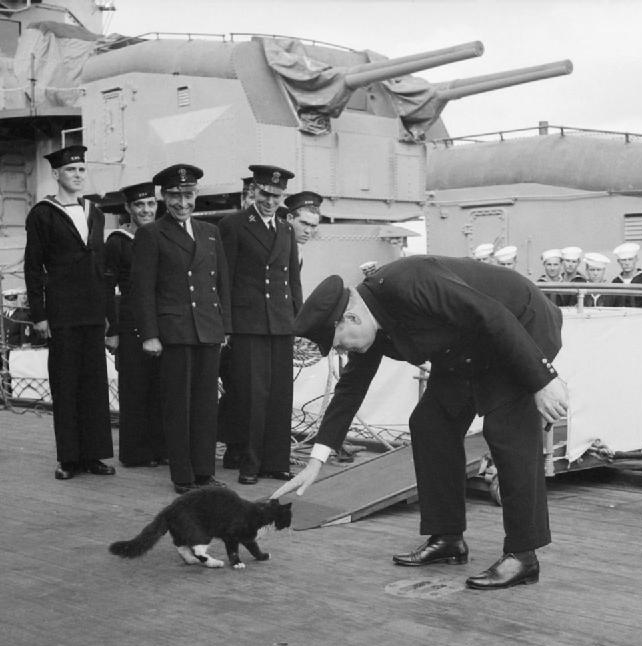
Until very recent times, cats on ships were not only nothing unusual, but mandatory. Especially on merchant ships, but also warships hardly dared to sail without a cat. And thus, cats came to America with Columbus.
The legal sources date back to the Middle Ages: The Rôles d’Oléron, a 13th century French maritime code. The Black Book of the Admiralty from the 14th century. The 15th century Code of the Consulate of Valencia. They all stipulate that the shipowner is liable for damages if the ship fails to carry a cat and goods on board are damaged by rats as a result. If the cat dies en route, a new cat must be taken on board at the next port.
According to a Scottish law from the 13th century, a stranded ship remained the property of the shipowner as long as there was still a man, a dog or a cat alive on it. The cat thus prevented the ship from becoming an ownerless shipwreck that any beach walker could pocket.
From the time of mercantilism onwards, France insisted in all trade treaties that every ship must carry at least two cats. Otherwise, the vessel was not considered fit for sea.
It was not until 1975 that the Royal Navy banned ship cats from its warships, and it is probably no coincidence that this marked the final end of the British Empire. Just think of the Seychelles, Solomon Islands and Gilbert and Ellice Islands.
From ocean-going cats, I could now move on to the development of maritime law, submarine warfare, the Titanic or the Battle of Jutland.
But I return to the Bermuda Triangle.
Not only do ships disappear there, but so do plenty of airplanes. (That’s why most US citizens don’t fly directly to Cuba, but first to Mexico and then approach the Caribbean island from the west, to avoid the Bermuda Triangle.)
Because this series could also be called “How to get from one issue to another hundred topics” instead of “A Hundred Years Ago …”, the planes disappearing in the Sargasso Sea remind me of planes disappearing in Germany at the time covered in this series. Without the Bermuda Triangle, but in an equally mysterious way.
But I will keep this short and only reproduce a newspaper article from Freiheit, a left-wing Berlin daily newspaper from 29 December 1920:
Under the heading “The Mysterious Planes” it says:
The Reich Ministry of Transport appeals to the public to turn in the airplanes that are still being kept hidden among the population. Since the working class does not have barns, forests, sheds and similar places of storage, there is hardly any point in asking them to hand over the hidden planes. So where are the hiding places? Well, in the enclosures of the large agrarians in the countryside, and it is strange that it is always the Entente missions that uncover such hiding places, causing utmost inconvenience to the German government.
Just the other day, as the Reich Ministry of Transport has to admit, another batch of planes, which had been kept hidden, was flown to Poland. The government has the obligation to pose as harmlessly as if it considered these shenanigans with airplanes to be merely black-market maneuvers and financial speculation. In truth, of course, these planes fill the arms depots of Orgesch and its related organizations, which move their stockpiles of weapons around to keep them out of the sight of the Entente mission.
[…]
That would give rise to at least three further topics:
The fight of right-wing forces against the republic did not begin in 1933, nor in 1923 with the Hitler putsch, but on the day the republic was founded. Perhaps that is why we should take a closer look at the constant revelations of right-wing extremist networks in the contemporary German military and police. In the past, airplanes disappeared, today weapons, explosives and ammunition disappear.
You probably wondered why German planes were flown to Poland. Well, it’s a bit like Fiume: Neither the armistice nor the peace treaties really brought World War I to an end. War was still raging on all fronts in Poland, and the planes from Germany were probably used to support the Germans in Upper Silesia. Everything quite unofficially, of course.
Under the Treaty of Versailles, Germany was prohibited from building an air force. What did the German military do? Well, of course, it secretly built up an air force. And it did so at the secret fighter pilot school and testing facility in – you’ll never guess – Lipetsk. That was in the Soviet Union. The intensive German-Soviet cooperation (there was also a joint secret tank school in Kazan) lasted until 1933. The foundations for the Hitler-Stalin Pact had been laid.
Each of these complexes deserves its own article. But for today, that was enough history, I think. So now I’ll disappear into my Bermuda Triangle and leave you to guess where in the world we will reappear in February 1921.
If someone is interested in deepening the topics only touched upon: No problem. With a little support for this blog, I could work on more topics per month. In return, you will get the perfect papers for your history class.
Links:
All articles of the series “One Hundred Years Ago …”.
With all this Bermuda Triangle stuff, maybe it’s safer not to have any sea, like Bolivia.
If you do not want to leave your ship, your house and your cat alone during a long absence, you need not worry: I am available as a house and cat sitter!
I don’t remember exactly what year I moved to Lithuania. It must have been about ten years ago.
But I do remember that it was on July 1st. Because in the same week, on July 6th, was my birthday.
From Vilnius, where I lived, I traveled to nearby Trakai. This is a national park with a lot of water and many islands, a castle, beautiful old villages, mysterious cultures like the Karaites, and – like everywhere in Lithuania – a lot of nature and greenery. Some of the islands are connected by wooden bridges, others can be reached by rowing boat.
So I hopped from island to island, like the Allies advancing on Japan, only more peaceful and placid. And without being shot at.
Instead of kamikaze killers, on many of the islands, especially the wooded and remote ones, I was greeted by fairy circles. Through the trees, I observed girls in long white dresses with flowers pinned in their hair. They held each other’s hands and were dancing in a circle and singing.
It was beautiful.
I didn’t want them to spot me. I didn’t even want to take pictures so as not to destroy the magic.
On some islands, there were several of these dancing and singing circles, and some noticed me. I turned down all invitations to join the dance, because at that time, I was still very shy.
When they realized that I was not Lithuanian, they welcomed me to the country and explained that July 6th was a very special day. I agreed with that, but – because I am not only shy, but also modest – without revealing that I was the birthday child.
I don’t know how word of my arrival had spread so quickly. And how they knew I was coming to Trakai that day.
In any case, no country had ever given me such a reception.
Later, someone told me that July 6th is a national holiday because King Mindaugas had been crowned on that day in 1253. However, this was so long ago, I don’t think people would still dance and sing for it. Besides, Lithuania is not a kingdom.
Puno, a small town in Peru. Situated at 3827 meters above sea level. It’s rather chilly uo there. I go to bed with a jacket and go jogging in the morning to defrost.
The people here don’t care about the 3827 meters. The ocean is far away. Besides, they have their own sea, right on their doorstep: Lake Titicaca. They call it a lake because you can drink the water, but it’s as large as the sea. Like 15 Lakes Constance, 47 Districts of Columbia or 107 Guernseys.
Looking for the train station, I follow the railroad tracks. Instead, I find the harbor. Doesn’t make much difference, I guess, steam locomotive or steamboat.
One of the ships is about to sail. Its horn roars. A man on deck calls out to me: “Do you still want to get on?”
“Where are you going?”
“To the Uros.”
Oh. A floating convention of urologists, then. All right, maybe I can sponge a free prostate exam. I get on board seconds before the gangway is pulled from under my feet.
But it’s not completely free, because Hernan, who is apparently something like a tour guide, relieves me of 70 soles (= 20 dollars). Never mind, I’ll eat more from the buffet to make up for that.
Hernan, who can read minds, says: “Lunch on the island is an extra 20 soles.” Alright, the prospect of an island puts me in a generous mood. Hernan introduces me to his sons: Lionel and Cristobal. The boy with the name like a soccer player is wearing a tracksuit of the German national team. Talking to the children incurs no extra charge.
It turns out to be a beautiful, sunny day. The kind of day that looks much warmer in photos than it is in real life. But at least there is no storm. The ship chugs through calm, waveless water. When you have a lake like this on your doorstep, you really don’t need the sea. (Only the Bolivians keep making a big drama, ever since they lost access to the sea, instead of being happy about owning half of Lake Titicaca.)
We are sailing through reeds. Or rather through a channel that leads through the reeds. So straight that it must have been artificially constructed. Like in Venice.
At a checkpoint made entirely of reeds, the boat slows down. Hernan hands down a stack of Peruvian soles and we are allowed to pass. No canal without a canal charge collection checkpoint.
“Now we’re in Uro territory,” Hernan explains.
“Once they lived on land, but when the Spanish came and forced the native population to work in the silver mines, the Uros fled onto the water.” Ever since I was in one of those mines myself, I can sympathize.
They built ships out of reeds and lived on the lake from then on, undisturbed by the Spaniards. (At the time, Europeans didn’t yet know how to swim.) After they realized that the Spaniards weren’t leaving anytime soon, they built entire islands out of reeds. Floating islands. With reed huts on them. I don’t know how they don’t sink, but they do look pretty.
“Originally they had their own language, Urukilla, but then it mixed with Aymara and eventually died out,” Hernan continues. That’s sad, but better the language dies than the people. The Romans don’t derive any benefit from everyone still speaking Latin, after all.
On the other hand, if more people died out, it would be better for the environment and the sea level would not have risen to over 3800 meters already. But for this complaint, the Uros are the wrong target. There aren’t really that many of them. About 1200 Uros on 87 islands, Hernan says.
Now their population is holding steady, he says, because they have two to three children per family, not all of whom stay on the islands. “Fifty years ago, each family would produce a soccer team as offspring.”
Ah, that’s why the floating soccer field is deserted now. Or maybe no opposing team wants to compete on such shaky ground.
We dock at a relatively small island. Six simple huts. And a tower, for communication with the other islands, using smoke, flags and mirrors.
I’m beginning to realize that I’ve joined a tourist cruise and that the 25 or so passengers will now harass the poor family on their little island. But the island does not sink. The ground is pleasantly soft and gives way with each step. And there is always a slight swaying. I would love to lie down and fall asleep.
But I have to pay attention, because now the island chief is explaining something. Five families live on his island. If there were ever ten families, then new living space would have to be created in the form of a new island, explains the man driven by an expansionist urge.
No problem, he says, there are plenty of totora reeds. They get them from the national park. He builds a small model of an island, fast and simple, poof poof. But because the water attacks the reeds, the island has to be renewed every three months. While living on it. It’s like changing the engine of a car while driving.
Speaking of cars: The island chief is quite proud of his two boats. A small one and a large, splendid one. “These are my Volkswagen and my Mercedes-Beng,” as he calls it.
They also have solar panels. For TV, radio, light. It’s definitely smarter than lighting a campfire.
What’s the rifle for, I ask, hoping for stories of pirate raids or the fight against colonialism.
“I shoot birds,” he says martially. He likes his role as defender, protector, breadwinner and leader of the small island. When we leave, I will ask for his name and won’t be surprised in the least that it is Adolfo. The other islands can be glad that he hasn’t invaded them yet.
Particularly sought after is a type of bird whose name I didn’t remember. Because of their large eggs. For omelets. In a corner of the island, I find only one dead bird. Apparently starved to death. With a last desperate cry in its beak.
When Adolfo casually mentions that reeds are edible, I can’t help myself. I haven’t had breakfast.
Tastes like celery. It would be monotonous, but in an emergency, I could eat my way through an entire island. Oops, now I forgot to wash my hands between touching the dead bird and the reed stick. Happens every time.
Adolfo invites us onto his boat. The big one, the “Mercedes-Beng”. And suddenly, from every corner and every hut, children come running, wanting to get on the boat.
It’s as busy here as on the canals of Venice. And everything because of the bloody tourists. Just like in Venice.
We cross over to the main island of the Uro territory. There are stores, restaurants, even lodgings for tourists. And for one sol, you get your passport stamped. All on a billowing patch of reeds. One storm, and the capital city is gone.
And there is a public telephone. In case you need to reach the children who live too far away for smoke or mirror signals.
Hernan would like to give smoke signals, too, because we have to move on. Strict schedule. So, back on the motorized ship and further out into the lake.
I am sitting next to Ryan from Alaska. He is with the Seventh Day Adventists and proudly points out a school run by his sect on one of the floating islands.
“We are represented in over 200 countries,” he says proudly, as if it was a business. Well, maybe it is.
One can only hope that Adolfo will soon turn his rifle on the invaders. The audacity of Christian missionaries to show up in areas where the population has been slaughtered, enslaved and raped by Christians really deserves a salvo from the shotgun.
But you don’t want to hear my angry rants, you want to listen to Hernan’s information-packed explanation. So: We are heading to the island of Taquile. Almost like Tequila, but not related in any way.
The terraced fields are the first thing you notice about the island. They protect the soil from erosion. It clearly works, as can be seen from the fact that many islands without terracing have disappeared. Atlantis, for example. The Solomon Islands and the Maldives are next.
The terraces date back to the time of the Tiwanaku. They ruled the island before the Inca. Well, actually before the Kolla, but after those came the Inca. This reminds me that I have wanted to write about the Tiwanaku, as I once visited their capital. Which is also called Tiwanaku, you can see it in the southeast of the map above. Southeast is in the bottom right. So, if you want to hear from the Tiwanaku, let me know. But first, let’s get back to Taquile, or you’ll get anxious with impatience.
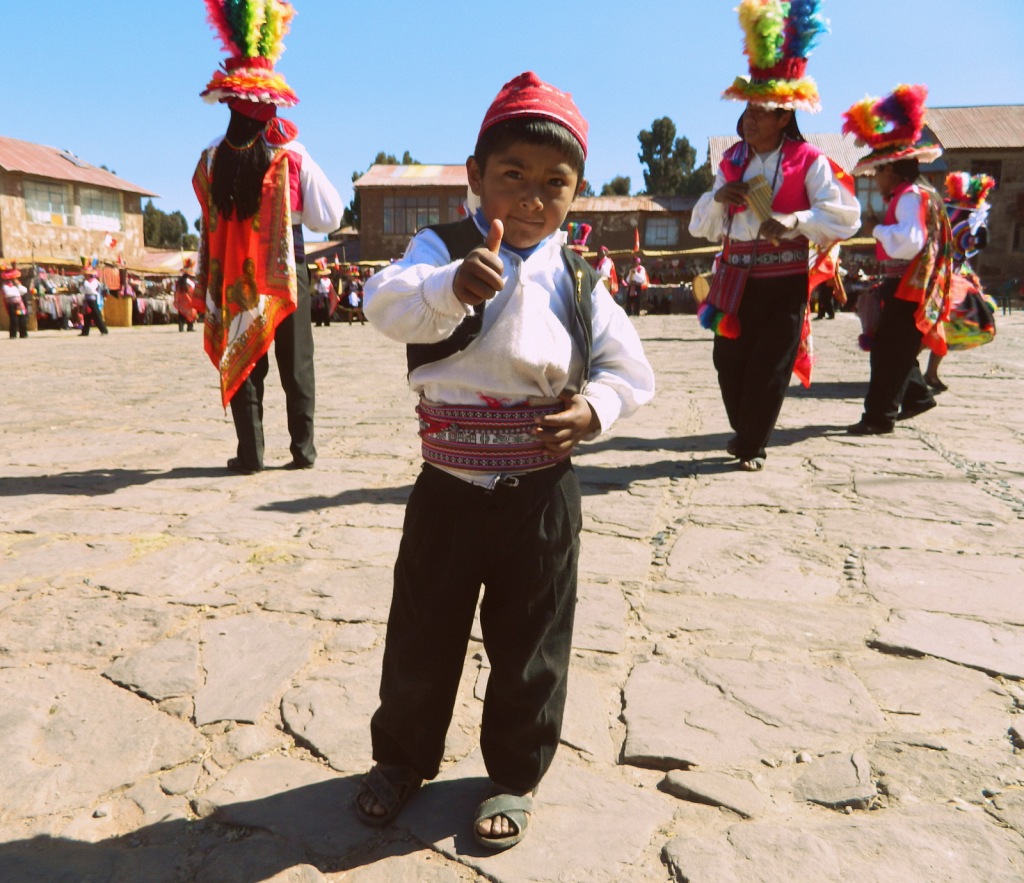
Taquile was the last place in South America to be conquered by the Spanish. It was not until 1580 that they took the island, which at that time was part of the Inca Empire. The Spaniards wanted to show who was boss and banned traditional Inca clothing. Instead, the inhabitants of the island had to dress like Spanish peasants. They still wear this costume today and present it as “traditional,” even though it was the imposed clothing of the colonizers.
Clothing is important on Taquile in two ways. Beyond the obvious, I mean.
On the one hand, the island lives on textile production. All over the island, you see women and men weaving and knitting.
Secondly, Taquile may only be entered wearing a hat. The archways that guard the entrances to the inhabited parts of the island make this unmistakably clear.
The head coverings worn by Taquileños give all kinds of information. Depending on their shape, color and angle of wear, they indicate whether one is single or married. Whether one has a baby. Whether the baby is a boy or a girl. Whether one holds an office in local government. Whether one is looking for a girlfriend or not. And so on.
Of course I respect the local culture and wear a hat myself. Hopefully not indicating anything that I don’t want to indicate.
The island has some peculiarities to offer. In the 1930s, the islanders pooled their funds and bought all the land from the state. And then the land was distributed among the resident families somewhat equally. Okay, not quite the October Revolution. But at least a small land reform.
When tourism became more important than agriculture, socialist ideas finally prevailed. People organized themselves as cooperatives and vowed not to build large restaurants or hotels. Rather, each family was to profit from tourism. If you want to stay overnight on Taquile, you simply come by boat (also run by the cooperative from Taquile) and tell the reception at the wharf how many nights you want to stay. Then you will be assigned to a family that is currently hosting. Thus, everyone takes turns with the tourists.
The stores selling textile products also belong to the cooperative. Every producer can offer his or her products there. The prices are set jointly. There is no haggling. Anyone who is caught letting tourists bargain the price down, or who sets up a small stall himself, has his products removed from the stores for two weeks.
Because socialism is known to form better human beings, the 2000 or so inhabitants don’t need any police. The prison has been sitting empty since 1937.
The table is empty, too, because before lunch comes art. Enter Ricardo. With hat, guitar and pan flute. He has apparently been active in the tourism sector for some time, because he speaks German quite well. Or he is the foreign minister of Taquile, and music is just his side hustle. A side hustle that, Hernan sternly informs us, is not included in the total price. After my last bill sails away, I fervently hope that the return trip to Puno is included in the price.
On the other hand, it’s quite nice here. Too bad I’ll probably never be invited for cat sitting. Because – another rule from the time of the Tiwanaku, Kolla and Inca – cats and dogs are forbidden on the island. After all, there were no cats in South America before the Spaniards brought them. That’s probably why Peruvians have no problem eating cats.
The return trip to Puno takes three hours. For the children, that means six hours of traveling to and from school every day. Enough time to get their homework done.
Suddenly, an explosion rips through the air. Black smoke rises. Probably some error in the chemistry homework.
Easter Island is shrouded in mysteries. Where did the first inhabitants come from? How did they manage to cross the Pacific Ocean? Why did they do it? What is the point of the stone statues across the whole island? How could people without sophisticated technology move and erect huge pieces of rock (up to 15 meters tall)? Why were all the moai, as they are called, toppled and pushed over?
That’s right, they were once all toppled by the islanders themselves.
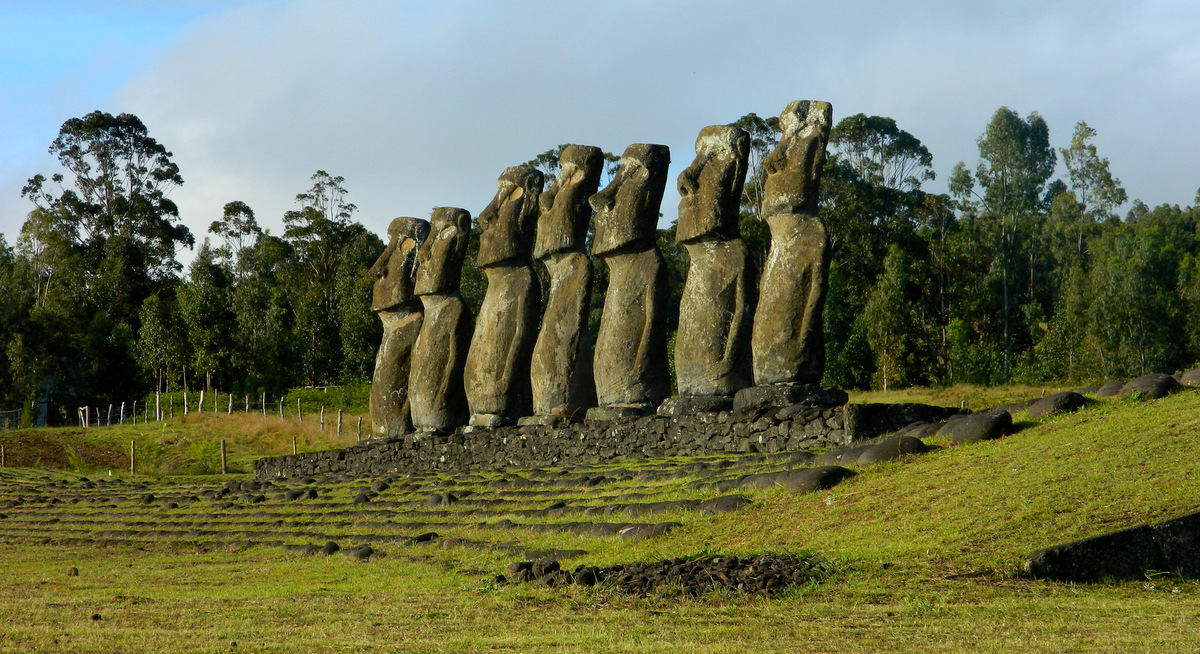
Everyone knows photos like this.
But in reality, only a few of the statues have been put up again, and very recently. All across the island, most places look like this.
Still, the big question remains: how could people move such huge stones? I can reveal the secret. It’s the material. It is a special kind of stone with lots of air bubbles inside, which is actually very light, called tuff. But look for yourself:
Links:
More stories from Easter Island. The comprehensive article about my week there is still outstanding, though.
Do you also have so many travel guides at home for countries you never made it to? I still got a Lonely Planet guidebook for Central Asia, which I bought in 2007. Apparently, in the past 13 years, a lot of things have come up, because I still haven’t been to Kazakhstan, Turkmenistan, Tajikistan, Kyrgyzstan or Uzbekistan.
Because I still have to save a little until I can afford the train ticket to Tashkent, I have shortened the waiting time with a book about these five fascinating countries. Thankfully, the Norwegian author Erika Fatland took it upon herself to travel through dictatorships, autocracies, barren steppes and drafty yurts for her book “Sovietistan”.
Even if I still can’t tell all the -stans apart one hundred percent after reading the book (for that, an intensive personal inspection is essential), and even if one or the other revolution has changed circumstances in the meantime, I still got quite a good impression, which only intensified the travel bug. Fatland interweaves her own experience with historical inserts, which sometimes get a bit out of hand when she lectures about Genghis Khan for pages on end.
Fatland’s new book, “The Border: A Journey around Russia”, continues the method slightly modified, unfortunately with less of what was strong about “Sovietistan” and more of what was less good. Here, the lecturing takes over, again for pages on Russian Siberian expeditions or on border conflicts, with only little conversation and personal encounters to make up for it.
In this second book, one gets the impression that Fatland was sent on a long journey to repeat the success of “Sovietistan” come hell or high water. The author herself admits that she would not have spent $20,000 to cross the Northeast Passage, for example. More enlightening are the reports from places that remain closed or hard to get to for the average traveler, like the Donetsk Republic or South Ossetia.
Again and again, her impatience and annoyance shine through when an agreed interview is delayed, when the cab driver doesn’t show up, or when the internet connection is bad. In Urumqi, she spends four days just staying in the hotel and watching Netflix. Clearly, someone is not very enthusiastic about her own journey, which, according to the subtitle, must lead “through North Korea, China, Mongolia, Kazakhstan, Azerbaijan, Georgia, Ukraine, Belarus, Lithuania, Poland, Latvia, Estonia, Finland, Norway and the Northeast Passage”.
This is simply too long and too much for one book.
For authors, my general advice to travelers applies as well: Less is more. Focus on one or two places, but really immerse yourself in them. And don’t make plans for more than 50% of the time. The rest must remain open for spontaneous encounters, for surprises, the stuff that makes for good stories.
When I disclose that I am from Germany, I am always asked about soccer, cars or Nazis. Sometimes, I would rather pretend that I am from Lithuania or some other little known country.
But in Peru, I had a new “Ah, you’re from Germany” experience.
In a vegetarian restaurant that takes animal welfare as seriously as Peruvian politicians take the fight against corruption, I order rocoto filled with minced meat.
While I am waiting, Ivan joins me at the sturdy wooden table. He has a beard like Lenin, hair like Bob Ross, and he is wearing shorts and trekking shoes. He seems to be working in the restaurant or helping out or just always around.
As soon as he learns where I’m from, he blurts out:
“Ah, like Gunter Hampel!”
Oh dear, no idea for what team he is playing.
“And Reinhard Giebel!”
Hm, never heard of him before.
With increasing enthusiasm, Ivan comes up with more names: Toto Blanke, Hans Koch, Werner Lüdi.
Typical names of soccer players, but none of them rings a bell. Maybe I should read a soccer magazine once a year, so I can have at least a little chat about the subject.
I’m about to apologize for my sporting ignorance, but impetuous Ivan continues already: “Germany is the leading nation in Jazz! Not France. Not the USA. What you are pulling off over there, it’s incredible!”
The filled rocoto is as spicy as a burning volcano. Ivan notices my pain and gets a large jug of lemonade for the ignorant German.
In front of the Shah Cheragh Mosque, a guard stops me: “Are you Muslim?”
“To be perfectly honest, I am not.”
“I’m sorry, Sir, but today the mosque is only open to Muslims,” he explains, referring to the festival of Ashura. Trying to be helpful, he adds that tomorrow it will be open to everyone again.
But today is my last day in Shiraz; tomorrow morning I have to catch an early flight to Tehran. Too bad, the mosque with a mosaic of millions of mirror shards is supposed to be one of the most beautiful in Iran.
The guard suggests that I come back in ten minutes. Puzzled, I walk around the block. Will he be on lunch break then?
No, he is still there. With a broad grin, he asks: “So, are you Muslim now?”
I smile appreciatively at his ingenuity and reply: “Allahu akbar.”
With a welcoming wave of his hand, he invites me into the mosque.
Some of you claim not to have enough time to read my longer articles. I am already trying to make it easier by dividing articles into up to 183 numbered chapters, so that you can get a pizza in between and can easily resume reading where you left.
But I also want the super-busy, child-rich and attention-deficient among you to share in my travels and observations. (Honestly, I don’t like to read longer articles on the screen myself.)
So from now on, there will be a weekly short bulletin, about the length of a postcard. Just one anecdote, from first-hand experience. And only one photo. Exactly like a postcard.
You are invited to browse the list of my travels and let me know from where you’d like to read a virtual postcard.














 The Happy Hermit