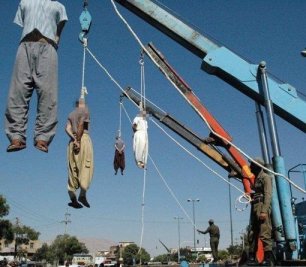
After 179 reported executions in 2010, it looks like the Islamic Republic of Iran is seriously set on becoming the number one state murderer (in per capita terms).
Most executions in Iran are carried out by hanging.
The film “The King’s Speech” depicts the speech problem of King George VI (reign 1936-1952) and how he struggled to overcome his stammering with the help of Australian speech therapist Lionel Logue. Now if you think that this is a bit of a narrow subject and that you are not too interested in the details of British royal history, allow me to proleptically warn you that you might miss one of the best films of this year.
The films begins with a public speech by Prince Albert (as was his name before he became King George VI) which is severely marred by his strong stammering. This opening scene already provides a taste of the very visible pain that this speech impediment causes to the Prince and to his (ever supportive) wife. The portrayal of King George VI as a very likeable person is aided by the contrast of the rest of the Royal Family who are unsupportive to mean, cold-hearted to selfish.
His wife finds the Australian speech therapist Lionel Logue, who doesn’t think much of protocol and is not burdened by any sense of unnecessary respect: “Then your hubby should pop by”, he tells the Prince’s wife. The future king and the therapist get off to a rocky start, but over time develop a relationship of trust and mutual respect. The king visibly enjoys the friendship of “the first commoner I ever really got to know”, while Mr Logue tries to hide the honour he feels for being entrusted with the task of brushing up the speech of the head of state. Their witty and at times sharp exchanges provide the film with a good tempo and add a perfectly dosed amount of humour into this drama. Just one example: After the first war-time speech, King George VI tells his therapist (and by now friend) that he doesn’t know “how I will ever be able to thank you for your help.” To which Mr Logue suggests “How about knighthood?”
“Who invented this bloody radio?”
When watching a film, I am usually more interested in the story, in the dialogues, the scenery, even the music, than in the actors. But in “King’s Speech” the acting by Colin Firth as King George VI is phenomenal. When he is stammering, you can see the pain in his face in every scene, as if he was really affected by this impediment. This is one movie where superb and outstanding acting opens the viewer up to a story that he might not otherwise be too interested in, and even the most die-hard republican (like myself) will find himself rooting for the king in no time. Geoffrey Rush (of “Munich” fame) is also impressive as the speech therapist.
Politics or even history are not the main focus of this film, but if one is inclined to, one can see a sort of juxtaposition between King George VI and Adolf Hitler. The king and his family, one of them the current monarch Queen Elizabeth II as an adorable girl, are watching the news when part of a speech by Mr Hitler is broadcast but not translated. His daughters ask the king “What is he saying?” to which the king – with a slight hint of admiration – replies “I don’t know, but he seems to be saying it rather well.” – This reflects the belief (which I hear quite often from non-German speakers) that Mr Hitler was a great orator. Understanding German, I have to say that I do not share this impression at all. To me, these speeches sound rather ridiculous, pathetic and like that of a yob. – A more interesting aspect to me was the juxtaposition between radio, which in the British Empire was portrayed as the up-and-coming tool for politicians to connect to their people, whereas the Nazis were already trying to utilise moving images, most famously through Leni Riefenstahl’s films.
The former King Edward VIII visiting a friend.
On the history leading up to World War II, the film can be accused of being a bit distortive of historical reality: King Edward VIII, King George VI’s older brother who abdicated less than one year into his reign to get married to an American divorcee, is shown as a selfish and unappealing character. However, the films makes no mentioning of the Duke of Windsor’s (as the title of King Edward VIII was after his abdication) visit to Nazi-Germany in 1937, during which he and his wife met with Adolf Hitler, and of his sympathies for Germany which he expressed after the Nazis’ rise to power. – The other figure who gets off the hook too easily is Winston Churchill who in the film supports George VI against his brother. In reality, Mr Churchill was a vocal supporter of King Edward VIII during the abdication crisis; not one of Mr Churchill’s finest hours.
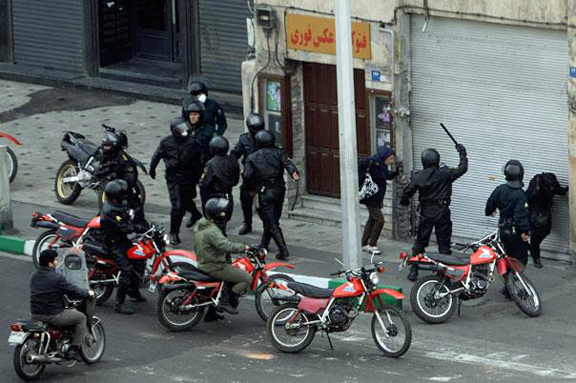
That may well be so, although I don’t think that Iran’s rulers have much to fear domestically after the protests of 2009 have fizzled out. And if this brutal regime will ever be brought down, it certainly won’t happen in courtrooms. The role of lawyers in dictatorships is limited to being tolerated in order to maintain an illusion of some resemblance of a legal system, while the judiciary is in fact just another tool of state power and oppression. (When I was interned at Evin prison in Tehran in summer of 2009 and charged with “conspiracy against the government of the Islamic Republic of Iran”, I didn’t get to see a lawyer for the whole week of my detention.)
Fear does play a role though. But possibly more so on Ms Ebadi’s part: When millions of Iranians took to the streets in summer of 2009 to protest against the rigged elections and for political reforms, Ms Ebadi preferred to remain in her exile in London. She, the only Iranian to ever win a Nobel Prize, did not consider it worthwhile to put her personal support behind the protests that were sweeping Iran at that time.
Would it have been dangerous for her to return to Iran? Possibly. But it was also dangerous for anyone else in Iran who took to the streets for protests. Millions had that courage. The Nobel laureate did not. But her presence would have led to even more international attention. Even for a brutal regime, there is a difference between shooting and killing student protesters and arresting hundreds on the one hand, and arresting or even harming the only Nobel laureate the country has ever had on the other hand. – Having seen thousands who took that risk without any of the protection that such fame and publicity bestow, and having taken that risk myself, I respectfully suggest that it would have been worthwhile for Ms Ebadi to step forward at that crucial time.
“Street protests? No thanks, I already have a Nobel Prize.”
But even in her chosen exile in London, Ms Ebadi has been painfully invisible: I have helped to organise a few events against the institutions of the Iranian government here in London, and I have participated in and attended many more. Ms Ebadi never showed up. – This a criticism that can be extended to many Iranians living in exile; but then most of these at least don’t pretend to be human rights activists.
Returning to the subject of fear, Ms Ebadi is quoted as saying: “Any person who pursues human rights in Iran must live with fear from birth to death, but I have learned to overcome my fear.” – It must be terribly fearsome to have to live in London and enjoy personal and political freedom, while in Iran thousands haven been imprisoned for political dissent and 47 prisoners were executed in the first 2 weeks of 2011 alone.
The Nobel Prize comes with an award of 10 million Swedish Krona.
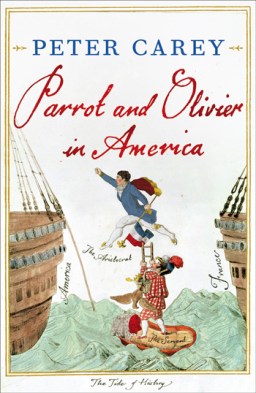
I would like to share the following excerpt which is a nice literary explanation of (some of) the reasons behind the recent housing bubble and ensuing credit crisis in the US.
It is a conversation between Olivier de Garmont, the visiting French aristocrat, and Mr Peek, a New York banker, taking place while they are riding through Manhattan in Mr Peek’s coach and recounted from M. de Garmont’s perspective. Mr Peek just explained to the surprised Frenchman that he would loan money to anyone who wanted to buy or build a house, which M. de Garmont finds rather foolish.
“The business of land in Manhattan,” Mr Peek said, “is mathematical. I am a mathematical man. It is my hobby and my interest, and I do not mean arithmetic. Do you read Mr Newton’s calculus, sir?”
“I know of it.”
“Well, first the A plus B. Arithmetic. Immigration to America increases thirty thousand persons annually. Seventy per cent of these immigrants come through New York.”
“I understand.”
“Then you understand too quickly. The workers stay close to jobs, the people with the money are moving out, here and here, farther from the city. Now can you read what I have written?”
It was follows: h(t) = Xitß.
“The first equation,” he said, “expresses the quantity of housing (in logs) as a linear function of the attributes X of housing unit i.”
Blah-blah, I thought. What this means I do not know except it has a nasty smell of freemasonry – the strange symbols, the mathematics, their use in the service of a prophecy.
“You could predict the price – Xit – of a Manhattan lot in any given year.”
A farmer spouting calculus. That is what it is like with Americans. The moment you think you understand a man’s character, then you are a foreign fool.
Ph(t) = -δt ßT = 0.
“It is Greek to me,” I joked.
“Ah but it is Greek,” he said, the autodidact.
“But no matter what the equation, it makes no sense to lend money to a debtor who will almost certainly default.”
“Ah,” said he, “spoken like a banker. Spoken like my good friends who are busy lending money to each other, but your painter will pay me back for a year, for two years, for three years. I will do very well. The moment she defaults why it is back to Ph(t) = -δt ßT = 0. The land is worth a fortune. I have a house on Sixteenth Street and then I make money again.”
And there you have both the explanation for the credit crisis, and an example for the witty tone in which this novel is set. I have tried to find anything about this subject in Alexis de Tocqueville’s “Democracy in America”, but have been unable to do so. If you know of a chapter where M. de Tocqueville addresses the issue of banking or of loans, please let me know.
Now the Kingdom of Saudi Arabia has detained a bird and is investigating if it might be an Israeli spy. The vulture was found in Saudi Arabia and aroused suspicion not only because it had a tracking device, but this equipment even bore the name of Tel Aviv University. Israeli scientists were quick to explain that a number of birds had been equipped with tracking devices to study the travels and the behaviour of the endangered vultures.
Saudi officials have neither been able to explain why Israel, the Middle East’s most technologically advanced country by far, would resort to the use of unpredictable birds instead of drones or satellites, nor why a “spy-bird” would carry the insignia of Tel Aviv University. The anti-Israeli reflexes seem to cloud any Arab counter-intelligence agency’s judgement.
If this is symptomatic for Saudi thinking, you don’t have to wonder why no Nobel Prize has ever been awarded to a Saudi (while 9 Nobel Prizes have gone to Israel). But it rather adds to my worries about what will happen with Saudi Arabia once the oil reserves will have been depleted.
Das war es also mit der Wehrpflicht: Zum Juli 2011 wird nach 54 Jahren die Wehrpflicht in der Bundesrepublik Deutschland ausgesetzt, was einer praktischen Abschaffung gleichkommt. Man wird wohl nie klären können, ob dieser Eingriff in das Leben junger Männer gerechtfertigt war. Ich vermute, daß die zu immer kürzeren Diensten eingezogenen Wehrpflichtigen der Bundeswehr weit weniger zur Abschreckung der Sowjetunion und des Warschauer Paktes beigetragen haben, als die in Westdeutschland stationierten Truppen der USA, Großbritanniens und Frankreichs und die Vollmitgliedschaft in der NATO.
Juristisch fand ich es immer zweifelhaft, ob der Staat junge Männer zur Drangabe eines Jahres ihres Lebens, noch dazu in der Zeit dessen beginnender Blüte, zwingen kann, ohne überhaupt versucht zu haben, den Bedarf an Soldaten durch Freiwillige zu decken. Dies gilt selbst dann, wenn eine Freiwilligenarmee mehr kostet, denn Grundrechte werden nicht aufgrund von staatlichen Einsparungswünschen verwirkt, sondern allenfalls aufgrund von zwingenden Notwendigkeiten. Auch wurden die Begründungen nach dem Ende des Kalten Krieges zunehmend konstruierter, bis zuletzt klar war, daß die Wehrpflicht nur mehr aufrecht erhalten wurde, weil Krankenhäuser und Altenheime auf die durch die Kriegsdienstverweigerung gewonnenen Zivildienstleistenden nicht verzichten wollten. Wenn ein Grundrechtseingriff aber deshalb aufrecht erhalten wird, weil der Staat von denjenigen profitiert, die sich diesem Eingriff unter Bezugnahme auf ihr Gewissen nach Art. 4 III 1 GG verweigern, beginnt die fehlende Notwendigkeit der Wehrpflicht evident zu werden. (Ich will bei alledem nicht verleugnen, daß die Frage der Verfassungsmäßigkeit der Wehrpflicht durch deren Verankerung in Art. 12 a GG und damit in der Verfassung selbst nicht vereinfacht wird.)
Spätestens jetzt ist aber auch die Zeit gekommen, mit dem Mythos der Wehrpflicht aufzuräumen: Sie war in den letzten Jahrzehnten keine Pflicht mehr, die die gesamte männliche Bevölkerung betraf. Die Wehrgerechtigkeit war nicht mehr gewährleistet, weil durch Ausmusterung und Ausnahmetatbestände mehr als die Hälfte eines jeweiligen Jahrgangs weder Wehr- noch Zivildienst leisten mussten.
Vollkommen unempirisch vorgehend, möchte ich dies an meiner eigenen Geschichte darstellen:
Die Verweigerung aus Gewissensgründen nach Art. 4 III 1 GG wollte ich nie in Anspruch nehmen, weil (a) ich keine wirklichen Gewissensgründe gegen das Töten in bestimmten Situationen habe und dies nicht vortäuschen wollte, und weil (b) der Zivildienst auch nicht unbedingt mehr Spaß gemacht hätte. Mein Hauptanliegen war es, kein Jahr zu verlieren, sondern unmittelbar nach dem Abitur mit dem Studium beginnen zu können.
Um zu versuchen, in der Musterung als körperlich untauglich eingestuft zu werden, war ich zu stolz. Und obwohl nach Auskunft einiger meiner Altersgenossen weit weniger Schauspielkunst als einstmals bei Felix Krull gefordert war um überzeugend zu hypochondrieren, traute ich mir dieses Talent nicht zu.
Als angehender Jura-Student wälzte ich stattdessen das Wehrpflichtgesetz (WPflG) und stieß auf § 13 a I 1 WPflG, der die Zurückstellung vom Wehrdienst vorsah wenn man sich zur Mitwirkung im Katastrophenschutz (z.B. THW oder Rotes Kreuz) verpflichtete und dieser Verpflichtung (damals) sieben Jahre nachging. Der Vorteil bestand darin, daß diese Mitarbeit im Katastrophenschutz – außerhalb von tatsächlichen Katastrophen natürlich – nur am Wochenende stattfand und somit dem sofortigen Studienbeginn nicht im Wege stand. Da Erdbeben und Tornados in Deutschland selten sind, hielt ich dies für eine im Vergleich zur täglichen Anwesenheitspflicht in der Kaserne zeitsparende Variante.
So bewarb ich mich also beim Roten Kreuz und wurde auch tatsächlich in den Katastrophenschutzdienst aufgenommen. Mein Studium konnte ich ohne Verzug beginnen. Jedes zweite Wochenende mußte ich für ein paar Stunden zu einem Kurs oder einer Fortbildung. Die Katastrophen blieben wie gewünscht aus.
So ging dies das erste Jahr; das erste von vorgesehenen sieben. Zwei Semester meines Jura-Studiums hatte ich schon absolviert, während ich als normaler Wehrdienstleistender zu diesem fortgeschrittenen Zeitpunkt erst mit dem ersehnten Studium beginnen hätte können.
Nach Ende dieses ersten Jahres wartete ich geduldig auf Zusendung des Zeitplans für Kursen und Fortbildungen des zweiten Jahres. Diese Zusendung erfolgte nicht. Sie erfolgte nie. So ging ich das Risiko ein, passiv gegenüber meiner staatlich auferlegten Dienstpflicht zu bleiben, wobei ich nicht versäumte, dies mir gegenüber selbst durch gesteigerte Aktivität im Studium zu rechtfertigen.
Trotz meines Fernbleibens erging weiterhin keine Einladung, weder durch Brief, noch durch einen Anruf, oder gar einen Besuch. Langsam aber sicher geriet diese Art des Ersatzdienstes in Vergessenheit, wie anscheinend auch ich in Vergessenheit beim Roten Kreuz geraten war. So ging das zweite Jahr ins Lande, und ich wurde kein einziges Wochenende aus meinem Studentenleben gerissen.
Mit zunehmender freudiger Überraschung konnte ich die folgenden Jahre feststellen, daß sich dies auch in den Jahren 3, 4, 5, 6 und 7 fortsetzte. So hatte ich also tatsächlich nur an ca. 25 Wochenenden einen Art Erste-Hilfe-Kurs besucht und war damit einem Jahr in der Kaserne entkommen.
Bis ich eines Tages, im siebten Jahr, ich hatte nicht nur schon lange mein Studium sowie mein anschließendes Refendariat (ironischerweise zu einem erheblichen Teil und auf meinen eigenen Antrieb beim Juristenkorps der US-Armee) vollendet, sondern war mittlerweile als Rechtsanwalt selbständig, einen Brief der Wehrbehörde erhielt. Schlagartig wurde mir mein negativer Saldo der dem Staat gegenüber erbrachten Dienstzeit bewußt, und ich sah mich schon im fortgeschrittenen Alter von 27 Jahren in die Kaserne einrücken.
Ich öffnete diesen Brief mit dem fatalistischen Gefühl desjenigen, den die gerechte Strafe einholt, und las: “Mit Vollendung Ihrer siebenjährigen Dienstzeit beim Katastrophenschutzdienst des Deutschen Roten Kreuzes ist Ihre Verpflichtung zum Wehrdienst erloschen. Wir bedanken uns für den von Ihnen geleisteten Dienst.”
The Islamic Republic of Iran is again at the forefront of social progress (see my previous posts about scientific and academic progress): This time, it’s women’s rights, something very dear to the Mullahs.
All over the world, women are victims of oppressive laws that do not allow them to get married as early as they want. In some countries, the poor girls even have to wait until they have reached the age of consent. What a wasted youth, spent dreaming of the forbidden fruits of marriage.
But girls in Iran must no longer despair: Iranian president Mahmoud Ahmadinejad has emphatically invited Iranian women girls to get married when they are 16 or 17. The idea behind this plea is to increase the population from 75 million to 150 million, because Iran has enough space, enough resources, enough jobs, enough of everything.
I have only been to Iran twice, but I must have been in the wrong parts of the country, because I mainly met young people in their 20s and 30s still living with their parents for lack of housing and even skilled academics without jobs.
Maybe a smarter population policy would not only consist in a sensible economic policy and in a foreign policy that doesn’t deliberately provoke crippling sanctions, but also stopping to drive young and smart Iranians out of the country through the oppression of all freedoms, personal as well as political?
This Iranian lady was still unmarried at 27. Shocking!
Deforestation speeds up climate change in two ways: First, the loss of trees reduces the forests’ capacity to convert carbon dioxide through photosynthesis. Second, if deforestation is not carried out for the production of timber, but for the winning of arable land, it is often done by burning down forests, which in turn sets free even more carbon dioxide.
In the past years, there has been some progress in slowing down and even reversing this development through so-called REDD (Reducing Emissions from Deforestation and Forest Degradation) initiatives.
All the progress in the rainforests of Brazil and Sumatra is however in danger of being undone by the strange environmental policies of another country: Iran.
The Iranian military is reported to have set forests in the Kurdish region of the country on fire, arguing that these forests have served as a cover for Kurdish rebels.
With only 6.8 % of Iran’s area covered by forest, the Iranian government should maybe think of more sophisticated measures. But sophistication is the last thing we expected from the government of the Islamic Republic of Iran, isn’t it? Or maybe Iran is simply jealous of the massive tree-killing taking place in other places at this season?
Ever since the UK government announced its plan to raise the cap of tuition fees that British universities are allowed to charge and to introduce changes in the student loan scheme, British students have filled the streets with protests,
"To pay? For education? No way!"
have gone on “strike” (whatever that is supposed to mean for a student) and have staged “sit-ins” at their universities. To no avail in the end, as the British parliament passed the amendments to higher education funding on 9 December 2010.
Although I am a student in the UK myself (of Philosophy and Economics), I have refused to participate in these protests, as it is not clear to me exactly what the students want. The are very outspoken about what they don’t want, but don’t seem to offer any alternatives.
Let’s examine the grievances in detail:
The increase of the cap from 3,290 £ to 9,000 £: An increase in the cap of what universities are allowed to charge for undergraduate degrees does NOT equal an increase in fees. It signals only a potential increase to anywhere between 3,290 £ and 9,000 £. When students (and indeed university staff and media) keep on speaking of a ” rise in tuition fees to 9,000 £ per year”, that is simply wrong. We don’t know yet if universities will make use of this higher cap and which universities will do so at what level. I assume that the more sought-after universities like Oxford, Cambridge and LSE will most likely raise their fees quite high. But I also assume that many other universities won’t do so. Even now, not every student can attend the university of his or her choice, not only for financial reasons, but simply because places are limited.
The burden of debt after graduation: Continuing with that error from argument # 1, students now always claim that everyone will graduate with a debt of 27,000 £. That is of course just as wrong. It might be that some students will have that debt-load upon graduation, but most students will have much less debt. And the new law actually increases the minimum salary that has to be attained before anything needs to be paid back from 15,000 £ to 21,000 £ per annum. Above this income threshold, repayment is capped at 9 % of the income. This is in fact a progressive graduate tax, which is only officially not a tax because then emigration from the UK would allow graduates to avoid the repayment. If part of the tuition fees still have not been paid back 30 years after the student’s graduation, his outstanding balance will be waived.
The deterrent effect on students from lower income families: Because fees will not necessarily be higher, depending on the university of your choice, and because repayment will only set in once you reach a certain income, I fail to see any deterrent effect. If at all, the deterrent effect is caused by the distorting propaganda of the protesting students about “mountains of debt”. Higher income for universities should actually lead to more available places in higher education which will benefit those who so far would not have had a chance to enter university.
As a student myself, I find it absolutely fair to pay for my education, as I will be the one who will reap the (intellectual and financial) benefits of it. I wouldn’t want people who never want or will become students to have to pay for my personal advancement with their taxes.
Last night, I attended a screening by the Birkbeck Law Society of the film “The Specialist” about the trial of Adolf Eichmann in an Israeli court in 1961. The film, by Israeli director Eyal Sivan, works with original footage from the trial, most of which had been televised, plus some technical tricks (which I found wholly unnecessary).
I found the film quite good as it showed some key points of Adolf Eichmann‘s testimony, the questioning by the prosecutor Gideon Hausner and by the three judges. It also included some very moving witness testimony by victims of the Holocaust, including one scene of a witness who enumerates all members of his family, his parents, uncles, aunts, grandparents, brothers, sisters, cousins, with their respective ages and upon the question who of his family is still alive today has to answer “I am the only one.”
When confronted with the evidence of the defendant’s role in the Holocaust, which was well documented due to the Nazis’ obsession with bureaucracy, protocols and reports, time and again Mr Eichmann replies “That is correct. I was following orders. I had to do it.” He still seemed proud of his “organizational talent” that he used for organizing the transports of millions of Jews (and other victims of the Nazis’ racist policies) to the concentration camps. Mr Eichmann didn’t even claim to not have known that he sent millions to their deaths, as he recounted four of his visits to concentration camps where he saw, and wrote reports about, how the killing was done. In some of his testimony, he still referred to Jews as “transport material”. When asked by the judges if he felt any remorse, Mr Eichmann responded “Remorse is pointless. Remorse is for children”. He clearly didn’t even attempt to win any sympathies.
Mr Eichmann’s only defense was that he was obeying orders. He in fact claimed that he didn’t like the nature of his job and had asked to be transferred (something which no documentary evidence exists about). He claims that he was a small part in a large machine and that he was bound by his oath to follow orders.
I found it shocking and disturbing to hear from one of the organizers of the Holocaust himself and to listen to his banal explanations of administrative responsibilities, showing flow-charts of intra-ministerial organisation. But listening to his voice and words, the story of a bureaucrat just following orders didn’t convince me. If even 16 years after the end of the Holocaust, you still cannot utter a word of remorse, and if all this time and the developments since have not forced you to rethink your past actions, then you were not only a cog in the wheel, but you were truly evil.
I applaud the film for showing this. Or applauded, I should maybe say. Because the subsequent discussion at the Birkbeck Law Society revealed to me that the film might not be too helpful if you don’t already know a lot of the facts and the background of the Eichmann trial. Thanks to an internship at the German Federal Agency for the Investigation of Nazi Crimes that I did as a law student, I have had the (at times horrifying) privilege of participating in the investigation of small parts of the Holocaust.
Here some points from the discussion at the Birkbeck Law Society:
Many participants dismissed the trial as a “show”, with the verdict known in advance.
Some even thought it worthwhile to discuss if Mr Eichmann was innocent.
Israel was criticised for violating international law.
Let me address these points (in more detail here than I could at the discussion):
It was a very fair trial. The defendant had defence lawyers of his own choosing, he could submit all the evidence that he wanted, his lawyers could cross-examine any witness (but regularly chose not to). The trial was not only interpreted in German, but the prosecutor and all three judges spoke German at times if they felt it was necessary. The judges were even surprisingly polite when questioning Mr Eichmann. I had the impression that they switched to German at times to get closer to the person of Mr Eichmann, to try to find out what drove such a man, what were his motives, his thoughts.
That people can watch this film and believe the “I was only following orders” defense shows that Mr Sivan might not have chosen the best scenes for his film (although I think he chose quite some powerful ones and I admit it is hard to make a 90 minute film of a trial that lasted 8 months). The film fails to mention some important points about Mr Eichmann: (a) He had joined a right-wing organisation in 1927 and became a member of the Nazi Party and the SS in 1932, one year before the Nazis came to power. (b) He volunteered to work for the SD of the SS in Berlin. (c) He set up the authorities responsible for the forced emigration of Jews from the Reich. (d) He was responsible for the rounding up of Jews from all of Europe and their transport to the concentration camp. He was the head of this department. (e) He was regularly visiting concentration camps and witnessed killings himself. (f) He personally attended the Wannsee Conference in 1942 at which the decision was made about how and where to execute the extinction of all Jews of Europe. As the person in charge of deportations and transport, it is unlikely that Mr Eichmann did not play a prominent role at this conference, which was attended by only 15 high-ranking officers and officials. (g) While living in Argentina, Mr Eichmann gave interviews to a former fellow SS member in which he stated “Had we killed 10.3 million Jews, then I would be satisfied and would say we have annihilated an enemy. […] I was not a normal subordinate, […] I was an idealist.” (h) He had the rank of a Lieutenant Colonel and thus was hardly a low-ranking bureaucrat.
International public law does not protect individuals, it protects the sovereignty of states. While the abduction of Mr Eichmann from Argentina did violate Argentina’s sovereignty, Argentina settled this issue with Israel later. The UN decided that Israel should be allowed to retain and prosecute Mr Eichmann. Germany, as his country of citizenship, did also not raise any objections.
Israel caught and tried Mr Eichmann because other countries refused to do so. Both Germany and the USA knew about Mr Eichmann’s fake identity and whereabouts since 1958 and failed to request extradition from Argentina.
Besides Adolf Eichmann, Israel only put one other (alleged) Nazi criminal on trial: John Demjanjuk who was first convicted, but then acquitted by the Israeli Supreme Court. This shows that trials even against Nazis in Israel were not show trials, but fair and thorough. Mr Demjanjuk is currently on trial in Germany for assisting in the murder of 27,900 people.
To those who represent legal positivism and therefore argue that Mr Eichmann was innocent because he did not break the laws of his country at the time, I would like to point out that most of the Holocaust happened in countries that had been attacked and occupied by Nazi-Germany against all international law, including in violation of treaties of non-aggression that Germany was a member to. So even if you think that positive law should be the decisive law (a view which I don’t subscribe to because it reduces law to just another tool of the exercise of power), you can still come to the conclusion of Mr Eichmann’s (and other Nazis’) guilt.
I guess one should neither judge the Holocaust by one trial, nor a trial by one film about it. For those with more time, the full transcripts and even the complete video footage of the Eichmann trial are available online.



 Peter Carey which is based on


 Deforestation speeds up climate change in two ways: First, the loss of trees reduces the forests’ capacity to convert carbon dioxide through photosynthesis. Second, if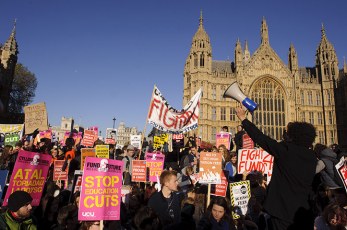


 The Happy Hermit