Last weekend, I finally hit the road again: hitchhiking through the Swiss cantons of Zurich, St Gallen and Thurgau, across Lake Constance and through the German states of Baden-Württemberg and Bavaria. A brisk 500 km is what I had planned.
However, I strayed from the path so often that it turned into a veritable odyssey. Consequently, the account became so long that I turned it into a trilogy, so as not to overburden those of you who get upset about the length of my articles.
So here is the first part:
Switzerland is beautiful. Rolling hills, lush green and some lakes in between. Perfectly marked hiking paths, leading through deep gorges with small creeks. Villages with meticulously kept houses, flowers in the gardens and fluffy clouds above.
Like a postcard.

And perfectly organized. Although the village of Waltenstein (near Winterthur) has barely 15 houses, and that’s already counting the tree-houses for the children, there is a bus every hour. From 5am until 11pm! Even on Sundays! I am so fascinated by this, because in Germany I live in a village which has a hundred times more people, but no bus bothers to venture there after 6pm, let alone on the weekend. Well, now we know why Switzerland has such high taxes, but I think it’s worth it.
Problem is, it’s all too picture-postcard perfect.
I really like countries that are more exciting than beautiful, where stuff happens, a little bit of chaos, maybe even a revolution from time to time. Because in my experience, there are more authentic and interesting human interactions in such places than in the ones where everybody has everything they need or can call a number to get it. Too much organization destroys communication between people.
For example, because of the exemplary public transport, I wonder if motorists see any need to stop for hitchhikers at all, knowing that in this mountainous country you can be reliably chauffeured from any point A to any point B by public bus.
So, after finishing a two-week cat-sitting job in Waltenstein, I decide to try it and place myself at the side of the road, as curious as a cat.
Shortly before 8am, I stand at the crossroads in the village. A sunny Saturday morning. I have to go to Ammerthal in Bavaria, so I have about 500 km ahead of me. And 13 hours of daylight. That should be enough.
After 20 minutes, a gentleman who is going to the next village, Elgg, stops.

He is on his way to a job interview as a sales manager for kitchens. After 22 years with the same company, it’s time to try a new employer, he thinks. About time, I think.
“That’s really nice of you to stop for me on such an important day. I would probably be much too nervous and excited,” I express my gratitude.
“Oh, no problem. I still have 12 minutes until the appointment.” Swiss people are very precise and never arrive a minute late, nor a minute early.
It’s market day in Elgg, so people should be flocking from all over to buy agricultural products, and afterwards they can give me a ride on their way home. So I stand just a little bit away from the market place on the road leading north-east.


“Difficult, isn’t it?” asks a passerby with an air of connoisseurship, as if he too is disappointed by a society of people who are shy, even scared of meeting new people.
But soon, a young man stops and introduces himself with a firm handshake: Thomas. He is only going to Aadorf, about two and a half kilometers away, but he sometimes hitchhikes himself and encourages me: “Hitchhiking is not about your thumb, it’s about your head. It’s all a matter of attitude. With the right mindset, you can do it!” His optimism is contagious.
In Aadorf, a young family first drives past me, but then turns around and comes back to pick me up like a dog forgotten at the highway rest station. The landscape gardener, his wife and the baby are going to St Gallen. About 50 km, now things are really picking up.
When I am in the car with couples, I always feel guilty about telling them about my life and my adventures. I am worried that the young man will pack his backpack afterwards, leave his wife and child and go on pilgrimage to Nepal. On the other hand, as a landscape gardener, he has peace and quiet all day anyway.
Completely committed to the idea of spontaneity, I did not pick a good spot in St Gallen beforehand. The two drop me off at a shopping center near the motorway. There, it takes me less than 10 minutes to realize that it’s a hopeless spot. The cars are too fast, there is no place to stop, and without a sign, no one knows where I am going.
Near the motorway entrance, there is a small chapel for lost souls and lost hitchhikers. On the steps of the hitchhiking hermitage, I spread out the map and get an overview of my position and my situation. Both are very bad, not even the mindset helps. When Saint Gall founded the city, he must have taken Los Angeles as his model, as the city is covered with highways going in all directions and crossing and intersecting each other. It’s a mess of urban planning and hitchhiking hell.

An older, very friendly gentleman approaches me and asks if he can help. I explain the situation and the plan.
“Forget about it,” he says crisply, but not without reason, “you’re on the wrong side of the city.” I’m all the way on the westside, he says, and need to get on the eastside, once through the elongated city. “Anyone who gets on the motorway here certainly doesn’t want to go in your direction,” he says.
“Walk 300 meters down the street and take the bus through town for only 2 francs. Or, even better, go straight to Wittenbach, from there the country road goes to Romanshorn.” The latter is the last destination in Switzerland, because from there a ship sails to Germany. From readers’ feedback, I know that you appreciate it when I vary the means of transportation on my journeys.
I am reluctant to travel in any other way than by hitchhiking. But if I walk two hours through the whole city, I will miss the two hours at Lake Constance later. Besides, I am hitchhiking for pleasure, not out of puritanical purism, even though St Gallen is a Reformation city.
And there comes bus no. 4 already. The gentleman explained everything to me so kindly and helpfully, it would be rude not to follow his advice.
“And from Wittenbach, you can take the train to Romanshorn,” he shouts after me, letting his low confidence in my beginner’s hitchhiking skills shine through.
No, I certainly won’t do that. Back on the road, I will trust only my thumb and my smile. And indeed, in Wittenbach, after only a few minutes, a man stops and drives me almost the whole way to the port. He goes to Egnach, already on Lake Constance and only a short walk from Romanshorn.

It is already the second driver today who introduces himself as someone downplaying the corona virus. “Masks don’t help against viruses at all.” “I refuse to follow all this crap.” And best of all, “You shouldn’t believe everything” from people who, after 10 minutes of YouTube University, think they know everything better than the broad consensus of virologists, epidemiologists, immunologists and medical doctors. And these are the people who are voting in referendums on corporate liability in supply chains, unconditional basic income, and the framework agreement with the EU.
There are people trivializing the corona virus everywhere. But in Switzerland, there’s another aspect: the desire to distance themselves from Germany. “Oh, you’re going to Germany? That’s bad, you have absolutely no freedoms there anymore.” I keep hearing that, as if Germany were North Korea, just because gyms and cinemas have been closed. It is always uttered with ostensible pity (“you poor Germans”), doing an inadequate job of concealing the Swiss sense of superiority and condescendence.
But I don’t want to argue with people. First, I’m a guest in their car. Second, it’s useless. Third, I am glad for anyone who is not afraid of infection and therefore willing to give me a ride.
The driver drops me off at the hiking and biking trail along the lake, because I want to walk the last few kilometers. It’s a beautiful day, with views of Lake Constance on one side and the Alps on the other.


On the lakeside footpath, a stressed-looking man with a builder’s uniform and blueprints under his arm approaches me: “Tell me, is it half past eleven already?”
“Yes,” I confirm, “it’s 11:35.”
“I don’t believe it! Where on Earth is he?” the waiting person is furious with the 300-second delay of his colleague, boss or customer. Normally, the Swiss are so punctual; here, even women show up reliably and to the minute for a date.
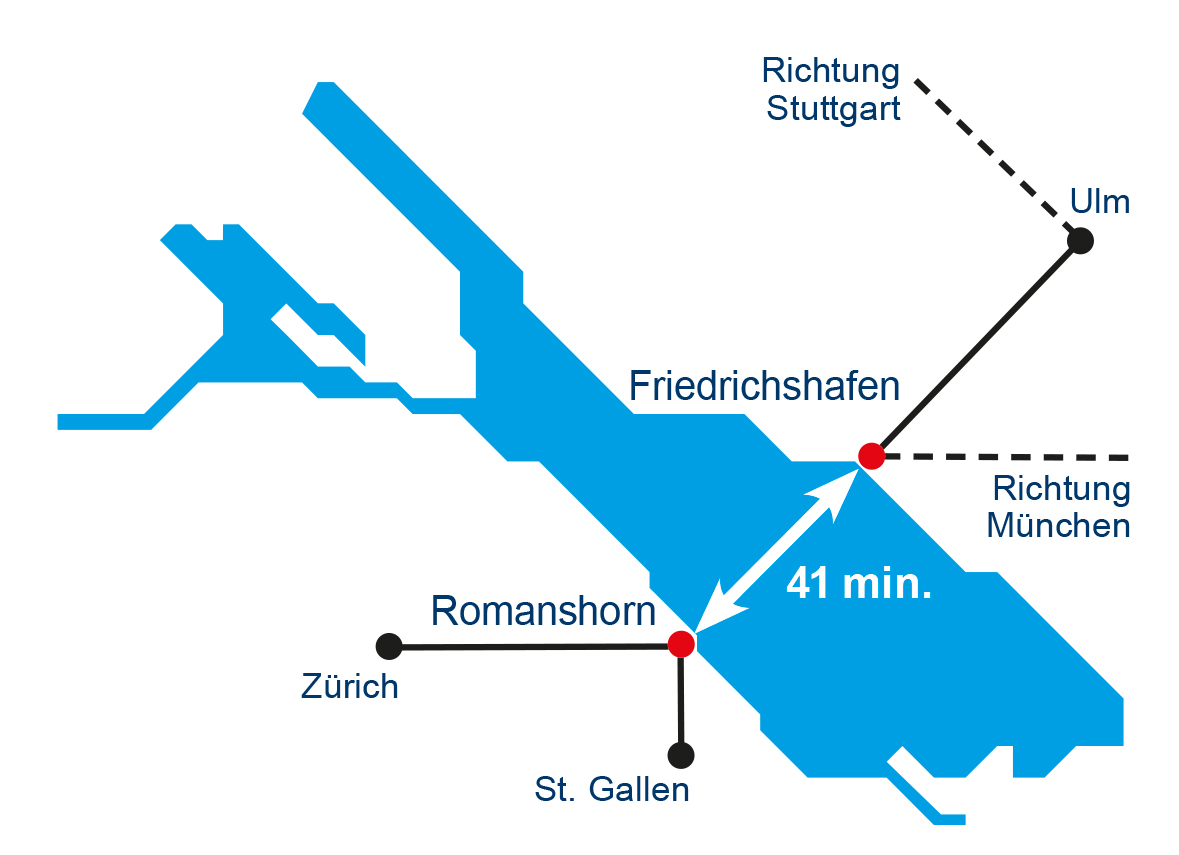
To continue hitchhiking in Germany, I thought that I will talk to motorists on the ferry to Friedrichshafen to find out if anyone is going to Bavaria.
That’s a great plan, I am thinking to myself.
Unfortunately, the port in Romanshorn and the ferry look as empty as if a naval blockade had been imposed. Hopefully the sea mines have not been laid yet.


Distance-wise, Lake Constance is not the halfway point. I have 70 km behind me and at least 360 km ahead of me. But mentally, the water and the international border, the leisurely cruise and the return to the EU make me think that I am halfway there, so I am relaxing. Relaxing too much, as it will turn out later. But I don’t suspect anything of that yet, while enjoying these views:


Very briskly and very narrowly passing the quay wall, the ferry heads into the harbor of Friedrichshafen. Perfectly parked. A modernist-style building, now the Zeppelin Museum, and a hangar at the harbor reveal what the city was really built for.


For the people of Friedrichshafen, Lake Constance soon became too small, and they wanted not only to reach the other shore, but other continents. So they built airships and flew to New York, Tokyo, Los Angeles and Rio de Janeiro.


Unfortunately, I don’t have a ticket for the airship, and we know from the movies how harsh their ticket inspectors are.
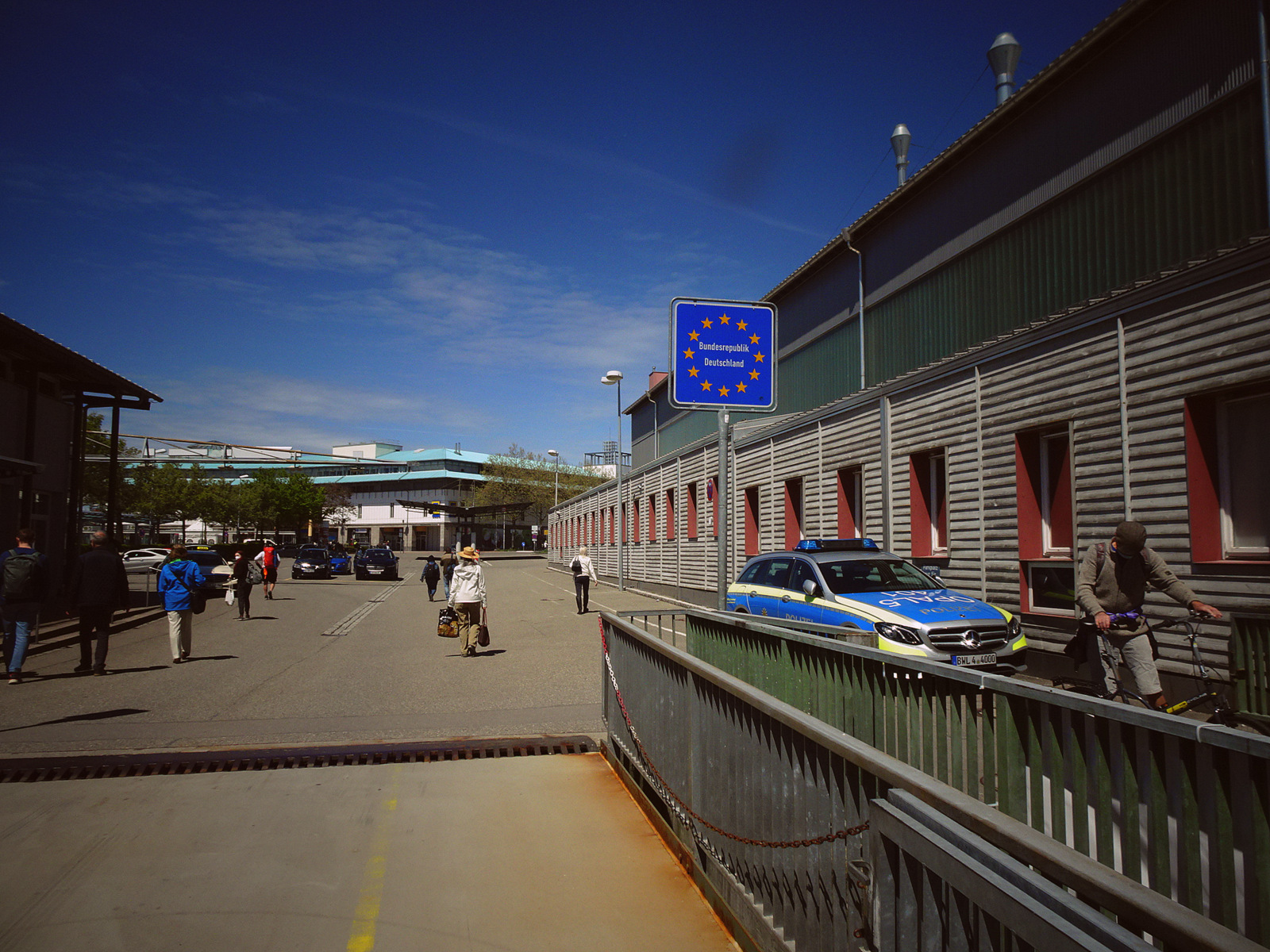
Far less harsh are the German police, supposedly controlling the supposedly strict coronavirus protection measures when entering oh-so-strict Germany. An empty police car is guarding the border, the officers are out to lunch.
A good idea! I’ll get myself the first kebab after two weeks of abstinence, because in Switzerland, this staple food costs a whopping 10 euros, for which in Germany you get two kebabs, or even three on student discount.
For the Swiss friends who believe that in Germany everything is frozen in quarantine, here are a few photos of Friedrichshafen:


People are strolling, eating, holding hands, kissing, dancing, singing and jumping here, too. And unlike in Switzerland, you can even lie down on the grass, smoke, barbecue in the park and pee in the bushes. There are no signs prohibiting this and that and telling you where to do what, but finally there is graffiti again, and people don’t put their empty beer bottles in the trash can, but deliberately next to it, so that the bottle collectors can make a living as well. Even the monument to Kaiser Wilhelm I is not taken seriously by anyone.

The Corniche of Friedrichshafen has a flair of cities by the sea, like Nice or Sukhumi. It is so beautiful, also thanks to the Swiss mountain panorama from the other side of the sea, that I would love to stay a few days.


Only with the firm resolution to come back for a trip around Lake Constance, I finally tear myself away. Now, somehow, I have to hitchhike northeast, in the direction of Bavaria. I walk to the beginning of highway B30, which leads to Ravensburg and Ulm – not yet able to imagine what headaches this highway will give me today. It will turn into a veritable way of the cross.
How or if I manage to continue the journey at all will be seen in part 2. There, you will also hear what the 50 Hail Marys are all about.
Practical advice:
- If you want to move faster, a little planning helps. For example, I could have asked to be dropped off in a better spot in St Gallen. And on the German shore of Lake Constance, I would have been better off hitchhiking to Lindau, where the motorway A96 begins. But more about that in part 2.
- Friedrichshafen is definitively worth a visit.
Links:
- More hitchhiking stories.
- And other travel stories.









 The Happy Hermit