Whenever I walk through a mosquito- or fly-infested forest or swamp, I light up a cigar. A strong one preferably. It keeps these rowdy little animals at bay.
Tobacco was embraced by Ming soldiers, who disseminated it as they marched around the empire. In the southwestern province of Yunnan, one physician reported, Chinese soldiers “entered miasma-ridden (malarial) lands, and none of them were spared disease except for a single unit, whose members were in perfect health. When asked the reason, the answer was that they all smoked.”
So now ISIS have also captured Palmyra, the antique oasis town in the Syrian desert. Another cultural heritage faces destruction.
The world community will be more agitated by this than by the civilians killed in Syria every day. Old stones arouse more compassion than Syrian children. If the Roman columns could make it onto a boat to Europe, they would probably be warmly received.
But I want to use the impending pillage to tell you about my trip to Palmyra.
It was a few years before the war, I believe in 2006. I had just spent Christmas in Beirut, had taken a taxi across the mountains and through a fierce snowstorm to Damascus. I had contracted a serious cold on the way, because the three smokers in the taxi had left the windows open during the whole ride. My plan was to spend a few days in Syria, which was less dangerous than Lebanon back then. How things change! Nowadays, anybody who can walks, drives and flees in the opposite direction.
From Damascus, I wanted to take one of the colorful buses welded together from different models for a day trip to Palmyra. About 250 km one way, so I could get there and return on the same day. Except for the ruins, there wasn’t much to experience there anyway, particularly if one doesn’t speak Arabic.
The Lonely Planet guidebook had pointed me to a travel agency which dispatched a bus to Palmyra once a day, leaving at 10 am and returning to Damascus in the afternoon or evening. Perfect. The day before, I walked to that travel agency in one of the larger roads leading away from the Old Town. Of course I have forgotten its name after so many years.
There was a small office with a desk, a lot of paperwork and calendars and maps pinned to the wall. Two men sat in cane chairs, one of them with a plate of meat and rice in his lap. He was having lunch, so I guessed he must have been the owner or an employee of the agency. In Arabic, I couldn’t say more than “salam aleikum”, so I added “bon appétit” in French. A grim stare and a grumbling sound indicated that I had mistimed my attempt to pay my respects.
So I buggered off and hung out in the street for a while, before returning half an hour later. One of the employees, now happily fed, sat behind the desk. In English I asked him if he spoke any of it. In Arabic he negated that. Strange that people always understand each other when they pretend not to. I stammered something with the words “ticket”, “autobus”, “Palmyra”, but received incomprehension instead of a bus ticket. It went back and forth like this, with words in English, Arabic and French flying across the desk and being bounced back like tennis balls, until the Syrian ran out of patience. He got up, walked into the road, shouted into the crowd and returned with a nicely dressed gentleman of medium age who spoke English. He looked like a lawyer or a manager, but for a moment he readily interrupted his business affairs to interpret the purchase of a bus ticket. Very nice.
That was when I finally learnt that the Arabic name for Palmyra is Tadmur, which explained the communication problem. Progress was still slow until it became understood that I wanted to take the bus the next morning and return the same evening. Again and again I was being shown a calendar in which I should indicate the dates. In elementary school we are being taught that our numbers are Arabic numbers, apparently to spice up the otherwise dull math lessons. Complete bollocks. Arabic numbers are just as strange as Arabic letters. At best, one could identify the 1 and the 9.
With the friendly help of the gratuitously laboring interpreter and with great efforts, we managed to fill in a ticket in a way that I couldn’t read it. I don’t remember the exact price, but it was something between 1 and 2 $. For a distance of 500 km. I was told to show up at Harasta bus station the next morning at 10 o’clock.
Filled with pleasant anticipation, I spent the evening reading about Palmyra’s history: caravans, oases, Syrians, Babylonians, Romans, the Silk Road, religions of which I had never heard before, battles, architecture.
The next morning, I overslept.
That way, Palmyra joined the list of places which I have almost visited. Now it’s too late. Damn terrorists! Damn alarm clock!
If you have been putting off your trip to Africa because you are afraid of aggressive and large animals like elephants, lions, gnus, hippos or giraffes running you over, here’s a solution for you: Go in summer when the marula fruit is ripe. It knocks out the animals and you can wander through Africa without any of the animals running after you.
Well-rested, with enough sleep and an empowering breakfast behind you, you get to the office. Your desk is still empty, as is the e-mail inbox. Slowly and with a relaxed pace, you start yet again from zero. Another week, with only 37 and a half hours of work to put in.
– – –
Not so for the self-employed and freelancers among us.
This is how my desk looked this Monday morning. A tangled mass of unfinished jobs. A to-do list from last weekend, hardly tackled at all. Notes which only make sense again after re-reading them several times. Thousands of unanswered e-mails. Reminders of past trips to write about and of future travel to be planned. And more and more issues pile up every day.
(If you have a boring, non-fulfilling job with an insurance company or in some kind of marketing department, you are welcome to use this image as your desktop background. – Zur deutschen Fassung.)
If a company advertises its services and products as “artistic and up to date” but uses the following display to do so, I doubt both parts of the statement.
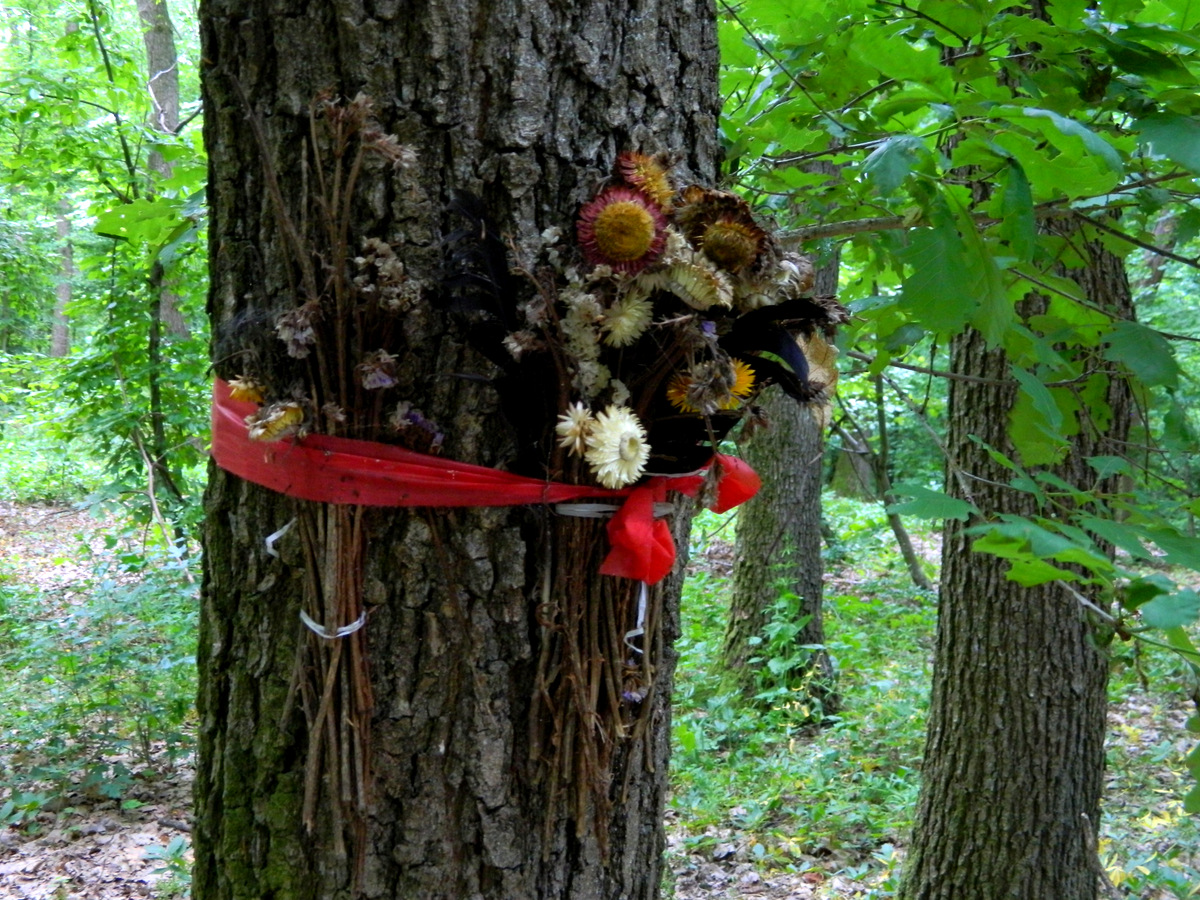
Hiking through the forest behind the zoo in Targu Mures, Romania, I spotted this spooky bundle strapped to an innocent tree. It was hidden far from the path, as if some secret society did not want to scare the hiking public or wanted their mysterious rituals to remain undetected.
Fighting my way through layers of cobwebs, I got closer – and was shocked by what I saw: evil flowers, feathers of a black bird that had been sacrificed, and all of this tied together with a piece of cloth soaked in blood.
This little bird flew through the open door and made itself comfortable in my office while I was gone for a shower. When I returned to my desk, it didn’t want to move away and simply remained there, right next to me – until I finally took a photo of it; as if that had exactly been the purpose of the visit.