The real Bay of Pigs is not on Cuba, but on the eastern shore of Isla del Sol in Lake Titicaca in Bolivia. Here, the pigs have the beautiful beach to themselves.
And even when a human being passes by, it doesn’t bother the pigs. They keep enjoying the sun, the cool breeze and the view of the Cordilleras in the background.
When I came back home from a trip to the Bolivian jungle yesterday, I had already received dozens of e-mails from Britons along the lines of “my grandfather was from Germany, can I get a German passport?” As an expert in German citizenship law, I get these kind of questions all the time, but the increase in volume was significant after 23 June 2016. And never before have I gotten so many requests from Britain.
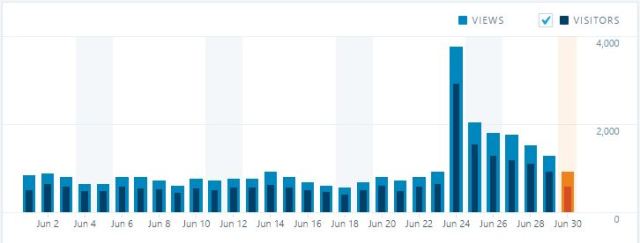
You can also see this in the statistics for my blog:
Clearly a significant spike after the result of the Brexit referendum was announced.
What did people look for? The top 3 posts all deal with German citizenship law.
And where do these questions come from? The overwhelming search volume was from the UK, and I bet that many visitors from Spain, France and the Netherlands were Britons who live there.
As a European, I am sad about Brexit. But for lawyers, these are going to be a few prosperous years.
Here are just a few samples of the questions I received in the days after the Brexit decision. You can enlarge them by clicking on the photos. Answers can be found on my FAQ page about German citizenship.
The more often you move, the more you find out what you like and what you don’t like. It has been emerging that I love mountains and grassland more than the sea or the tropics. Huge cities are impractical because you lose too much time in transit, but small villages become boring too easily. Mid-sized cities between a few hundred thousand a million people are perfect. If the climate is one of constant spring, one could almost want to stay forever. Like here in Cochabamba.
But because I am illegal in Bolivia since my visa expired in March and I am thus living under the constant threat of going to prison, it’s time to get moving again.
Looking for a city in South America with a similar quality of life, I have stumbled upon Arequipa in Peru, where I will move to in August 2016 and stay until the end of the year.
As you know, I am a great fan of natural disasters. It is therefore a further benefit that there are almost daily earthquakes in Arequipa and that I will have a view of volcanoes from my window.
The volcanoes Misti (5,822 meters) and Chachani (6,057 meters) are relatively easy to climb – when they are not erupting – and I will try to set new altitude records there.
Colca Valley also seems to be predestined for hiking.
But apart from that, I actually want to take a slow approach over the next six months. Less traveling, more sitting in the garden in the shadow of palm trees and finally putting the stories of the last few years to paper.
For my readers in Arequipa: I have rented a room for the first month of August, but I am still looking for an apartment for September-December 2016. Something furnished and quiet, so I can write there. Because of that, I am looking for an apartment of my own, nothing shared. Location almost not important. I hope to find something for less than 800 soles/month. Gracias!
Some people use their annual holiday for the Football World Cup. I only noticed that there even is a World Cup after planning my trip to Greece, Macedonia and Albania. I didn’t care, as long as it wouldn’t lead to trains being cancelled.
Thus, I was in the Albanian capital Tirana on 13 July 2014, the day of the final match between Germany and Argentina. The whole day I had seen people in Germany jerseys, German flags in front of restaurants and bars and on cars, and other black-red-golden markings. During a hike on Mount Dajti, I had met an Albanian who had pointed out that the parents of one of the German players, Shkodran Mustafi, actually came from Albania. But the enthusiasm for Germany seemed to be more general and independent of one player (who had to drop out due to an injury anyway). Already the day before, the lady who owned the pension where I stayed, had told me that she couldn’t wait for this World Cup to be over because she couldn’t bear the constant talk of “Germany, Germany” by her husband any longer.
The match was shown in every bar, ever restaurant, every garden. I could walk through all of Tirana without missing a second of the match. The largest congregation was in the center, where several huge screens had been put up, back to back, to that the viewers could watch from both sides. Each 50 or 100 meters there was another one of these sandwich screens, all the way through the pedestrian zone.
This is where I happened to pass by when the only goal of the match was scored:
And this was no neutral jubilation just because a goal had been scored. Even prior to that, the cheers had obviously been for the German team. I was however shocked to see that even in Albania, which had once been occupied by the Nazis, someone ran around with a “Deutschland über alles” placard. Lack of historical knowledge is a global phenomenon.
This boy couldn’t wait until the final whistle and started burning his flare prematurely:
When the match was finally over, the crowds were dancing as if Albania had become world champion:
Someone had brought along some fireworks (and I wonder if he would have used them for Argentina as well):
From the minaret of the nearby Et’hem Bey Mosque, the muezzin called “Allah u akbar”: God is great. That was really over the top, I thought.
Keep in mind: if you plan to escape the football frenzy during future European or World Cups, Albania is not a good destination. Apart from that, it is a very likeable country.
My steadfast refusal to read e-books even in 2016 has two practical disadvantages:
Each year, a few trees are felled just for the books I read.
Whenever I stay at one place for a few months, I am gathering a small library, to which I have to say good-bye when moving. Shipping chests full of books simply is too expensive.
Despite this method, during my last year in Romania there were still quite a lot of books that had accumulated:
In Târgu Mureș I had too many friends who would have argued about who gets what if I had tried to distribute the books among them. Thus, the most obvious solution was to bequeath this treasure to the public library in Târgu Mureș.
So please consider this: If you send me books, you are not only making me happy, but hundreds of other readers too. The next library that will be blessed in such a way is the one in Cochabamba in Bolivia. (There is even a German library for those who mail me books in German.) Each of your book shipments can thus change the lives of poor Bolivian children. It can be your book that makes them discover their love for literature, science and the wider world, makes them stop toiling in the silver mines in Potosí, makes them go to college instead, to study and to become successful and happy.








 The Happy Hermit