
In my room in Arequipa immediately after moving from Bolivia to Peru.

And this stack doesn’t even include the book packages which had already come for me before my arrival.
In my room in Arequipa immediately after moving from Bolivia to Peru.
And this stack doesn’t even include the book packages which had already come for me before my arrival.
It was summer, I was single, I had some time on my hands and I wanted to explore more of Romania. The advertisement for the group of adventurers I saw at a bus stop in Târgu Mureș came at the perfect time.
“7th Day Adventurers” sounded a bit too much like a steady rhythm, more chronological corset than free-wheeling frolicking. But then, not everyone is a freelancer and can take off a Tuesday as easily as a weekend.
I called the number and was relieved when the guy at the other end spoke English. Inquiring about the next trip of the adventurers may have been too straightforward because John curbed my enthusiasm: “It’s probably better if you come to our next meeting on Saturday.” So that was their “7th day”, leaving Sundays for family, church and football. Very thoughtful, very organized. That they wanted to get to know me before taking me on a trip fueled my impression of a not very spontaneous group of “adventurers”. A bit over the top, for I hadn’t exactly asked to join them on a 6-month expedition to Antarctica. Usually, people in Romania were more open and spontaneous and welcoming.
On Saturday, I showed up at 10:30 and felt so under-dressed that it hardly made any difference that I had slipped out of my pyjamas and taken a shower that morning. The guys wore suits and ties, despite the summer heat. The women looked as if they were looking for a husband. They were still nice to me though, and painfully avoided looking at my torn-out sneakers for a second time after the first glimpse had widened their eyes as if I had leprous symptoms.
I had brought a box of cigarillos, the good Italian ones. Always a useful ice-breaker. More special than cigarettes, but not as overwhelming as cigars. The adult version of a joint. Yet, one after the other, they all declined politely, some of them regretfully, others indignant, as if I had insulted them, until one middle-aged man said – in a tone that a father would use to correct a long-held misconception of his son – “we don’t smoke”. I could handle a bunch of health freaks, but that sounded like a rule, not a coincidentally reached mutual decision. “Ok, no problem, I don’t need to smoke,” I tried to ease the tension which had begun to creep up across the horizon (which was ironically filled with much unhealthier smoke from the Azomures chemical plant), as I shut the box of cigarillos and stuffed it back into my bag.
Luckily, at that moment the meeting began. They were all standing, holding hands and reciting something which was unintelligible to me, but which they all remembered by heart. From the solemn look on their faces, I assumed that this was a ritual to honor/commemorate/remember their comrades who had passed away. So even people who don’t smoke die.
Then the guy with a round face like the missing Kaczyński brother gave a speech, interrupted by controlled cheers from the audience. I wondered if they heard the same speech every week, because the cheers seemed to be as spontaneous as the bells of Big Ben. I was beginning to feel genuinely uneasy, maybe amplified by my lack of Romanian, as any group with a leader, a clear structure and uniform behavior reeks to me of a possible incubator for fascism or at least one of its mindless little brethren.
I couldn’t really picture these clone-like besuited men on any adventure deserving of that name. If they didn’t smoke, they probably didn’t barbecue either. Time passed more slowly than in a dentist’s waiting room. I was looking for signs of the meeting coming to an end or at least to an interesting part, but stamina these people had. Enough of it that they could have swapped some of it for creativity, spontaneity or individuality.
My mind was wandering, the only way to overcome boredom, to Transylvanian castles, Moldovan monasteries, Szekler towns, rolling hills and Roma villages and the hospitality found in all of the above – that is once one got beyond the dogs, again in all of the above. No longer noticing the time, any train of thought – and I tried to make them as slow as CFR to make them last through the whole meeting – was only interrupted by the standing up, sitting down, standing up again, grabbing each other’s hands. I hadn’t caught the leader’s name but they referred to Mr Jesus so frequently that I assumed that this must be him.
It felt strange, almost impolite that nobody bothered to explain to me what the hell was going on. But then I realized that it had nothing to do with me. The individual simply didn’t matter; the group was everything. I was not overlooked because I was new or a stranger or a foreigner; everyone else had gone up in a togetherness in which they maybe expected me to join. No thanks, no mass hysteria for me. I know enough about history and psychology to know where that leads to. More frighteningly, I know how fast it leads to it.
“If you want, you are welcome to join us again next week.” It sounded as much a lie as my “Thank you, I would love to, if I can make the time.” I’d rather make time for a proctoscopy.
As I stepped out of the building on Strada Filimon, I looked back and noticed my mistake.

“Adventista”, not “aventură”. I should always wear my glasses.
(This story was also published by Medium.)
Mass hysteria:

Mass hysteria:

As always, it was the innocently looking girls:
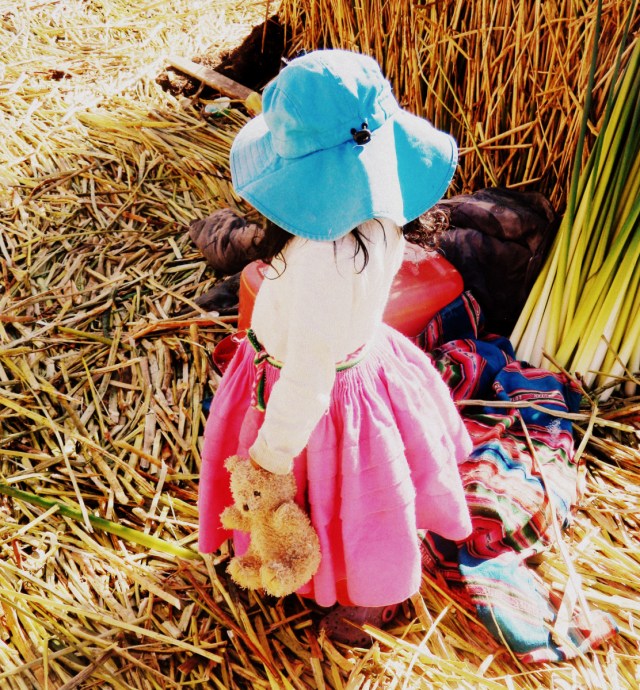

The first girl is one of the Uros living on the floating islands in Lake Titicaca in Peru. The second girl is one of the Mojenos living in the remote community of Buen Pastor in Tipnis National Park in Bolivia.
– “Good evening. I am a renowned writer with many prizes to my name.”
– “Nice to meet you. I am Andreas Moser and there is a price on my head.”
– “Priceless!”
– “Prizeless as well, to my despair.”
You have all seen these cables on wooden poles, dangling across fields, leading from village to village, from country to country and even connecting the continents underwater. This is how the internet comes into your home.
Have you never asked yourself where this internet actually begins?
I have. That’s why I have been following these cables on a multi-year journey. And now I finally found it: The place where the internet is produced is on Isla del Sol in Lake Titicaca, situated in a small but beautiful bay.


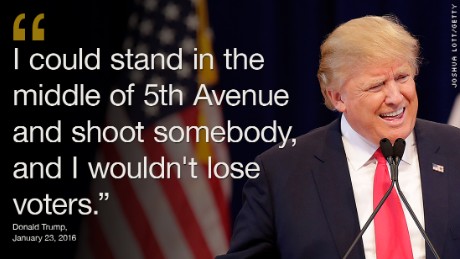
After Donald Trumps’s speech at the Republican National Convention, I made this joke, inspired both by the plagiarism in the current Mrs Trumps’ speech and by the speech itself:

As with all my other Donald Trump jokes however, it turned out that I was actually spot on. From the very revealing article Donald Trump’s Ghostwriter Tells All:
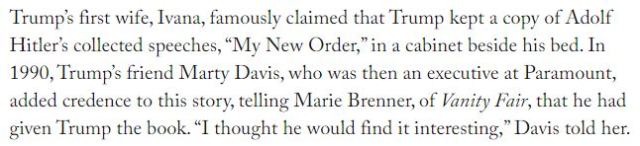
Now, I would like to clarify that I think all Hitler and Nazi comparisons are over the top. I also think that Mr Trump’s danger lies less in what he believes (he’ll change his mind tomorrow anyway or just lie again) than in being a psychopath. Many elements of fascism can be found in Mr Trump’s speeches. But until the first people will get killed, let’s just stick to Mussolini comparisons for now.
In his autobiography My Early Life, the young Winston Churchill writes about his feelings towards war and conflict. He seems to regard it all as one great adventure.
About his time at the Military College in Sandhurst:
Here the study was of divisions, army corps and even whole armies; of bases, of supplies, and lines of communication and railway strategy. This was thrilling. It did seem such a pity that it all had to be make-believe, and that the age of wars between civilized nations had come to an end for ever.
On the latter point, Churchill was wrong. He would live to see World Wars I and II, and make a considerable contribution on behalf of civilization in the second.
If it had only been 100 years earlier what splendid times we should have had! Fancy being nineteen in 1793 with more than twenty years of war against Napoleon in front of one! However all that was finished. The British Army had never fired on white troops since the Crimea, and now that the world was growing so sensible and pacific – and so democratic too – the great days were over. Luckily, however, there were still savages and barbarous peoples. There were Zulus and Afghans, also the Dervishes of the Soudan. […]
These thoughts were only partially consoling, for after all fighting the poor Indians, compared with taking part in a real European war, was only like riding in a paper-chase instead of in the Grand National.
In 1930, it was apparently absolutely OK to publish an autobiography riddled with racism.
The young Churchill was so eager for war that in 1895, he took leave from the British Army to sail to Cuba at his own expense and join the Spanish in the Cuban War of Independence. Always on the side of European colonialism.
Each officer received a solid block of two and a half months’ uninterrupted repose. […] as I could not afford to hunt, I searched the world for some scene of adventure or excitement. The general peace in which mankind had for so many years languished was broken only in one quarter of the globe. The long-drawn guerrilla between the Spaniards and the Cuban rebels was said to be entering upon its most serious phase. […] It seemed to my youthful mind that it must be a thrilling and immense experience to hear the whistle of bullets all around and to play at hazard from moment to moment with death and wounds.
What would get you on a terrorism watch-list today, in 1895 was considered to be a completely decent plan to spend one’s holidays.
The Colonel and the Mess generally looked with favour upon a plan to seek professional experience at a seat of war. It was considered as good or almost as good as a season’s serious hunting, without which no subaltern or captain was considered to be living a respectable life.
Churchill did indeed come under fire and received his first medal. Equally important, it was in Cuba that he discovered cigars.
A few years later, he still hadn’t lost his taste for war. About a battle in the Second Anglo-Afghan war, Churchill writes:
So a lot of people were killed, […] and others were badly wounded and hopped around for the rest of their lives, and it was all very exciting and, for those who did not get killed or hurt, very jolly.
Very jolly indeed, all this war stuff. It makes me regret that I never fought in one.
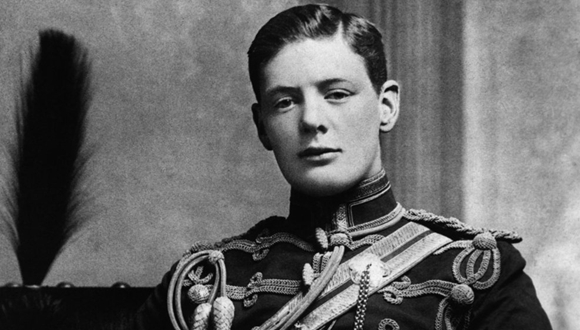
“Well, we didn’t have cinema yet. What else was a young man supposed to do?”
(Thanks to long-time reader Ana Alves who mailed me Churchill’s autobiography as part of her annual book package. If you want to support this blog too, here is my wishlist of books. It’s hard to get the books I want in English or in German in South America, so I appreciate any help. Thank you!)
Before I went into the jungle in Bolivia, my biggest fear was of snakes.
But then, after a couple of days of wading through the green hell, completely lost, I heard something move in the tree above my head. I took a few steps back and saw this scary reptile lowering itself slowly. It moved like a snake, but it’s head was much bigger. I saw no eyes, no nose, it seemed like the whole head consisted only of claws ready to devour me.

It was the scariest thing I have ever seen.
I definitely ain’t going back to the jungle.
From Donald Trump’s book – or to be precise: Tony Schwartz‘s book with a photo of Donald Trump on the cover – The Art of the Deal:
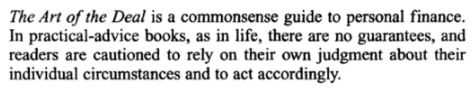
“There are no guarantees,” warns the man who keeps shouting “Believe me!”

 The Happy Hermit