Donald Trump on GDP:
I already understood more about GDP in 9th grade. But then, I just went to a regular public school.
Donald Trump on GDP:
I already understood more about GDP in 9th grade. But then, I just went to a regular public school.
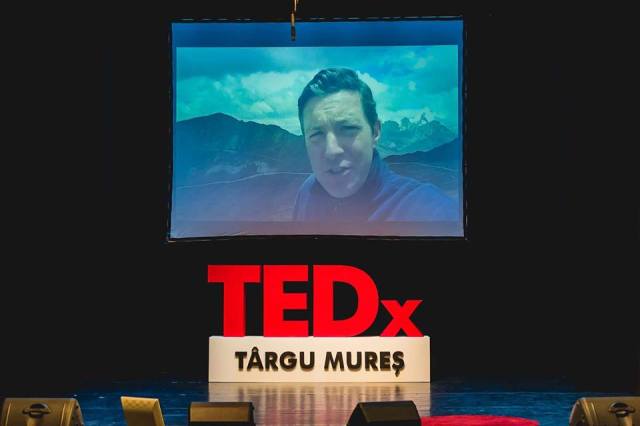
After giving a talk at a TEDx conference in Romania in 2015, I stayed in contact with the very friendly team in Târgu Mureș even after I moved to South America. So, for this year’s conference, they asked me for a video message.
I was happy to do that and climbed all the way to Mount Chacaltaya in Bolivia, at 5395 m a new record for me, a great adventure, but sadly also a place where the effects of rapid and dramatic climate change can be observed.
Here are the few words I could manage to speak, still short of breath after the heroic feat of climbing that mountain.
If you don’t believe that there really was the world’s highest ski resort, look at some photos from a few years ago:
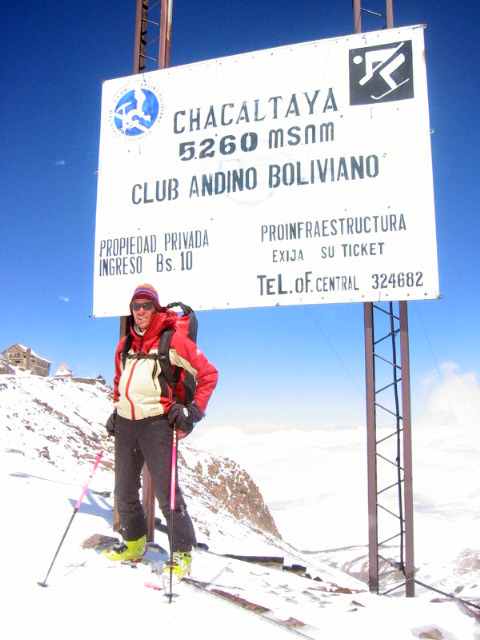
Admittedly, I was there in summer, but until 2009, the glacier had been there all year round, as glaciers usually are. And above 5000 m of altitude, the change in seasons – less pronounced that close to the equator, anyway – shouldn’t make that much of a difference. (The Făgăraș Mountains in Romania are only 2500 m high, and I saw snow there in a very hot summer.)
In another coincidence connecting my two favorite countries, Romania and Bolivia, I was wearing my cool Gabor hat from Transylvania on that expedition.
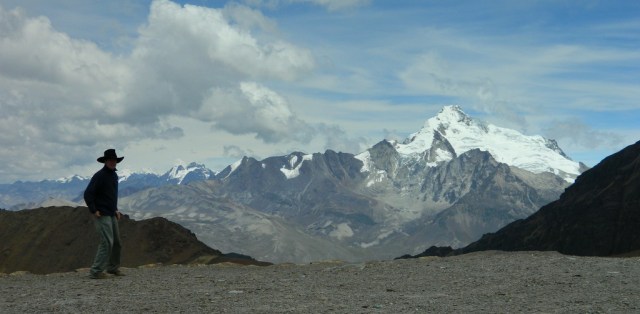
The mountain in the back, Huayna Potosi, still has snow because it is another 1000 meters higher, but the glacier there has lost thickness and is retreating too.
Because I am returning to Europe in May 2017, I will probably be able to attend the next TEDx conference in Târgu Mureș in person.
It’s mid-February. If you are like me, most of your new year’s resolutions have already dissipated, been forgotten or pushed to March or April. The smarter ones among you won’t have made any resolutions in the first place.
But if you want to feel really bad, consider young Winston Churchill’s new year’s resolutions, as reported in his autobiography My Early Life:
I therefore planned the sequence of the year 1899 as follows: To return to India and win the Polo Tournament: to send in my papers and leave the army: to relieve my mother from paying my allowance: to write my new book and the letters to the Pioneer: and to look out for a chance of entering Parliament.
These plans as will be seen were in the main carried out.
A year has after all 365 days. Why limit oneself to resolutions regarding exercise, diet or learning a language?
 When Winston Churchill made these resolutions he had just turned 24. The planned book was about the war in Sudan. Churchill had requested to take part in that campaign several times but had always been turned down. He eventually paid for his own trip to Africa and financed it by writing reports for newspapers. The River War came out in two volumes comprising around 1,000 pages. Shockingly for someone of Churchill’s age, the book was already his third. It should however be remarked, without the age of the writer or the age of the time being able to serve as an excuse, that The River War includes some crude racist and anti-Islamic passages.
 Churchill did indeed run for a seat in the British Parliament at age 24, but did not get elected that year. Of course, he managed to get elected in the same constituency only the following year. It probably helped that he had used the few months in between to work as a war correspondent in South Africa where he, as a civilian, took part in some skirmishes, got captured by the Boers, managed to escape from a POW camp, found some English miners in South Africa (one of whom happened to be from Oldham, Churchill’s constituency) who hid him underground before he managed to escape South Africa hidden on a train, making him a celebrated war hero. Obviously, Churchill also wrote a book about these exploits, London to Ladysmith via Pretoria.
All in all, Churchill published 43 books in 73 volumes, some quite good ones among them (he won the Nobel Prize in Literature). All of this while fighting military and political campaigns, governing an empire and winning World War II. He also found time to paint, to build houses as an amateur bricklayer and to collect butterflies.
So now, please tell us why YOU can’t find the time to go running three times a week or to read one book per week.

Winston Churchill in 1900, unimpeded in his productivity by Facebook and YouTube
(Thanks to long-time reader Ana Alves who mailed me Churchill’s autobiography as part of her annual book package. If you want to support this blog too, here is my wishlist of books. Thank you! – This article was also published by Medium.)
It’s really not that complicated:
Where The Hateful Eight failed, Hell or High Water succeeds: in reviving the Western genre. It’s not done with gory violence or with a cast of clichés, but with strong characters, well-acted and, above all that what makes a good Western, scenery. Both prairie and small towns play their part, where Quentin Tarantino completely wasted that asset by holing his eight people up in a hut.
It’s a movie about bank robbers, so of course there are gunfights, but here you are not exposed to the overdone, mindless rain of bullets that we have to endure in so many wannabe-Westerns. Hell or High Water is even quite funny, without ever becoming cheesy.
Here’s hoping that the film will be a commercial success, so that more producers and directors will try a Western again instead of the 13th sequel to some dipshit comic strip picturization.

I guess you can see that I was hungry when I replied to that comment.
Sometimes people say: “I understand that you charge so much. After all, you had to study for 4 or 5 years to become a lawyer.” That’s nonsense. Theologians and experts in ancient Chinese literature of Mongolia study even longer, yet you wouldn’t pay them your life’s savings, would you? You pay a lot because you are in a messed-up situation that only one person, the hot-shot lawyer, can solve. And by doing that, he will save you not only more money than you invest, but also your life, your freedom and your sanity.
And realistically, you only need a lawyer once or twice in your life. So you may as well pay a bit more than for your monthly haircut. Regard it as a treat, like a vacation. Just a more intellectually rewarding treat, at least if you find a lawyer who is also a philosopher.
Remembering in how many countries the Jehovah’s Witnesses have already visited me at home could almost make me paranoid: in Germany, England, Malta, Lithuania, Italy, Romania, Bolivia and Peru. In Sicily and in Romania they showed up within days after me moving in, as if Mr Jehovah had an intelligence operation that is constantly monitoring all moves and movements around the world. Often, the Jehovah’s Witnesses stopped by to welcome me to their hood before the internet guys – whom I had asked to come – managed to do so. This actually led me to a business idea which I should convey to the CEO of the Jehovah’s Witnesses if I ever meet him.
And then there are the old ladies talking to me in the park, the younger ladies standing in pedestrian zones with their evolution-misunderstanding pamphlets, and the gentlemen who seat themselves next to me on the train, always quite coincidentally of course.
Based on my roughly 67 encounters with the Jesus Witnesses, I meanwhile know how to keep them at bay:
But now comes the trick:
What had happened?

The first time, it happened in Malta, where I still attributed it to the anti-Semitism which is part of the local folklore. But when exactly the same happened in Lithuania and in Romania, I recognized a pattern that went beyond the personal prejudice of the individual standing in my door.
A quick research yielded that the Jehovah’s Witnesses do indeed have an anti-Semitic tradition, which they are still nursing and which is also directed against Israel.
But at least now you know how to get rid of these obtrusive guys. Good luck!
(I haven’t found the exact sweater online, but here you can order a T-shirt with the same logo.- Hier könnt Ihr diesen Artikel auf Deutsch lesen.)
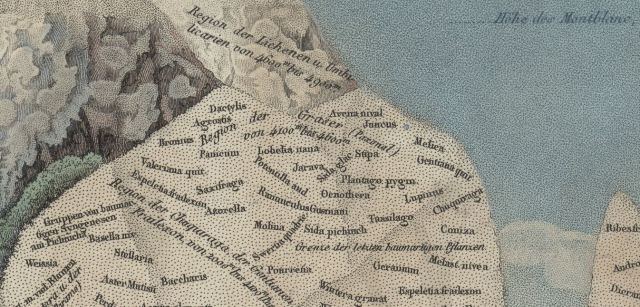
Reading about Alexander von Humboldt’s scientific voyage in South America, I stumbled upon his Naturgemälde (“painting of nature”) which he drew after almost conquering the summit of Chimborazo in Ecuador in 1802.
It shows a cross section of Chimborazo, arguably the highest mountain in the world, with different vegetation zones. Hundreds, if not thousands of plants are listed in a lovingly detailed manner. (If you click on the photo, you can view an enormous resolution of 15,000 x 10,000. Now you only need a good printer, and you’ll have a beautiful poster for your living room.)

Plus information about altitude, air pressure, refraction, electrical appearances, humidity, soil quality and plenty of other scientific parameters that I never heard of. (What the heck is a cyanometer?) But it also lists useful information for hikers, like temperatures at different altitudes, the snow line and which animals live at what altitude. All of this is so rich in detail that you can get lost in the chart for hours.

So, Alexander von Humboldt not only
but on top of all of this,
One could call Naturgemälde the world’s first infographic. Actually, most infographics published today don’t come close to it with respect to information content, clarity and graphic design.
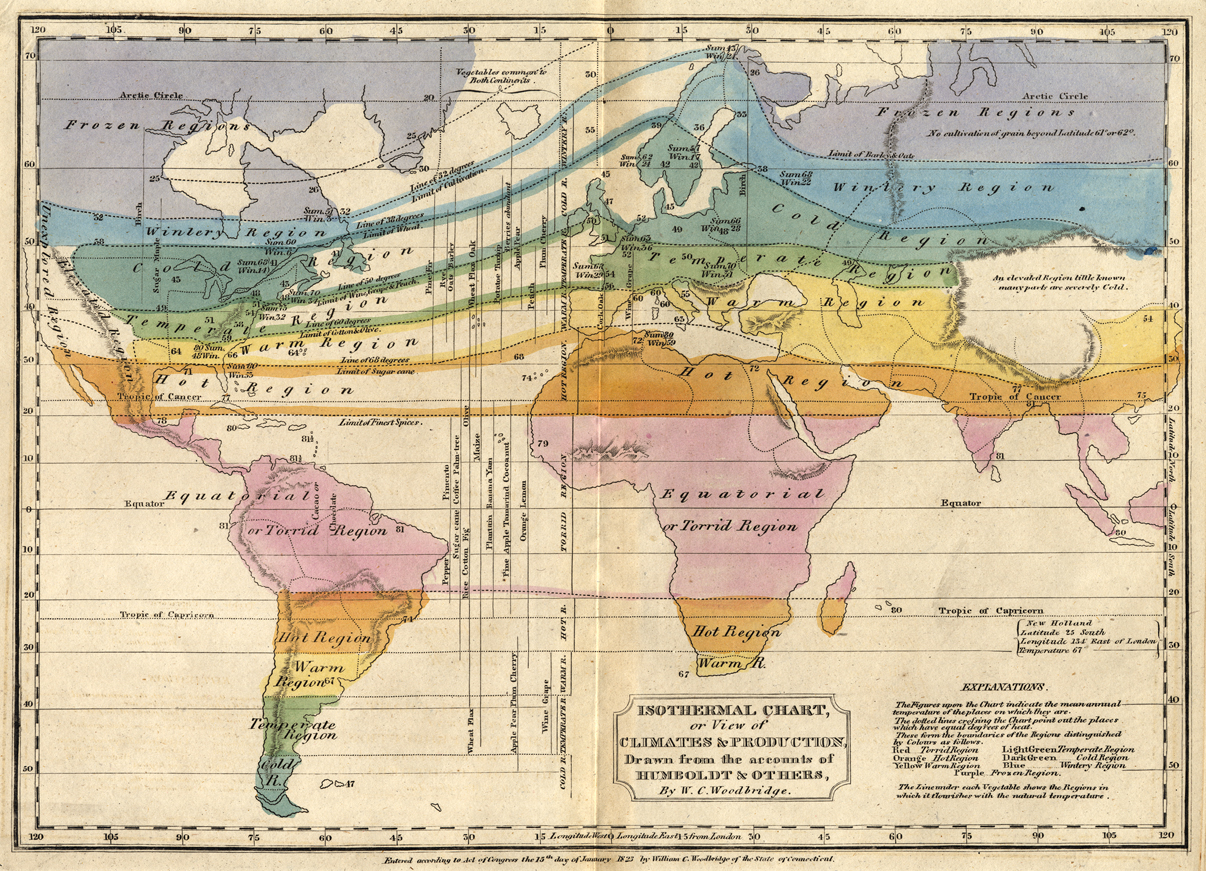
Humboldt was also the first, in 1817, to use isotherms, the lines on weather maps that connect different geographical points with the same temperature. Until then, global temperatures had been collected and compared already, but the data had been presented in long lists, making it difficult to compare. Due to Humboldt’s visualization, one look at the isotherm map revealed patterns around the world. It made the difference between looking at weather and looking at the global climate.
If this has made you curious about Humboldt, I highly recommend The Invention of Nature by Andrea Wulf. Or, if you want it more light and amusing, Measuring the World by Daniel Kehlmann is an exquisite fictionalization of Humboldt’s journey.
“If you are going to be pick-pocketed or mugged in Brazil, Salvador is likely to be the place,”
says the Lonely Planet guide on South America.
“Don’t take anything with you when you walk around Salvador. No watch, no expensive phone, no cards, no jewelry, not even fake jewelry,”
the lady from the cruise line Pullmantur had warned on the ship before we disembarked in Salvador, scaring some of the passengers into staying on board.
Well, nothing happened to me during two weeks in Salvador, although I lived in a neighborhood that some people called dangerous, I usually walked around alone, also late at night, I went into dark alleys, I looked white and foreign, I didn’t speak Portuguese, I was wearing a watch, khaki pants and a white or blue shirt, I had a camera with me which I often carried openly, and whenever I was lost, I took out my tablet to check the GPS.
I was never assaulted, mugged or robbed, but I noticed two things happening over and over: First, Brazilians would look at me in disbelief, particularly if I was in some dark alley at night, they would look at my camera, look at me again and I could notice the “Oh my god, this guy is so stupid to walk around like this” in their eyes. Second, people called at me from their windows or balconies to not go down that way or this way, either signalling with their hands or shouting “dangerous!”. That was very caring and nice.
There is a lot of standard advice on how to behave if you get mugged:
Often, this advice comes from people who did get robbed, though, so how much can their advice be worth? Obviously, it’s bullshit. Actually, it’s not only bullshit, but it’s dangerous advice. If Europeans and North Americans repeat this mantra of “don’t resist when you get robbed in Latin America,” of course the gangsters will prefer to attack people who are obviously tourists. “Haha, these gringos, they don’t even fight back. It’s like robbing little children, hahaha!” you can imagine the bandits laughing while having a drink after a successful day. Telling people to not resist muggers is like putting a huge “Rob me!” sign on top of their heads.
As the expert in not getting robbed, let me give you my advice:
To summarize this: Don’t look scared. Don’t look like a victim. If you don’t have natural confidence, watch a James Bond film before you go out, observe the way he walks and imitate it.
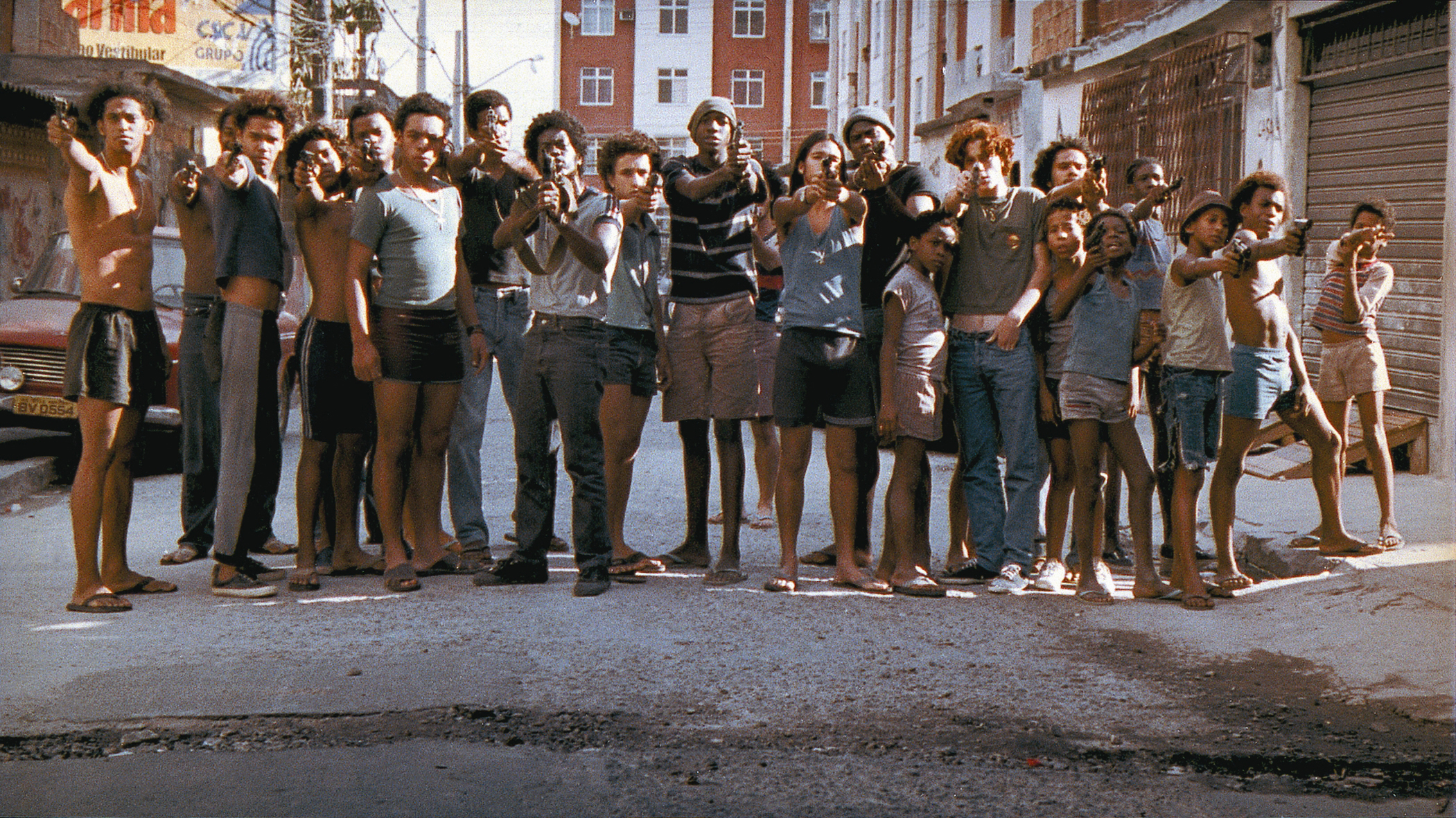
But even then, the worst-case scenario may happen. So here is my advice in case you do get robbed:
Following the argument above, even if you fight and lose, you are making everyone else safer by removing the myth that tourists are docile victims.

 The Happy Hermit