Film Review: “Cast Away”

As I am currently stranded on a far-away island myself, people have been making references to “Cast Away”, Chuck Noland and Wilson. The references seemed to increase as my Robinsonade persisted and my beard grew.

Andreas Moser beard like Captain Haddock

Finally, I felt like I had to watch the movie.

What a waste of time!

First of all, is this some bloody FedEx commercial? It sure seems like it. Even when Chuck is stranded on the island, packages continue to arrive. He is supposed to be on a deserted island, with nobody knowing where he is. That’s the point of the whole movie! How would anyone send him packages? That is not how FedEx, any other mail carrier or oceanic water currents work.

151227-1532336916

Let me call bullshit on that, because I’ve been sitting on an island for months and I haven’t gotten a single package! (Although people know where I am and I have a wishlist of books.)

Then he somehow survives for four years. Without a sunburn. Not very realistic. I have had to find water and food on islands, and I can tell you: Banana trees don’t produce new bananas every morning. There is not enough rain every day to have sweet water. And a lot of the fish will eat you before you can eat the fish.

And why, for fried fish’s sake, can’t we have one disaster movie without a love story? Aren’t plane crashes and islands and sharks enough? Although, I have to concede one thing: The love story was at least realistic. Because the girlfriend keeps telling him that he is the love of her life, but, once he doesn’t come home from the plane trip, she gets lonely, marries and has children. After a month. That, I am sad to say, is what always happens in real life. All this “love of my life” bla bla doesn’t count for nothing if you ain’t there. It doesn’t matter if you were stranded on an island or in prison, in either case without a phone. “Well, what was I supposed to do? You didn’t message me anymore,” she will ask, putting the blame on you. “How about waiting?”, I would say, but then I seem to be too romantic to think that constant availability is a requirement for love.

Anyway, we have all experienced this in real life, we don’t need a pointless film to show us what it’s like to be punched around like a volleyball. Speaking of it, Wilson was by far the best actor in the movie.

Seriously, if you are ever on a deserted island, use the time to think of something better to do with your life than to return to your corporate job. I did.

And if you give a reception for someone who was stranded on the high seas for four years, then don’t offer him sea food! This movie was wrong on so many levels. But then, what would you expect if a shipping company gets to film a two-hour commercial?

Links:

  • More film reviews. (I am not always that critical.)
  • My TEDx talk on how I changed my life after a traumatic experience.
  • Next, I’ll probably have to tackle Robinson Crusoe, because he is the other reference that gets used all the time. Well, at least there is a book, so I don’t need to decide which of the many film adaptations to watch.
Posted in Cinema, Travel | Tagged , | 8 Comments

In the Clouds

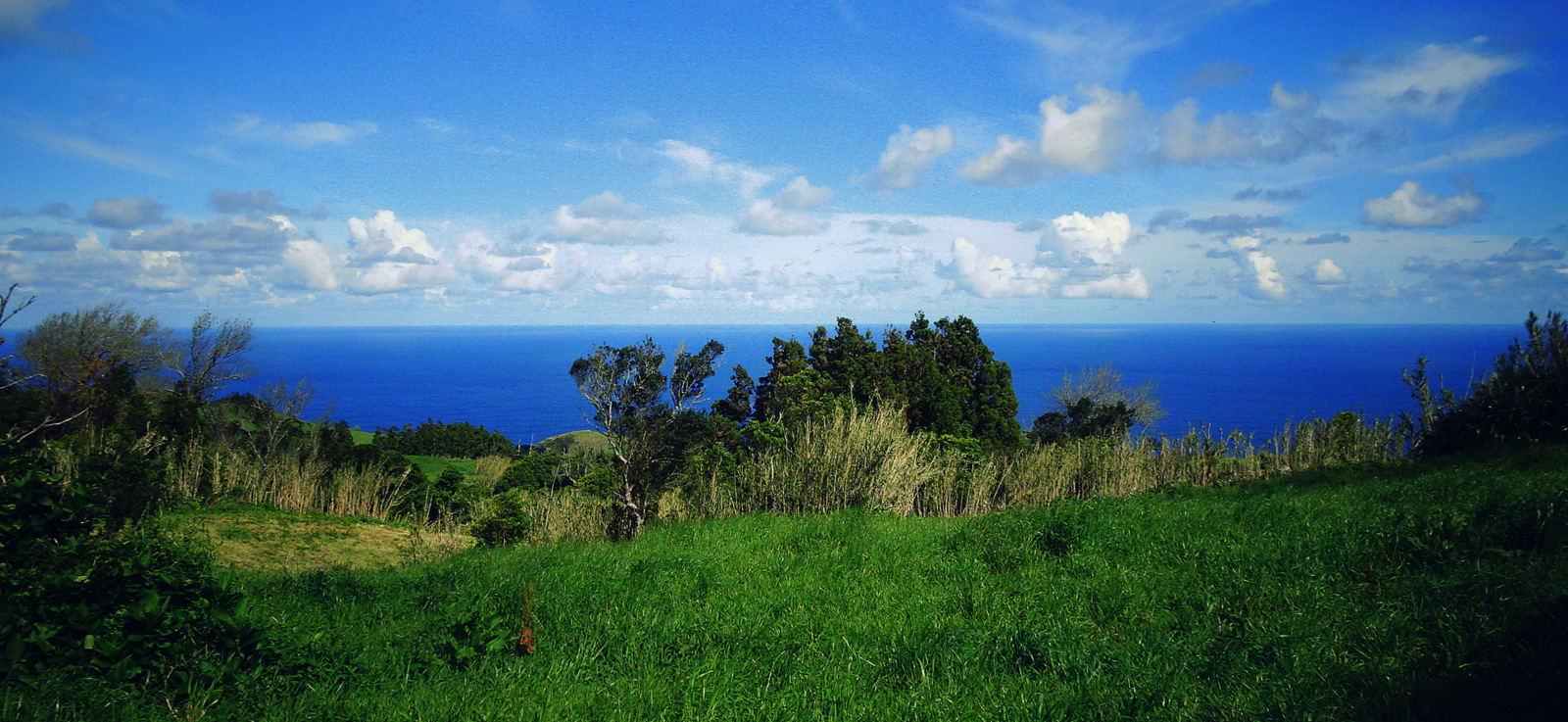
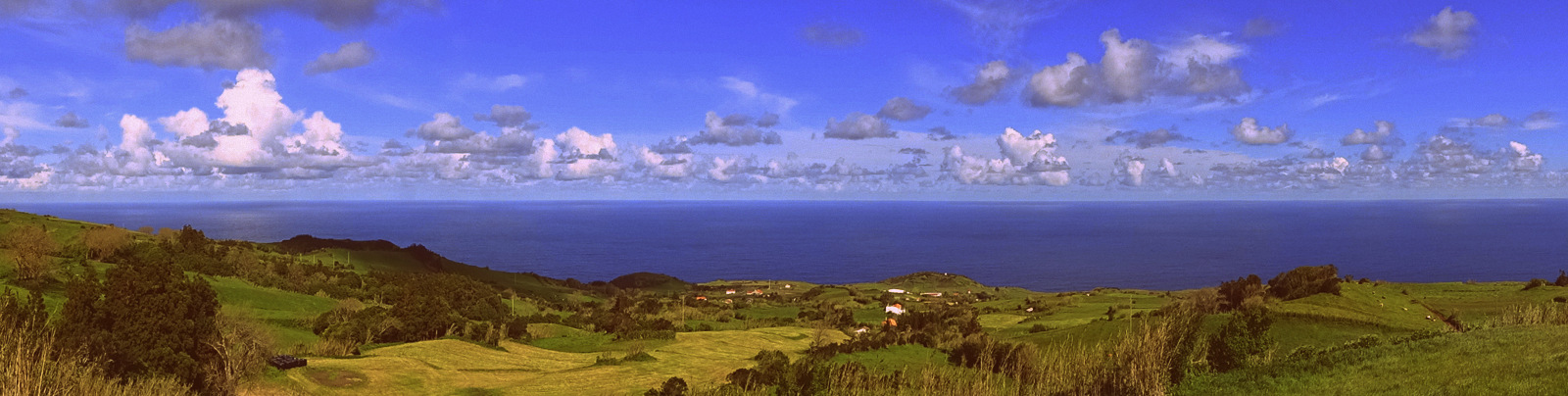
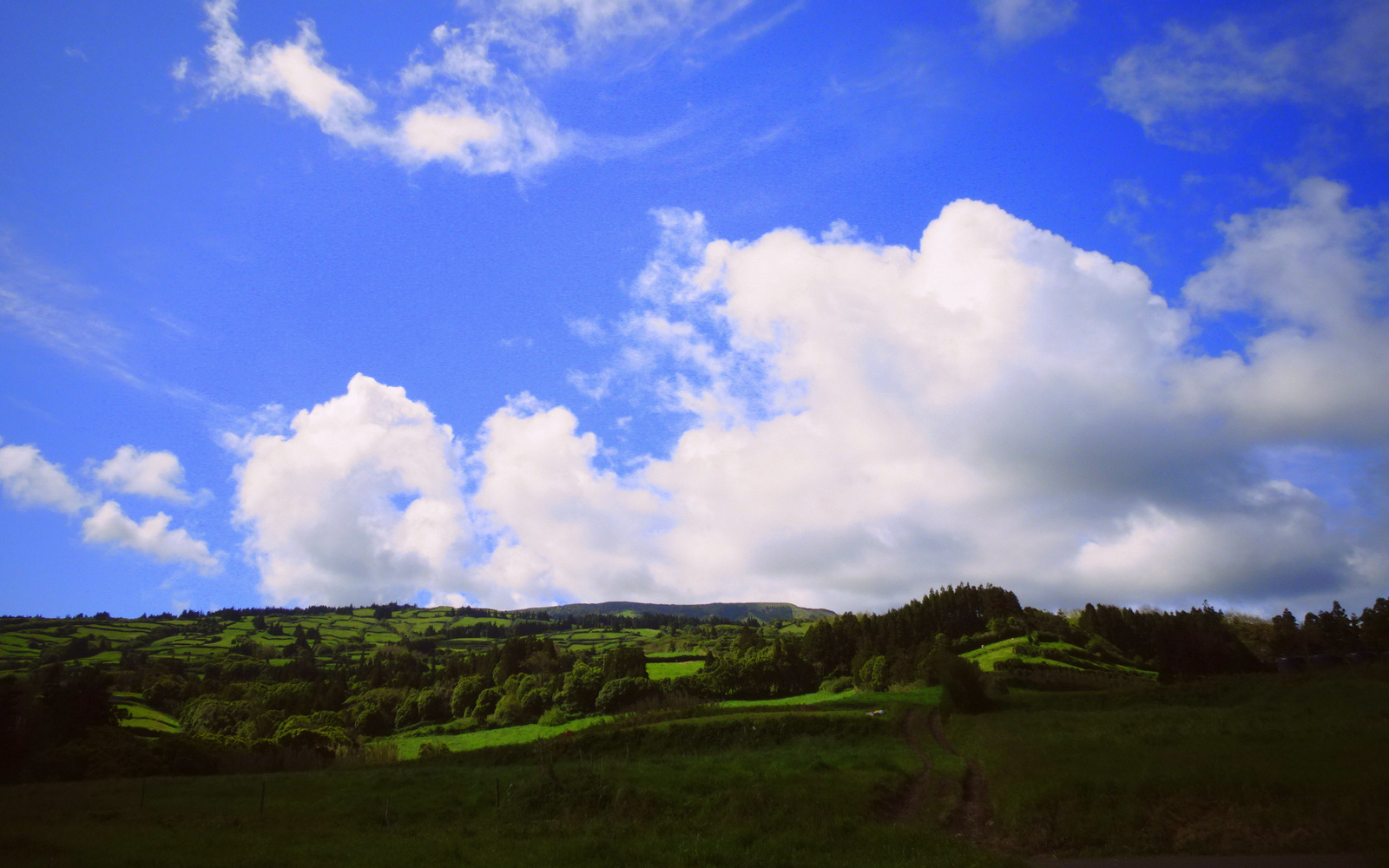
It was a beautiful day on the island, made all the more beautiful by white fluffy things floating through the ink-blue sky.

clouds on Faial (3)

clouds on Faial (4)

clouds on Faial (5)

clouds on Faial (1)

clouds on Faial (2)

“Are these air-sheep?”, I asked the farmer in the field, for who would know more about animals, land- or airborne, than someone who milked and killed them for a living.

“No,” he said, as if talking to a city guy who knew nothing about that, by which he may have been right.

“These are clouds,” he explained, which didn’t explain anything.

“They are beautiful,” I said, to which he shrugged his shoulders.

I think he was one of those people who aren’t interested in what can neither be eaten, nor counted towards the gross domestic product.

I, on the other hand, am an adventurous aestheticist, and thus, I climbed up the steep volcano which is the center, the foundation and the peak of the island, to get closer to the clouds.

Well, I did get very close. Actually, I climbed straight into the clouds. They were cold, windy and wet.

Maybe clouds, like humans and other things, are best admired from afar.

Links:

Posted in Azores, Photography, Portugal, Travel, Video Blog | Tagged , | 13 Comments

In the Foreign Legion

Diesen spannenden Insider-Bericht gibt es auch auf Deutsch.


A few years ago, the desire for education reared its nosy head again, remembered the high school from which I had graduated decades before, and was in deep and mournful regret that I had never awarded the same attention to the language of Germany’s neighbor to the west as I had to English, which, to add insult to injury, now claimed the Romanic title of lingua franca.

It happens however that I live in the most provincial rural area in Bavaria, where people are against anything international, but in particular against anything French because in 1796 our little town blocked the path of the advancing Napoleonic army and was punished with a little bit of a shelling. Ever since, neither the Institut français, nor the Alliance française, nor a proper baguette bakery have been able to gain a foothold in Amberg.

So if I wanted to reactivate, renovate, emend, advance and polish my French, I would have to travel into the big wide world. Preferably to France.

But how to finance such an endeavor? I always found applying for scholarships too much paperwork hassle. And even if progress could be made by simply listening, reading and speaking French in everyday life, I would need to work somewhere for food, shelter and Gauloises. But, from reading Germinal, I remembered that working conditions were still miserable, despite the revolution. I didn’t want to work myself into a hunchback.

And then, maybe it was because the Vietnam, Golf or some other War was happening at the time, the Foreign Legion marched into my mind. This third French institute of culture and language, which does not not only pay its students the aforementioned basic necessities, but also work clothes and even a salary.

normandy_2712_-_day_5-_pointe_du_hoc_28746639206029

So I got on the train to Marseilles. Many trains, actually, via Nuremberg, Stuttgart, Karlsruhe, Basel, Dijon and Lyon. About 30 hours. A lot of time to think, little time to sleep. The other people on the train were tourists going to the Côte d’Azur for swimming, sailing and snorkeling. Carefree and jaunty. Two weeks of holiday, everything paid already. But after that, they would have to return to the coal mine in Klagenfurt or the brewery in Dortmund, for which I didn’t envy them a bit.

I arrived in the morning.

At the station, I asked around for the Légion étrangère. Chemin de Génie No. 18, somebody said, and to me, the name of the street was waving in the wind like the flag of fate. What a fitting address. I would never be able to stop smiling when giving my postal address as the immodest “Way of the Genius”.

I had to march a few miles from the station, but I wanted to freshen up after the long train ride anyway. The sun, the breeze from the sea, the brisk walk and above all the light, that light in the Mediterranean which made me wonder why the same sun doesn’t shine the same everywhere. I had to go to the most western point of Marseilles. The neighborhood laid there almost like a peninsula, and I noticed that it was as close as one could get to Monte Cristo Island with Château d’If.

My heart beat faster, my mouth became dry, as I counted the numbers at the side of the road. 12, 14, 16, there it was. Chemin de Génie No. 18. The soldiers seemed to have really nice apartments! With a view of the island, exactly one nautical mile away. I rang the bell and I want to shorten the ensuing conversation, as it would reveal some embarrassing details. To sum it up: I had been sent to the Centre des convalecents et des permissionnaires de la Légion étrangère, to the Legion’s retirement and nursing home. Whether it had been a joke or if the man at the train station hadn’t known any better, I never found out.

But at least the convalescing combatants could give me the correct address: “For recruitment, you have to go to the barracks in Aubagne.” That’s about 7 miles outside of Marseilles, the train had passed through the little town. Had I known that, I would have jumped off there.

To Aubagne I didn’t walk. Bus lines 69 and 100 go there, I am just mentioning this in case any of you have got the same plan. Meanwhile, it had become afternoon, and I should have eaten something. Or slept. Or first eaten and then slept. But I wanted to go straight to the Legion, on the first day, instead of loitering around town and risking that I would end up at university or in a relationship instead.

In Aubagne, the Centre de présélection was in Route de la Légion, which really made more sense than the folly with the geniuses. But it looked far less noble. More like a decaying youth hostel or an old kibbutz. The ashtray in front of the door was a steel helmet turned upside down. An army with humor, that was a good sign. Maybe it would really be as funny as in The Good Soldier Švejk.

In a way, it was already my second attempt that day, so I was less nervous as I stepped through the glass door under the letters Information – Recrutement. But as soon as I had spoken my first sentence, the sergeant got up and pointed me towards the door through which I had just entered. “Why?”, I asked, not yet having learned that this is a taboo word in the military. Because I had shown up without an appointment? Or were there no job openings? Was my French too bad? But I had come exactly to repair that fault.

But the non-commissioned officer wasn’t unfriendly at all. He walked through the door ahead of me, into the garden and to something that looked like a playground. There were climbing frames, ropes hanging from beams, with a big fat knot at the bottom, and horizontal metal bars, maybe to attach swings. Only the ground wasn’t as nice as you see it at modern playgrounds nowadays, where they have this bouncy rubber, so that the child plopping from the seesaw don’t disturb his mother, who is sitting on a nearby bench, but prefers playing with her cell phone over playing with her son. There, it was only dusty, hard, dirty sand. Probably, there were even snakes.

The sergeant went straight to the metal bars, where the swings were missing, pointed to them and said: “Quatre tractions.” Now, you have already gathered that my French was rather schooled by Hugo than in the hood. I didn’t understand what “tractions” were supposed to be. But apparently, this had happened more often, because the Frenchman, who, as it only appeared to me later, must not necessarily have been French, for after all, this was the Foreign Legion, not the French Legion, stooped to the use of English, just for once: “Four pull-ups.”

I couldn’t pull them off.

Then, I went to the harbor in Marseilles, got onto a ship, emigrated to South America and learned Spanish. A much nicer language anyway. And less command and obedience and parachuting and all that army crap.

Links:

To avoid that I ever have to apply as a mercenary again, I am thankful for any support for this blogMerci beaucoup!

Posted in France, Language, Military, Sports, Travel | Tagged , | 19 Comments

German Law: What happens to Children when the Parents die?

Recently, parents seem to be thinking about their possible early demise, because I have been getting this question more frequently: “What will happen to our children if we, mother and father, were to die?”

I don’t know why people are so full of doom and gloom, especially now in spring when the flowers are blooming, the rabbits are jumping, the days are getting longer and warmer, and the parks are full of, oh wait, I guess I do understand why people are a bit cautious nowadays and want to plan ahead.

Before addressing the issue, let me remind you that my blog is full of advice on German law and that I really appreciate it if you were to support this blog. This question falls into the realm of child custody law, on which I have a set of FAQ and a few other articles.

Milluni6

First of all, I am a German lawyer, so I will only describe the situation under German law. German law applies if the child or children has/have their habitual residence in Germany, regardless of the citizenship of the child or the parents.

Let’s start with the simple scenario: A child has two parents and both parents have custody. In this case, if one parent dies, the remaining parent will have sole custody (§ 1680 I BGB). Easy peasy, no problem here.

Milluni2

Second scenario, already more complicated: A child has two parents – and they need to be legal parents, so step-parents don’t count, unless they have adopted the child! -, but only one parent has legal custody. This is often the case when the parents are not married, but it may also be the result of a previous custody decision by a court. Now, if the custodial parent dies, the Family Court will usually grant custody to the surviving parent (§ 1680 II BGB) – unless the welfare of the child requires otherwise.

Except in grave cases of child abuse where the surviving parent can/must be disqualified, other reasons could be if the surviving parent has been absent from the child’s life for a long time, or if there is another person in the child’s life who has already been assuming the role as parent, without legally being one. The latter is typically the case if the child is growing up with a step parent. (These are usually also the most contested cases.)

How the case will play out greatly depends on the will of the child, too. The older it is, the more weight will be given to the child’s wishes. Especially if remaining with the step parent will mean living in the same house and going to the same school, whereas moving to the biological parent would mean a move to another continent, the biological parent often faces an uphill battle.

cemetery-gate

Now to the worst-case scenario: Both parents die at the same time or the only surviving parent dies. In that case, the Family Court will appoint a guardian for the child (§ 1773 I BGB).

Some people assume that guardianship will automatically go to uncles, aunts, grandparents or other relatives of the child, but that’s not the case. The court will investigate who is willing and able to carry out that job, it will ask the child (depending on its age), and if there are more “applicants” for the child, the court will first try to mediate, but ultimately it will have to make a decision. Obviously, close relatives are always an option, but the court can also consider other people, like a teacher or a neighbor or the parents of the child’s best friend.

Again, the wishes of the child itself are more relevant, the older it is. Once the child is 14, it has a veto right (§ 1783 I no. 3 BGB).

In my experience, the toughest cases are those where two family clans (maternal and paternal) are fighting over who is better suited to take care of the child. This seems to happen more when the child is the only grandchild (and when the grandparents never approved of the marriage anyway and always hated the other clan). Oh, I could tell you stories where people go all-out nasty and you just want the child to run away Tom-Sawyer-style.

cemetery-cactus-western-001

And that leads, as if I had planned it that way, to the culmination, where parents ask, worriedly: “Can we determine who will be the guardian of our child once we die?”

The answer is: Yes, with some restrictions. The way to do that is to set up a last will on child custody (“Sorgerechtsverfügung”), which according to § 1782 I 1 BGB is subject to the same formal requirement as a testament (see no. 4 of my FAQ on inheritance law in Germany). I always recommend that it not only includes the name of the intended guardian, but also a few reasons for your decision. This will come in handy in case there will be a dispute.

In this last will, the parents can also explicitly exclude persons from being appointed as guardian for their child (§ 1782 I 1 BGB).

Obviously, if both parents are alive, it would make sense if they could agree on a guardian. However, this is sometimes not possible. In that case, each parent (as long as they have legal custody) can set up his/her own last will on child custody, and the one of the parent who dies first will become irrelevant. Because the last will of the last surviving parent is the decisive one (§ 1782 II BGB). This also makes sense, as many years can pass between the deaths of the parents, so the surviving parent will gain information and insight about the child and the potential guardians that the predeceased parent couldn’t have had.

Oh, one last thing: Cats and dogs don’t fall under custody law. You can dispose of them like chattel. Just mention in your testament who should receive them.

Links:

Posted in Family Law, German Law, Germany, Law, Travel | Tagged , | 17 Comments

A Chinese in Vienna

During some meeting of some committee of some sub-organization at the United Nations in Vienna, I got to know a young lady from China.

Qian was doing an internship as a simultaneous interpreter for Mandarin and English. Simultaneous interpreters are those super-brains who listen to several participants in a discussion about the Nuclear Non-Proliferation Treaty and at the same time (!) interpret all speeches, questions, answers, interruptions and arguments into Chinese. Then, in the afternoon, they do the same about fishing policy or an agreement on tariffs and trade.

She suggested that we should meet for dinner or something like that.

Because Qian had mentioned that she had only arrived in Vienna a few days earlier and because I wasn’t quick enough to think of anything smarter, I asked if she already knew her way around the city.

“Of course, it’s a really small town.”

There are around 2 million people living in Vienna.

“Ehm, it’s the largest city in the country,” I replied, not really trying to correct, but to understand her.

“Oh yes, you are right,” she said with a smile, “I am sorry, I still have to get used to that.” The look on her face was like that of a titan who had come to a country full of mini-dwarfs, accidentally stepping on some of them, and fretting about it terribly.

She was from Qingdao, a name which didn’t ring any bell, until Qian patiently explained that this was Tsingtao, the capital of the former German colony of Kiautschou, and that they still had the best beer in China. More than 8 million people live in Qingdao.

There are hundreds of cities in China larger than Vienna. I could name only two or three of them, which shows that despite all my travels, there are still very large white spots on my map of the world. And Hainan province alone, one of the smallest provinces in China, has as many people as Austria.

China map population

Links:

  • In this article, you can find out how I ended up in Vienna in the first place.
  • And if I ever go to China, it will definitely be by train. I already have a savings piggy for the train tickets, but any support for this blog would be of great help.
Posted in Austria, China, Language, Travel | Tagged , | 9 Comments

Strangers in the Park

Hier geht es zur deutschen Fassung dieser Geschichte.


I had two days left in Boston before returning to Germany, and I didn’t know anybody in the city. The year was 2009 and, as far as I knew, the internet hadn’t been invented yet.

For dinner, I got a pizza and a copy of the Boston Globe. I went to Boston Common, a park, to sit on a bench and eat and read. Alone, as I often do. I had already finished half of the pizza and decided to leave the rest for later (American pizzas are made for American stomachs), when a young man walked by. He continued for a few meters, or yards, as he would call them, paused, turned around and came up to me. I quickly analyzed the situation, saw that it had gotten dark, that I was rather alone in the park, and that I hadn’t even taken a plastic knife from the pizza parlor. There are about 50 homicides per year in Boston.

“Excuse me, Sir. I am sorry if I am disturbing you.” He sounded and seemed polite. I was ready to hand over the rest of the pizza, should he pull a gun. (Americans are crazy about guns and pizzas.)

In my repertoire of facial expressions, I have one that says “I’ll give you a few seconds to explain what you want, and depending on what you say, I will be your best friend or I will tear you to pieces.” It was the moment to use it.

The young man, whose name I have sadly forgotten, and whom out of journalistic integrity I cannot simply refer to as David, Michael or Jonathan, although it would make the story much easier than these convoluted insertions, was either quite honest or quite clever in his approach. “I was wondering if I could ask you a question, because you look intelligent.”

I had to laugh before I could say “thank you” from the bottom of my heart. “Why do you think I look intelligent?”

“Because you are reading a newspaper, Sir.”

I was still smiling and pointed out that reading a newspaper may not qualify me to answer any question, but I asked the young man to take a seat. I did not offer any pizza yet because that would depend on the type of question. If it was a stupid one – yes, there are stupid questions – I wanted to be able to get rid of him and return to the pages that made me look so erudite.

“So, I have this problem with a girl,” he began. How convenient that I was a family-law specialist, although he couldn’t have possibly known that or known that I was a lawyer at all. Would the lawyers of Boston Legal ever sit in a park late at night to eat pizza? Probably not. In any case, I was relieved. This was my area of expertise and I had already helped hundreds of men regain their freedom. I could liberate this young man as well.

“She likes me and she told me that she wants to be with me. I also like her as a friend, but I am just not that attracted to her.” So far, it sounded like a surprisingly teenage problem for someone who looked like he was at least 21 or 22 years old. “But I am attracted to another girl. Now the matter gets complicated: the girl who likes me is white, and the girl I like is black. The white girl now accuses me of racism. And I find this thought quite disturbing, because I never thought of myself as a racist.” And, ending with a poignant question like a high-school essay paper: “Do you think I am racist for liking a black girl and not the white girl?”

That was a new question, which I liked. (One reason why I quit my lawyer job later that year was that clients rarely came up with new questions. I was getting bored.) A question that deserved a lot of thought, but I couldn’t let the young man wait, or he would sign up with the wrong girl. And I wanted to give him a positive answer, to be honest, so my thoughts were not swirling around completely free, as they should have. I also realized that he wanted practical advice, not a sociological discussion about race. After all, one could argue that everyone is a little bit racist, at least sometimes. (Just stop for a moment to realize how you have been imagining me and the young man in this story, although I haven’t given you any indication about the color of either.)

“I don’t think that you are racist. First of all, if you are in love, I am not even sure it’s your own decision. Sometimes, it just happens, and we don’t really have any control over it.” In the 16th century, love was seen as an illness by some, necessitating medical treatment. And who hasn’t ever wished that there was a vaccine against it?

“And then, I assume that your attraction to the lady in question is not based on the color of her skin, but on her character, on her smile, on her intellect, on what she says, does and thinks,” I possibly extrapolated from myself to him. “Maybe the way she kisses,” I thought, but didn’t mention it, because it seemed to me that he hadn’t gotten that far yet.

“And lastly, you might want to ask the white girl if it wouldn’t be equally racist against all other colors if you became her boyfriend. Whenever we choose one person only, we are disappointing dozens of others. Relationships are not the realm for anti-discrimination laws.”

“Say, do you want a slice of pizza?”, I offered, far too late.

“Oh, thank you very much, but I should actually be going. I am staying at a shelter for homeless veterans and I need to be there by 10 p.m.” It was already ten past ten. He thanked me again, visibly relieved.

It was a warm night, I had gotten hungry enough to finish the pizza, munching it while pondering thoughts about race, about love, and about how a rich country treats its military veterans.

reading park Chisinau

I don’t know what became of the young man and the girls in Boston, and chances are low that either of them will read this. (Unless you widely share the article with your friends.) But even now, ten years later, as we have Couchsurfing and Tinder and Bumble and lots of other apps to meet people, I am still thankful for that chance encounter. Because it taught me a lesson that I turned into a strategy.

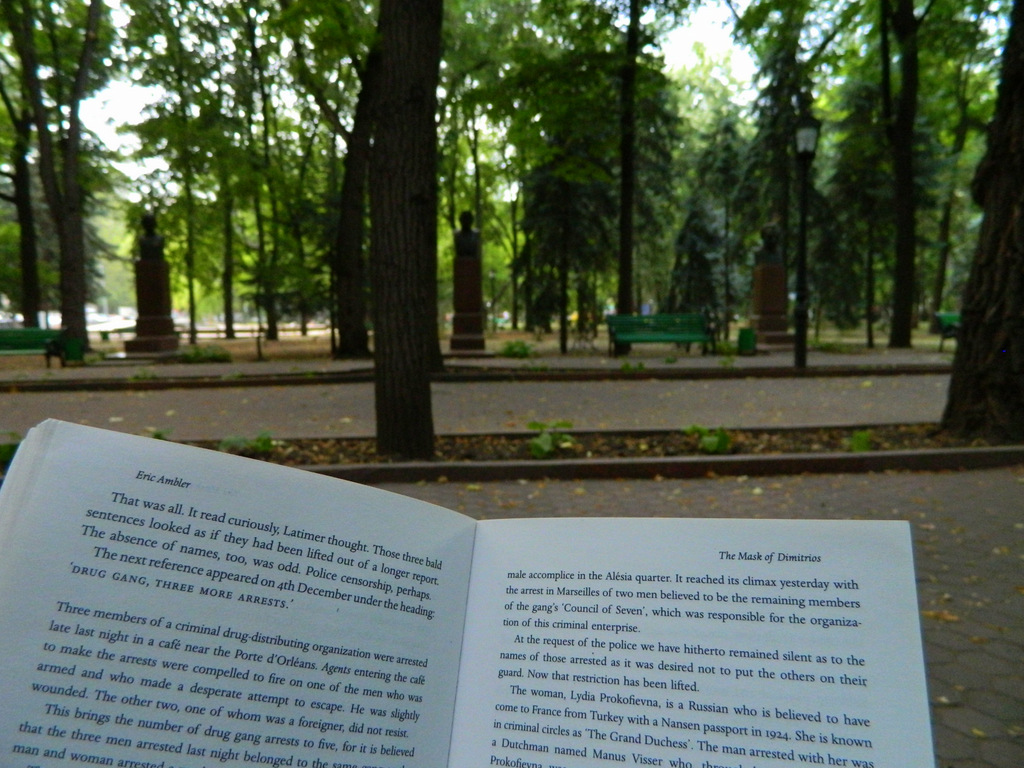
Since then, whenever I have more than a few days in a city (and weather permitting), I will go to a park and just sit there for a few hours, open to any surprises that fate may throw my way. I like to read a book or a newspaper, so people see that I am not in a hurry. You don’t see that many people reading in public, so it also makes me more interesting, I imagine. And to someone who is curious, a book or a newspaper is a good conversation starter.

Once, in Belgrade, I was sitting in Studentski Park, enjoying a few sunny hours and a copy of Süddeutsche Zeitung, bought from the well-stocked newsagent just on the other side of the street, who is always my first stop after a few weeks without news in the Balkan countryside. A couple in their 60s, Miro and Maia, two chemical engineers, thus saw that I spoke German and started telling me their life story, which included working in East Germany. They were so happy to meet someone willing to listen that they were almost fighting with each other about who got to tell which story. (They were also in heated disagreement about many of the memories, as well as about the industrial policy of the GDR.)

bulevardul cetatii 3

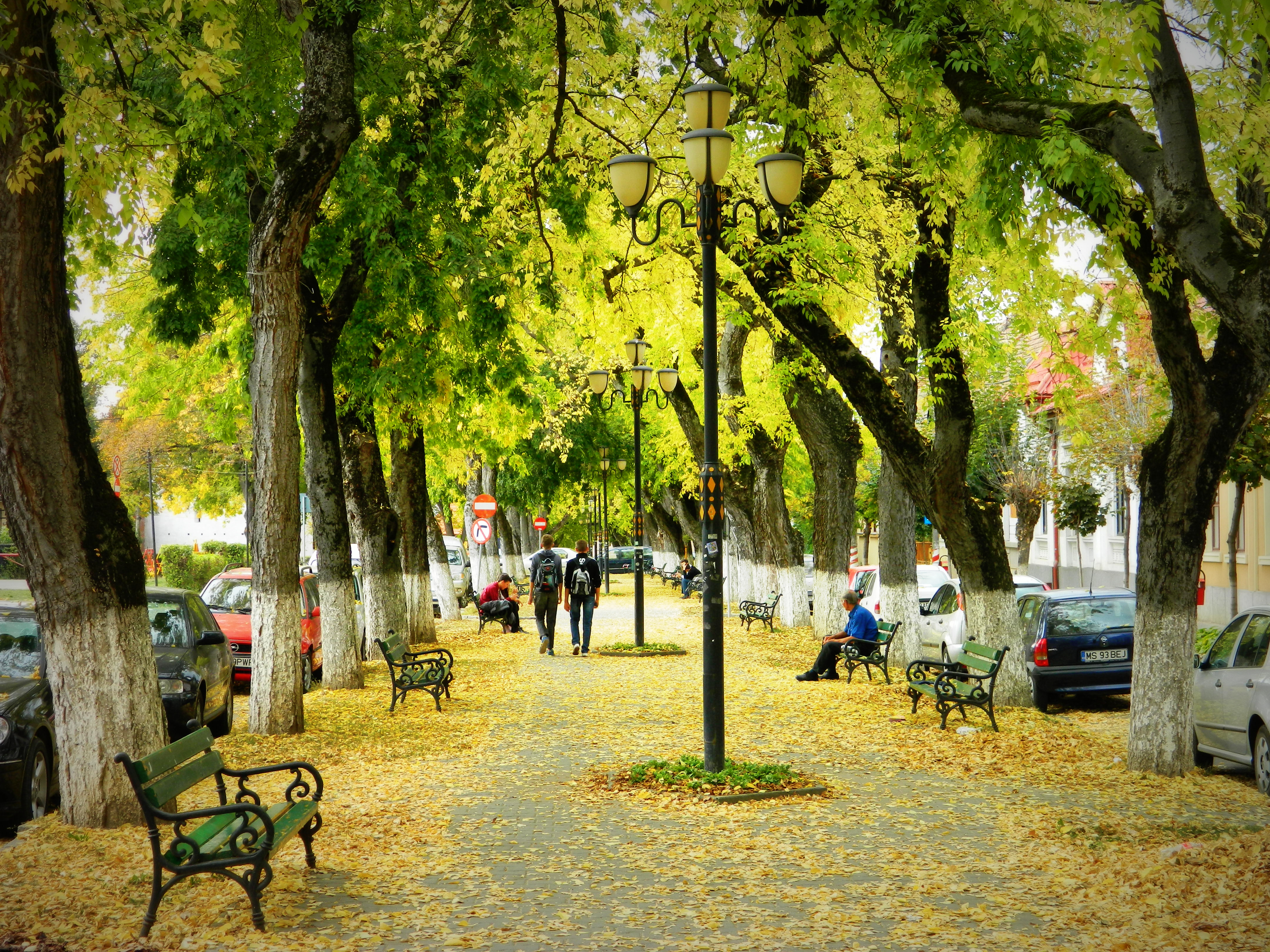
In Targu Mures, I sat outside, reading again. On the next bench, there was an elderly man, looking as if he had just finished a hard day’s work at the chemical plant, holding on to a bottle of beer instead of a book. After a wile, apparently recognizing me as a foreigner, he asked if I happened to speak Romanian, Hungarian, English, French or Russian, for he would like to ask me a question, if I permitted. We settled on English, and he said: “I was just wondering if I could take a look at the book you are reading, because I noticed you smiling and chuckling repeatedly.” The book was “Scoop” by Evelyn Waugh, a truly funny read.

It turned out that the gentleman was a retired engineer, a good-humored fellow, and had published a collection of stories himself. (Romanians love books and writing as much as Americans love pizzas and guns.) We had a wonderful conversation, realized that we lived in the same neighborhood, and when we exchanged business cards, as old-fashioned people do, I realized that Vasile was also the chairman of the local Jewish community. Noticing my interest, he said without hesitation: “If you have time this Saturday, why don’t you come to our synagogue at 10 in the morning? I will give you a tour of the building, it’s quite beautiful, and then you can celebrate shabbat with us.” I felt the need to point out that I was not Jewish, but he cut me off, “And why would that bother us?”, as if it was the silliest excuse he had ever heard.

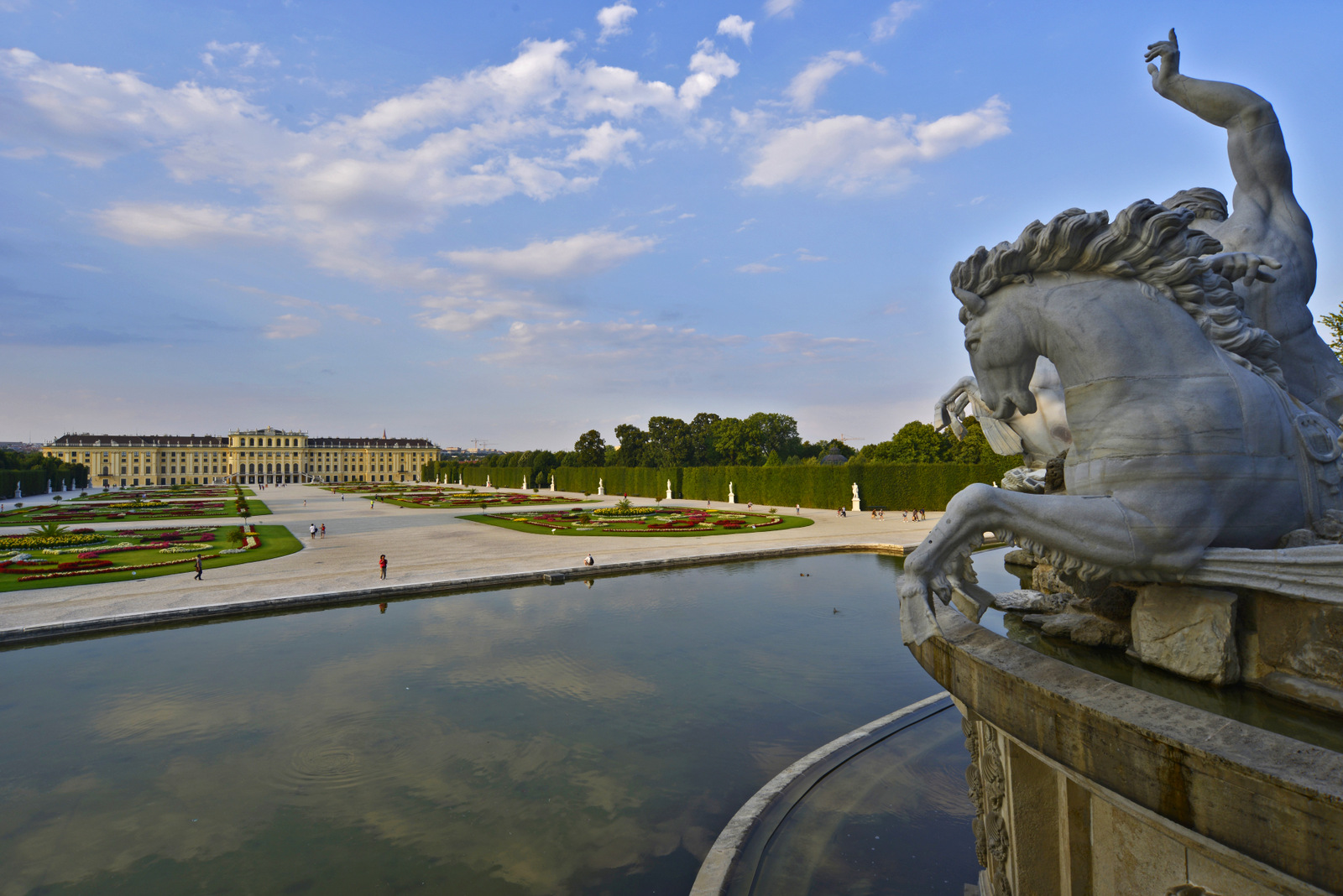
I did show up and met a very welcoming community of mostly elderly gentlemen and a young family from the United States, living in Romania at the time. To cut this long-winding story short, they later moved to Vienna and I became their house/cat sitter for two summers. So, if I had stayed at home that summer evening in Targu Mures, or played on my phone instead of reading a book, or ignored the gentleman’s question, I never would have had the chance to live in Vienna for a few months and I wouldn’t have discovered what is probably my favorite city in the world.

A city with quite some cute little parks, too, coincidentally.

Brunnen von oben mit Figur Schönbrunn

The people who approach me are usually older, the ones who are lonely and have time to talk. Often, it’s people walking their dogs. But I have also met interesting young people that way. They are often intelligent individuals who appreciate the sight of someone reading or writing. And of course there are the homeless and the beggars, but they have the best stories of all.

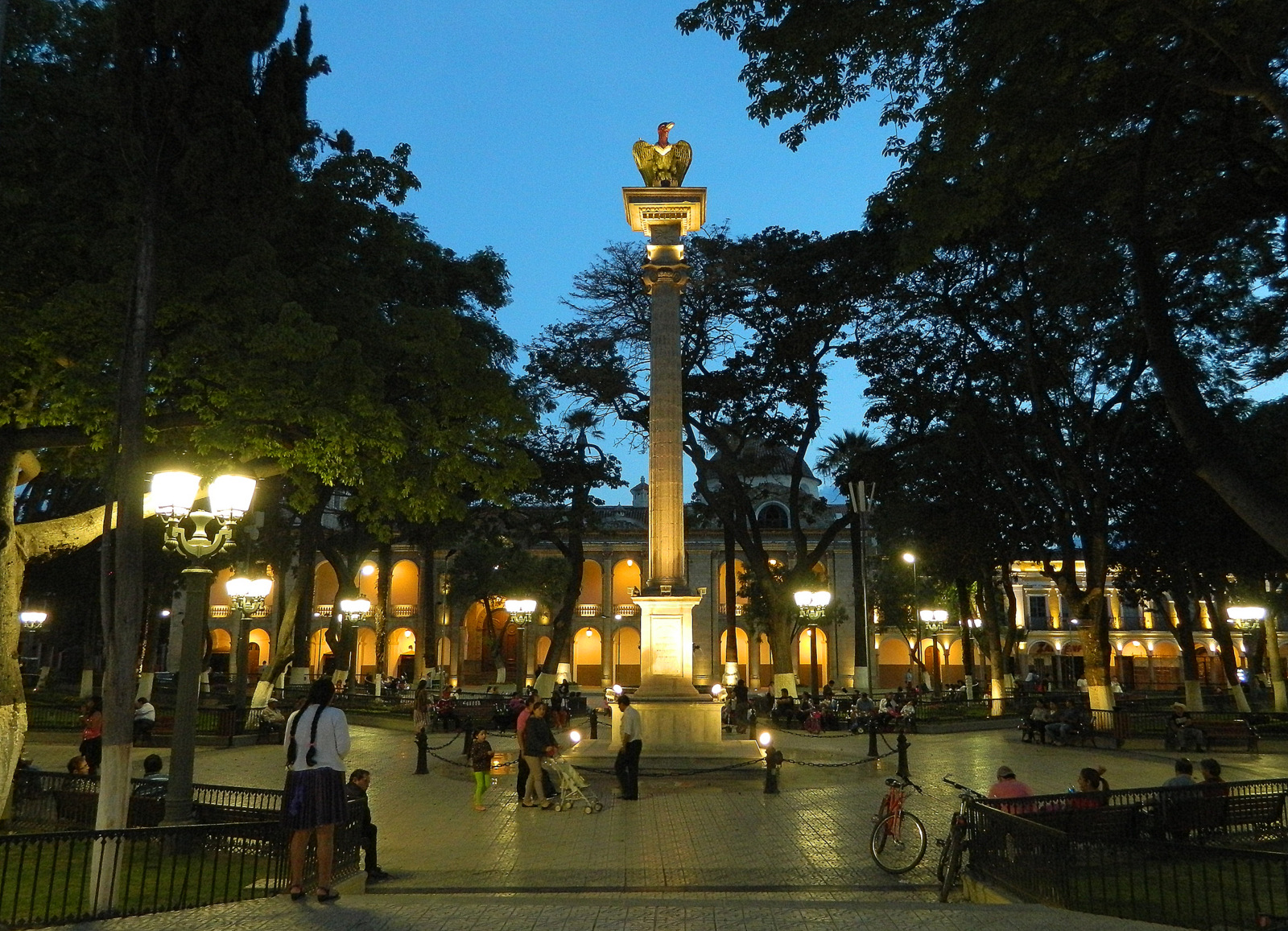
Only the Jehovah’s Witnesses can be annoying. But when I lived in Cochabamba, I even spoke with those freaks, using them as Spanish tutors sent from heaven, as much as they were threatening me with the prospect of going to hell.

14 Septiembre lively evening

There is a reason why I am tapping into these memories now. We probably won’t be able to travel far and wide for the next year or two. But, as you have seen, it’s not necessary to travel far and wide. Once you can go to the park again, just listen to people, and you may be surprised by how many beautiful souls and stories have been living around you all your life.

Links:

  • More travel stories.
  • More stories about love and life.
  • Luckily, my way of reporting doesn’t cost much, just a newspaper and a new pencil from time to time. If you enjoy stories like this, you can make sure that there will be more of them by supporting this blog. Thank you!
Posted in Austria, Bolivia, Life, Love, Photography, Romania, Serbia, Travel, USA | Tagged , , , , , | 23 Comments

Not quite a Thousand Kilometers, but a Good Start

Den deutschsprachigen Lesern empfehle ich die deutsche Originalfassung.

I have hitched rides a few times already, but merely short distances. Usually on the way back from hiking in the mountains when I didn’t feel like stumbling through the night any longer. But even my hitchhiking record so far was less than 50 km.

For a long time, I have wanted to take up serious hitchhiking and cover longer distances that way, but I have never dared to. And I don’t mean that I have been afraid of getting into cars of strangers or of getting killed. I am just not as spontaneous as I would like to be. Not knowing where I am going to spend the next night, that thought bothers me a bit. I always had excuses: too cold, too much luggage, I have to be somewhere on time.

And then, one Saturday afternoon in February, the university field trip to Ypres is over. I haven’t got a bus or train ticket, and I decide, quite spontaneously, that I shall attempt to hitchhike home to Bavaria. (The train was a bit expensive, and I can’t really endure 12 hours on a bus.) No round-the-world trip, but still quite a trip. From the west of Belgium to the south-east of Germany.

hitchhiking from Ypers to Ammerthal

I am excited.

Actually, I start by cheating a bit. A fellow student lives in Ghent and I ask her if she could take me there. Why should I stand next to World-War-I trenches for a few hours, holding up a sign, if I can ask someone? And compared with the whole distance, the way to Ghent is really just a tiny bit.

“Of course,” she says. Once in the car, she recounts stories of when she was hitchhiking all over Europe. In the good old real-adventure times before the internet and Google Maps. For her retirement, she is planning to drive a truck to Tajikistan.

Lesson 1: The real adventurers are often the quiet people who don’t make any fuss about their experience, nor annoy the world with their blogs and Instagraph photos.

When she points to a village next to the highway, saying “this is where I live”, I realize that she wouldn’t really need to drive all the way to Ghent. But she takes me directly to South Park, where the cars get onto the highway. “Here is a parking lane, cars can easily stop. Up there, you see the traffic lights, so the cars will come to a stop there, too. The highway from here goes to different directions, so it’s better to use a sign. If you want to go to Germany, just write ‘Aken’, that’s Dutch for Aachen/Aix-la-Chapelle.”

The wealth of professional advice is both calming and motivating at the same time. “Do you want to take some food?”, she asks and I am overwhelmed by her caring helpfulness. I decline the offer, which I shall soon regret.

Lesson 2: Being too timid is always a mistake.

The spot seems rather perfect to me, too. I hold up my sign, put on a friendly smile, and stand there for half an hour. The cyclists turn around to read my sign, but they can’t help me. A car with “AC” on the German license plate shows up and I am already celebrating. But the driver winds down the window and apologizes. He is going in the other direction, unfortunately. No one else stops.

I change the waiting spot, from Jules de Bruyckerdreef to Franklin Rooseveltlaan, just across the street. After less than five minutes, a BMW station wagon sounds the horn from afar and signals with the lights that my waiting has come to an end.

Lesson 3: If nobody stops, it’s usually the fault of the location, not your fault. The best spot is one where you can be seen from afar and where drivers can stop without blocking the traffic. Set yourself a time limit, after which you change the location.

The driver is a friendly and distinguished gentleman who looks the way I would look if I was still working as a lawyer: white-blue-checkered shirt, burgundy sweater and glasses.

He is going to Eindhoven. That’s in the Netherlands, where I don’t really want to go. “Well, it’s somehow in the direction of Germany,” he insists and it’s obvious that he is very keen on taking a hitchhiker. Okay, after all, Maastricht is on the way to Aachen, I remember. The main goal is going east for now, I can always turn south later.

He tells me that he used to hitchhike a lot when he was younger and laments that there are far fewer hitchhikers around today. And it would be so good for the environment to share a car, he adds. But an environmentalist he is not. For that, he is too critical of restrictions, like the prohibition of diesel cars in some areas or the speed limit. And he deems it disappointing that teenagers nowadays don’t drink as much alcohol anymore. “My teenage children don’t even know what it feels like to be drunk. What kind of life is that?” In his view, the obsession with health has replaced the church, which also operated with the fear of the unknown. It used to be the devil, now it’s diabetes.

He praises the Trappist beer of Westvleteren. When I tell him that I have tried it, he doesn’t believe me at first, until I describe the bottle and the process of purchasing it. But Jan, the Couchsurfing host in Ypres, had kept calling the Abbey of Saint Sixtus until he was finally allowed to pick up two crates of the beer, which has been voted the best in the world several times. The bottles have no label, and you can only get two crates per quarter, if at all. Resale is prohibited.

“Wow, that must have been a really nice guy that he presented that beer to you,” the driver is visibly amazed. And jealous, it seems. He himself has been applying for one crate, but hasn’t received anything for over two years. We come to the agreement that Belgium has far better beer than Germany. He explains that it’s due to the German “Reinheitsgebot”, another one of those stupid restrictions.

I talk a bit about my trip to Ypres, which he knows quite well from cycling tours. As he talks about the tough ascent of Kemmel Mountain, I can even give him a new tip for his next trip there: the former Belgian Military Command Bunker deep inside the mountain, which is now a museum and quite interesting.

The driver is indeed a lawyer too, but now working as a banker and in real-estate, building shopping malls from Bucharest to Moscow. From millionaire to student, we are having an excellent conversation. Maybe he is generally a nice and open guy, maybe it’s because of a similar habitus. And then he already has to drop me off at a highway intersection. He has to visit his parents in the countryside and a few bottles of red wine.

Lesson 4: Some people give hitchhikers a ride because it reminds them of their own lighthearted youth, I believe.

I have no idea where I am. But the afternoon sun is shining with verve and beauty, allowing me to get my bearings towards east. That’s where I need to go and I position myself on the ramp leading onto the highway in that direction. It’s not a good spot, the cars are coming around the bend fast, and there is not much space to stop. I guess I should find a better position.

But there already stops a car with “four intellectual women”, as they introduce themselves. They are psychologists or something like that. The two in the backseat squeeze together to make room for me and my backpack, and one of them tells the story of having hitchhiked from Spain through France to Belgium, just recently.

Lesson 5: Everyone says they don’s see hitchhikers anymore. But when you ask around, quite a number of people practice it. Maybe you never spot them because they rarely have to wait that long?

The driver introduces the lady in the passenger seat as the singer of the band Smooth Wing. They are on the way to a party party in Eindhoven, but today only as guests, not as musicians. Hence they have enough time to take me to the highway towards Maastricht, dropping me off at a service station, although it means a huge detour for them and there is already a little bit of grumbling in the car. They are quite worried how I am going to survive the storm Dennis. Because I have been on a trip with university, I hadn’t found time to read the newspaper all week and thus learned nothing of the impeding end of the world. Damn. Or thankfully. Because had I known, I probably would have used it as yet another excuse to cancel the hitchhiking plan.

As we say goodbye, they ask me to tell the world that four Belgian – not Dutch – girls have helped me out, because they want to fight the alleged stereotype of Belgians being unfriendly. I have to say, I know Belgium quite a bit and I have found people very friendly everywhere. Okay, the thing in the Congo was not quite correct, but that’s not really the fault of contemporary Belgians, is it?

So now I am at Haasje service station on the highway A2. It’s getting darker quickly, not because of the storm, but because night is falling on this February day. I can still use the sign “Aken – Germany”, which shows that I haven’t come very far. I place myself under the light of a lamppost and smile. For at least an hour.

I remember lesson 3 and walk closer to the gas station, where the cars have to slow down. An elderly gentleman stops, only to tell me that he will leave the highway at the next exit. He is so sorry. Other than that, nobody stops.

Well, I guess I finally have to do what I loathe: walk up to strangers and talk to them. In the parking bay, there is a car with a Swiss license plate and an Asian boy sitting in the passenger seat. The driver, another Asian boy, is just walking out of the gas station. That’s my chance.

“Excuse me, are you going to Switzerland?”

“Yes.”

“Could you give me a ride to Germany?”

“Yes, sure.”

And he invites me to get into the car. No questions asked who I am, where I want to go, and not a second of hesitation. He doesn’t even ask his friend. It soon turns out that they both live in Sankt Gallen, so we can even converse in German.

Lesson 6: If I hadn’t addressed the driver, he would have walked past me. But he was absolutely willing to help. Often, even the most helpful drivers won’t initiate the contact.

But we aren’t talking much, because the two boys are driving back from Amsterdam, are still in party mood and are listening to very loud and terrible music. Hip Hop, Macarena and such things. I should have bought a CD from the Smooth Wing ladies. The two are talking with each other in some Tibeto-Burman language and don’t pay any attention to me.

Lesson 7: As a guest in someone’s vehicle, you respect the driver’s rules. If the driver wants to talk, you listen. If they want to listen, you tell them stories. If they are listening to the radio, you shut up.

But the ride is going very well. The young Tibetan is driving one of those 350-horsepower Mercedes cars and is chauffeuring me through Germany at 200 km/h (= 125 mph). And he is a really good driver. Fast, but not aggressive, never insecure. I would really love to fall asleep on the backseat and stay with them all the way to Switzerland.

Lesson 8: Without a fixed destination, hitchhiking is even more fun.

Approaching a service station, the driver asks if I want to stop here. I decline, for I am happy to keep going with them for a while. I won’t progress so fast and in such a relaxed manner in any other car.

He keeps going, asks again at the next service station. “If you don’t mind, I would be happy to go a bit further south,” I try to extend the ride. And thus he keeps speeding across highways that are almost empty by now. I don’t speak Tibetan, but some of the words remind me of Sanskrit, and I seem to understand that the driver is the next Dalai Lama, who has been parked in exile in Switzerland for his own safety. The friend is his bodyguard, who should really be driving, but whom the boss doesn’t allow to take over the wheel.

By now, we are already in Rhineland-Palatinate, and the driver asks again if I want to be dropped off at the next service station. Well, I really shouldn’t overstrain their hospitality. “Oh yes, here it’s perfect,” I reply with typical Asian politeness, although I have no idea where we are. And thus, we all get out of the car at Hunsrück service station. “I need a break too,” the driver explains, “I can’t drive to Switzerland in one go.” And only now do I understand that for about an hour, I have been delaying his rest, thus endangering the safety of us all. Oops. The two boys wish me plenty of luck.

It’s 10 pm, there are fewer and fewer cars, although it’s one of the larger service stations. But I am not panicking yet. I go to the parking bays and address an elderly man, wearing a typical elderly-man hat, who is just about to get into his car, although he is limping so badly that I am not sure he should be driving. “TR” says his license plate, and if that stood for Traunstein, it would be perfect. But it stands for Trier, of which I didn’t even know that people still live there after the retreat of the Romans.

He would like to give me a ride, he says, but he is going to Mainz, which wouldn’t help me. “This will be hard tonight, because it’s the main carnival night,” he explains the meager traffic. Great. For once, I am hitchhiking long distance, and I run into a combination of storm and carnival. And then I miss the few cars because the gentleman with the hat is talking to me for a full hour! He is from the Egerland, which I know quite a bit, and we speak about MarienbadPrague, Plzen and Cheb, which he insists on calling Eger. He is a scholar of German and linguistics with a particular interest in comparative literature. As the tempest is closing in, we discuss novels in different language families, Finno-Ugric and Baltic languages and the Illyrians. “Oh, now it’s so late, there won’t be any more cars coming by,” he remarks as he finally bids farewell at 11 pm. “If you want to go to Mainz, you are welcome to stay at my house. But I have no electricity and no heating at the moment, because the roof collapsed. Oh, damn it, I don’t really want to go there myself.” I had kind of noticed that already.

Lesson 9: Maybe I should have terminated the conversation, using the time to talk to other drivers. But hey, this is not a race.

I am standing all alone in front of Hunsrück service station. I really wouldn’t have thought that there can be that little traffic in the middle of Germany. At least I am not cold. But a bit bored. If the professor hadn’t alluded to some Pan-Germanic fantasies, I might even have accepted his invitation.

There is only one car stopping in front of the service station. It’s a taxi. That doesn’t help. I am not even withdrawing my thumb from the warm pocket for that futile attempt.

But the taxi driver, who just picked up a cup of coffee, stops right in front of me, rolls down the window and asks: “Can I take you to Frankfurt?”

“Ehm, I can’t really afford the price of a taxi.”

“No, no, I’ll take you for free.”

I am totally perplexed.

He asks me if I wasn’t afraid to get into cars with strangers. He would never dare to do that. I cannot appreciate it enough that he offered me a ride nonetheless. “It’s okay, I still have time. It’ Saturday night, the business in Frankfurt will only start at around 1 in the morning.” He just drove two Spanish women to the airport in Hahn, which calls itself, most deceivingly, Frankfurt-Hahn Airport, and where tourists are then stuck in the middle of the forest. They had to pay 230 € for the taxi. For that money, they might as well have taken the train to Spain.

“If I had known that I will pick you up, I would have brought you a coffee as well,” the taxi driver apologizes, and I notice that, once again, I have come across an extremely kindhearted human. But the taxi entrepreneur has to get one diatribe off his heart. He rants about Uber, about electric scooters, about the city trains which are even going at night now, and about Frankfurt: “It wants to be a metropolis, but it doesn’t have a single taxi lane.” In the last two years, his revenues have gone down by 50%. He is sorry about the Uber drivers, they are being exploited too, but he cannot understand why a company that keeps breaking laws is allowed to put up its advertising all over the city. “Capitalism has gone too far. Students and pensioners are driving cars, and the corporation isn’t even paying any taxes in Germany. If someone cannot drive anymore, they simply drop him. People are judged only by their productivity nowadays, that’s inhumane.”

“If you need to go towards Bavaria, then it wouldn’t make sense if I take you into Frankfurt, would it? I’ll take you to the other side of Frankfurt then, onto the A3. From there, you will definitely catch a ride to Aschaffenburg, Würzburg, Nuremberg.“ He knows everything without GPS, the Uber drivers can’t match that.

Lesson 10: A paper map is useful. Most people have become such unquestioning believers in their navigation tools, that they have no idea of the general direction of highways and cities.

He asks me where my trip began. I tell him that I have been to Ypres for a seminar about World War I. “And it all began where I come from,” he replies. He is from Bosnia, and from then on we speak about the Yugoslav wars, the clear water of the Drina and the Sava, the political situation in Bosnia and the books by Ivo Andrić. He is so excited to meet a German who knows the Balkans that he misses the first service station after Frankfurt. And he will soon need to start his night shift. In the end, he drives me to Weiskirchen service station near Hanau. 100 kilometers in a taxi, for free, and in likable and intelligent company.

I still can’t believe my luck. Now I am confident that it will continue like this. But Weiskirchen South will be my Bermuda Triangle. To make short what took very long: I’ll be standing in the cold from midnight until 7 o’clock the next morning.

Too late I am thinking of food, Burger King has already closed. I still get one bagel, but it’s lukewarm and tastes like plastic. I could probably just sit down in a corner of the empty restaurant, there are no other guests anyway, but I don’t want to miss any car.

So I stand right next to the petrol pumps, addressing the drivers directly. There aren’t many. Most cars are from Holland and full with children, apparently on the way to a skiing holiday. I always check the license plates and greet the drivers in their language. “Goedemorgen.” “Bună dimineața.” “Good morning, Sir.” The strategy yields no result, but it keeps my brain awake. The Lithuanian driver whom I welcome with “labas rytas” is mightily impressed. But he doesn’t have any space.

Hour after hour passes, very slowly and very boringly. What if nobody will give me a ride? There is no bus or train stopping here either. Could I be stuck at the service station for days? Like Tom Hanks in Terminal? There is a shower here, I already checked that. And food, albeit at inflated prices. And they get the daily newspapers. I guess there are worse places.

Lesson 11: At the end of this adventure, I will have spent zero money on transport. But because I failed to prepare the trip properly, I had to buy drinks and food at the expensive gas-station shops. Always go to the supermarket before!

There are so few cars that I take a book from the backpack and start reading. All Quiet on the Western Front by Erich Maria Remarque. Maybe drivers are more open to accept a hitchhiker who appears to be intellectual, I am hoping. They are not.

Lesson 12: At night, it’s definitely harder than during the day. I guess I should simply have slept and begun the next morning somewhat rested.

From 6:30 on, traffic picks up noticeably. Yoohoo! And it looks like it’s going to be a beautiful, sunny day. At 7:15, I ask the young driver of a stonemason van if he could take me towards Würzburg or Nuremberg.

“If that’s on the way to Hungary, then yes.” It is, and I am relieved. The driver is from Romania, his wife even from Târgu Mureș, where I once lived. He has a stonemason business in Cologne and is on the way to Budapest to pick up a machine which cuts stone, using water and sand. Incredible, this modern technology.

“That’s quite a long way,” I say.

“Oh, that’s nothing. I should be there by 4 in the afternoon, at the latest. I often drive to Romania, that’s even farther. And once, I drove 3000 km in one go, 36 hours, to Turkey.” Because he won’t be able to speed in Austria and Hungary, he wants to win time now. He is getting 150 km/h (= 93 mph) out of the van, even as we go across bridges, where the gale-force winds are hitting hard. During that race against time, he keeps the right hand in his pocket, only taking it out from time to time to show me some videos on his YouTube gadget.

Lesson 13: If technology was really intelligent, so-called smartphones would switch off automatically once the car is moving. One day, this stupid distraction is going to kill somebody.

I am terribly sleepy, but luckily, the Romanian likes to talk about his life and even more about his business. Now he is a stonemason, but he used to organize bus transports between Germany and Romania. 80 € door to door, nobody could beat that price and service. And when he went to visit his family in Romania, he announced that on the internet before and delivered parcels and packages from the diaspora to the homeland. He received so many that he had to buy a trailer. After each trip, he sold the trailer in Romania, making yet more of a profit.

Rarely have I met someone with such business acumen. When he was 13, he always took the train from Bistrița to Bucharest, bought clothes there and sold them at his home-town market at a profit. That way, he earned enough to buy a car. Of course he was way too young, so he registered the car in his father’s name and rented it out to teenagers who had just gotten their driving license and who wanted a car to impress girls. The business worked so well that he owned several cars before he could drive himself.

Lesson 14: The guy was unshaved and wearing a tracksuit. Yet, he was probably cleverer than most business consultants with MBAs. There are millions of interesting people whom we would overlook if we judged them on first sight.

But then, the local authorities in Romania wanted too much “profit-sharing” and he moved to Germany. He still can’t quite believe his experience here: “When I go to a government office in Romania, they ask how much I pay before I even know if I receive what I need. When I go to a government office in Germany, they seriously want to help me!”

At the Ludergraben parking area, our ways need to part, because the business mason continues on the A3 to Regensburg, while I need to turn east on the A6 towards Amberg. Unfortunately, this here is only a parking area next to the highway, no gas station, no restaurant. So there is less traffic. There are plenty of trucks parked. Based on their license plates from the Czech Republic, they should all be going east, which is very useful for me. But it’s Sunday, and most truck drivers are forced to take the day off.

After a few minutes of holding up a sign “A6 => Amberg”, I realize that I won’t leave this godforsaken place until I will be more proactive. I walk up to the first parking vehicle. It’s a small car, and in front of it, a Mediterranean-looking young man is engaged in some yoga stretching exercises, enjoying the warm spring day.

“Excuse me, do you happen to go towards Amberg on the A6?”

“Yes.”

“That’s perfect! Could you give me a ride?”

“I’d be glad to.”

Lesson 15: It seems people are in a better mood when the weather is nice.

He apologizes that he has an appointment in Cham at 10:30, otherwise he would drive me all the way home. But given his pressing schedule, he has to drop me off at Oberpfälzer Alb service station. That’s actually very helpful, I hadn’t dared to hope for anything else.

He works as a construction draftsman, although he used to be a civil engineer in Syria. But Germany doesn’t recognize his diploma from there, wasting his time and his talents. He is working Saturdays and Sundays, not only to remedy the lack of housing in Germany, but also to collect enough vacation days. He wants to go to Turkey, hoping that his parents and relatives who still live in Syria can also come there to meet. He hasn’t seen them in four years.

“My mother has died in the meantime,” he says and his eyes fill with tears. Mine too.

Saying nothing or talking of trivial things, we reach our destination just before Ursensollen. Once again, the Syrian apologizes that he is pressured for time and therefore unable to drive me to my village.

Lesson 16: You may have noticed that it was mostly people with migration backgrounds who gave me ride. Not only because of that, but because of the conversations I had with them, I realized once again how much poorer Germany would be without immigration.

I know the way from the highway service station to home. I am often going for hikes in this area. It’s a 5-km walk, not a problem really. But, to continue the experiment as long as possible, I stick out the thumb each time a car comes by. Outside of Ritzenfeld, a hunter in his small off-road vehicle stops. He is going home from the hunt, but luckily, there is no bleeding deer in the back of the car, just a well-behaved dog.

He doesn’t actually need to go to Ammerthal, but he takes me all the way home. And at 10:30, the Odyssey is over. For 888 km, it took me 20 hours. If I had been driving myself, I would have needed to sleep at night and would hardly have been any faster. And I wouldn’t have noticed how many good people are out there.

Lesson 17: Even if you are totally broke (like me), you can experience a much more interesting day than you could on any package holiday. And you can start just outside of your house.

Lesson 18: Now that I know how well hitchhiking works, nothing can stop me. Why wouldn’t it be possible to go all the way to India like this, for example?

Links:

If you enjoy reports like this one, I would appreciate your support for this blog. That will allow me to go hitchhiking again, returning with yet more stories for you.

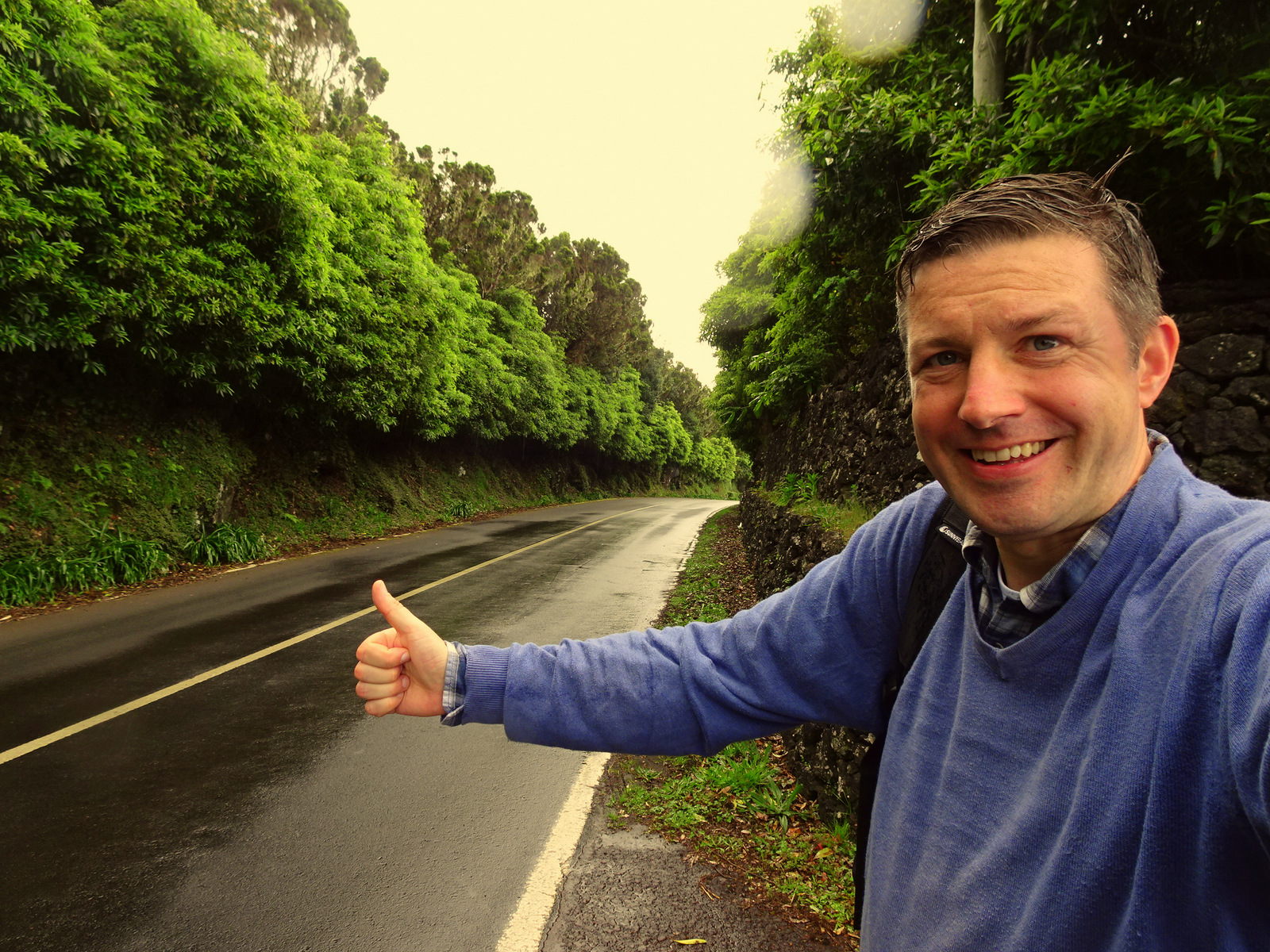
Andreas Moser hitchhiking in the rain
Posted in Belgium, Germany, Travel | Tagged , , , , , , , | 19 Comments

German Supreme Court approves anti-Corona measures – for now

The German Supreme Court, or Federal Constitutional Court, to translate its name literally, has approved the anti-Corona measures. At least for the time being.

The measures to fight the pandemic in Germany are not the strictest in Europe. For example, there is no general curfew and a lot of businesses are still open, but there are restrictions in place against leaving the house and meeting in public. Because of its federal system, there are actually 16 different regulations in place, issued by the respective states. This confuses people because they read something online about what is allowed or not, without realizing that the news are from a different state. Well, that’s the problem when people don’t read their local paper and trust the internet instead.

In the German legal system, you can challenge state laws before state courts and/or before federal courts. (I have published FAQs on how to do this before the Federal Constitutional Court.) In this case, someone challenged the Bavarian regulation, specifically the ban on meeting friends, visiting his parents, staging public protests and meeting new people. (Maybe he matched someone on Tinder an didn’t want to lose any time, not realizing that not meeting women was the best way to keep one’s sanity.)

On 9 April 2020, the German Supreme Court denied the petition for an injunction against said ordinance. Usually, cases before the Supreme Court take years, so the petitioner brought a case for interim relief. In such a proceeding, the court doesn’t have the time to look into all the evidence, nor all the legal arguments. Instead, it weighs the consequences of different scenarios. On the one hand, it has to consider the disadvantages to the petitioner if the law in question is upheld, although it will later turn out to be unconstitutional. These disadvantages, i.e. the restrictions on his civil rights, are quite severe, as conceded by the court.

But, on the other hand, there are the disadvantages caused if the court suspended the application of the law in question, yet it would later turn out that the law is constitutional. The consequences of that scenario, which would include more people than just the petitioner going outside and mingling with others, thus greatly increasing the risk already inherent in the pandemic, are much more dramatic than the temporary suspension of some civil rights. The protection of life and health weighs more than the protection of liberty in this case.

In denying the petitioner’s request, the Supreme Court pointed out that the measures are temporary (opening the possibility of a different decision at a later point in time), that they allow for a number of exceptions and that fines can be reduced or waived by the state in special circumstances.

It is important to keep in mind that this decision is merely based on a comparison of the consequences of two different scenarios. This does not provide any guidance on how the Supreme Court will ultimately rule, which it will certainly be asked to do at one point, for example by someone refusing to pay a fine for meeting friends in a park, or maybe claims for state liability due to lost income.

(For my lawyer friends: I think the main question won’t even be about substantive issues, but about formal constitutional law, because most of the anti-Corona measures have been imposed by the executive branch, based on very wide powers granted by the parliaments. It is however long-standing case law by the Federal Constitutional Court that especially in areas that touch upon civil rights, as these measures heavily do, the main decisions need to be made by parliament and only the details can be left to the executive branch. – On the other hand, the German Supreme Court has a tradition of ruling something unconstitutional, but saying that it was OK to apply the law for a time, or even keeping unconstitutional laws in effect until a new law has been enacted within a deadline imposed by the court.)

517846b2-4a0b-42c0-8ce2-9f2474715e7a

In a second decision on 10 April 2020, the Supreme Court used the same reasoning to uphold a ban on religious services in places of worship in the state of Hesse. Again, the same arguments would apply in all other states. The case was brought by a Catholic who wanted to attend church on Easter, but the court specifically mentioned that it would – for the moment – rule similarly in case of other religions and other religious holidays. (Passover is happening currently, and Ramadan and Orthodox Easter will happen in the following weeks.)

And then there was that one lawyer, obviously not versed in constitutional law, who petitioned the Supreme Court to declare that the government response to Covid-19 was threatening the existence of the Federal Republic of Germany, democracy and the rule of law and asked that all measures be suspended. Well, the court had to point out that she hadn’t even met the formal requirements of filing a proper constitutional complaint. Since then, she is running amok, screaming of tyranny, proving that some people do indeed crack under the slightest pressure.

In somewhat related news, it’s interesting to note that Germany has not declared a derogation from the European Convention on Human Rights, as several other member states of the Council of Europe have done, referring to Art. 15 of said convention.
Links:

Posted in German Law, Germany, Human Rights, Law | Tagged , | 4 Comments

The Asparagus Airlift

Zur deutschen Fassung dieses Artikels.


To fight the Corona virus pandemic, Romania has imposed a very strict curfew, which is being controlled by the police and by the military. Now, the happiest people are those living in the countryside and those who have at least a balcony, from which to marvel at the super moon and the sparkling stars in the skies, as clear as never before since the invention of the jet engine. (One of many Romanian inventions, by the way.)

But yesterday, Romanians were wondering when they looked up: What’s with all the planes? Where do they come from? Where are they going? Why? What about the curfew and the travel ban?

Even at a small airport like Cluj, the flight plan looks very full these days, albeit with a narrow choice of destinations.

Spargelflüge

These are the flights for the people who are supposed to save the asparagus harvest in Germany. Apparently, asparagus is very important there. (I am German and I hate that vegetable.) Or maybe it’s the profit of the asparagus farmers which is really important, hence their refusal to accept the help of German workers, preferring to charter planes, flying vegetable pickers from Romania and Bulgaria directly onto the plantation.

Because these people are already used to working hard, working long hours, being housed in crammed conditions and getting paid the lowest possible wages, if at all. I guess this is what the asparagus barons mean when they say that the Romanians are already “experienced”. By the way, most of the other fruits and vegetables which we buy at the supermarket are only so cheap because they are produced under conditions which haven’t improved much since “The Grapes of Wrath”.

The only good thing about it? If you never wanted to eat vegetables, you can now decline them on moral grounds. Let’s hope the conditions on chocolate and tobacco plantations are better.

This was at the airport in Cluj yesterday.

Spargelpassagiere

When it comes to asparagus, all the safety rules on keeping distance are scrapped, it seems. Well, if the Romanians get sick in Germany, they will at least be able to communicate in Romanian there. Because the German healthcare system relies on thousands of Romanian doctors and nurses, too.

How naturally some peoples or nations are regarded as a pool of labor for Germany (and as nothing else beyond that) does raise the suspicion that the image of the “Ostarbeiter” is still in the minds of many.

Gruppe von Ostarbeitern vor Fahrt nach Deutschland

Somehow, this leaves a bad aftertaste. Like asparagus itself.

Links:

Now that you are going to boycott asparagus, maybe you can spare a few of the dollars/pounds/euros thus saved to support this blog? I guarantee that my articles are far more nutritious than that strange vegetable.

Posted in Economics, Germany, Politics, Romania | Tagged | 6 Comments

Conversion in Jerusalem

Um diesen Artikel auf Deutsch zu lesen, klickt einfach hier.


Just as I leave the courtyard in front of the Church of the Holy Sepulchre in Jerusalem, walking through a small gate, there are two Muslim men waiting. One of them is wearing a white jalabiya, the long and wide-cut gown, and the type of beard brought into disrepute by Salafists. The other one is clothed casually, but also with beard and prayer cap.

They approach me in a friendly way. Of course I know what their end-goal is, but for curiosity’s sake, I play along. “Do you hear this sound?”, he asks, pointing upward with the finger. And, before I can even reply: “This is the call of God. God is calling for you, my brother, to follow him.” I point out that it’s probably the muezzin or maybe a recorded tape that is filling the Old City with its charming chants.

He laughs, extends his hand and introduces himself as Musa, the Arabic name for Moses and not dissimilar to my own name. I better keep this to myself, because I don’t want them to consider me a prophet. In the end, they might even ask me to deliver the sermon this Friday.

market day

What follows is a back and forth of religious and atheist arguments and questions. I have gone through this with the Jehovah’s Witnesses a dozen times. It’s no longer intellectually challenging. These conversation all run so similar that I am getting the suspicion that both the Jehovah’s Witnesses and the Muslim Brothers have taken the same correspondence course in converting non-believers. They should both ask for their money back.

Musa’s sidekick hands me a small box of tasty strawberries, which he just bought at the nearby market, visibly excited that a bearded brother is sticking around for a longer discussion. But after ten minutes – the muezzin is still singing -, they are becoming restless. They hand me an English translation of the Quran, apologize for their hasty departure – “It’s the call for prayer.” – and then run off towards the Temple Mount.

They also gave me a business card, which asks “What is the religion of Jesus?” on one side and “?מהי דת הנביא משה” (“What is the religion of the prophet Moses?”) on the other. For me, this symbolizes the allure of Jerusalem: two Muslims waiting in front of Christianity’s holiest church in the capital of the Jewish State, trying to convert Christians and Jews to Islam. In the evening, at the appropriately named Abraham Hostel, I discover several identical copies of the Quran in the bookshelf as I place mine there.

The next morning at breakfast, Jessy from Tennessee wants to convert me to Christianity, claiming that chariots of Moses had been found in the Red Sea, which was proof of the parting of the sea. He apologizes to me and to God each time a “damn”, “bloody” or even “fuck” comes across his lips, which happens quite often. I don’t really mind, I am bothered much more by the Bible quotes.

After a few days in Jerusalem, all those religious nutters are becoming too much for me. I take my backpack and jump on the bus north, where I want to go hiking for a few days. From Nazareth to the Sea of Galilee. The hiking trail is called Jesus Trail. In Israel, it’s hard to escape religion altogether.

Links:


Posted in Islam, Israel, Photography, Religion, Travel | Tagged , | 14 Comments