Mandela deserves better

The mail delivery centres where you have to pick up the parcels that are too big to be squeezed through the letter slot, are rarely housed in beautiful buildings or located in enticing parts of the city. My local Royal Mail depot in London is no exception. – Actually, I don’t mind the walk to this post office, because on the way I get to pass a Soviet T-34 tank in someone’s backyard.

This area is not particularly more depressive than any other industrial/commercial area of London, but it is also not better:

the Royal Mail delivery centre at Mandela Way in London

What makes the whole affair a bit sad is the name of the street: “Mandela Way”. – A small thoroughfare in a not particularly beautiful part of London that houses a post office, a bus depot and some storage facilities. Please! Couldn’t London find anything better for Nelson Mandela, the hero of South Africa and indeed of Africans across the continent, the first South African President to be democratically elected, the man who so gracefully reached out to his oppressors, and the winner of the Nobel Peace Prize?

But it reminds me of something similar in Nürnberg, the closest larger city to my home town of Amberg in Germany. There is a Nelson-Mandela-Platz (“Nelson Mandela Square”) behind the main train station. No, not in front of the train station, behind it. It is mainly used as a parking space:

Nelson-Mandela-Platz in Nürnberg, Germany

Is this a consistent theme in cities around the world that Nelson Mandela is “honoured” with back alleys or decrepit squares being named after him?

I think Mr Mandela deserves better!

Posted in Germany, London, Politics, Travel, UK | Tagged , , , , , , , , , , , , , , , , | 3 Comments

Auch Scammer sehen Nachrichten.

Auch Scammer und Spammer verfolgen die aktuellen Entwicklungen im Nahen Osten offenbar genaustens. Nur wenige Tage nach dem Sturz Hosni Mubaraks in Ägypten erhielt ich heute diese e-mail:

From: Herr Omar Sam [vincenteelena@aim.com]
Sent: 15 February 2011 07:11
Subject: Dringend benötigt reagieren

Hallo,

ich bin der offizielle Anwalt von Präsident Hosni Mubarak von Ägypten,

bitte ich suche Ihre Hilfe, um mir zu helfen 2.5 Millionen Dollar zu sichern, die in Belgien eingefroren wurden.

Reagieren Sie auf diese E-Mail:(omar.sam@webadicto.es), wenn Sie in der Lage sind, diese Transaktion zu verwalten. Sie werden fuer diesen Service bezahlt.

Mit freundlichen Grüßen,

Herr Omar Sam

Die Betreffzeile “Dringend benötigt reagieren” legt nahe, dass neben Präsident Mubarak auch die Grammatik von der Revolution hinweggefegt wurde.

Wer Ex-Diktatoren helfen und Scammern auf den Leim gehen möchte, kann sich gerne an Herrn Sam wenden.

Posted in Travel | Tagged , , | 3 Comments

Two down, more to go.

What a year 2011 has already been in the Middle East and North Africa: In Tunisia and in Egypt, two long-term dictatorships have been toppled by street protests. If the transformation of this part of the world continues at the current rate, 2011 might turn out to be for the Middle East what 1989 was for Eastern Europe.

So which country do you think will be the next one to get rid of its oppressive regime and make a big step towards freedom? You can tick up to three countries.

Please also add a comment below with your prediction and especially with the reasons for it. As an additional incentive to get the discussion going, I advertise a book prize as a reward for the prediction that will become reality first.

Posted in Egypt, Politics | Tagged , | 5 Comments

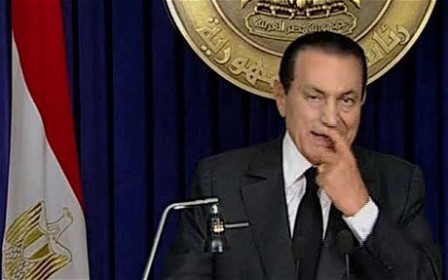
Mubarak doesn’t get the point.

"Is there something wrong in my country?"

“Is there something wrong in my country?”

President Mubarak’s speech on the evening of 10 February 2011 was not only a disappointment to Egyptians and the world, but it will be remembered as one of the worst political speeches ever. Poorly written and delivered, filled with platitudes, it leads me – together with the conflicting announcements from different parts of the Egyptian government and military – to believe that Mr Mubarak did not know until late tonight what he was going to say.

Egyptians had come to expect nothing less than Mr Mubarak stepping down immediately, preferably even leaving the country for good. That this did not happen, was reason for anger and disappointment enough, but it was made worse by some parts of the speech:

  • Very early in the speech, Mr Mubarak said “I am telling you before anything, that the blood of the martyrs and the injured will not go in vain. And I would like to affirm, I will not hesitate to punish those who are responsible fiercely. I will hold those in charge who have violated the rights of our youth with the harshest punishment stipulated in the law.” – After it was the police and government thugs who had killed and injured hundreds of peaceful protesters, this statement must have come as a blow in the face to everyone listening. I certainly went “What the f***?” when I heard the speech start like this. And then Mr Mubarak immediately went on to explain what HE will do, thus making clear that he will remain in power and control, even trying to use the necessity to investigate the bloodshed of the past weeks as a reason why he must remain in power. Cheeky would be the most positive word to describe this reasoning.
  • But it became worse: “I am telling families of the innocent victims that I have been so much in pain for their pain, and my heart ached for your heartache.” – The worst soap opera wouldn’t use empty rhetoric like this. Don’t lie so blatantly to the face of people whose children you have murdered, Mr Mubarak!
  • Then some bathos: “Any regime could make mistakes in any country, but what is more important is to acknowledge these mistakes and reform and correct them in a timely manner, and to hold those responsible for it accountable.” – No, not in any country can the head of state make mistakes for 30 years without being voted out of office. And who else than the President would be responsible?
  • I do not find it a mistake to listen to you and to respond to your requests and demands.” – OK, our main demand is that you LEAVE IMMEDIATELY. TODAY.
  • He then went on to say that he will step down in September (which he had said before) and that the Vice President will perform some of his duties (which has already been happening for two weeks now). No new major concessions.
  • We also have agreed on a road map – a road map with a timetable. Day after day, we will continue the transition of power from now until September.” – Who has agreed with whom? Just today, we heard from the Army that the protesters’ demands will be fully met. We heard from several sources within the government that President Mubarak would step down or at least step aside. I bet that until the last minute before the speech, there was no agreement even within the government about what the speech should contain. And most importantly, the people of Egypt do not agree with this.
  • The President suggested that he might “open the door to ending the martial law, as soon as we regain stability and security and as soon as the circumstances assure the stability.” – Is this the attempt to justify the martial law which has been in place since 1981 with the protests of the past two weeks? Clearly, it is saying that martial law will only be lifted when all protesters have gone home.
  • Mr Mubarak is 82. Yet, he did not find it too silly to identify himself with the “youth movement” as he kept calling it (although it is a far broader movement across generations): “I was a young man, a youth just like all these youth, when I have learned the honor of the military system and to sacrifice for the country.
  • Of course, Mr Mubarak went on to talk about his military career, as if he needed to recite his CV, culminating in this claim: “During the victory in 1973, my happiest days were when I lifted the Egyptian flag over Sinai“, referring to the Yom Kippur War which was started by Egypt attacking Israel during Ramadan and Yom Kippur – apparently something that Mr Mubarak is extremely proud of. Also, I find it a bit curious for Egypt to claim victory in that war. After initial Egyptian gains in Sinai (because of the surprise nature of the attack), Israel managed to fight back. Egyptians were indeed able to capture parts of the east bank of the Suez Canal, but Israel had gained control of the west bank of Suez and Israeli forces were 100 km from Cairo when a ceasefire was agreed.
  • Bla bla bla, et cetera. There was much more empty rhetoric and platitudes of pathos.

Listening to the speech, I was struck by how evidently Mr Mubarak did not get the point of the protests. They have been demanding nothing less than the end of his rule and his regime. Did he not want to get the point or is this what 30 years in power do to you? I could not make any sense of this speech, except that Mr Mubarak was maybe trying to pave the way to being declared unfit for office on grounds of mental incapability.

Let’s hope that Egyptians learn a lesson from Tunisia and don’t give up until they have achieved their goals.

Posted in Egypt, History, Israel, Military, Politics | Tagged , | 4 Comments

Human Rights with Hollie

The debate raging in Britain about the European Convention on Human Rights has been enriched by a new pundit on the block:

(CAVEAT: I do not buy, read or even look at “The Sun”, one of Britain’s worst tabloids. Thanks to the “Liberal Conspiracy” blog for the pointer. For those unfamiliar with the British press, “The Sun” has a scantily clad girl on its page 3 every day.)

There are a lot of things to be said about the ECHR, the British position to it, and Lord Carlile‘s review of anti-terrorism laws. But for now I only take issue with Hollie’s call “to tear up the human rights law books”. Neither do we expect anything sophisticated from a model, nor does Hollie’s biography suggest any exposure to the study of law (actually there is no education mentioned at all). – But why doesn’t Hollie pack her stuff (she doesn’t have too many clothes anyway, apparently), move to a country without human rights protection and then try to publish her photos there? Maybe this would change her mind about the value of European human rights.

Posted in Human Rights, Law, Politics, UK | Tagged , , , | 10 Comments

Now I know whom Ed Balls reminds me of.

Ed Balls, Shadow Chancellor of the Exchequer (Labour Party, UK)

Ricky Gervais as Mark Bellison in "The Invention of Lying"

Posted in Politics, UK | Tagged , , | 1 Comment

Why can Tunisians achieve what Iranians couldn’t?

Ever since Tunisians successfully ousted their dictatorial and kleptocratic President Ben Ali after 23 years of his oppressive rule after just one month of protests in December 2010 and January 2011, people have been asking: “Why can Tunisians achieve what Iranians couldn’t in 2009?”

Not having been to Tunisia (but having been part of the protests in Iran in the summer of 2009) and believing that personal experience is a very underestimated research tool

"Please, feel free to copy us."

international politics, I am reluctant to compare the situation in two quite different countries. But the following are a few thoughts that come to mind:

  • Tunisia is a small country with 10 million people, whereas Iran encompasses a huge area with 76 million people. (This argument will be void however if Egyptians will succeed to oust Hosni Mubarak.)
  • On average, Tunisians might be more and better educated as Iranians. Tunisia has been investing heavily in higher education and is widely credited for good results in this sector. Iran, on the other hand, sees education mainly as a threat to Islamic values and its power and has thus been cracking down on education and academia.
  • Facing large protest in June 2009, the Iranian government did not make the same “mistake” as the Tunisian one: In Iran, no concessions were made, neither political, nor social, nor economical. Concessions by an embattled government seem to embolden the protesters even more.
  • President Ben Ali of Tunisia gave up. After just one month of protests, he decided to pack his gear and start a new life in exile. The Iranian government, in contrast, remained steadfast and it was the bulk of Iranian protesters who gave up very quickly once the crackdown became brutal around 20 June 2009.
  • Tunisia was basically ruled by one clan. In Iran however, the government does have some basis of support, for one among clerics and very religious Muslims, and also among the bloated number of civilian and para-military government employees who see their economic future tied to this particular government.

But one rather embarrassing difference was clarified again these days by the figureheads of the opposition in Iran, Mir Hossein Musavi and Mehdi Karrubi, themselves:

If you are a dictator, that’s the kind of opposition you can live with: “Please Mr Dictator, can we protest a bit?” Do these gentlemen not know that Tunisians and Egyptians did not ask for permission, but have been defying curfews and bravely facing beatings and bullets? Asking a brutal, oppressive regime for permission to protest against it is already embarrassing enough, but then even asking for a guarantee of non-violence from the dictatorship that you wish to oust clearly displays the timidity which is one of the reasons why the Iranian protests crumbled. (In another post I point to an Iranian Nobel laureate as a further prominent example of this disheartenment.)

If there is one generalisable lesson from successful revolutions throughout history and around the world, it is this: Courage is a necessary ingredient. If you are not willing to risk anything, the dictator won’t need to budge.

To those of us who have been looking at Tunis and Cairo with the hope for a revival of the Green Movement in Iran: I am afraid we can stop holding our breath.

Posted in Iran, Politics | Tagged | 14 Comments

Upside down?

Ever since I spent 3 months on student exchange in Australia in 1992 and realised that I was not walking upside down, let alone falling off the earth, I have been very adamant against the use of “up” or “down” when describing locations on this planet. Without a reference point in space, there is no “up” or “down”.

Try to think of the world map as follows, for once:

Only too bad that even the publishers of this map cannot refrain from using the words “upside down”.

But this is not the only way in which maps over-emphasise the Northern hemisphere.

Posted in Politics, Travel | Tagged , , , , , | 6 Comments

Merger Control of a different kind

With merger control, governments and courts usually try to prevent companies from joining forces and forming a monopoly that would have negative effects for the market and for consumers. A court in Germany has now stopped a merger of a different kind:

The District Court of München (Munich) has stopped the merger of two right-wing parties. In December 2010, the “Nationaldemokratische Partei Deutschlands” (NPD) and the “Deutsche Volksunion” (DVU) had signed an agreement to integrate each other into one new party. Far from posing a substantial threat to democracy though, this merger was rather a symbol of both parties’ dwindling popularity. They have consistently been fighting with the 5 % threshold that parties have to overcome in federal and most state elections in order to be represented in parliament.

Despite some election successes (the NPD is currently represented in the state parliament of Mecklenburg-Vorpommern), these and other right-wing parties have not played an important role in German politics. A major reason for this is lack of intelligent personnel. They are made up of dimwits and ludicrous wannabe-dictators.

"Wait, did anyone actually count the votes?"

The legal reason for the halt of the merger was not any concern about democracy or fear of a stronger right-wing alliance, but rather the typical infighting: Parts of the DVU had filed the lawsuit and ere able to convince the court that the internal poll that the DVU took among its members was not up to democratic standards and therefore has to be repeated.

So much for Aryan supremacy. This inability to follow even the easiest legal procedures might explain the NPD’s and the DVU’s admiration and striving for authoritarian leadership.

Posted in Economics, Germany, Politics | Tagged , , , , , , , , , , , , , , , , | 1 Comment

Frauenquoten – warum nur in Vorständen und Parlamenten?

Die deutsche Bundesarbeitsministerin will Unternehmen zwingen, ihre Vorstände und Aufsichtsräte mindestens zu 30 % mit Frauen zu besetzen.

Dies führt zu offensichtlichen Fragen, die schon vielfach diskutiert wurden: Was wenn sich nicht genug Frauen bewerben? Was wenn diese Bewerberinnen nicht qualifiziert sind? Was wenn nicht genug Frauen in einem bestimmten Sektor oder einer bestimmten Firma arbeiten wollen? Reicht es nicht aus, Frauen und Männern gleiche Bildungschancen zu geben? Geht es den Gesetzgeber etwas an, wen ich in meinem eigenen Betrieb einstelle? Führen Quoten eventuell sogar dazu, daß Frauen die Motivation verlieren?

Aber mir stellt sich immer eine ganz andere Frage wenn ich die Forderung nach Quoten in Vorständen und Parlamenten höre: Wenn man Gleichbehandlung durch Quoten durchsetzen möchte, warum dann nicht in ALLEN Berufen? Warum keine Quoten für Frauen in Schlachthöfen, bei der Müllabfuhr und der Infanterie? Warum nicht in Bergwerken und auf Fischkuttern?

Solange ich diese Forderungen nicht mit dem gleichen Nachdruck vorgetragen vernehme, weiß ich daß es den Feministinnen nicht um Gleichberechtigung geht. Es geht ihnen um eine Überholspur für ihre eigene Karriere.

(For the English version of this article: https://andreasmoser.wordpress.com/2010/10/03/quotas-for-women-why-only-in-boardrooms/)

Posted in Economics, Germany, Politics | Tagged , , | 12 Comments