
-
Recent Posts
-
Join 3,468 other subscribers
This blog is entirely based on facts and true stories.
The names, characters and incidents portrayed in it are the work of the author’s observation and not to be construed as fiction.
Any resemblance to actual persons, living or dead, events or localities, is entirely intentional.
Thanks to everyone who supports my blog! As promised, I send you a postcard from one of my journeys.
If you are still waiting, it could be for the one I mailed in Humberstone in Chile. I should have guessed that this mail box wasn’t being emptied anymore.

Before I went to Azerbaijan, I was like you: I didn’t know Heydar Aliyev.
But then, I had already gotten sick and tired of him by the second day.
Let me share this experience with you, so that you will be prepared. That’s important because – whether you want it or not – Heydar Aliyev will be your guide and constant companion in Azerbaijan.
When you fly to Baku, you arrive at Heydar Aliyev Airport. When you arrive by train, you travel on the Heydar Aliyev Express, get off at Heydar Aliyev Station and walk along the wide Heydar Aliyev Boulevard to Heydar Aliyev Square, past Heydar Aliyev Foundations, Heydar Aliyev Schools and Heydar Aliyev Institutes.
If you want to take a break from Heydar Aliyev and thus prefer to travel across Azerbaijan by car, you will still see a photo of the ex-president at every intersection, every turnoff and every roundabout.

“Your ad here”, such unused billboard space would advertise in the rest of the world, but in Azerbaijan nobody dares to commission advertisement that large because it would require pasting over the photo of Heydar Aliyev. An unthinkable sacrilege.
On 6 July I happened to be in Ganja. It was my birthday, but I didn’t know anyone in the city. So I made my way to the park to read a book, eat ice cream and to strike up conversations with strangers. This had worked well in the past.
But Azerbaijan is different.
The park is of course named after Heydar Aliyev. It isn’t fenced in, because who would dare to vandalize, urinate or camp in a park named after HA (for reasons of laziness readability, I shall henceforth abbreviate the name of the great leader)? Or maybe there simply wasn’t enough fence for a park which is larger than some independent states.
It’s not yet 8 a.m., but a few joggers and some old but fit walkers are already circling the (artificial) lake. Later, it will be too hot. Or maybe they come so early to escape the surveillance, because at 8 o’clock sharp the staff shows up: security guards, cleaning ladies and men, gardeners. They sweep the floor, water the green beds, twitch at the flowers.
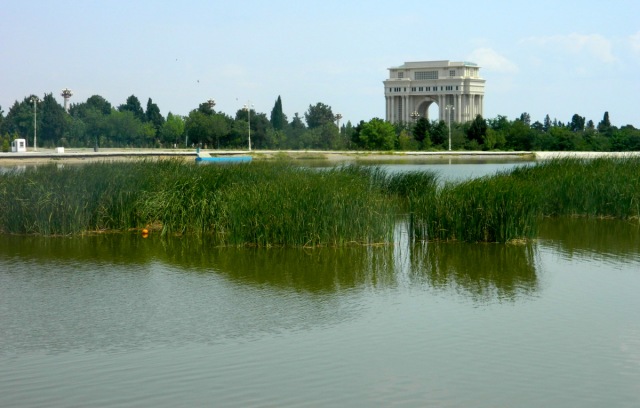
The only thing that’s missing are visitors. Maybe it’s simply too far. First, you need to cross a 12-lane street. Don’t worry about the traffic, because all of Ganja doesn’t have enough cars to fill this street. But most school runs are shorter.


When you have crossed the widest street in the world after a march of ten minutes, you have reached the parking area. A car park like the one in front of the Olympic stadium. It was planned big enough that all cars in Azerbaijan could park here simultaneously. But it is empty. The public squares in the city were already overdimensioned, but this here is megalomania at a North Korean level.


Once you have walked through the triumphal arch (as big as in Paris and, for the avoidance of any doubt, adorned with the name of HA), which is the actual entrance, you have to traipse for another mile to reach the HA Museum. Just like people had to walk through a long hall in the royal palace before meeting the king.


All the people whom you see in the photos are staff. Constantly sweeping staff. When I sit down on a bench (you do get tired when having to walk one and a half hours from the car park to the museum), they come closer and sweep the area around me. When I get up and continue the long march, they sweep the place where I just sat with utmost intensity. From time to time, a man walks up to the cleaning ladies and instructs them to sweep more, sweep faster, sweep better, sweep more patriotically.
As everyone is giving orders to everyone else, it becomes obvious that even the non-uniformed passersby are employees. I almost feel as if the whole park is only being operated for me. But I don’t want to pass judgment prematurely; I am certain there will be more visitors at night.
But now in the morning, the amphitheater is as empty and oversized as anything bearing the name of HA.

Men are wading in a water fountain that has been switched off and frantically rubbing the floor and the water taps. A worker breaks out tiles from the walkway to clean them from below and puts them back. This is a mega-project for people with obsessive-compulsive disorder. I want to wish them a proper storm, so that they really have something to clean up for once.
A cleaning lady fills a bucket with water from the fountain, pours it over the path and begins to clean what wasn’t dirty. A cleaner hoses down a column-like lamppost which is then wiped dry by another cleaner.
Walking past hundreds of cleaning maniacs, I finally reach the museum. In case one has forgotten to whom this park is dedicated since the sign at the entrance or the triumphal arch, a mere few hours ago, golden letters and a statue of HA remind you. To make sure, the statue is inscribed with HA’s name.


Finally, I will learn everything about the man who thrusts himself into every step of my journey. But first, I look back at the long-distance hiking path that I have already walked this morning. And I am only halfway through the park. One could still walk (and clean and sweep) for days.

The museum is three floors high, with a glass dome, much marble, much gold and white leather armchairs. Typical dictator kitsch. If you have ever visited the Gaddafis, the Husseins or the Trumps, you are familiar with it.


I am the only visitor, which startles the man behind the desk so much that he turns off his YouTube video, jumps up and henceforth follows my every step, always four to five meters to my side and always looking at his phone when I look at him. We are the only two people in the whole building (incomprehensible why there are no cleaners here), making his constant proximity and observation quite obtrusive.
And there wouldn’t even be anything of value to steal because the “museum” only has dozens of display boards about the life of HA with hundreds of photos of him. Protected by glass, there are a few books about and by him. Two-meter wide TV screens are ready to show biopics, but I couldn’t really run off with such a large TV on my own. Nor could I steal the white grand piano (a Blüthner).

Maybe the guard simply doesn’t like my camera and my notepad. Journalists and reporters are not particularly liked in Azerbaijan. When I walk towards the exit, the museum guy has come as close as one meter and almost pushes me out of the door. Apparently, he is keen on being alone with HA again.
Despite all the glorification of HA, two points were interesting about the exhibition: First, his past as a leading member of the Communist Party of the Soviet Union is not glossed over.
In 1990, Ryszard Kapuscinski wrote from Baku:
On the central boulevard, there are a few light, luxurious and massive apartment complexes, these are the houses which the ruler of Azerbaijan, HA, had built for his camarilla. He is a famous figure. At first, HA was head of the KGB in Azerbaijan, then, in the seventies, First Secretary of the Communist Party of the republic. He was a disciple of Brezhnev, who appointed him Deputy Prime Minister of the USSR. He was fired from that post by Gorbachev in 1987.
HA was part of Breznehv’s circle – a group standing out for deep corruption, preference for any kind of luxury and overall debauchery. They displayed that corruption with provoking openness, not ashamed in the least.
Of course one doesn’t find this quote in the shrine of homage to HA, but the last paragraph could be the motto for the museum, actually the whole park or indeed for the whole country. For someone who was already famous for open corruption under communism, an independent Azerbaijan with gushing oil wells must have been the mother of all dreams. Thus, it comes as no surprise to meet the whole Aliyev family in the Panama Papers.
The second point that I found interesting about the exhibited photos was the extent of self-staging already during Soviet times, when HA did not actually depend on the benevolence of those governed by him. But he looks as ardent a campaigner as Bill Clinton in his best days: HA in a field with farmers, HA with soldiers, HA with children, HA as an archaeologist, HA with a water melon, HA at a busy market. As if he already sensed in the 1960s that he would need photos for election campaigns after 1990.


Behind the museum, the park continues, as far and as straight-lined as over the miles already covered.

A mosaic shows a king whose subjects submissively take notes of the ruler’s remarks. We know this from North Korea, too.

A cleaning lady uses her broom to wipe off a perfectly shaped bush. I’ve had some petit-bourgeois neighbors over the years, but I ain’t never seen nobody clean bushes in the garden with a broom.
After a few hours, I finally spot the first other visitors: a young couple who are having their immediate surroundings cleaned by a cleaning lady with little regard for privacy. Well, at least I know now that the cleansing wasn’t directed against me personally.

For the non-present children, the part with rides and attractions (bigger than Disneyland) is getting cleaned and swept. They won’t appreciate it (unless their parents got a job this way).


Even Mr Shrek has to help.

The café has the size of a university dining hall, but as soon as I enter, two guys run towards me, take me between them and express in no uncertain manner that I should sit outside in the glaring sun. Maybe the interior hasn’t been cleaned in the last hour.

The only thing that adds a friendly touch are the birdhouses (despite a sticker indicating to the birds that their home was sponsored by Kapital Bank).

Nice that someone thought of the animals. It’s bad enough that the humans in the nearby housing estate or the refugees from Nagorno-Karabakh are not getting their share of the oil money.
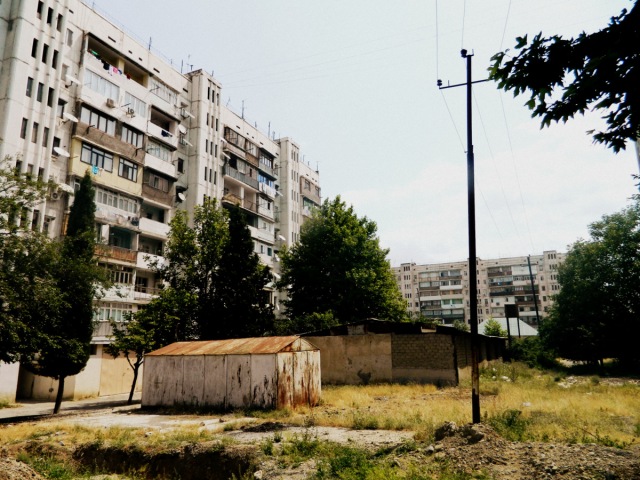
At the entrance/exit, there is a surprisingly modest column (only of menhir size) pointing to the inauguration of the park in January 2012 – in the presence of President Ilham Aliyev. Yes, that’s the son of the overly worshiped HA. That too reminds one of North Korea. The son of the present president is conveniently named Heydar Aliyev again. The young boy will doubtlessly enjoy a dynamic and dynastic career.

On the way home, I remember where I have seen an Azerbaijanian park before: in Podgorica, the capital of Montenegro. There are also Heydar Aliyev Parks in Tbilisi, in Istanbul, in Ankara, in Bucharest, in Kiev and maybe soon in your hometown. You simply have to talk to your city council about it. Azerbaijan will pay for everything.
When I return to the house, the landlady asks me what I thought of the park. I am thinking how to express my thoughts about megalomania and personality cult diplomatically, when I – just in time – spot a photo of HA and the presidential successor son on top of the cabinet in the living room.

It is larger and more prominently placed than the photos of nephews, children and parents.
A strange country. But at least I don’t have to visit North Korea anymore.
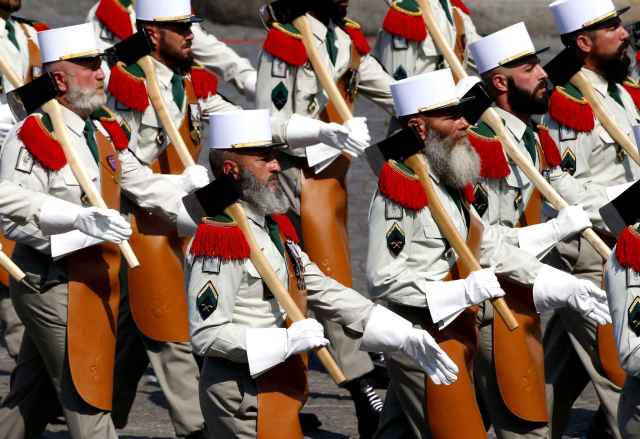
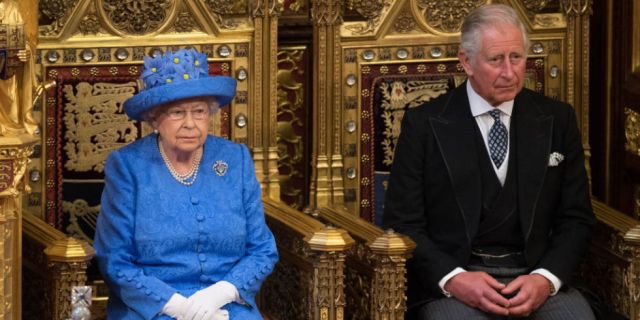




(Photographed in Tbilisi, Georgia.)
Those were the reactions when I announced my plan to travel to Abkhazia:
My first visit to Abkhazia only lasted four days. But as I was out exploring every day and crossed almost the whole country twice, I dare say I got enough of a first impression to tell you about it.
And this is what Abkhazia looks like:


So, how dangerous was Abkhazia really?
Quite dangerous indeed! Dangerously beautiful and dangerously interesting. It is particularly dangerous for people who don’t want to lose the prejudice about anywhere east of Italy being dangerous, evil and poor.
Seriously, the most dangerous thing was this cat who tried to eat my shoelaces.

By the way, while I was gone exploring the Caucasus, Germany looked like this:
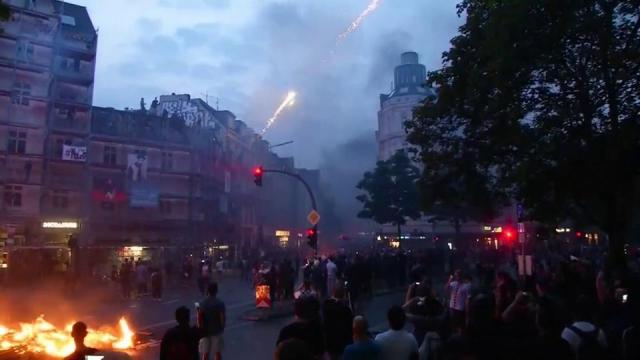
Lesson: Most travel warnings are useless and wrong because they are issued by people who have never visited the relevant country, or their last visit was 10 years ago, or who are sitting in an office all day and are generally scared as soon as they venture outside.
Tbilisi is formed by so many different architectural styles, that it’s difficult to take a photo of just one. Here, the tower of a brick mosque and a wonderful wooden balcony are squeezing themselves into the picture.

The building with the blue facade, reminiscent of mosques in Isfahan, is the Orbeliani bathhouse. When I was in Tbilisi, it was unfortunately closed for renovation.
You can either have a big car and a live in a run-down house

or stick to the old car and live in a mansion.
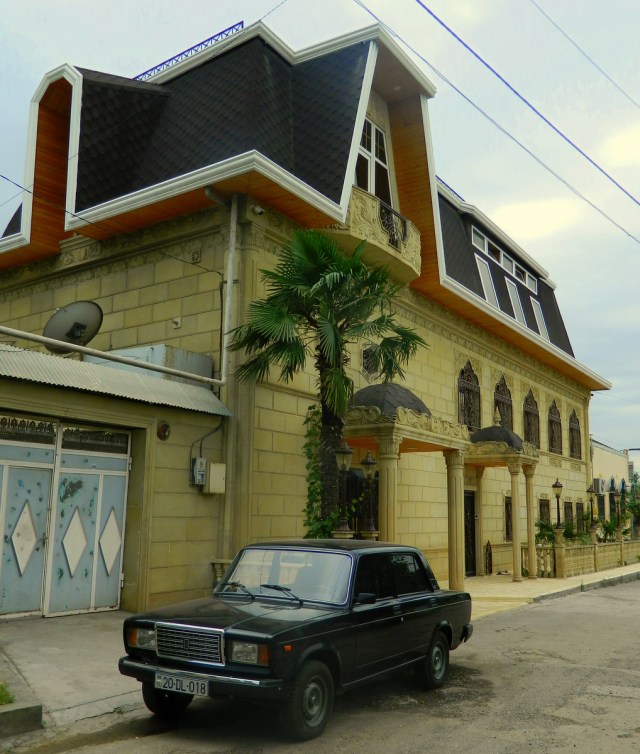
As you know, I have neither and travel the world instead.
(Photos taken in Tbilisi, Georgia, and in Ganja, Azerbaijan.)
It was my last bottle.
But when you meet a bear,
you share.
He drank it full throttle.

(Photographed in Novy Afon, Abkhazia. – But it’s nicer to meet bears who live in freedom.)

 The Happy Hermit