
In 1973, Paul Theroux was a novelist and out of ideas when he came across my blog and got the inspiration for a trip around the world by train. From the UK, he set out to Istanbul, of course, and then onward to Iran, India, Burma, Malaysia, Japan, with some flights and ferries in between, obviously. On the way back, he took the classic route through Siberia from east to west. He published The Great Railway Bazaar about that journey and became the famous travel writer that he now is.
Quite why he became so famous is a secret to me after reading this book. I am fanatically railway-minded myself and love the idea, although I am a much slower traveler and would dedicate more than four and a half months to such a trip. But then, Theroux had a wife waiting for him at home.
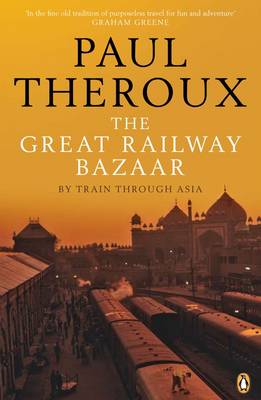 Maybe it’s the style of writing, for that is good indeed. Sadly, though, I got the impression that he didn’t enjoy the trip as much as anticipated, an impression fostered by the ever-increasing complaints the farther he gets east. Fellow travelers will know the old Englishman or American whom you meet on trains or ships, complaining that there is no NFL on television in Tehran or that they have the wrong kind of biscuits in Bombay. Theroux sounds like that kind of person. He complains about the weather, about late trains, about not being able to buy tickets, about the food, and mostly about other people whom he encounters on the train. I almost wished him an accident, to put him out of his misery.
Even worse, many of his remarks and “jokes” are deeply insulting, racist and stupid. He probably thinks he is funny, in a way that Westerners steeped in colonial thinking of superiority play little jokes on everybody who is not a WASP. Once he gets on the Transsiberian, he finds it appropriate to address the Russian passengers as “monkeys”. Decide for yourself if you want to like such a man.
His constantly getting drunk and unsuccessfully trying to cheat on his wife doesn’t help to endear him, either. There is a reason why travel bloggers and writers should remain single.
There is a sequel, Ghost Train to the Eastern Star, where Theroux went on a similar journey in 2008. I am curious if he learned anything from his first trip, if he matured, if he has come to realize that non-Anglo-Saxon culture is not inferior. Has anyone read the Ghost Train? I am curious to hear your opinion!
Links:
- Get The Great Railway Bazaar or Ghost Train to the Eastern Star on Amazon.
- More articles about train travel.
- More book reviews.
- My wishlist of books.

 The White House is dysfunctional and the President was and remains unprepared; that’s not news. Everyone can see that, every day. Thus, Bob Woodward doesn’t have that much new to offer. But the sheer amount of information and in particular the verbatim conversations, mostly provided by people who have since been fired or resigned (Gary Cohn, Rob Porter, Steve Bannon, Reince Priebus and John Dowd seem to be the main sources), can still be shocking at times.







 As with most books by Steinbeck, not all ends well, but it is far less heart-breaking than some of his later works. And even when a story ended on a sad note (not all don’t), the feeling for me as a reader was one of melancholy more than of sadness, and it was overshadowed by how marvellously the story had been told. As I sat on the porch, I closed the book after each chapter, for I had to reflect on the people whose lives had been presented to me. With each of them, I had the sensation of wanting to meet them, although I am usually not a very social person. Even when a character has a negative trait, like the farmer who constantly brags about his wealth, you feel more sorry for him, rather than rush to judgment.

 The Happy Hermit