If a bank cannot even build a straight office tower, how can you expect it to keep a straight balance sheet?
The headquarters of Bankia in Madrid, Spain:

“We are not only drunk when building office towers.”
If a bank cannot even build a straight office tower, how can you expect it to keep a straight balance sheet?
The headquarters of Bankia in Madrid, Spain:
“We are not only drunk when building office towers.”
In the year 1995
Question: What do you study?
Me: Law.
Reaction: Wow!
In the year 2012
Question: What do you study?
Me: Philosophy.
Reaction: ???
When I studied law more than a decade ago, some of my high school classmates were jealous, the girls admired me and my parents were happy not to question what I was doing during these four years at university. It was largely unwarranted awe and admiration because law is not a particularly hard subject to study, it just requires a lot of reading, some logical thinking and writing skills. I still don’t know why so many fellow students dropped out (about half of them) or failed the bar exam (about a third of the remaining).

“But what shall we do with this philosophy?”
Wherever I went and declared that I studied law, the reaction was “Wow!”
Now, that I study philosophy, the reaction is a totally different one. Often I can see that the questioner regrets posing the question because he or she doesn’t know how to continue the conversation. I can virtually see the question marks in their eyes.
But sooner or later somebody will ask “And what do you want to do with that when you’re finished?” Notwithstanding my disdain for people who believe that philosophy is something that can be or even has to be “finished”, I could come up with some “sensible” or widely accepted replies:
You see, I can think of some possible way to make a living with philosophy. But the truth is, I don’t want to. Because in all honesty,

“To you it may look pointless, but I enjoy it.”
There is a country in Europe
The country is Britain. Or as it pompously calls itself “the United Kingdom of Great Britain and Northern Ireland”.
Well, “stuff happens” one could say. Not all countries can be perfect, not all countries can do well, not all countries can be liberal democracies. But the real question is: what do the people do against this bleak situation? Do they revolt? Do they protest? Do they engage in a civil debate about important issues? Do they try to change their situation? No, no and no.
Why not? Because the dictator monarch throws a big party, gives people a few days off and because the country will have a sports festival for 2 weeks in summer.

“Flags are more important than jobs.”

“Equality is for wimps.”
“Panem et circenses” still works.
Some photographers complain about their models; that they never do what you tell them, that they think they are the better photographers, that they constantly criticize and nag and that they are a spoiled bunch of people.
I don’t have that problem.
I told all of my models to look in the same direction at the same time, and they obeyed.

(photographed in June 2011 during my walk along Hadrian’s Wall)
The BBC ran a report about Syria, Amnesty International and the United Nations Security Council. Next to the Syrian flag and the logo of Amnesty International was what was supposed to be the logo of the United Nations Security Council.

I had never seen this logo before, but I was quite sure that the logo of the United Nations Security Council is closer to the UN flag:

The BBC’s choice for the “UNSC” logo seemed a bit odd, too modern, extraterrestrial. And indeed, it turned out that it was the logo of the fictional “United Nations Space Command” from the computer game “Halo”.
Somebody at the BBC must have used Google image search and not noticed the mistake. This somebody was working at the “News” or “Current Affairs” department of the BBC of all places. He or she did not know anything about the Security Council of the United Nations, a body that has not only been in existence since 1946 but that has been covered in the news at least once a week since then. In addition to that, stumbling across a logo that looks like an alien with forks as extremities did not even raise an eyebrow with these people.
That level of incompetence makes me doubt the quality of the rest of the news on the BBC.
Dear BBC, I live in London and I still have some time on my hands. I am smart, educated and a meticulous and fast researcher. Why don’t you invite me for an interview?
For the upcoming 60th anniversary of Queen Elizabeth’s ascension to the throne, cinemas throughout Britain are showing a special film dedicated to this unelected monarch: the film with the surprisingly honest title “The Dictator” is in theatres throughout the country now.


British politicians, especially from the Conservative Party, tend to call the European Court of Human Rights a “foreign court”. Prime Minister David Cameron just did so again in the debate about prisoners’ voting rights: “This should be a matter for Parliament to decide, not a foreign court.”

More British than you think.
Setting aside the issue of judicial review, which in the UK is – like almost anything – more complicated than in normal democracies, this statement is so wrong that it drives me crazy each time a politician or a newspaper repeats it, which unfortunately is about every day.
Dear British, once and for all: the European Court of Human Rights is NOT a foreign court.

“Sorry, I was not at university the day we had law. Or history.”
The only “foreign” issue in this context are the thoughts of Mr Cameron and some of his colleagues. If a Prime Minister continuously gets even these basic facts wrong, he must be stupid. Or a demagogue.
If it so wishes, the UK may leave the jurisdiction of the European Court of Human Rights. Simply leave the Council of Europe, withdraw from the European Convention of Human Rights and leave the European Union (which has acceded to the ECHR). All of this is a genuinely British decision. Nobody can and will stop you. In fact, many of us in the rest of Europe won’t miss your constant nationalist bickering at the intellectual level of the drunk crowd in a pub.
“Women and children first” as practised around the world:

“Women and children first” as practised by President Bashar al-Assad of Syria:

(Zur deutschsprachigen Version dieses Artikels: Frauen und Kinder zuerst.)
We have become accustomed to undemocratic countries being awarded Football World Cups or to European Football Championships being held in countries like Ukraine with less than optimal respect for human rights. (Although Ukraine at least has the hottest political protesters in the world.)
But there is also the reverse connection: countries using sports events as a reason to curtail human rights. The latest example comes not from one of the usual suspects, but from the United Kingdom.
The UK has been keeping Abu Qatada detained on and off since 2002. Tellingly, he has never been charged with any criminal offence by the British government. Currently, Britain is trying to deport Abu Qatada to Jordan. He contests these efforts in court.
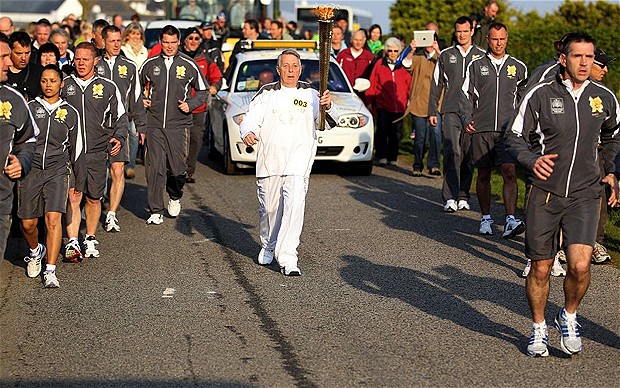
“We are REALLY busy watching this guy with the torch.”
Today, the Special Immigration Appeals Commission ruled that Abu Qatada will have to remain in jail for another 5 months until the next hearing, denying him bail. The reasons for this decision? “The very high level of demand in resources” during the Olympics that would be necessary to ensure the curfew that had previously been imposed.
In effect, the court allows the British government to limit the right to freedom based on a sports event and the lack of enough police or the – possibly erroneous – decision to put almost all of Britain’s police and military resources into protecting the Olympic Games in London. With this reasoning, countries can simply hold major sports or other events or reduce the number of available police officers, and the court will always have to rule in favour of jail. Absurd. And dangerous. Definitely more dangerous than a man who has never even been charged with a crime in this country.


