I have been living in this beautiful town in Transylvania for almost a year, yet hardly any of my foreign friends have visited me here. It’s not that they wouldn’t be interested, but it’s just too complicated to travel here if you are not familiar with some Romanian peculiarities.
In Google Maps, the town is called Târgu Mureș. So, my friends try to find a train connection to Târgu Mureș. After searching for half an hour, they tell me: “There is no such place. Or it doesn’t have a train station.” Offended in my adopted local pride, I tell them that Târgu Mureș does of course have a train station, and that we even have international direct trains.
After some back and forth, I go to the website of our fantastic Romanian Railway and search for the connection myself. Ah! Now I see the problem. I call my friends and tell them: “You need to search for Tîrgu Mureș, not Târgu Mureș.” This question always comes next: “How long have you been living there? And you still don’t know how to spell the name of your town!” I mumble some apologies about recent linguistic and spelling reforms.
But pay attention: While your ticket will say Tîrgu Mureș, the train station where you get off is called Târgu Mureș.

After a few days, my friends call me again, telling me that if they took the train, they would spend all of their holiday on the way to Tîrgu Mureș and back home from Târgu Mureș or the other way round. – “No problem,” I reply, “we also have an international airport. WizzAir has cheap flights to here from anywhere in Europe.” (I don’t mention that only three planes land every day, that it’s the smallest airport in Europe and the only airport which doesn’t even have a cash machine. They will notice it soon enough.) A few hours later, I receive another phone call: “I don’t know what you are telling me, but there are no flights to Tîrgu Mureș.” They are already getting slightly annoyed. “Oh,” I remember now, “on the WizzAir website, it’s spelled Târgu Mureș.” The airport’s website is one of the many examples where you find both spellings used by the same organization, as if they can’t make up their mind.
At this point, my friends usually think that I have been joking and that I made up some random town. They suddenly got their vacation “cancelled” or their child becomes sick.
And they haven’t even asked about the bus website. There, you can book a bus from Târgu Mureș to Tîrgu Mureș. Confusingly, it takes between one and one-and-a-half hours to get from one name of the same city to the other.

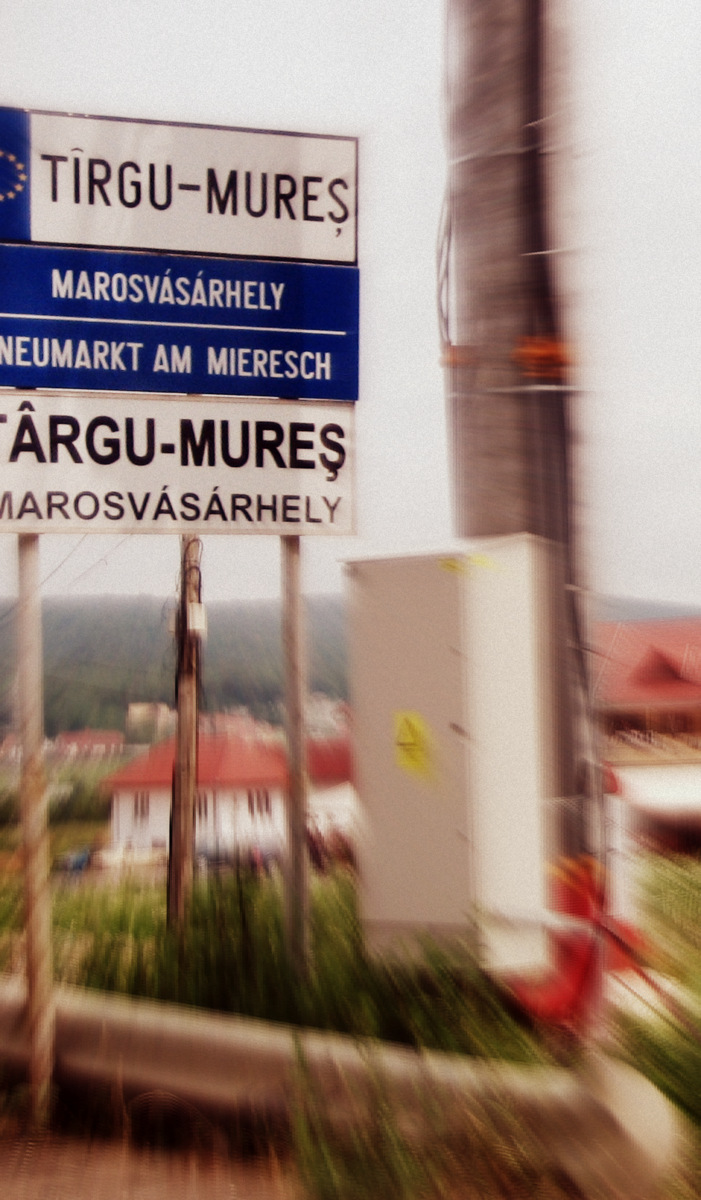
So I decide to take a walk around town to find out once and for all what the correct spelling is. Naturally, my first stop are the signs outside of town. Sure enough, they say Târgu Mureș. (The signs also list Marosvásárhely, which I assume, based on the unpronounceability of the word, must be an Icelandic twin city.) These are the official signs, so everything is settled. Or is it? I shouldn’t have walked past City Hall on my way back home, for there I got mightily confused. Like on the city’s own website, it says Tîrgu Mureș.
At that point, I realized that I couldn’t solve this puzzle on my own. I would need to ask my Romanian friends. Many of them had studied languages, so they would be competent experts. All I got, however, was the information that the name should actually be spelled Târgu-Mureș or Tîrgu-Mureș, with a hyphen. “It is most annoying how the hyphen gets dropped and people get caught up in the â-vs-î debate,” these academics proclaimed indignantly, before arguing among themselves whether the official name should be Târgu-Mureș or Tîrgu-Mureș, in the most heated manner.
“It has always been Târgu-Mureș.” – “But there was a spelling reform in 1953!” – “That was a Communist plot!” – “It doesn’t matter whose idea it was, but the spelling is now Tîrgu-Mureș.” – “You are way behind! There was another spelling reform in 1993.” – “That was a plot by the European Union!” – “What would the EU care about our spelling?” – “We should not forget that we are the true descendants of the Romans!” – “You nationalist!” – “You internationalist traitor!” – “Anyway, a spelling reform doesn’t affect names, you dumbass.” – “It does affect official names. Târgu Jiu, Târgu Neamț, Târgu Cărbunești, they all changed their names.” – “They are losers!” – “Look how it’s spelled in your ID card!” – “In my ID card, it also says that I am 183 cm.”
The debate got out of hand and I began to understand why Târgu/Tîrgu-Mureș has so many hospitals. I had also understood what made Târgu/Tîrgu-Mureș so special. In other cities in Romania, this was a matter of spelling. If it changed, it changed; no big deal. In Târgu/Tîrgu-Mureș however, there are basically two factions of the population (let’s call them Târgus and Tîrgus) and both of them make up around 50% of the population, making sure that the debate will never be settled.
Like in Eastern Ukraine and in Transnistria, the debate about language is not only a debate about language here. It’s a debate about identity, about history, about interpretation, about representation. Language is used not as a tool of communication, but as a divisive tool, as if people weren’t able to speak two or more languages (which even the most radical Târgus and Tîrgus implicitly acknowledge by sending their children to English- and German-speaking schools).

At one time, the sign at the town entrance looked like this. Don’t worry, it’s all the same place.
Now, I should say that most Târgus and Tîrgus are absolutely friendly, welcoming and helpful people. In fact, they get along in everyday life much better than their distant cousins in Buchapest and Budarest believe.

However, when I look at who goes to which church, who goes to which bar and who gets married to whom, there is still a level of (voluntary) segregation like in Alabama in the 1960s. If you are reading this from afar, you probably find all of this very funny (I can assure you that the locals don’t and that I will suffer everything from being unfriended on Facebook to finding Molotov cocktails in my mailbox), but let’s not forget that as recently as in March 1990, people were killed over this shit.
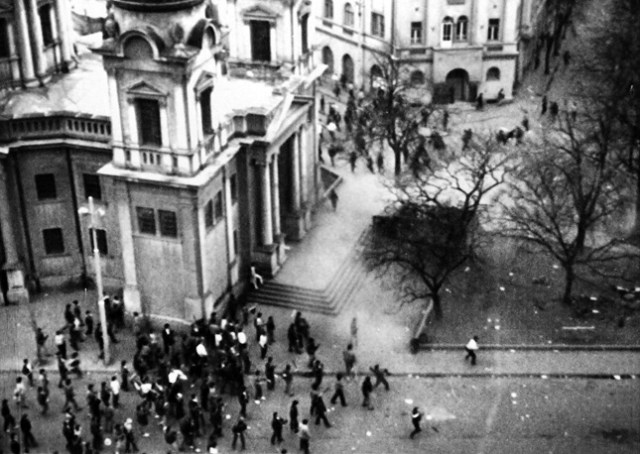
Some centuries ago, the conflict between Târgus and Tîrgus had actually escalated so much that Europe’s most peace-loving and peace-guaranteeing nation had to intervene. Germans settled the area and decreed that the town would henceforth be known as Neumarkt am Mieresch. For linguistic, political or ethnic reasons, this new name never took hold. But, in an appreciative nod to the one thing the Germans were really good at, the local beer is still called Neumarkt.
 It must be really depressing if your nation is good in literature, poetry, music, football, engineering and even humor, but everything the world knows you for is beer.
Anyway, as an international visitor to Târgu/Tîrgu-Mureș you want to know how to refer to the city you are about to visit. That one is actually surprisingly easy:
- In written communication, many people avoid the problem by writing Tg. Mures. Clever, huh?
- When I first moved here, my solution was to start pronouncing the a in Târgu, but change it to an i while the sound was formed in my mouth, to create some a/i-mix. Surprisingly, this came very close to how locals pronounce it.
- Oh, I forgot to mention that the whole Târgu/Tîrgu debate is irrelevant in spoken language because both vowels are pronounced the same. Because it’s a very light vowel, almost not discernible, you do best by simply omitting it altogether instead of messing it up. Just say “Trgu” as if you were pronouncing an Arabic word with a crazy combination of consonants.
- Some people try to be very cool and say TGM, pronouncing all three letters like in NYC, and in English of course. These are the same kind of folks who order OJ instead of orange juice, so, needless to say, you better stay away from these highly annoying people.
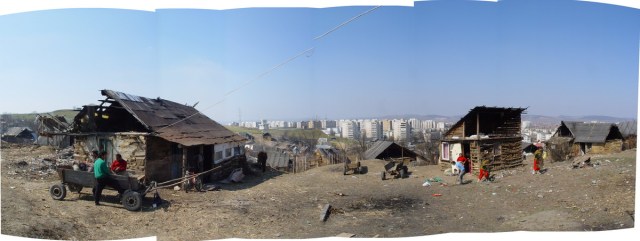
“And what’s with the roof on top of the a and the i?” you have been wondering all along. Once you are in Târgu/Tîrgu-Mureș, take a walk to Valea Rece, the largest slum in town, and you will see where the roofs are missing. After all, a silly language dispute is more important than housing people.









 The Happy Hermit