

Unfortunately, we had no food for them. Actually, we were beginning to get hungry ourselves, so the ducks should be happy that we didn’t take one of them with us.
Photographed in the Central Park in Cluj-Napoca, Romania by my brother.
Unfortunately, we had no food for them. Actually, we were beginning to get hungry ourselves, so the ducks should be happy that we didn’t take one of them with us.
Photographed in the Central Park in Cluj-Napoca, Romania by my brother.
Every week now, thousands of refugees make it to Europe. Thousands die trying. In debates on immigration, refugees are referred to by the numbers in which they arrive, in economic or in legal terms.
It’s time to read the account of one of these refugees themselves. Even better when he is an observant boy who fled Afghanistan (alone) when he was 10 years old and who recounts the story of the odyssey that took him to Pakistan, Iran, Turkey, Greece and finally to Italy 6 years after.
 Enaiatollah Akbari was lucky to survive this harrowing journey, during which he came across many who wouldn’t. We as readers are lucky that, once in Italy, he met Fabio Geda who transformed the boy’s story into “In the Sea there are Crocodiles“.
He does not want to leave Afghanistan for economic reasons. He is a Hazara and as such is persecuted and threatened by the Pashtun and the Taliban in Afghanistan. One day the “longbeards”, as the boy calls them, come to his school and shoot the teacher in front of all the children. That’s the end of that school. At home, he and his brother are hiding in a hole in the ground whenever a stranger approaches the house. In fact, Enaiatollah doesn’t want to leave Afghanistan at all. It is his mother’s idea when he becomes too big to hide in the hole. She takes him to Quetta in Pakistan and leaves him there alone, hoping that he will be safe and that he will survive. She has to return to his younger brother in Afghanistan.
All of this was at a time when nobody cared about Afghanistan. It was before 2001, before 19 Saudi men hijacked 4 planes and killed 2,977 people, putting Afghanistan on the world’s map. Enaiatollah remembers 11 September 2001. He was already in Iran at that time, where he had crossed illegally from Pakistan in search of a better life. He was working on a construction site and thought that something was wrong with the little black-and-white TV because each of the channels showed the same “film” of planes hitting skyscrapers.
His journey was not straightforward. He was picked up by the police in Iran three times, and deported to Afghanistan three times. Three times, he decided and managed to return to Iran. Overall he spent three years there, almost exclusively among other Afghan men and boys who work on construction sites or stone quarries. He was in Isfahan for several months, but never saw anything of the city, although he had heard that it is beautiful (which is true, I can say, having been there myself), because he and the other refugees slept and lived on the construction site for fear of running into the arms of the police.
After being kicked out of Iran for the third time, Enaiatollah decides to move further west. In winter, he walks across the mountains to Turkey with a group led by traffickers. They walk for 26 days. At one point, he takes the shoes of a frozen body they encounter in the mountains. In the end, “twelve, of the group of twenty-seven, had died during the walk […] and I hadn’t even noticed.”
 Turkey is not the final destination, but Enaiatollah didn’t save enough money for the passage to Greece. He is a very clever boy though and tells the four passengers of the small rowing dinghy that they need him because he can speak English. They ask him to prove it. He utters the words “house”, “port” and “ship” and is accepted by his impressed peers. At 15 or 16 (he doesn’t know his exact age), he is the oldest boy on the boat. The youngest is 12. Five children/teenagers who have never been to the sea and try to drink salt water (they think it’s poisoned to stop illegals from crossing the sea). Of course most of them don’t know how to swim. They don’t know how to row either. First they all row on the same side of the boat, making it turn in a circle and hit a rock.
The boat ride from Turkey to Greece is an example for the tone of the whole book. Funny observations, explanations and thoughts (the boys are afraid of sneezing because they are sure it can be picked up by the radar of the Coast Guard; they are wondering if they are rowing uphill because the current keeps driving them back) go hand in hand with dramatic moments (one of the boys falls out of the boat and perishes). There is either heart-break or something heart-warming on almost every page. The story is told from Enaiatollah’s perspective and he speaks directly to the reader, at times asking questions or even giving advice. His witty, youthful tone reminded me of another great teenage character: Holden Caulfield in “The Catcher in the Rye“.
The adventurous journey continues, across many obstacles, through Greece – where Enaiatollah is lucky to be during the preparation for the 2004 Olympics, when undocumented labor was in demand – and finally to Italy, where he finds his new home, a friendly foster family and – again with impressive wit – manages to convince the asylum hearing board to grant him asylum.
But regardless of the immigration/asylum/refugee status, someone who went through such a journey really deserves to live in Europe or wherever they managed to swim, crawl or climb to. Much more so than all the people like me who just happen to live here by accident.
– – –
What the author says about this review:

(This book review was also published by Medium.)
You know these donation boxes at airports, where you are supposed to drop the change that you couldn’t spend during your vacation? Often they are made of glass, for you to see how generous other travelers have been. So you pull the last Transnistrian rubles or Yugoslav dinars from your pockets and donate them for children, against cancer, for or against dogs, maybe even for refugees. Worthwhile causes, all in all.
At the airport in Cluj-Napoca in Romania however, the collection does not serve to mitigate hunger, poverty or disease, but to support a church.
 That is a rather surprising act of begging because the Romanian state already finances the building and maintenance of the Orthodox churches in the country, as well as the salaries and pensions of priests and a lot of other frippery. Each year, hundreds of new churches are being built. Even the smallest of villages are bombarded with cathedrals the size of St Peter’s. For that, they often lack a school or a clinic.
But, as it says on the donation box, “God will bless your journey”. Sick children or starving refugees cannot compete with such a lofty promise. Just opposite from the airport, there is actually the Pata Rat slum, where every euro or dollar would help.
 Not only was I too stingy to donate for the church, I was also too clever. Because for God to bless the journey, it would be enough if one of the other passengers left a few Romanian lei. After all, God can’t make part of the plane crash and keep the other part flying.
The moment before the cloud monster swallows the moon:

Impaling in the 15th century:
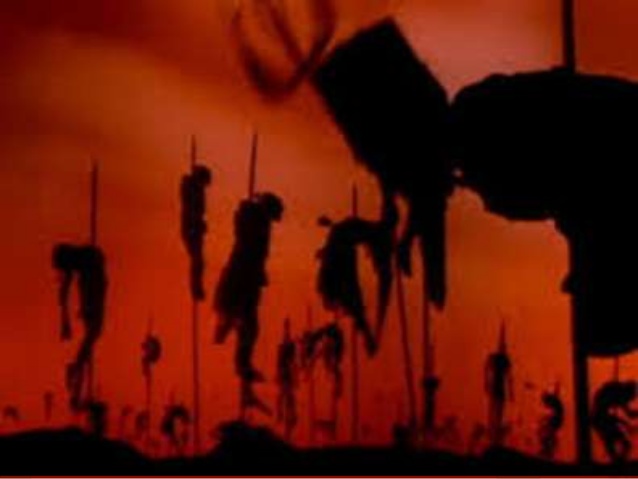
Impaling in the 21st century:

No wonder this method of barbecuing pork is popular in Transylvania.
Poor pigs. :-( After seeing this photo, I think I will become vegetarian for a week or so.
(Thanks to Johann Stan for the photo!)
Photographed in Venice:
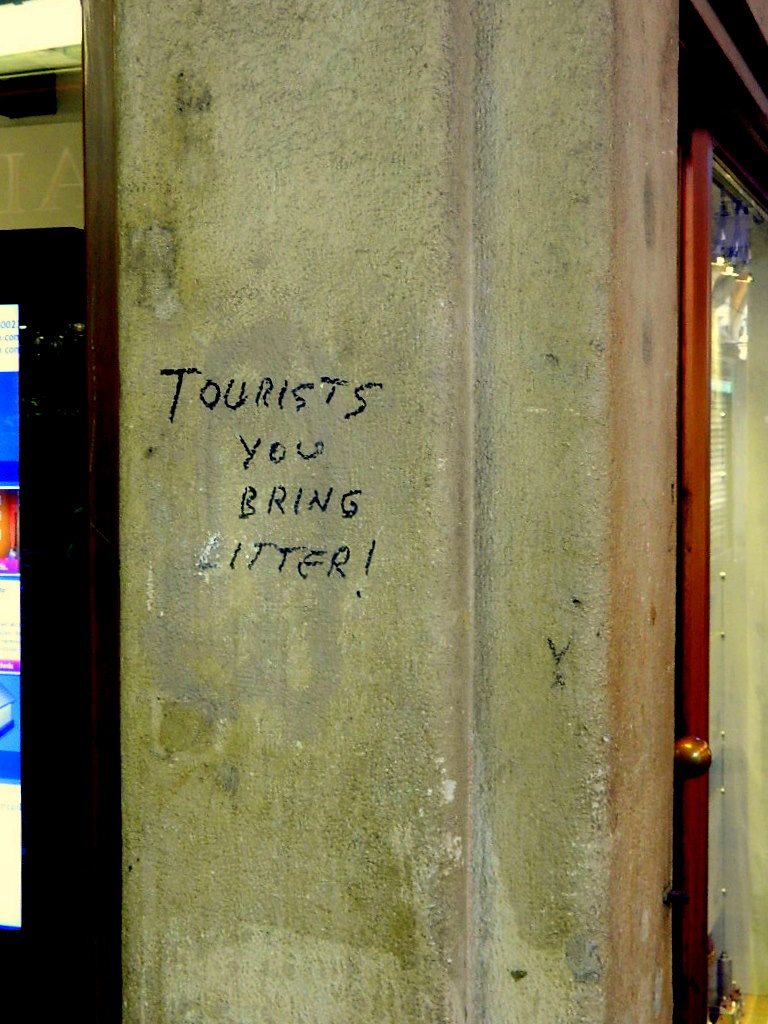
“Tourists, you bring litter!”
But apart from that, Venice was rather welcoming and I spent a very interesting, if cold, February weekend in this unique city. I can however understand the frustration of people who just want to live, study and work there, with millions of visitors clogging up the waterways, alleys and restaurants, driving up prices.
Tourists, there are a thousand other beautiful places in Italy to visit. Give Venetians a break!
I don’t call my blog a “travel blog” for several reasons:
My blog is not only about travel, but about politics, history, books and about other serious, silly and random stuff. Some of it you find interesting, some of it you find curious, some of it makes you hate me and unsubscribe. Because my blog is like me, a person with many different interests. I am not a brand or a product or a company, I am a human being.

Or, if you don’t already know what you want to say, you could just shut up.
I don’t want to be grouped together with most other travel bloggers who are going from sight to sight, from beach to beach, take a photo of a sunset here and a cup of coffee there. Seriously, what’s so special about coffee mugs that people fly halfway around the world to bring back photos of them? Probably, they never leave the hotel or resort, don’t meet anyone interesting, let alone experience any real adventures.

And that photo isn’t even straight.
You know these kind of bloggers: Everything is “the greatest”, “the most adventurous”, “the most beautiful”, “perfect”, “breathtaking”, “amazing”, bla, bla, and everything “needs to be on your bucket list”. By the way, a bucket list is for people who are about to die or for people who don’t know how to enjoy life. Lists are for going to the supermarket, not for leading your life.

With at least 11 stunning and breathtaking clichés, that you have already read on 11 of the world’s most extraordinary travel blogs.
These bloggers travel to wherever they get invited by hotels or tourism associations, and of course they have to write positively. I, on the other hand, I go where I want to go, and I am interested in looking behind the glamour of travel. I don’t shy away from conflicts, tensions, poverty, lies, environmental destruction and the complexity of life. And I write about that. If it offends some people – as it often has – I don’t mind, because I am not a paid PR blogger.
I have to throw up (my hands in despair) when I read the umpteenth blog which praises the old cars and the music of Cuba, the beaches in Dubai, or the pyramids and camels in Egypt, without mentioning that these countries are authoritarian, oppressive or even dictatorships where people get imprisoned, and sometimes executed, for trying to exercise basic human rights.
When I read praise about Thailand, for example,
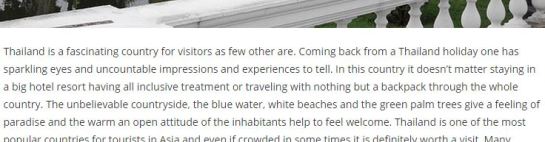
I can’t help but point out:

Having lived in Malta or Sicily, I can’t help but write about the thousands of refugees being washed ashore, dead and alive. Living in Romania, I can’t help but write about the discrimination/segregation of the Roma. Traveling through Eastern Europe, I can’t ignore the falsification of history that is prevalent in many people’s minds.
While it is sad that most travel bloggers know nothing about history and politics and probably aren’t interested, as long as they get paid for swimming in a pool and taking photos of their drinks, the most shocking surprise is their lack of geographical knowledge. Or how else would you explain that they constantly “discover” “surprising” “hidden spots” and “secret destinations”, when every 8-year old knows these places from school or the documentary channel?
I don’t even know which examples to pick because the internet is full with this most annoying fad. The “10 wonderfully secret tourist destinations” include Tasmania (it’s one of Australia’s states!) and the Pyrénées (a 500-km long mountain chain between France and Spain, you can see them from space or from Barcelona, that’s how secret they are). These “19 secret travel destinations you never knew existed” include Machu Picchu (!!). If you are the only person in the world who doesn’t know Machu Picchu, go on Facebook and check your friends’ profile images. Yes, the ruins in the hilly jungle.
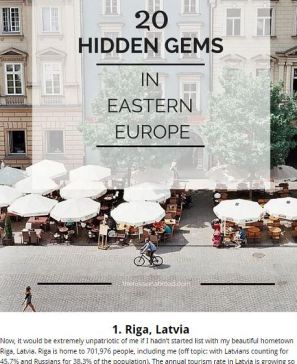
How can the capital city of a European Union country be “hidden”??
Isn’t it insulting to readers if an author refers to places like these as ones “you never knew existed”? The people who put together “Europe’s best hidden gems” don’t ever seem to have read a book about Europe either, let alone been there. Lugano, Cinque Terre, Trieste, Santorini and Kotor as “unknown destinations”? Hm, I wonder how all the cruise ships with thousands of tourists find some of these places, then. Every day.
Because I currently live in Eastern Europe, I don’t want you to miss the “20 hidden gems in Eastern Europe”. The list includes capital cities like Bucharest, Tallinn, Riga and Budapest. My Romanian readers will be surprised that Brasov “has numerous Black Sea resorts”.
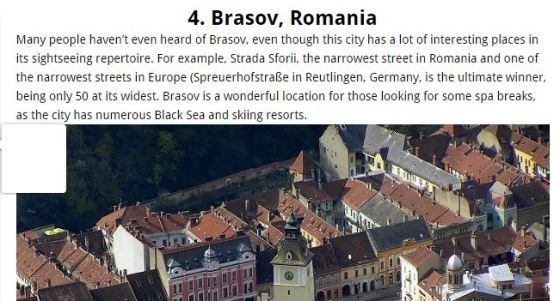
I couldn’t help but comment:

This “secret”, “hidden” and “unknown” mania is getting so out of hand that I bet you can find New York, Paris and Berlin on some of these lists. If you want to read about a genuinely hidden spot, check this out. But that requires a ride on a boat and a bit of walking, for you can’t even fly to that island.
I have now come across someone who seriously claimed Sevilla as an “undiscovered gem” and “one of the most underrated destinations” in Andalusia. I had to point it out to him:

–
Please, please don’t ever lump me together with people who write terrible stuff like that!
So, if you have been wondering why my blog never appears in some “Top 50 Travel Blogs” list, why I never get invited to anywhere, why I can’t even return to some places where I have already been arrested, why my blog is banned in some countries, you now know why.
If you have been wondering why I don’t write very often, why my articles are sometimes years behind my travels, it’s because I need time to prepare my journeys, to read, to think, to write, to research. Keep in mind that I don’t travel to show off or to tell others about it. I travel to satisfy my intellectual curiosity, to experience other places, to get confronted with new ideas. Some of these ideas I will share on my blog, mainly to motivate you to explore the world yourself. But most of the time, I prefer to simply live my life instead of writing about living it.
Lastly, if you have been wondering why I don’t have many friends, you may understand that a bit better now. – No, I cannot be silent when people spread bullshit.
–
In the interest of naming and shaming proper sourcing, if you click on any of the photos in this article, you will get to the original website/blog.
Now that I have ranted a bit, I am asking you, my esteemed readers, to nominate your favorite travel blogs in the comments below and to tell me why you like them. I am thinking of putting together a list (oh, the irony) of the best travel blogs and – this will cause lots of enemies – of the worst travel blogs. Obviously, don’t nominate me. You are free to nominate yourself, but please add an explanation. What I am looking for is original, thoughtful or thought-provoking writing by people who care about people in other countries and who regard travel as an intellectual journey, not as a list to tick off. I won’t consider the quality of the photos or the design, only the text. – Thank you for your comments!
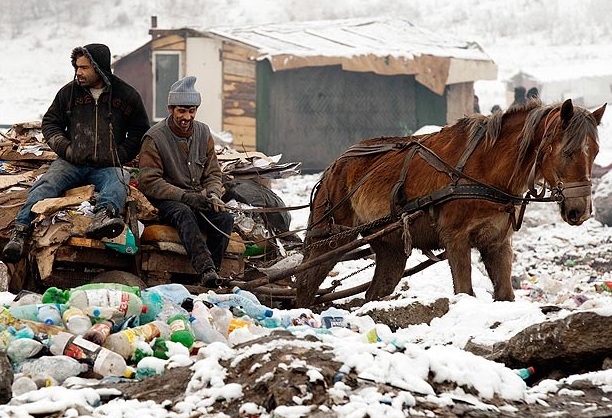
Recycling in Germany:
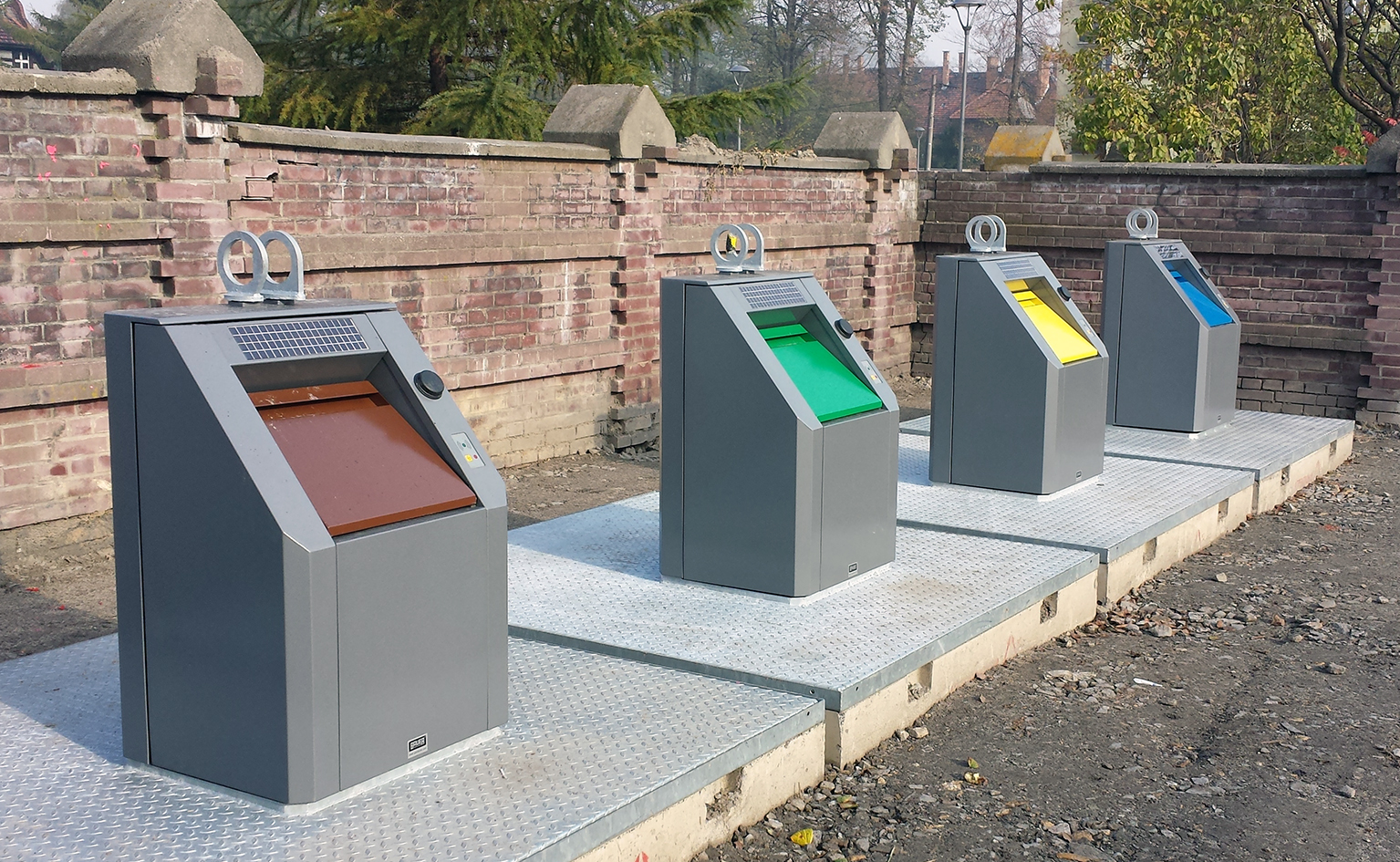
Recycling in Romania:


One is Michael the Brave, at one time the Prince of Wallachia, Transylvania and Moldova, and the first Romanian ruler to rule over these three principalities together, albeit only for half a year. The other one used to play football.
One was assassinated. The other one gets paid for having his image put up, preventing people from using their windows.
One hardly anyone would recognize. The other one you already knew.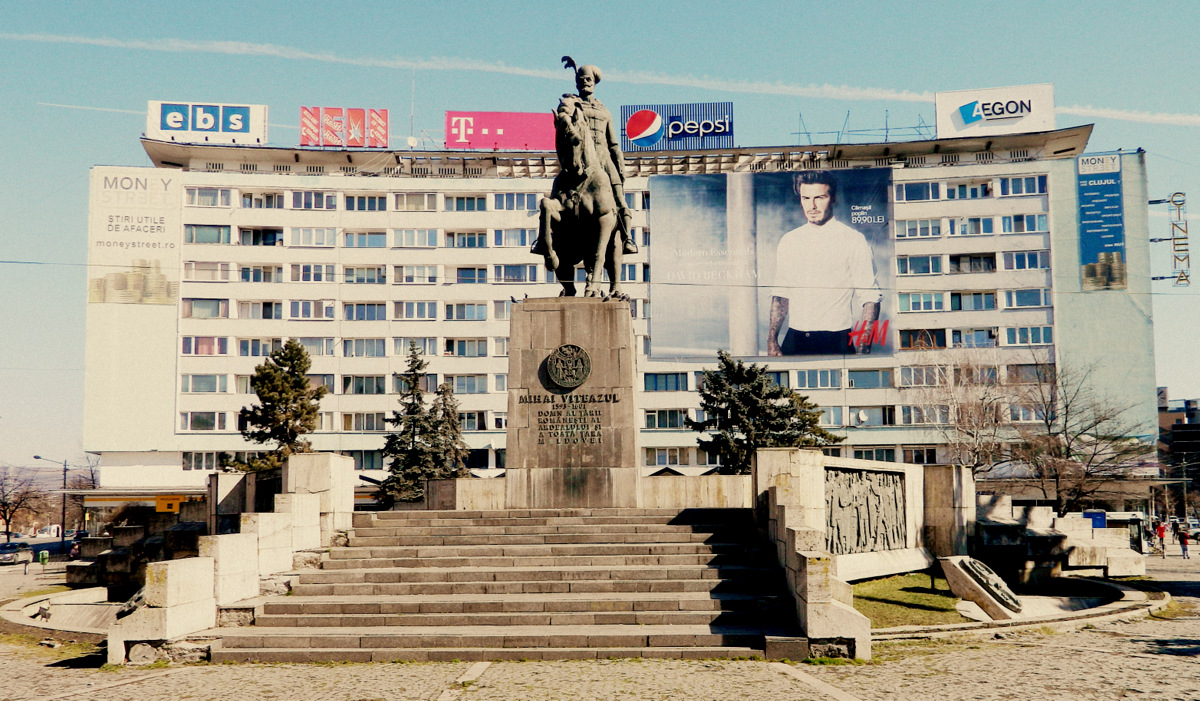 Kids, if you want to become famous, don’t go into politics or war.
(Photographed in Cluj, Romania.)
I don’t know why I go for historical fiction or alternative history again and again, when I should know by now that I’ll be annoyed or disappointed.
 In Young Philby, Robert Littell tries to flesh out the early life of British spy Kim Philby who worked as a double agent for the Soviet Union, where he defected to in 1963. Obviously, that involves some guesswork and some creative liberty, which is fine for a novel. Littell tries something different by writing each chapter from the perspective of a different person. At first confusing, this trick actually caught my interest. It may have worked to make the book more interesting, but I will never find out, for I stopped reading after about a third, when the amount and severity of historical inaccuracies became too much to bear.
When Kim Philby is in Vienna, he joins an underground group of left-wing students and workers, many of whom have escaped Germany. Littell lets some of these characters speak about Nazi Germany as if the problem was solved if Hitler was killed, when people in 1933 actually knew much better than most people know today that the problem was not one person, but a society in which a large number of citizens were racist, anti-Semitic, nationalistic, militaristic, anti-democratic and so on. Littell transfers the simplified explanation of events which took root after the Nuremberg Trials back to the 1930s.
The book had already lost all credibility, but I finally closed it for good when Litzi Friedmann, who in reality was a rather well-informed and active young woman, is quoted as saying “[Hitler] controls the important strings. He had a plurality in the Bundestag until he expelled the Socialist and Communist deputies, at which point he had an outright majority.”
The Bundestag?? That conversation took place in 1934, and the Bundestag did not become Germany’s parliament until 1949. The parliament in the Weimar Republic and during the time of the book’s plot was called Reichstag. If an author can’t even get that right, then he can write children’s stories or poetry for what it’s worth, but please no historical fiction.
The best book about Kim Philby is probably still the one by Phillip Knightley.


