Suicide is not such a bad thing

Hier findet Ihr die deutsche Fassung dieses Artikels.


September 10th is “World Suicide Prevention Day”. Well, at least it is safe to assume that this day was not conceived by the greeting cards industry, for once. Yet the question remains: Suicide Prevention Day? What for? Why would we want to prevent suicide?

I won’t argue that we should have a “World Suicide Day” or that suicide should be actively encouraged. But I do believe that the stigma of failure and despair has to be removed from suicide and from people who choose this option.

What appalls me most after someone’s suicide is the question posed by other people, full of reproach and quite often self-pity, “How could he do that to us?” First of all, every person’s heart is full of secrets, so any judgement should be withheld unless that person discloses their motives. Second, nobody has an obligation to live. As nobody asked us if we wanted to be born, we don’t even have an obligation towards our parents, let alone friends, colleagues or society.

The only people that could argue that somebody contemplating suicide should have to think about them, are their children. After all, one is responsible for having put them in this world. However, I would argue that such a responsibility does not even exist towards a partner. Because surely any relationship can be terminated by leaving. And what else is suicide than an unambiguous goodbye?

A suicide is far too easily associated with failure, interpreted as an act of giving up. But many different reasons can be fathomed: a sense of having had a rich life with experiences that cannot be topped, curiosity about the act and a possible afterlife (something which should endear suicide to religious people), an exaggerated sense for adventure, or even to make a political point.

How can anybody associate suicide with failure unless one can explain what the meaning of life is? As long as there is no convincing argument about the meaning of life, leaving this life is no worse an option than staying.

A suicide looks less negative or frightening when we keep in mind that we are all going to die. No exception. Some of us will die in our sleep and we don’t even know if that is as peaceful as it is usually depicted. Others of us will have a terrible disease or will be hit by a truck and bleed to death, while others might drown or step on a landmine, burn in a fire or starve.

Please excuse the drama, but are you beginning to see that choosing one’s time, place and manner of death might be quite a sensible wish after all?

If the social stigma of suicide was somehow removed or at least reduced, it could be done in an even more peaceful and controlled manner. Then, people might not resort to jumping in front of a train or blowing up their kitchen.

This leads us to the legal status of suicide. The whole affair would be much cleaner and less disruptive (especially for train services) if it was legal to assist people in implementing their wish to end their life at their own choosing. I find it particularly unfair and unethical that sick people are in many countries not allowed to use any assistance of this kind, while a healthy person can just grab a gun and shoot himself (at least in the USA). This puts old and frail and sick people at a significant disadvantage versus a young and healthy person.

Suicide is a decision of which you can be certain that you won’t regret it afterwards. This cannot be said about many things in life.

When I hear of somebody’s suicide, my first reaction is one of admiration. I admire their courage (because logical as it may be, it’s not easy) and the determination to make the ultimate decision in life oneself. We are arguing for so many personal freedoms. Why should we exclude this ultimate freedom, the exercise of which harms no one else’s rights?

Suicide, 1881 (oil on canvas)

Links:

  • This article was also published on Medium.
  • This was easy to write, because it came from the heart, but hard to publish. It hurts a lot of people, I know. But I wrote this after my cousin’s suicide, when I was angry about everything I had heard at his funeral, and I felt like I was the only one with some understanding for him.
  • If this has helped you, I would appreciate any kind of support for my blog. Thank you!
Posted in Law, Life, Philosophy | Tagged | 408 Comments

Mountains in Romania

There are places where everyone wanted to visit me while I lived there. Sicily was such a place. Particularly after they learned that I lived right by the beach, almost every week relatives and friends wanted to come over .

In other places, I am almost not being bothered at all. Romania is such a country. Almost nobody is able to even find Târgu Mureș on a map. “Why would I want to go to Romania?” they wonder and ask, displaying their lack of geographical, historical and cultural knowledge, thereby missing out on a lot, not least mountains like these.

DL Piatra CraiuluiDL Piatra Mica 2

DLP_223_0543

DLP_224_0544

DLP_228_0568DLP_229_0581

DLP_234_0635

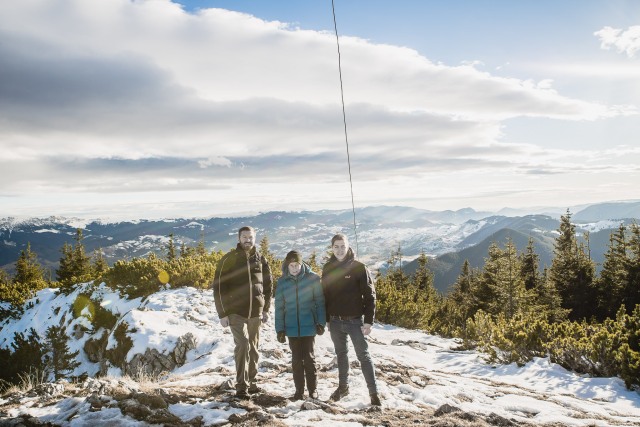
These photos were taken by my brother during our ascent of Piatra Mică, which at 1,816 m is not Romanian’s highest, but its steepest mountain. Don’t be scared though, even my 65-year old mother managed it, so you can do it too!

Mutter Gipfel 1

Posted in Photography, Romania, Travel | Tagged | 9 Comments

Leaving Books in Public Places

I love books. So, naturally, I used to collect them. I kept all the books I had ever read, I bought dozens of books that I still wanted to read and I even bought antique books which I would never read but which looked good. My house was like a library.

And then I began to move to a different country every year. Books are a bloody hard thing to move, especially hundreds and thousands of them. So, I had to leave them behind. I sold some of them, I gave some of them away as gifts and many of my books remained behind in heavy cardboard boxes.

Now, because I know that I will move to another country, possible even another continent, every few months, I don’t have this obsession with ownership anymore. I know there is no point in keeping my books because they won’t fit into my bag when I move to South America, take a train to Russia or hike through Africa.

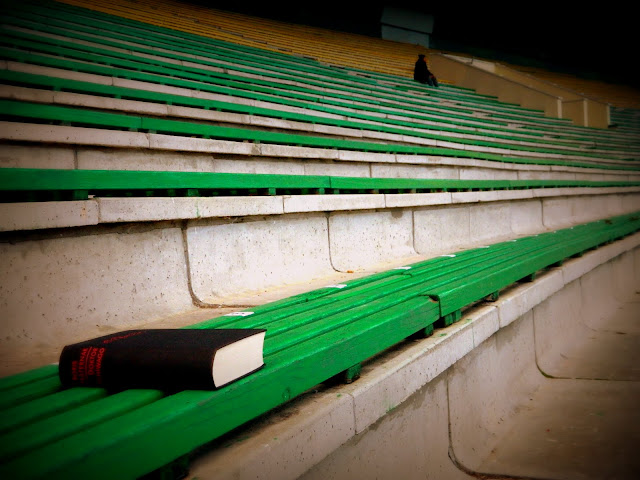
Now whenever I finish reading a book while on a train, in a park or in church, I leave it behind and hope that somebody will find it, pick it up and read it. If you have found a book on a bus in Malta, a train in Lithuania, a boat in Venice or a park in Romania in the last few years, chances are that it was one of mine. I hope you enjoyed it.

When leaving books in public places, I have the romantic imagination of somebody finding it whose life will be touched, or even changed, by the book. A poor child who will discover her love for literature. Somebody who will fall in love with a hitherto unknown writer. Someone who hasn’t traveled but will read about foreign countries for the first time. – I am aware that the book is probably more likely to end up in the trash, but still, each time I leave a book behind, I wonder who will read it next.

Another romantic thing which you can’t do with your e-book.

Links:

  • More about books.
  • And my wishlist. Maybe you have one of those books at home and don’t need it anymore?
Posted in Books, Photography, Travel | 26 Comments

Why Eastern Europe cannot accept more Refugees

Dear Western Europe,

it seems you are in sulk about our unwillingness to accept more any refugees. It hurts us to hurt your feelings, so please allow us to explain things from an Eastern European perspective. We are certain you that you will understand us better after listening to our arguments.

First, we really don’t have any space. We are tiny countries. Most people wouldn’t even find Lithuania or Slovakia on a map. How are the poor refugees supposed to find us? What, “Great Plains of Hungary”, “Poland is the 6th largest country in the EU” I hear you retort? Well, we can’t really count Poland because it has a tendency to lose large parts of its territory, if you remember.

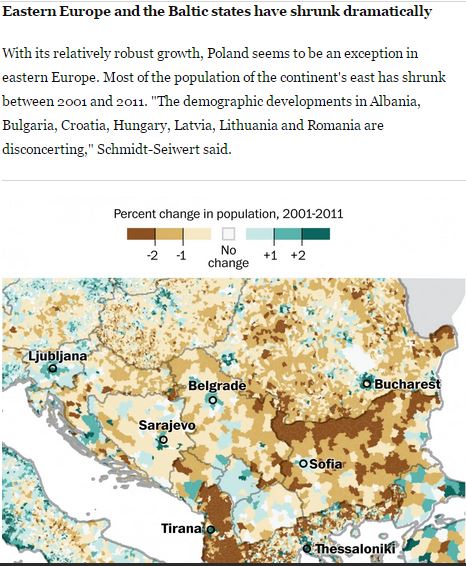
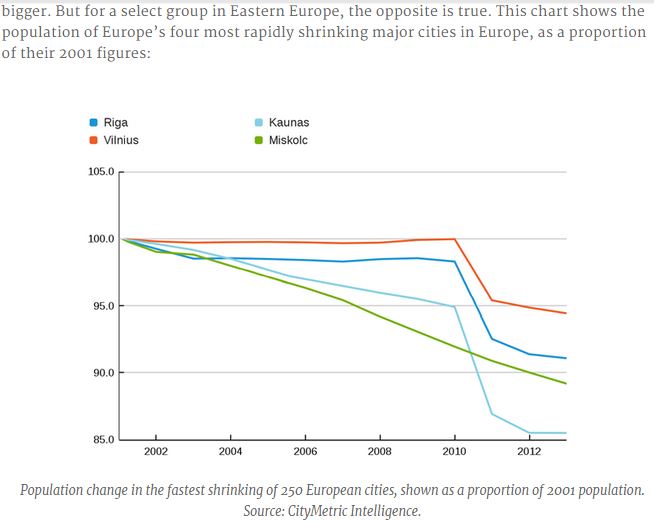
Second, we are already full. All of our houses and apartments are so packed, you couldn’t even fit an extra cat into them. Heck, we don’t even know where to house our own people!

Eastern Europe shrinking population

Eastern Europe shrinking cities

Oh. Anyway, these are the numbers of the past. Our population will increase dramatically in the future because we will appeal to the patriotic pride of our young women. What, our young women have all left to Western Europe and America? Damn. (10 of the 11 countries projected to lose the most population by 2050 are in Eastern Europe, with losses of up to 50%.)

Well, there you see it! We are experts in emigration, not in immigration. You can’t expect us to suddenly reverse course and do something completely different. That would cause major upheaval in our societies. It would be like asking a communist dictatorship to turn into a free-market democracy from one year to the next. Crazy! That could never work.

Third, our languages are really hard to learn. No one has ever mastered Hungarian. Lithuanians pride themselves on having a highly complicated language that nobody can learn. It would be unfair to expect refugees to learn a complicated language when they could also move to England or Italy with their simple idioms. Or to Malta, they speak Arabic there already.

Fourth, we have bears in our forests. It’s not really safe here. Probably more dangerous than in Syria.

Fifth, we are too cold. No, not us as human beings, the climate. Have you seen Doctor Zhivago with all the snow? Yes, that’s how it looks here. You can’t seriously expect people from the desert to settle in Siberia. No, we haven’t heard about Sweden and Norway accepting hundreds of thousands of refugees. Also, their snow is not as cold as ours. And we don’t believe you that Doctor Zhivago was Egyptian. Or if he was, well, you see how unhappy he was in Eastern Europe.

Sixth, most refugees are Muslims. We drink vodka, pálinka, rakija and slivovitz all the time. That would offend the refugees, so it’s better they move on to non-alcoholic countries like Germany, France or Britain where they are not confronted with beer and wine wherever they go.

Seventh, if you want to know the truth, we are either genuinely xenophobic and racist or we suck at public policy and are worried that our electorate will judge us by economic progress, education, health and other complicated stuff. It’s much easier to insult families who have narrowly escaped bombardment and snipers and call them terrorists. They are such perfect scapegoats, these black people with names like Muhammad and Ali. (If only they didn’t have these cute children with curly hair, they make our demagoguery a bit trickier.)

Lastly, have you ever seen how we treat our own minorities, the Roma? If we don’t even provide basic services like water, sewage, roads or schools to some of our own citizens, how do you expect us to do this for foreigners?

We hope you have gained an understanding of our perfectly legitimate reasons to refuse any solidarity, help, compassion and humanity.

Solidarność,

Eastern Europe

PS: The next tranche of the regional restructuring funds is due next week on Monday. Please make sure the bank transfer will occur on time!

Posted in Economics, Estonia, Europe, Human Rights, Hungary, Islam, Latvia, Lithuania, Poland, Politics, Slovakia | Tagged , , | 20 Comments

250,000 cigars

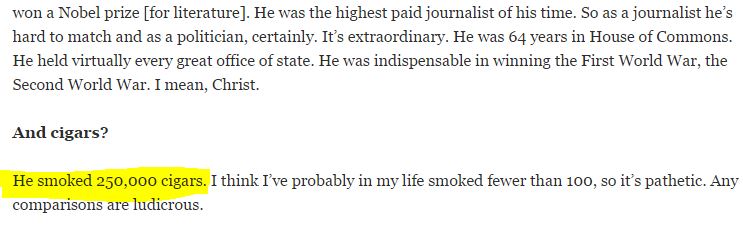
In his book The Churchill Factor, Boris Johnson makes the apodictic claim that Winston Churchill smoked 250,000 cigars over his lifetime.

winston churchill 250000 cigars

This number looks too much like it has been pulled out of Mr Churchill’s famous hat.

Let’s apply some simple maths: Churchill lived for 90 years (putting me as a fellow cigar smoker at ease, although I always suspected that cigars are actually good for your health). Assuming that he picked up the habit as soon as he left school and attended the military academy at Sandhurst when he was 19 (not that you can’t smoke before, but realistically he wouldn’t have had the money to purchase cigars), 250,000 cigars divided by the remaining 71 years still come out at more than 9 cigars per day.

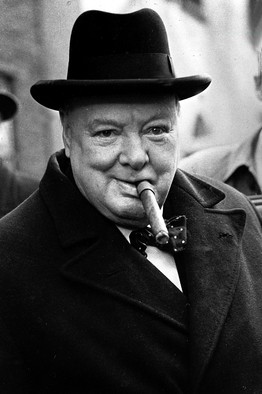
winston churchill cigarA cigarette smoker may find this totally acceptable, but we are talking about cigars. Huge cigars. Churchill-size cigars, as they have become known. Smoking one of them can easily take an hour or more.
Theoretically it is thus possible to smoke 250,000 cigars over a long lifetime, but I find it highly unlikely, particularly when you have a number of busy jobs to attend to. Or maybe we have finally stumbled upon the secret behind a productive life? After all, Churchill not only kept the Allies in World War II together, organized the defense of the British Isles, but as a journalist and writer, he wrote dozens of books and hundreds of articles. – If I only smoked more, I might get there, too.

Posted in History, UK | Tagged , , | 2 Comments

Welcome to Germany!

It has been funny how many people have been telling me that Germany should be careful not to accept too many refugees, that they would be a threat, a burden or what not. It’s particularly funny when these comments come from people who have migrated themselves. And even funnier when it comes from immigrants who live in Germany.

No, actually it’s not funny. It annoying. Highly annoying.

At best, these comments reveal a lack of knowledge about Syria, about war, about refugee law, about Germany, about economics and so on. At worst, they reveal xenophobia and racism.

The following has been a recurring conversation in recent weeks: Someone meets me and, upon learning that I am from Germany, they say “Oh my gosh, you are receiving so many refugees. You must be really worried!” When I reply “No, I am not worried. I think we should welcome anyone who manages to escape a war which has been going on for years, with no end in sight,” I receive flabbergasted looks, as if humanity was a stranger notion than xenophobia.

I go on to point out that Germany is a large country, with plenty of space, no real shortage of money and that we have accommodated millions of refugees before.

The self-appointed Germany experts then usually tell me that I represent an elitist, intellectual minority opinion and that the large majority of Germans don’t want any immigration (often claiming that Germans don’t want to be in the EU either, and so on). All of this is news to me, who should know.

Now, it’s absolutely true that there are millions of racists, xenophobes and neo-Nazis in Germany. But, unlike in some other European countries, in Germany they are not in government. And they are far from being in the majority, although admittedly they are a sizable, scary and dangerous minority.

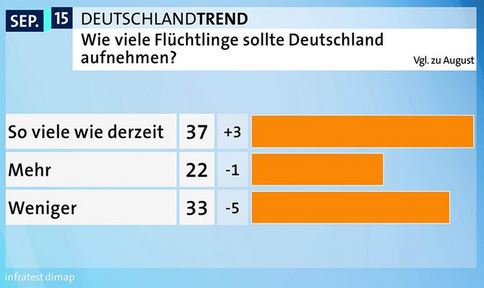
This poll was conducted in September, while the mass migration was already underway. 37% of Germans said that Germany should continue to take in as many refugees as now (which is already a lot compared with most other European countries) and 22% of Germans said the numbers of refugees to be accepted should be increased. Granted, a third wanted to take in fewer refugees in the future.

German refugee poll

So if you only hear from Germans who are scared or who hate to help refugees, maybe the problem is your circle of friends.

The only proper way to welcome refugees could be observed today at Munich train station:

Today alone, Germany welcomed around 7,000 refugees. That’s more in one day than many other European nations will accept in the whole year.

It’s sad to see particularly Eastern European nations refusing to take in a few thousand people in need, when they have the space (millions of their own citizens have emigrated and are still emigrating). Slovakia, Hungary, Lithuania, Romania and all the others are big on “solidarity” when other EU nations finance their highways and hospitals, but far less so when human lives are at stake.

In 20 years from now, Hungary and Romania, Latvia and Slovakia will have even fewer people. Their population will be much older than now, and with xenophobic governments like some of them have, you can’t blame their intellectual and open-minded people for leaving to Western Europe. The countries who welcome and integrate the largely young, fit and energetic refugees (because the others die on the way, a drastic example of the survival of the fittest) will have the youngest and most productive population. Eastern Europe will kick its own ass for having missed this opportunity. Lastly, if you are not swayed by humanitarian, moral, economic and demographic arguments, without immigrants Germany would never have won the Football World Cup.

Posted in Europe, Germany, Human Rights, Politics | Tagged , | 7 Comments

The three books that influenced me the most

When I was recruited to give a speech at the TEDx conference in Targu Mures, Romania, I was asked to submit a list of the three books that influenced me the most. I have read hundreds, maybe thousands of books, and from many of them I have taken something. The following list is thus merely an excerpt, and if I were to compile it in half a year, it might look completely different.

The Trip to Panama by Janosch

A children’s book? But of course! When looking for the most influential books, we have to start in our childhood.

My heroes were never the princes or princesses, sorcerers or knights, firemen or astronauts. Nor was I impressed by cowboys, bandits or sheriffs. There were three professions with whom I identified: vagabonds (or hobos or vagrants), journalists and private investigators. In that order.

Janosch trip to PanamaThe first hobos with whom I made my literary acquaintance were probably the tiger and the bear in The Trip to Panama by Janosch, who decide to walk all the way to Panama (it is not clear from where, but as a child I naturally assumed that they were also in Germany, where I was at the time). It doesn’t matter that they will never reach Panama.

Later came the adventure novels by Karl May, not too well known in the English-speaking world, I believe. The vagrant who is here today and somewhere else tomorrow and who carries all of his belongings in a bundle thrown over his shoulder always struck a more sympathetic chord with me than all the boastful heroes. He epitomized freedom.

Martin Eden by Jack London

This book didn’t influence me in the way that it changed my mind or gave me new ideas. But it was the first time I read a novel and could completely identify with the main character. I felt like finally someone had understood me, and maybe it did effect a change by making me more confident about being my true self.

The issues of education, class, authenticity, loneliness, critical thinking and disdain for shallowness all resonated with me. On top of that, Martin Eden is also one of the most beautifully written books, very different from Jack London’s other books about the gold rush or the wilderness.

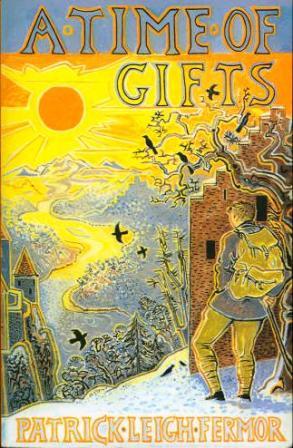
A Time of Gifts by Patrick Leigh Fermor

This is the first of three book in which Patrick Leigh Fermor recounts the journey he made across Europe, from Holland to Istanbul. On foot, largely. Alone. Beginning in 1933. When he was just 18 years old.

time_of_giftsAnother literary masterpiece, this book influenced me by showing that great adventures can be tackled without much planning, without large amounts of money, without any equipment. If an 18-year old can walk across Europe without GPS, internet and a mobile phone, then why shouldn’t I just get up and start walking?

The true story of the English boy who slept in barns, in fields, in gypsy camps, but who was also invited to monasteries, mansions and castles and who ends up in a relationship with a Romanian princess made me exclaim “What a life!” again and again as I followed his lyrical descriptions of the landscape, his encounters with people from all layers of society and his analysis of the political, social and cultural changes occurring between the two world wars.

Into the Wild by Jon Krakauer had a similarly motivating effect on me. Books like these give me itchy feet and I would love to pack my backpack right away and go hiking for a few days, preferably without a map, without a fixed destination even. Books like these render the idea of ever returning to an office full-time unthinkable.

Links:

Posted in Books, Life, Philosophy, Travel | Tagged | 2 Comments

Planes disturbing the sunset

The sky above Targu Mures in Romania is busy, probably because of all the extra flights coming into town for our TEDx conference.

planes sunset

Posted in Photography, Romania, Travel | Tagged , | 2 Comments

A polite coffee

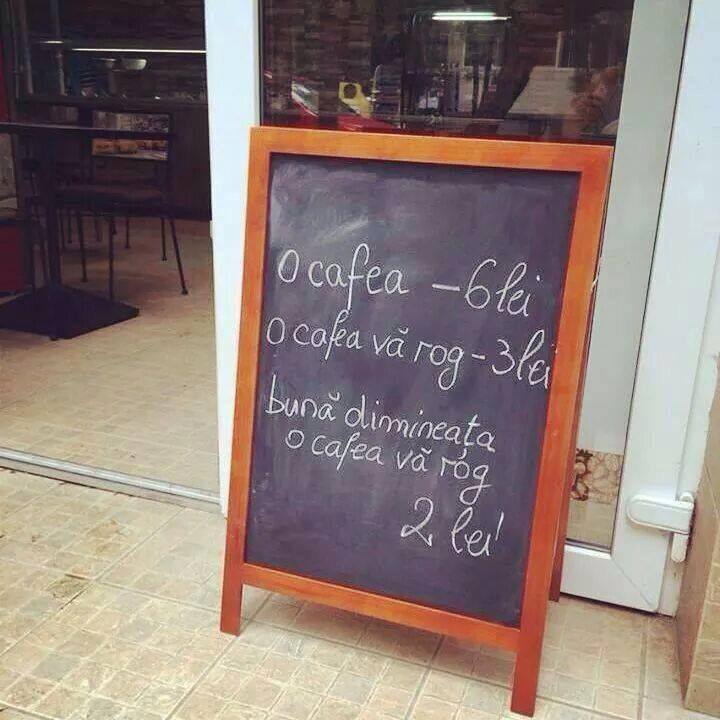
At a café in Sibiu, Romania:

cafe 6 lei

One coffee – 6 lei

One coffee please – 3 lei

Good morning, one coffee please – 2 lei

Polite, as I always am, I get a really good deal here. 2 lei are 50 US-cents.

Posted in Economics, Food, Romania, Travel | Tagged | 4 Comments

Modern art exhibitions are so bad that even the “art” tries to run away

This happened in Toledo, Ohio, but the Red Ball will soon come to a city near you. You can’t escape it! But maybe someone could shoot it. After all, that’s the fate of animals who escape from the zoo.

Artists are so creative these days! A big piece of plastic, who would have thought of that?

Posted in USA | Tagged | 1 Comment