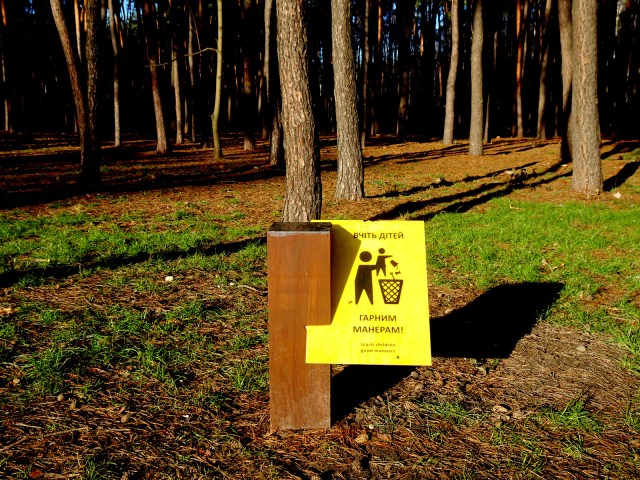
Dear Calgary Sun, I don’t think we need a microscope to spot the machismo on this page.
Nice juxtaposition, really, and all too common, sadly. Whenever I read about traditional gender stereotypes or objectification of women, I just need to flip a few pages to see the problem itself. On TV, it’s worse. Actually, come to think of it, you may even find it on this blog. :-(
Links:
All episodes of “Did you notice the Irony?”, some good, some not so good. But because I numbered them, I can’t delete any without leaving a trace.
It was supposed to be winter, but the day was unseasonably mild, warm even.
I dressed quickly, confident that I needed neither hat nor gloves, and left the house, lured outside by the sun, the warmth and the joyful day they promised. I walked up the nearby hill, energized by the spirit of spring.
The clouds were fluffy, white and moving fast, turning nature’s painting into an animation, at least for those with patience enough to stare into the distant sky.
I stood on the bridge over the creek, looking at the melting ice, the families of ducks and the families of humans, the latter adhering to the signs banning them from feeding the former. I was more worried by the dogs, for there were no signs telling them not to feed on me.
The squirrels seemed to have no food shortage at all, judging by their happy faces. With the melting snow, they found the caches of food that they, or their colleagues, had prepared a few short months ago.
Children, oblivious to all of this, were running around, irresponsibly unleashed by their owners.
Trees were waking up from hibernation, freshly brewed maple syrup running through their veins (this was in Canada, after all). The flowers must have gorged on something delicious, too, for they looked deliriously colorful that day.
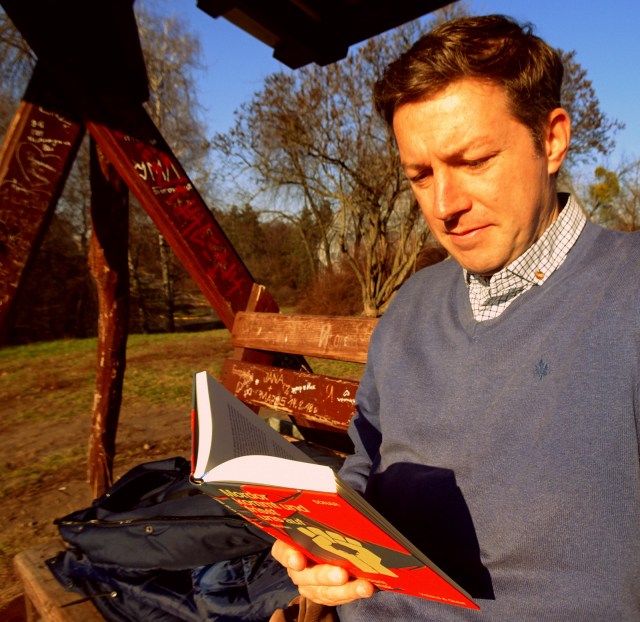
Whenever I passed a bench, I sat down, soaking in the sun. As I was reading a chapter or two of a novel, the sun became stronger as if she wanted to look over my shoulder and partake in the pleasure.
When I came home after four, five, maybe six hours, my heart content as only a day in nature can achieve it, I checked my e-mails. Two potential clients complained that I hadn’t replied to their messages, taking their business elsewhere. This would mean another month of struggling financially, of eating nothing but rice and soup, another month of dread.
A sense of beauty, of happiness even, can really be detrimental to so-called success.
Yet, on the next sunny day, I will go out again. There is enough winter in the world, literally and metaphorically. Links:
It was supposed to be winter, but the day was unseasonably – and unreasonably, I might add – mild, even warm. The sun shone, the sky was blue, the clouds were fluffy, the snow was melting, the squirrels were happy, children were running, trees were breathing fresh air, flowers rose their little purple heads, the ice on the lake began to crack, and Lisa, who wanted to go skating one last time, really did so.
The Georgian capital of Tbilisi impressed me so much that it has earned a particularly detailed article. I know you are short of time, so I have divided it into 52 chapters, allowing you to stop and resume reading at any time (or to find back into the article after your boss interrupted your reading pleasure at the office). It also allows you to skip the chapters which may be of less interest to you.
1
My first stop in Georgia was actually in Kutaisi, if only because that’s where the cheapest flights go to. There, I had stayed just a few houses from the Georgian Society for Artists, Writers and Scientists. In Tbilisi, I live on the other side of the street from the House of the Writers’ Association. This might be coincidence. It might also be a reflection of the country’s intellectuality.
2
The Littera restaurant in the palace of the writers’ union has been praised as an example of the “new Georgian cuisine”, but with my meager blogging income, I cannot afford to dine there. I am going for khachapuri instead.
In the same street, named after Ivane Machabeli, a writer who mysteriously disappeared in 1898, there is Kiwi Café. A while ago, this vegan restaurant became the target of an attack by anti-vegetarians who threw sausages at the patrons. The barrage of bacon came with reproachful questions why the guests didn’t eat meat, “like normal people”. Those were probably the elder and more rural traditionalists, the people who make three crosses each time the marshrutka passes by a church, and who beam with pride when they tell everyone in the village that their son or daughter got an Erasmus scholarship to study abroad, but who then regard all the ideas brought home by young people from the big cities, from universities and from the EU as a threat to the Georgianness of the country.
Having said that, I should add that in general, I don’t hear, see or feel many doubts regarding the country’s orientation towards Europe. The balancing act between the EU and Russia, seen in other countries in Eastern Europe, is not an option for Georgia, which fought a war with Russia as recently as 2008.
3
Tbilisi is so hot this summer that the landlady suggests to leave the apartment door, which leads into a large courtyard at ground level, open and to put up only the mosquito net instead. But I fear that some of the neighbors may be too nosy about the new temporary tenant. In the end, someone may deem me a worthy object of protest and throw a bratwurst into the living room.
4
Tamuna describes the neighborhood, in which she rents out the comfortable apartment: “Sololaki is a charming, historical district of old Tbilisi, mainly characterized by the architecture of the late 19th and early 20th century. The style was called Caucasian art nouveau. At the time, Tbilisi wanted to compete with the two capitals of the Russian Empire, Moscow and Saint Petersburg.”
Not without success, I would say.
5
The iron balconies are relatively modern. Under the Russian tsar, in a mood of misguided modernization, homeowners were ordered to replace the wooden balconies with iron ones.
The Georgians obeyed, but at the same time moved the wooden balconies to the back of their houses, creating cozy courtyards. Thus, the houses show a European facade, but an oriental soul.
The town reminds me of a single house with rampant floors, extensions and balconies, just as each of its houses is its own town in a way. Each of its branches is uncompleted like a living branch, budding and growing. You can never be sure if there won’t be another little balcony added to this house, or a staircase, or another attic to the attic – be it because you didn’t notice it yesterday, or be it because it will be added on tomorrow.
6
Quite some sense of humor is demonstrated by the Research Centre for Georgian Art History and Heritage Preservation, which welcomes visitors in a particularly well preserved heritage site.
Braggarts they are not.
7
A place that is all spruced up, by contrast, is Liberty Square, just a few blocks from the apartment and a point of orientation on my long walks. Until 1990, you could have seen Lenin here, now the square is guarded by the Georgian patron saint George.
8
One of the beautiful buildings in Liberty Square houses the “Information Center on NATO and EU”, a somewhat unlucky flat-share agreement, because Georgia might well want to become a member of one, but not of the other. That way, what was dreamed up by penny pinchers in Brussels feeds into the Russian narrative, painting both the EU and NATO as aggressive-expansionist anti-Russian organizations (which neither of them are).
Ironically – or is it a sign of protest? -, directly in front of the building, a flee market offers mostly Russian or Soviet literature, including the “Atlas of the USSR”. I can’t think of a more poignant demonstration of history.
9
A house built on top of the old city walls is adorned with wooden balconies all around and with chimneys that make it look like a paddle steamer on the Mississippi river. Freshly painted in optimistic azure, it is ready to sail west, as are so many in this country.
I am curious if it will still be here tonight.
Meanwhile, travel agencies offer flights to Astana, Aktau and Kharkiv. One generation later, the ties with the former Soviet brothers and sisters don’t want to be cut either.
Georgian soldiers are walking through the city in US uniforms, making a fashion statement for NATO aspiration. Good that the USA are not as childish as Greece, or they would block Georgia’s western efforts because it is homonymous with the US state.
10
For dinner, I had arranged to meet with Eka, but because she is a dentist, I have been having a bad feeling all day long. Passing Gabriadze Theater, I see that they only show “Stalingrad” tonight at 8 o’clock and make a spontaneous decision. World War II is better than a root canal.
As if to emphasize my statements about Georgian westward orientation, the girl at the box office is reading Kafka’s “America”, and she is not at all happy about being interrupted. Out of revenge, she charges me the maximum price of 30 lari for one ticket, that’s about 10 euros (= 11.30 USD).
There are still a few hours until the show, allowing us, that is me and you, the esteemed reader, to aimlessly walk around town, trying to remember the way back. The theater is ornamented by a funny tower, so it should be easy to find.
11
Near Gabriadze Theater, I spot some Soviet children’s books. They have neither a price tag, nor a visible owner, so maybe they are there to be taken home by children, nostalgics or students of Russian, for free in either case.
Briefly, I have to walk through one of those annoying streets packed with tourist restaurants on both sides, where young women and men shove menus into your face. If the food was good, it wouldn’t be necessary to advertise it that way.
12
Fleeing from the exaggeratedly cheerful tourist hunters, I escape into the somberness of Anchiskhati Basilica. It looks more like a small chapel than a basilica, but it’s the history that matters. And this is the oldest surviving church in Tbilisi, from the 6th century.
One of the paintings – no idea which one – is an icon painted by Jesus himself and thus super important and holy. Somehow, the story is about the King of Osroene, a pen pal of Jesus. The king suffered from gouty arthritis and asked the miracle man for a visit. Jesus didn’t have time or didn’t feel like traveling, so he pressed his face into a towel and sent it to the king. Miraculously and as expected, if those two aren’t contradictory, the king convalesced. This self-portrait has been the origin of all images of Jesus since.
You can learn a lot from old ladies in chapels, churches, cathedrals and cloisters, although as a history student, I dare to register some doubt as to the veracity of that tale. But maybe I simply didn’t understand everything correctly. After all, I don’t really speak Georgian. In any case, the nun or whatever she was, urgently warned me that nobody was allowed to pray in front of that icon.
“Don’t worry, Ma’am,” I sought to reassure her, “I am an Atheist.” Contrary to my expectation, she was not the least delighted to hear that, instead placing a curse on me. Ever since, I am forced to wander the vast widths of Wikipedia, from the Abgar legend to the mandylion of Edessa, from the archeiropoieton to Eusebius of Caesarea, from Manichaeism to the Zoroastrians (with whom we will have another encounter in chapter 22).
13
Around a few corners, hidden between cafés – some ice cream must suffice as dinner in that heat – and clubs for electronic music, there is a synagogue. An old lady, sitting on a chair in front of the heavy metal gate, notices my curiosity (maybe this is the place to learn more about the Artist formerly known as Messiah?) and signals that the door is open. A few men are sitting in the courtyard, greeting me friendly. I ask for a kippah, the head covering. The gentleman who stands up to get me one lets me feel that he regards this as unnecessary pietism and punctiliousness. This seems to be a relaxed place.
Inside, three young guys are sitting around a table with Exodus, Leviticus and bottles of Coca Cola. I would love to talk to them to learn more about the few Jews remaining in Georgia, but time is short. I am expected in Stalingrad. There is “no admittance for people arriving late”, the ticket warns. That’s an option that the men of the 6th German and the 21st Soviet Armies would have loved to have had in 1942/43.
14
The theater is filled to capacity, no seat remains empty. One practical piece of advice: you can purchase the tickets on the same day until 7 pm, but if you are in Tbilisi for several days, play it safe and take care of the tickets on the first day.
Gabriadze Theater is a puppet theater. Usually not my kind of entertainment, but this is no regular puppet theater with Punch and Judy, more an art form sui generis. For example, I have never seen such a creative, simple, yet haunting depiction of the advance of the Wehrmacht. I could try to describe it to you, but just go and see it for yourselves.
How do you illustrate a battle with 700,000 victims? It’s a stroke of genius to put the humans aside and to focus on the animals’ perspective instead.
But it is sad. The play is actually not so much about Stalingrad, but about disappointed love, about death and life in general, about how the Soviet Union lied to its own people, about Stalin. Because it’s in Russian, everything sounds even more melancholic. (The English text is shown above the stage.) As the ant delivers the final monologue, I cannot hold back my tears any longer. The boy sitting next to me suddenly has a very runny nose, too. We both applaud and clap all the more.
15
The steamship house has already turned on the lights, ready to cross the Black Sea, which, by the way, isn’t all that bleak as the name suggests.
16
“This is the Presidential Palace,” the guide explains the recent changes to the constitution, “but the main guy is now the Prime Minister.” The architecture along the Mtkvari river however, is still from the time of former President Mikheil Saakashvili (2004-2013), who thought that a modern country needs lots of steel and glass, commissioning ugly bridges and buildings.
The two metal tubes looking like drainpipes are part of the concert hall. The dome of the presidential palace is obviously a copy of the Reichstag building in Berlin.
Well, at least there is Rike Park in front of everything, so that one day it will hopefully be overgrown with trees, pianos and chess pieces.
17
Meanwhile, Saakashvili fell from grace, not only because of his terrible taste in architecture, and was chased out of the country. Remembering Napoleon, Georgia also withdrew his citizenship, probably an unprecedented act for a former president.
Georgia is generally quite relaxed when it comes to presidents and citizenship: the current president Salome Surabishvili was actually the French ambassador to Georgia, when she was asked if she didn’t want to become Georgian foreign minister and then president. I better keep a low profile here, because I really don’t want anyone to offer me a job.
18
By the way, nowhere else have I seen or heard so many grouching children. It’s about time that school will start again.
19
For me, the most beautiful thing about Tbilisi is that just two blocks from trendy Freedom Square, it looks like this:
With some of the houses, I am not sure if they are still inhabited. Some of them need support against falling over. Here, it is completely calm and peaceful even in the middle of the day. A car from Soviet times dreams of being a BMW.
20
Still under the influence of the Anchiskhati curse (see chapter 12), I start the next day with religion.
First, I go to the Grand Synagogue, after I saw on the map that the one which I visited yesterday was just a smaller one. This one is not guarded by an old woman, but by a white cat, probably the one from which we can learn modesty, according to Eruvin 100b.
They are just having a group of visitors from Israel, which is good because I understand some Hebrew, but wouldn’t have understood any Kivruli, the Judaeo-Georgian. Ashdod and Ashkelon seem to be the towns in Israel with the largest immigration from Georgia. The local representative still presents the Jewish community of Tbilisi as an active one, with two kosher restaurants and two yeshivot.
21
Next stop on my religious tour are the Muslim colleagues. At Juma Mosque, I am the only visitor. A lady in a Soviet-style dress with flower pattern grants me access. Before entering the prayer room, I take off my shoes, but here too, everything else is quite relaxed. If the Arab tourists, of whom some women are wearing the hijab even in Georgia, will find the way to the mosque, they are in for a surprise.
The mosque is built with red bricks, just like the Grand Synagogue, which reminds me more of British industrial towns or Hanseatic cities, rather than of the orient. In the corner, there is a tiled stove, like in a cozy living room.
There is no separate room for women, everyone prays together. But, and this is something I haven’t seen in any other mosque, there are two prayer niches, apparently for two imams. Only from Navid Kermani will I learn the reason: one half of the room is for Shiites, the other for Sunnis. A nice and simple solution. No reason for battles at Kerbala or elsewhere.
22
If you find synagogues (chapters 13 and 20), mosques (chapter 21) and churches (chapter 12) too mainstream, you can visit the oldest religious building in Tbilisi, which is near Bethlehem Church: the Zoroastrian temple, probably built between the 5th and the 7th century.
As I still haven’t stomached the crazy story about Jesus, the apprentice painter, I don’t even dare to enter this place of worship. Here, I would probably learn that Christianity is an idea from the Avesta that reached Israel via the detour of the Babylonian captivity. If I were to keep investigating this, I might end up finding the Holy Grail, which is the last thing I need right now. I’ll take another sundae instead.
If Dan Brown is ever going to write a book about these tangled theories, please remember where you read it first. Come to think of it, this article is getting out of hand already and I might as well tackle the book myself.
23
That evening, I have no reason not to meet with the dentist lady, which turns out to be a huge waste of time. During dinner, she answers her phone 8 times, makes 3 calls and plays with the gadget 22 times while I try to ask her about life in Georgia.
The next evening, I am going to meet two Iranian girls (more about them in chapter 41), neither of whom will undertake any of these incivilities, not once.
People think that technology means progress. But technology is just a tool, like a hammer or a machine gun or a drone. Progress should be measured in how we interact, how we treat each other, in sociological rather than technical terms.
The only useful thing about the evening with Eka is that she shows me a valley with a waterfall, just a short walk from the old town. At night, the frogs are quacking so loudly that I wish the muezzin from nearby Juma Mosque would call more often and more loudly to dispel the biblical plague (Exodus 8:1-4).
24
The next morning, I return to enjoy the valley without phone calls and frogs. The high rocks not only provide much-coveted shade, they also offer a solution to those wishing to untie the knot, of which they previously hoped that it would remain tied forever, a naive wish demonstrated a hundredfold by the love locks on the bridge at the entrance to the valley.
Like the waterfall, sweat pours down in streams, although it’s only 10:15 in the morning. I am dreaming of the cool apartment in Machabeli Street. If it wasn’t my birthday, I wouldn’t even go traveling at the height of summer. Somehow, I need to do this differently next year. Maybe go to Iceland. Or Canada.
25
That’s when I spot the Botanical Garden on the map, which sounds tantalizingly like shady trees, cooling creeks and time to read a book. What seems to be the shortest way on the map leads me across some hills, and suddenly I find myself within the Botanical Garden without having bought a ticket. Some helpful gardeners point me in the direction of the ticket booth, where I pay 2 lari (0.65 euros).
What is now the Botanical Garden used to be the Royal Garden from the 17th century. High up on a rock, you can still make out remnants of Narikala Fortress.
This looks like a steep climb, so I better begin the hike at the botanical café. It’s one of those modern buildings with lots of glass, as it used to be popular in Saakashvili’s time. But practical it is not. It stores the heat like an oven. The old wooden and brick houses are smarter and more beautiful. Another example of something sold as progress which is really regress. On the way from the kitchen to the table, half of the ice cream has already melted.
The Botanical Garden is a beautiful place for a walk up the valley of the Tsavkisistskali river, rather dry now in summer. By the way, are you keeping track of all these names?
26
Somehow, despite the heat, I am drawn to the highest point (one reason why I usually travel alone, I assume), where Mother Georgia overlooks Tbilisi with her sword and a cup of wine.
Father Georgia is nowhere to be seen. He is probably working somewhere in Central Europe. Or he died in the war for South Ossetia.
27
There would be many more hills to be climbed, with churches, castles and views as rewards. But I will come back to do that when it will have less than 40 degrees.
28
Another place to hide from the heat is the Georgian National Museum. In the entrance hall, there is an exhibition about Paul Salopek’s “Out of Eden” walk, which led him through the Caucasus. I hope for him that he was smarter and didn’t walk here in July.
The museum is open from 10 to 18 hours, except on Mondays. The entrance costs 7 lari (2.30 euros), and there are guided tours in English, too. For students, it only costs 1 lari (0.30 euros), but I am only going to take up my studies in autumn and don’t have a student ID yet.
29
The basement houses and supposedly protects the gold treasure of the Argonauts. Somehow, I know that all of this is connected to Jason and the Golden Fleece, to Medea and Colchis, but wandering around the Georgian Fort Knox, I fail to gain any real understanding.
Exhibitions of gold coins, skulls, axes, skirts and jewelry don’t capture my curiosity, which is a general problem I have with museums that are organized like storage facilities. Maybe it’s because my interest is more focused on 20th century history than on the Paleozoic era. Or because I am more interested in context and explanations, rather than in objects. A clay pot doesn’t tell me anything about family structures, a sword conveys nothing about the crusades, and even a pile of gold coins won’t make me understand how early trade was globalized. When I go to a museum, I want it to be a Fort Know, not a Fort Knox. Too often, I am disappointed.
30
And so I walk up to the fourth floor, bypassing the Middle Ages and the Battle of Didgori, where a permanent exhibition about the Soviet occupation from 1921 to 1991, as it is called here, will capture my attention for a few hours. (Yet another reason why I usually travel alone.)
Don’t worry, I am not going to roll out every detail here like a Soviet tank rolling over protesters. But I have to tell you a little bit. If you are not interested in history, you may jump ahead to chapter 37.
The history of each country that neighbored Russia or the Soviet Union in the 20th century is dominated by that sometimes overbearing neighbor. Some countries might even feel that this extends well into the 21st century.
After the February and October Revolutions in Russia in 1917, there was, as you know, a bit of a back and forth, which may have appeared like chaos from the outside, but which was really carefully choreographed by Boris Pasternak in a manner worthy of an Oscar. In any case, first there was the Transcaucasian Federation, which didn’t last very long (April – May 1918). The Georgian National Assembly found the situation too insecure and looked for a friend in the West. The choice was simply made by picking the country listed immediately after Georgia in the telephone directory: Germany. A big mistake, because, as many Georgians should find out, going to bed with Germany is the mistake of a lifetime. (At least in the first half of the 20th century. By now, we have become quite nice.)
Germany, always ready to play the big guy anywhere in the world, promised to protect an independent Georgia from the Ottoman Empire. In exchange for stationing 3,000 soldiers in Georgia, Germany was allowed to extract manganese, copper and oil. Kaiser Wilhelm II, megalomaniac as ever, propagated a “South-East Federation” between Ukraine and the Caspian See, from where one would join up with the Aryan brothers in Persia to fight the British in India. All this would occur under German leadership, naturally.
Georgia, starry-eyed from the prospect of independence (or maybe from wine and chacha) thought that this was all about Georgia and proclaimed independence as the Democratic Republic of Georgia in May 1918. It seems that the Germans were involved in this, too, because the museum thanks the German consul at the time for his contribution to the declaration of independence.
Interestingly, the westward orientation of Georgia was already evident back then. Prime Minister Noe Zhordania said in 1918: “Soviet Russia has offered us a military alliance, which we have refused. We are on different paths. They go east, we go west.”
The German troops then had to be withdrawn because all the meticulous planning had overlooked the fact that Germany would lose World War I.
The following years, Georgia was suffering from post-war back and forth, always threatened by Russia which had by now become communist. The thing that makes Georgians particularly cranky is that Russia recognized Georgia’s independence in May 1920, but already invaded the country in February 1921. That was unfair.
The museum illustrates all this with documents and videos from the time, but also explains the context. That’s much better than the golden space travelers. But maybe I just understand it better because I am well versed in the global context of the last century, and those of you who have other interests have long fallen asleep, like on a long train journey to Siberia.
31
And there were plenty of trains to Siberia at the time, let me tell you. Even more people were simply executed, though. From 1921 to 1926, the Georgian elite was eliminated: the nobility, the clerics, the landowners and the intelligentsia. After that, there came wave after wave of executions and expulsion. The displays in the museum go from one oppression to the next deportation, and one has a hard time understanding the difference between the specific periods of the Soviet Union. There was always oppression.
The total number of victims were 80,000 shot, 400,000 deported and 400,000 killed in World War II. Regarding the latter number, I do however doubt if all of them would have regarded themselves as “victims of Soviet occupation”.
32
Sovietization was also reflected in the image of the city. Art nouveau, so much appreciated by me, was suddenly too bourgeois and thus passé, as one says in Russian.
In its place came modern Soviet architecture, paradoxically also appreciated by me, although I am ready to admit that it is not beautiful in the classical sense. The best known example in Tbilisi is probably the former Ministry of Road Construction.
You have to admit, it was brave. The experiment hasn’t collapsed yet, unlike the underlying social model. Currently, the National Bank lives in the upended labyrinth.
And you have to give credit to the Soviets, they also delighted regular workers with motivating art at the workplace.
33
With the beginning of World War II, some people in Georgia had the hope of withdrawing from the Soviet Union (or, as the museum calls it in slightly falsifying manner, “from the Russian-Bolshevist Empire”). Not having learned anything from history – the intellectuals, who could have warned about it, had all been killed – about 30,000 Georgians sought their salvation with the Germans again, applying for jobs with the Wehrmacht, which happened to have staffing problems and was thus willing to accept Caucasians.
The Georgians were promised that their country would become independent, of course, and because Hitler wanted to top the megalomania of Kaiser Wilhelm II, the Nazis immediately began planning for a Reich Commissariat Caucasia (which was of course diametrically opposed to the independence promised), in which Tbilisi should become capital city and the Autobahn should go all the way to Baku. With all that planning, the Wehrmacht overlooked the fact that the Caucasus is protected by a high mountain range in the north and could not really be conquered. But at least the Wehrmacht got some units with non-Aryan names like “King David Bagrationi Agamashenebli” (Battalion 799).
34
All of this I don’t learn at the museum, by the way, where everything is about Georgia’s heroic resistance against the Soviet Union. I have to do a lot of reading after the visit to fill in the gaps. This is also sad because thus, the visitors to the museum don’t learn about the story of the Georgian uprising on the island of Texel:
This Dutch island in the North Sea was occupied by the German Wehrmacht, including the Georgian Infantry Battalion 822 “Queen Tamar”. On 6 April 1945, the Georgian soldiers rebelled against the Germans and killed at least 800 Wehrmacht soldiers. For a short time, they took control of the island, but the Germans reconquered it in the following weeks.
If you have paid attention to the date, you will have noticed that all of these fights and battles were completely senseless. But senselessness never stopped the Nazis, and so they kept on fighting even after the surrender on 8 May 1945. The island of Texel entered the history books as the last active battlefield in Europe. Only on 20 May 1945, Canadian troops landed and put an end to the charade.
35
But the overwhelming majority of Georgians, about 700,000 soldiers, fought in the Red Army. Thus, Georgians were fighting Georgians, often the same person on two different sides at different times, because signing up to fight was a way to leave the POW camp. As far as I remember, this is not mentioned in the museum either.
Here, the story continues only in 1956, with protests for Georgian independence (so says the museum), which had ironically begun as protests against de-Stalinization in the Soviet Union (so says the information read later; more about Stalin in chapter 42). A typical example for a protest that changes its goals in the course of a week. The brutal crackdown by the Soviet power probably did much to strengthen Georgians’ wish for their own independent way.
The next protests occurred only in 1978, when Russian was supposed to become an official language besides Georgian. That time, the protests were successful and Georgia kept the incomprehensible curly loops. If you dare, try to learn at least the alphabet.
By comparison, even Cyrillic seems easy.
36
By now, not only the Georgian people are revolting, the readers are too, because they expected an article about Tbilisi, not about the history of the Soviet Union. Hence just a quick rundown: protests in April 1989, another violent crackdown, dissolution of the Soviet Union, independence in April 1991 after a referendum.
37
In front of the museum, there is Rustaveli Boulevard, so wide and impractical that it’s impossible to cross on foot. You have to walk for several kilometers to reach an underpass to meet your friends on the other side. Crossing the Berlin Wall was easier.
Maybe this kind of city planning is supposed to be the last line of defense against a Russian invasion.
Forced to remain on the northern side, I walk past Rustaveli Theater. That’s for those who prefer classical theater over the puppet theater from chapter 14.
38
I notice that many cafés offer cigars on the menu or in glass cabinets. Here, one can still live in style and combine public smoking with discussions of new theater plays or recently published books. We just have to hope that the meat mongers from chapter 2 won’t find out that cigars are 100% vegan.
And there are more than enough books to be talked about. This was internationally recognized in 2018, when Georgia was the guest country at the Frankfurt Book Fair.
Walking around Tbilisi, you don’t need international acclaim to notice the love for literature. Rustaveli Boulevard is lined with booksellers. If you aren’t careful, you won’t lose any weight while going for a walk here, but return home with a few kilos more. My only protection against such folly is the return flight, already booked and with a strict baggage limit. Next time, I am going to come by ship.
I am however unsettled by the repeated display of “Mein Kampf”. What did grandma and grandpa fight in the Great Patriotic War for, if now there is fascist smut being sold in the streets?
The book dealers with a chess board, ready to play, are probably Armenians. They show up more for an interest in a good match rather than to make a lot of business, and if you win a game, you can pick a book.
If you still don’t have enough of books (and would one ever have that?), you can visit the Parliamentary Library
or the Book Museum,
of which I unfortunately read too late, or you can look forward to chapter 45.
39
Don’t confuse the Book Museum with the Museum of Georgian Literature, though, which is just around the corner in Gia Chanturia Street, fittingly right across from a leafy park, where you can enjoy drama, prose and poetry with a cigar.
The intellectual mood in this part of the city is only disturbed, and this shouldn’t come as a great surprise, by the Brazilian Embassy, which runs the salsa bar “Calypso” downstairs. I doubt there will be much of an overlap with the audience of the literary institutes.
40
As I come home in the evening, a former classmate tweets this advice: “When you are in Tbilisi, go to the Botanical Garden. Last time I was there, I saw a giant snake.”
Good that I only read that now, for otherwise I would never have gone there, or I wouldn’t have been able to enjoy the walk, being in constant fear. Dozing off after having walked a half marathon, I wonder why a classmate from Amberg seems to travel to the Caucasus on a regular basis. He must be a spy. I should have spotted that back in high school because he was always reading “Mort & Phil”.
41
Speaking of spies: the next day, I meet two sisters from Iran, who are suspiciously fluent in German. They also have quite a sunburn, not because there is no sun in Iran, but because they always have to wear the damn headscarf and a long coat there.
Freedom has made the Caucasus a popular holiday destination for Iranians. In Tbilisi, they also see Persian architecture and signs of past greatness, when Persia stretched from the Caucasus to India.
In 1795, the Persians came for the last time with evil intent to destroy the city, prompting the Georgians to call the Russians to help. A decision which they then regretted for two centuries.
Contemporary visitors from Iran don’t want to burn anything down, they are just happy to have some wine with dinner.
42
Pooyandeh and Payandeh, which sounds so much like the Iranian version of Dupond and Dupont that they must be cover names, just came back from Gori and, somewhat distraughtly, tell me about a town under the spell of Stalin. There is still a Stalin Square, a Stalin monument and a Stalin Museum, selling all kinds of Stalin souvenirs. I am relieved that they didn’t bring me a present, but only invite me to dinner.
Our conversation reaches the National Museum (see chapter 28 et seq.) at one point, and I believe that in the whole exhibition about the crimes of the Soviet Union, it wasn’t mentioned a single time, at least not explicitly, that comrade Stalin was from Georgia – and attended a theological college and worked as a bank robber in Tbilisi.
Walking around Tbilisi at night, I notice that even the haircut of young Stalin seems to be fashionable again. These are worrying signs.
43
The concept which I criticized in the National Museum doesn’t bother me two blocks further on: the mere collection of objects. What else is the National Gallery supposed to do, if not hang up paintings?
After acquiring a ticket for 7 lari (2.30 euros), I realize that it’s the same ticket as the one for the National Museum. Well, it seems like I have financed Georgian culture and arts once more than necessary. I’ll have to save that at dinner.
The paintings show scenes of fishing, hunting, feasts in the garden, shashlik and wine. Full of life and full of colors.
A painting by Niko Pirosmanashvili shows the funicular train to Mtastminda. It has to be rather old then, because the artist died in 1918. I can’t really be expected to put any faith in such old technology, can I? Another hill which I have to climb on foot. (Any excuse is valid to skimp on the fare of 2 lari [0.65 euros].)
Contrary to the stereotype, the young museum guard is reading a book, while her older colleague, from her parents’ generation, is watching YouTube videos on her cell phone (with headphones, of course, so as not to disturb anyone).
And that’s it, after three rooms I am done with the National Gallery. Sad, because I really like the style of the paintings here.
44
Besides the funicular, there is also a cable car, creating a nice contrast between the old and the modern.
The different styles of architecture sometimes stand opposite from each other as if they were ready for a duel. The newer one always loses, in my mind.
45
That I am coming to Tbilisi twice on this trip should illustrate how happy I feel here. Or maybe the route simply reflects the complicated border situation between Azerbaijan and Armenia, which forces me to a detour via Georgia.
Because I am only spending a short night in Tbilisi this time, I have booked a room in a hostel, Guesthouse Irina. As I arrive, the über-planning German traveler is met by shocking news: “We are sorry, Sir, the room that you booked is already occupied.” But luckily, the solution follows instantaneously: “We have got another room for you.”
It’s the library, and I couldn’t be any happier. I can’t read any of the Russian or Georgian works, but the mere presence of books fills me with joy. I always find it rather suspicious when I come to someone’s house and they don’t have any books at home.
The way the hostel looks on the outside would probably make many people walk by without giving it a second look, or a glance of disdain at best. I like such houses that got painted the last time when it was still a different country and century, where the plaster falls off, but where inside, books are being read in three of four languages. Probably because I like such people, too.
46
I also like the whole district: Marjanishvili. Old houses, a bit crumbling, a bit neglected, but all the more character for it. Opposite the hostel, there is an abandoned castle, maybe King Vakhtang’s or Queen Tamar’s.
Twice I came to Tbilisi, twice I was lucky with the parts of town where I stayed. If I was asked to develop a rule based on this experience, it would go like that: look for the cheapest room. That way, you almost always end up in the most interesting part of town.
I would also be interested in staying in Rustavi, a suburb or maybe a town in its own right, that I passed by today. It’s a typical example for a city planned and constructed in the Soviet Union. Its lack of character and the objective unattractiveness is exactly what I find charming. At least if I don’t have to spend my whole life there. Temporarily, for example when you have to focus on university or write a book, the drabness may enhance productivity. It’s no coincidence that Dostoevsky, Gogol, Pushkin, Bulgakov, Pasternak, Zoshchenko, Ilf and Petrov lived and wrote in prefab estates. In Tonga and Tuvalu, on the other hand, it’s always sunny, but nobody has ever won a Nobel Prize for Literature there.
47
Not far from Marjanishvili, there is Agmashenebili Street, in which I walk up and down, admiring the houses in full ignorance, at the time, of the fact that some of them came from Germany like me.
Too much has been renovated here already, but with some houses you can still admire their youthful style. The best known are probably Apollo Cinema (or as it was originally known: Apollo Electrical Theater)
and Marjanishvili Theater.
German settlers, most of them from Swabia and Pietists (fundamentalists, we would call them nowadays), began moving into the southern Caucasus in 1817. Where there is Agmashenebili Street today, the (economic) migrants established the village of Marienfeld, separated from the old town by the river. They were however unable to separate their fate from Russian and Soviet history, but I sense that the readers are no longer receptive to further historical digressions.
On my journey through the Caucasus, I met descendants of German settlers in Sukhumi and visited the former Helenendorf in Göygöl. If anybody is interested, I will have to write another article about these encounters.
48
In this street, I discover a bookstore that looks like it much rather purchases books than selling them.
And then there is this mosaic facade.
A tourist asks me whether this is the Museum for Modern Art. “It looks like it,” I reply, absolutely certain that it can’t be anything else. Only later, when writing this article, I find out that the building now houses mundane offices. The mosaic is still from Soviet times. In 1970, the building was opened as the House for Political Education, whatever that may have meant in practice.
I hope that the gentleman, whom I erroneously sent into the building, could still escape in time without being hired as a bookkeeper or some marketing guru.
49
From the window of the private library, my last view before falling asleep catches sight of Eiffel Tower. During the day, without illumination, I hadn’t even spotted it.
But maybe it was just finished tonight and the lights are turned on for a party. Tbilisi is a city in which a lot is changing, and fast.
50
That’s why I am worried about some of the areas. In part, there has already been too much gentrification. Navid Kermani, who is in Tbilisi at the same time as me, calls parts of the old town a “Walt Disney orient for tourists”.
Outside the old town, the same ugly concrete, glass and steel constructions are being built as everywhere else in the world. I would much rather keep the skewed wooden balconies, the tilting facades, the trees sprouting from the trusses.
And the scars left by previous earthquakes should serve as a warning against constructional hubris.
Tbilisi is a city, I am afraid, where it does make a difference if you visit now or in ten years. Don’t wait too long! The application to be recognized as a world heritage site, which has been sitting on UNESCO’s desk since 2007, probably won’t be granted anymore.
51
In the early morning, Tbilisi is at its most beautiful, because it is not a city of early risers. Even at 7 o’clock, you still have the streets to yourself. The facades are glowing in the early sunlight. The cats are filling up with warmth before being chased away by the hullabaloo.
I got up early today because I will continue my journey to Armenia. At 7:30, I am at Avlabari metro station, from where buses are supposed to depart towards the southern neighbor. A friendly taxi driver shows me the way, without claiming that there are no buses and offering his services instead, as taxi drivers usually do. Maybe he is more of a family guy than a businessman and doesn’t want to drive that far, so he can be back home in time for lunch with his wife.
At the bus stop, the buses and their drivers are already there, but the first one won’t get going before 9 am. I woke up early for no reason. The smoking bus drivers signal that I can already drop my backpack in the open trunk. I gladly do so, to show my trust in them. Another institution deserving our trust is the market economy, because by exactly 9 o’clock, Adam Smith’s invisible hands have brought exactly the number of passengers to fill every seat to Yerevan. I am always impressed how that works. Maybe people have internalized central planning so much, that supply and demand now find together, without help from the Committee for the Provision and Management of Inter-Urban Long-Distance Bus Connections (which would have been at the Department of Road Transport from chapter 32), as purposefully as Tariel and Nestan-Darejan in the Georgian national epic “The Knight in the Panther’s Skin”.
52
In case anybody should have been paralyzed by fear of the next wave of Stalinist purges, unable to pay any attention to what I have been saying: Tbilisi is tremendous.
I don’t know any other city offering so much art, culture and architecture, yet bragging about it so little. No other city that is so cool, yet so impressive. No other city that connects so many different cultures in a relaxed, casual way, just letting them coexist. No other city that is a capital city, but feels like a sleepy little town just a few blocks from the main square. No other city in which you want to get lost, because you know that you will discover great, beautiful, absurd and interesting things. Tbilisi couldn’t care less whether UNESCO will recognize it as world heritage, Tbilisi is world heritage.
But please don’t spoil it to unrecognizability!
Practical advice:
The cheapest flights to Georgia are often not to Tbilisi, but to Kutaisi, which is just a few hours and euros away.
People from a great number of countries don’t require a visa for Georgia. Generally, Georgia is quite liberal when it comes to immigration. With a German passport, I can for example stay in Georgia without a visa for 365 days per year, in other words, endlessly. If only it were that easy to settle everywhere.
This is the hostel with the library room. Using Booking, you still get 15 € if you use this link to sign up.
In Tbilisi, you don’t need a car. Metro and buses go everywhere and regularly and are very inexpensive. You’ll probably have to ask for help to find the right lines at first, but soon you will know where to hop on and off.
The internet generation may not believe it, but a guidebook is a good investment, particularly for all the public transport information. I used the Lonely Planet for Georgia, Armenia & Azerbaijan (which also covers Abkhazia) because I didn’t want to carry three or four books. For Georgia alone, I recommend the Bradt Guide by Tim Burford.
Tbilisi is the transport hub for travel in the Caucasus. From here, there are buses to Baku, Yerevan, Istanbul, Athens, Vladikavkas and Moscow.
The same is true for the railway with connections within Georgia and to Baku and Yerevan. Because trains go less frequently than buses, I didn’t have any time to check them out on my trip. But I will definitely do so next time!
And while you are in the region, I am sure you also want to pay a visit to Abkhazia, Armenia and Azerbaijan. If you let me know what is of most interest to you, I will get cracking on the next article.
So much research and writing made me really hungry. If you want to invite me to a khachapuri or support this blog in any other way, that would be most appreciated. Thank you, madloba!
A brief update for those concerned about my Canadian winter: it’s cold, but it’s no problem. Between severe cold and sweltering heat, I prefer Siberia over Samoa.
Yesterday morning, I walked for two hours in minus 26 degrees Celsius. That’s minus 15 in Fahrenheit, and that scale isn’t even supposed to go into negative territory ever.
But wearing three pairs of pants, five layers on top, the good gloves thankfully left by the homeowners, and a scarf given to me by an apparently rather traditional woman who thinks that my face should be veiled at all times, it actually didn’t feel that cold. Except that my eyelashes were frozen and I had to keep closing my eyes to melt the ice.
Cycling is also still perfectly possible, and the bikes have been equipped with extra gloves attached to the handlebars.
The interesting thing about such temperatures is how quickly one gets used to them. Now, when it’s only minus 10, I feel like in spring and almost forget to wear a jacket. And when the sun comes out, as it often does to make this winter even more beautiful, I sit outside with a book. Not for a long time though, admittedly.
And every night, there is yet more snow. Inches and feet of it every night.
The City of Calgary has organized a snow-shoveling competition to make the civic duty appear more fun.
These guys may be fast and fierce and competitive, but when it comes to quantity, nobody can beat me. I have been shoveling snow three times a day on some days, and it has been piling up so high that it blocks part of the road already.
Five years ago, an American lady contacted me about applying for German citizenship. She fell into that group of people who could qualify without living in Germany, but she would need to pass the German language test at a high level.
She had paid a consultation fee, I had assessed her case, we had discussed it, everything was on track.
Now, five years later, she e-mails me again, saying that she narrowly missed the required number of points in the C1 exam. That’s actually still very impressive, as C1 is the level required for university studies in German. Even if you miss that by a few points, it signifies an extremely good command of the language, possibly at a higher level than some native German speakers.
Naturally, my advice was to simply retake the exam after studying and practicing a bit. You can retake it as often as you want.
That advice did not make the lady happy. She asked if we couldn’t argue some exception. I told her that it would be a waste of her money and, more importantly, my time. In any case, I had already given her the best possible advice. For free! She kept insisting on submitting her application for German citizenship without retaking the test and asked me what I would charge for reviewing her application.
Two-hundred euros, I said, generously, to which she replied:
Okay. And before I pay you a fee for your help, I’m hoping to better assess my chances before I apply. Do most Americans in my situation request dual citizenship? I see that on the application, it asks why you would not give up your former citizenship. What is an acceptable answer to this? My answer is that once my children are in college, I would like to move to Germany to be near my mother’s side of the family. This is still some years away, hence, the reason for requesting both citizenships.
That sounded like someone was trying to get me to answer even more questions for free, something I have become rather allergic to.
Hence my short reply:
Before I answer your questions prior to potentially receiving payment, let me quickly go to the bakery and eat the cake before I decide if I want to pay for it.
This is the moment when a client with a sense of humor would wire the money and make a joke about cake. Not this one:
I take offense to your snarky response
I paid you quite a bit of money in 2014 for help with this application
I would have been willing to pay you more to help me see this through until receiving your email. My last connection to my family in Germany was my mother who just passed away through suicide
Obtaining dual citizenship is close to my heart as the rest of her family is still in Germany
I’m disappointed but have to remember not everyone has a kind spirit
For New Year’s Eve, a friend invited me to Cochrane, about 15 or 20 km west of Calgary. Looking at the map, I noticed that it lies by the same Bow River which flows through Calgary, and thus I came to the following decision: I would walk there. Simply following the river all day, even I should manage that.
On top of that, the walk goes through Glenbow Ranch Provincial Park, so it should be beautiful. If the weather would be cooperative.
I leave the house before sunrise, to make sure that I will get to Cochrane before sunset. First, I have to walk through suburbs like Bearspaw (which you have seen in the third season of Fargo), but soon, my excited eyes catch sight of the mountains.
The first shock appears in the shape of a huge bison on the other side of the road. My heart almost stops beating, that’s how scared I am. Such a monster! Luckily, it is fully occupied with having breakfast and doesn’t spot me. (Maybe it’s actually a moose or a reindeer, I am not that familiar with these Nordic animals yet.)
Having risen early saved my life. That way, the owners of the gardens which I have to trespass in order to reach the river were still asleep. A few hours later and they would be sitting on their patios with rifles, ready to shoot.
In case I miss the river, I could also use the railway for orientation. This is actually a general piece of advice for hiking in Canada. Following the railway, you will always reach the next town or ultimately the sea (if you don’t die of hunger or cold before). And when one of the long freight trains passes by, you can jump it and shorten your journey.
Instead of the train, I have to jump yet more fences, because there is no other way to reach Glenbow Ranch Park from this side. If you want to emulate the hike, this is the spot where you climb into the park:
There is no other way. Unfortunately, most land is Canada is fenced in and barbwired off. If a park ranger will catch me, I am simply going to say that I was walking on the frozen river and got lost.
Just as the first building comes into sight, my stomach is alerting me to the fact that I forgot to have breakfast. This is Bearspaw Ranch, which sounds like they will have coffee and cowboy-style breakfast with a huge pan of eggs and bacon.
As I step closer, jumping over another fence, I realize that it has been a long time since the last breakfast was served here. The map, which still shows a kiosk on this spot, must be from around 1890. The ranchers have gone off into the oil business, as practically everybody in Alberta. People here are in such an oil rush that they are even drilling for petroleum in the ice.
Well, then I’ll have to eat the first cereal bar. I don’t need to worry about drinking, though, for there is enough water, snow and ice. The river comes directly from the Rocky Mountains, so the water is potable.
Slowly but surely, it is becoming sunnier, warmer, more colorful. But next to the river, I detect traces of another dangerous predator. I have no idea what it is, but its teeth are sharp enough to bite off whole trees.
For the fact that there is a little bit of forest left, we have to be thankful to the great fire that ravaged Calgary in 1886 (in memory of which the local ice hockey team is called the Calgary Flames). After that, wood was no longer a fashionable construction material and got replaced by bricks and sandstone, both produced along today’s hiking route. On the other side of the railway line, and of course separated by more fences and prohibitive signs, you can still see the remains of a quarry.
Stones from here built the second Calgary, which has sadly and mostly been razed to the ground since and replaced by the third Calgary. The latest version of the city has been built with steel, glass and concrete, and we can’t really claim that it has become more beautiful in the course of so-called progress.
Good that I am spending the day in nature instead. In the distance, I can see the Rocky Mountains. I won’t reach them today, but with such a goal in sight, the walking is brisker, jauntier, happier.
On the other side of the river, in the distance, I can see the ski jumping hill from the Olympic Games in 1988. One day, I have to walk there too, to find out if anything is still going on there today or whether it is decaying without purpose, like an abandoned quarry.
Calgary was one of the candidates for the Winter Games in 2026. But a few months ago, the city held a referendum and 56% spoke out against doping and corruption. Probably, Qatar will now also get the Winter Olympics.
I am a bit surprised to discover that I am hiking along the Trans Canada Trail. The landscape is really beautiful, no doubt, but how is a hiking trail from the Pacific to the Atlantic supposed to work in a country, in which everything is fenced off and closed off?
Later, I check the map of the Trans Canada Trail and indeed, the trail runs to the eastern end of Glenbow Ranch Park, from where the hikers are then sent back and asked to walk into Calgary along the highway.
That’s a huge detour! And not at all suitable for hiking. So, I already have one suggestion for improvement. Once I will take a look at further sections, I will probably come up with more ideas. Maybe some expropriation will be necessary, but private ownership of land is a strange concept anyway.
Here too, the land only really gained in value once the railroad arrived, picking up stones and straw and delivering cigars and cider in return. The land appreciated in value even more when the railroad built a water tower and later a station at Glenbow. This led to a village, which turned into a small town.
A small town, but one that had a school, a post office, a store and of course plenty of farms. The village store would actually come in handy, because by now, it has become lunchtime.
Damn it, the retail trader seems to have been put out of business by the bloody recession. The investment in the picturesque location does not seem to have provided the expected profits. To make sure that he ain’t just sleeping, I knock on the door, but except for a few deer running away, nobody and nothing moves.
The farm is deserted, too. No rabbit to kill, no cow to milk. Maybe people here only discovered oil for lack of alternatives?
I gulp down another cereal bar. These things are beginning to become boring. But the day is becoming even more beautiful than expected. It’s the end of December, but I estimate the temperature to be at least 10 degrees. This is not the Canadian winter I feared (I will get to know it one month later, though). I have long taken off the hat and the gloves, now it’s time for the winter jacket to go. I even lay down in the warm grass for a nap in the sun. Let’s hope that the herd of buffalo will remain calm and won’t want to trample across the prairie all of a sudden. But the stampede is only planned for July.
Speaking of lethal dangers, at one of the rest places I see a sign, which is equally informative and disconcerting. Now I know which monstrous animal eats the trees around here!
Luckily, it’s winter, and snakes, geese and Canadian retirees have moved south. It would be good if somebody could keep the announcement of spring from the snakes, so they would remain in Mexico instead of scaring innocent hikers in Canada. (Mexico is so dangerous anyway that a few snakes won’t make any difference.)
As I see a teepee, it raises hopes for Native Americans inviting me to a buffalo barbecue. But the aborigines have disappeared too, whether fled, expelled or murdered, I don’t know. Maybe they have just been assimilated into Canadian capitalism and are also drilling for oil now. I am left with yet another cereal bar, and I am beginning to seriously hate those chunks of protein.
But I discover that a content heart offsets a discontent stomach, at least temporarily. The sun is on extra power, the hills are becoming more curvaceous, the grass is getting greener, the peaks in the distance appear pointier. All of this together consolidates into a mood of fulfillment and satisfaction, pride and happiness. Setting one foot in front of the other for ten hours is one of the best ways to spend a day. New year’s resolutions aren’t really my thing, but now, a few hours before the new year will kick off, I know what I want from 2019: more days like this one. Where in the world I will do it is almost irrelevant. I don’t need to travel far away for that purpose. I just need a pair of sneakers and some dollars for the bus back.
As darkness descends and brings the night’s cold, at around 5 pm, I reach the place of my friend Edward in Cochrane. Immediately, I tell him that all restaurants, kiosks, fast-food places and kebab shops along the way were closed and how much I am looking forward to a steak or a hamburger. “But you know that we are vegans?”, he shatters all my hopes for an unhealthy end to an otherwise healthy day. In such a household, I don’t even need to ask for a New Year’s cigar.
The internet is full of questions about travel and, having visited or lived in 62 countries or so, I regularly receive many such questions myself:
What is the best place to visit in Germany?
When is a good time to visit Spain?
What do you recommend to see in Israel?
Is it better to go to Cluj or to Brașov?
Is Colombia safe?
How many days do I need for Vilnius?
How much money do I need for one month in Europe?
Is Scotland worth it?
I refuse to answer such generic questions. More importantly, I suggest that you never pose them. Because travel advice is personal, like relationship advice or like financial advice. Its value depends on the goals, ideas, wishes, limitations, expectations of the individual traveler.
It’s impossible to give good travel advice to people without knowing them. The advice which I might give about hiking in Chapada Diamantina in Brazil might be wonderful for Joe, but terrifying to Anita. Some people think that 35 degrees heat or more is a requirement for enjoying a place, while others (like me) prefer to go in winter when you are the only visitor and the locals will have time for a chat. I hate masses of people, particularly when there is no compelling reason for everyone to be there, but others want to go to Oktoberfest, inexplicably.
I know some really quiet spots.
I would need to know if you prefer nature or cities, how many kilometers you can walk, if you prefer medieval architecture or communist brutalism, if you prefer to be among people or not, if you speak the language, how much time you have and how much money you want to spend.
Whenever I read questions like “We will be in Germany for one week. What do you recommend us to see?”, I also wonder why people even bother to go to a place if they have no idea about it. Is it only to check it off a list? How sad.
I might send you to towns where nobody lives anymore.
Having said that, of course I am going to continue giving unsolicited advice on this blog. But keep in mind that it’s my blog and that my idea of traveling is doing it slowly, preparing well, getting to know people and trying to understand a country. With those of you who think similarly or are curious to try it out, I am happy to exchange advice. Not surprisingly to master travelers, this will be far less about places than about methods and strategies, for example on traveling with little money, on adventure or on making friends in new places.
If you are the kind of person who is after yet more Instagraph photos, this is probably the wrong blog for you. Anyway, in that case, you don’t need to leave the house at all, because you can do everything on Photoshop. That would also be better for the environment. – All others, please keep the questions coming, but tell me more about yourself and what you want to get out of a trip! Otherwise, I won’t be able to help you, and I might send you into some mountain range from where you will never find the way back.
Be prepared to end up at the cemetery when you ask me for directions.
I haven’t been to the Calgary Zoo yet, because I am always a bit wary of watching animals locked up in cages. But then, I have seen so many wild animals walking around the city that I am beginning to wonder if the zoo might have an open-door policy.
One day, as I got up early, I saw a monstrous moose by the side of the road.
I don’t know if they are really dangerous, but the sheer size makes them appear quite intimidating. I was definitely happy that it was having breakfast and was thus less interested in me.
By the way, if anyone can explain the difference between a moose and an elk, I would be thankful. Not that I will be able to remember it, probably.
Much more numerous and definitely not dangerous are the deer.
Some of them even work in agriculture.
Other animals are just passing through, like the Canada geese. I was surprised to see them migrating south only in January, but they are an amazing sight (and sound), flying in large formations.
A particular phenomenon are white rabbits. They are all over town, and the story of their origin is quite peculiar. A few years ago, there was a magicians’ conference in Calgary. They performed tricks upon public demand and, as clichés are persistent, most people wanted the wizards to pull a white rabbit out of a hat. After a week, there were thousands of white rabbits roaming the streets.
Of course there are also plenty of squirrels.
Already on my first day in Calgary, walking in Nose Hill Park, I saw coyotes. A bit of a scary sight, at least for me, because I had never met them before and didn’t know how they would react. It turned out that they kept their distance.
Many people have warned me of coyotes, advising me to take baseball bats, hockey sticks or rifles with me as I go for walks. I never do that, of course, because most times, I even forget my glasses, my phone and my hat.
Also, it seems that fear of coyotes is more due to cultural heritage than realistically warranted, similar to the wolf in Europe. In Native American cultures, the coyote was an ambivalent creature, a trickster on the one hand, but also a hero or the creator’s sidekick. Anglo-Americans depicted the coyote as untrustworthy and cowardly, an image which seems to have stuck.
There have been attacks by coyotes on humans, but usually on small children. And many more humans get killed by dogs, other humans or cars.
One night, as I came home, there was a coyote hanging around the rubbish bins. I was startled at first, but the coyote seemed neither aggressive nor scared. It gave me time to take out my camera and then slowly walked away.
And then there are lions, watching over the city at sunset,
Everybody knows the line “no man is an island”, but nobody knows that when John Donne wrote Devotions upon Emergent Occasions in 1624, he actually warned of Brexit.
No man is an island,
Entire of itself.
Each is a piece of the continent,
A part of the main.
If a clod be washed away by the sea,
Europe is the less.
As well as if a promontory were.
As well as if a manner of thine own
Or of thine friend’s were.
Each man’s death diminishes me,
For I am involved in mankind.
Therefore, send not to know
For whom the bell tolls,
It tolls for thee.
I am not a big fan of John Donne, I should add. When I was in prison in Iran, I was given one book in English: John Donne’s Selected Poems. It was a nice gesture by one of the interrogators, but I am simply not a big fan of medieval poetry. Lying on the concrete floor, fighting insects and fear, listening to the screams in neighboring cells, still rooting for a revolution from whose ranks I had been plucked, I was not in the mood for romantic poetry.
I was in prison for one week, but I only got to page 5 or 6. And I would have had plenty of time, believe me. The light was on for 24 hours a day, too, which is quite a nice service for readers. But Evin prison should get some tomes of John Steinbeck, Alexandre Dumas or Thomas Mann, the kind of books one only finds time to read on internet-free islands, aircraft carriers and during incarceration.