Where did I put that Nuclear PIN?

Former Chairman of the Joint Chiefs of Staff, General Shelton, has revealed in his book Without Hesitation that during the Clinton presidency, the codes that were necessary to launch America’s nuclear arsenal had gone missing for several months.

“You have entered the wrong code 3 times.”

This is not only a story that induces a smile and maybe some bewilderment, but also serves to illustrate an important point about nuclear weapons: Since 1945, their exclusive use has been as a deterrent, so it doesn’t really matter if you are able or willing to deploy nuclear weapons or not, as long as your potential opponents think that you have the ability and are willing to make use of it.

In times of overstretched military budgets, this analysis should consequentially lead to the question how to achieve that deterring function with less money. This is similar to the military’s strive for “more bang for the buck”, except that the lack of a bang is the desired outcome. If the British government takes heart of this in its current defence spending review, it won’t have to fork out the estimated 100 billion £ to renew Trident, but would rather concentrate on merely upholding the impression that Britain had nuclear weapons – something that should be achieved for far less money and which would also be an appropriate strategy for British military ingenuity. After all, Operation Fortitude, a British ploy with a fake army to deceive Germany in World War II about the upcoming invasion in France, was a great success in 1944.

One country that has already followed this strategy, is of course Israel with its policy of nuclear ambiguity.

Posted in Israel, Military, Politics, USA | Tagged , , , , | Leave a comment

A new Chess War?

Alik Gershon has set a new world record for the most chess games played simultaneously by one player: He played against 523 people, moving from one board to the next in a Tel Aviv square. He only lost 11 of these matches. Taking into consideration the 58 draws, he won more than 86 % of the matches.

Just a nice story for chess freaks? Maybe.

But there might be more to it: Because not only is Alik Gershon an Israeli, but the previous world record in simultaneous chess had just been set last year by Morteza Mahjoob, an

Alik Gershon playing against Israeli President Shimon Peres.

Iranian chess player who had played against 500 people in Tehran. Mr Gershon noted the Persian origins of chess, stating that this makes his new world record even sweeter, but also adding that he hoped this “chess war” will be the only war ever fought between Israel and Iran. – As someone who has travelled both Israel and Iran and who appreciates both peoples, cultures and countries (although in the case of Iran this excludes the political and legal system), I can only share that hope.

For those old enough to remember, this brings back memories of the “chess war” between the USA and the USSR, culminating in the 1972 contest between Bobby Fisher and Boris Spassky. I am already curious what Mahmoud Ahmadinejad, Iran’s notoriously anti-Israeli president will have to say about this world record.

Posted in Cold War, Iran, Israel, Politics, Sports | Tagged , , , , , , , , , | 2 Comments

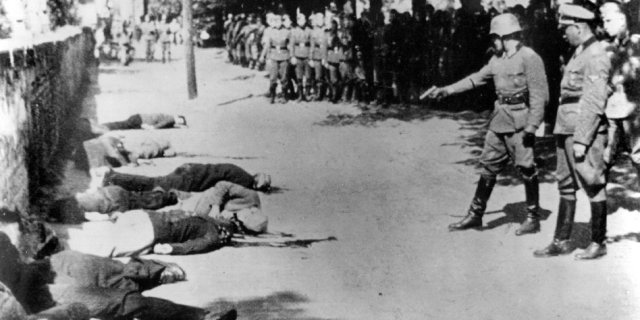
How about some Waffen-SS on the weekend, son?

Richard Iott is the Republican candidate for the 9th Congressional District in Ohio. He is also the father of a son and came up with an interesting idea for what to do with his son on weekends. As a “father-son bonding thing”, he was an active member for several years of a World War II re-enactment group.

But this American family did not wish to relive the storming of the beaches of Normandy or raise a flag on imagined Iwo Jima. No, they specifically played the part of 5th Panzer (“tank”) Division “Wiking” of the Waffen-SS.

The website of the re-enactment group “Wiking” is a prime example of falsification and trivialization of World War II history. It specifically “educates” about the foreign volunteers that the 5th Panzer Division was mainly made out of: “National Socialism was seen by many in Holland, Denmark, Norway, Finland, and other eastern European and Balkan countries as the protector of personal freedom and their very way of life. … Thousands upon thousands of valiant men died defending their respective countries in the name of a better tomorrow. We salute these idealists. … The front-line soldiers of the Waffen-SS (in particular the foreign volunteers) gave their lives for their loved ones and a basic desire to be free.” – Apparently, this group thinks that part of the authenticity of its re-enactment is the inclusion of pure Nazi propaganda.

Like the whole German military in the East, the “Wiking”-Division was active in the rounding up and the murder of Jews. It was part of the German effort to brutally rid Europe of all races they considered “subhuman”. It committed war crimes and contributed to the Holocaust, up until and including the death marches of 1945 with which the Nazis attempted to murder the last remaining inmates of the concentration camps.

Wehrmachtsausstellung

Will this be part of the re-enactment?

It is also not correct to claim that all foreign soldiers in the Waffen-SS were volunteers. Most came from countries that were under German occupation at the time, and many – including some prisoners of war – were forced to join. The International Military Tribunal at Nuremberg (with a significant and laudable contribution by Mr Iott’s home country) ruled that the Waffen-SS was a “criminal organisation” as a whole.

While I appreciate it if people show an interest in my country’s history, I suggest a visit to the Holocaust Memorial Museum in Washington as more appropriate for a “father-son bonding thing”. It might require more intellectual preparation, but you are sure to learn a lot and have a lot to think and talk about. And if you are so fanatical about Germany that you want an original German guide, Mr Iott, I’d be happy to give you and your son a tour.

Links:

Posted in Germany, History, Holocaust, Military, Politics, USA, World War II | Tagged , , , , , | 10 Comments

Nobel Peace Prize 2010 for Liu Xiaobo

Liu Xiaobo

The 2010 Nobel Peace Prize has been awarded to the Chinese writer Liu Xiaobo who is serving a prison term of 11 years for having signed Charter 08, a document that calls for political reforms and civil liberties.

More than enough has been and will be written about Liu Xiaobo, by far more competent writers, but I nonetheless want to share my initial first thoughts that came to mind after I heard of the Nobel Committee’s decision:

1. Finally a laureate again who really deserves the prize.

It was about time that this prize went again to somebody who is risking his freedom and his life in a peaceful struggle against a dictatorship, trying to achieve the most basic steps to democracy and human rights. Liu Xiaobo is exactly the man for whom the Nobel Peace Prize was created.

In recent years, the prize had become a bit of a joke in my eyes, having been awarded to 3 politicians in a row that serve or served in Western democratic countries. As valuable as the contributions of Al Gore, Martti Ahtisaari and Barack Obama may have been, none of them has suffered any hardship, risk to life or constraint of liberty for the work they did. The same is true for other Nobel laureates of the past decade, Kofi Annan, Jimmy Carter and Mohamed El-Baradei of whom you could say that they have merely been doing their (highly paid) jobs, or in the case of Jimmy Carter have simply been unable to come to terms with no longer being in office.

2. How to treat China?

Only days before the Nobel Committee’s announcement, German Chancellor Angela Merkel met Chinese Premier Wen Jiabao and agreed to “strengthen European-Chinese economic relations“.

The fate of Liu Xiaobo painfully reminds us: Any hope that we and people in China had that prosperity, growth and trade would somehow automatically lead to a more open society, to civil liberties and finally to democracy, has been crushed like a student underneath a Chinese tank. Conveniently for both sides, China’s leaders lied to the West about considering political reforms and Western politicians pretended to care about it. In reality, all they care about can be expressed in Euros, Dollars and Renminbi.

Our trade with China not only props up a Communist dictatorship, but because China in turn has very active trade relations with many other dictatorships in Asia and Africa, we indirectly prop up other regimes against which we purport to have sanctions in place. China is the hub through which we finance Iran, North Korea and Zimbabwe. If we want to use economic sanctions as leverage for our political goals (and I think we should), then China is the key.

(I wonder if this blog will fall prey to the Chinese internet censorship. If you can read this in China, please let us know!)

Posted in China, Human Rights, Politics | Tagged , , , , , | 9 Comments

No rape in marriage, says head of Islamic Sharia Council

Sheikh Maulana Abu Sayeed, president of the Islamic Sharia Council in Britain says that under Sharia law, there can be no rape in marriage “because sexual intercourse is part of the marriage”. That is clearly a repulsive view, because as much as sex may be part of a relationship or a marriage, the idea that one side can take it with force against his/her partner’s will is beyond what most couples would agree on. Surely this view will be refuted by other scholars of the Sharia, demonstrating what an ambiguous and unreliable set of “laws” the Sharia constitutes. (This will be the subject of another blog, and maybe one day of a more scholarly article.)

I wold however like to draw your attention to three other points:

1. Contrary to what the amount and volume of the debate about the influx of Sharia law in Britain would suggest, the Islamic Sharia Council is no court and does not have any legal authority. If couples approach this council, they do so voluntarily. The Sharia Council has no authority to force anybody to subject himself or herself to its proceedings.

2. Even the Sharia Council itself does not purport to have any authority regarding criminal law, although the question of rape within a marriage can admittedly become relevant in a divorce proceeding (over which the Sharia Council claims to have some kind of Islamic authority).

3. But most interestingly, especially from a comparative and historical aspect, is when other legal systems which we believe to be civilised, modern and respectful of women’s rights made rape within marriage a crime: In Britain, this was the case in 1991, in the United States between 1975 and 1993 (in the US, both criminal and family law is largely state law and can thus be different in some or all of the 50 states), Canada followed suit in 1992, Ireland in 1990, Germany embarrassingly late in 1997.
Interestingly, another country criminalised marital rape and based the relevant Supreme Court decision on religious law as well (Jewish, not Muslim in that case): Israel in 1980.

I am not saying that we should refrain from criticising Sharia advocates for their interpretation of Islamic law, but we have to be prepared to face some questions about why it took us so long to take the right steps. And as predominantly Muslim countries like Turkey (2005), Malaysia (2007) and Tunisia (2008) have made marital rape a crime, this might actually be one issue where the approximation of what could be seen as the consensus of Muslim thought is far less behind than in some other legal areas. Let us not forget that some non-Muslim countries like the Bahamas, Mongolia or Zambia still do not view rape of a wife by her husband as a crime.

Posted in Family Law, Islam, Law, Politics, UK | 2 Comments

UNESCO World Philosophy Day – why in Iran?

Since 2002, UNESCO is holding a World Philosophy Day each year in November. – That’s a nice idea because philosophy is much underrated in public debate.

This World Philosophy Day is hosted by a different country each year. – That’s fine because UNESCO is an organisation of the United Nations and philosophers can certainly learn from an international exchange.

This year, UNESCO has asked Iran to host the World Philosophy Congress. – Why on earth??

Persian/Iranian philosophy has undoubtedly contributed to debate and advancement of philosophy over the centuries. Unfortunately, since 1979 those Iranians who are continued to be interested in a free and open-minded debate of philosophy have to do this in the confines of their homes or in exile – or else risk persecution and prosecution, violence and torture, imprisonment and death at the hands of the Islamic Republic of Iran.
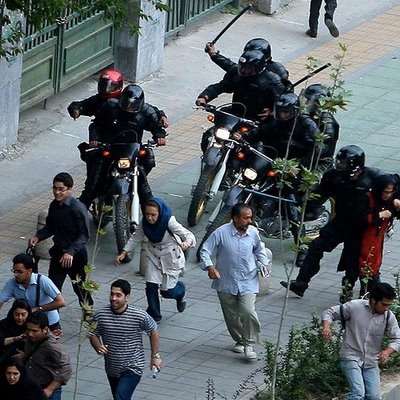
The Iranian government engaging in a lively debate with its citizens.

UNESCO says that philosophy provides the conceptual basis of principles and values on which world peace depends: democracy, human rights, justice, and equality. How on earth can UNESCO officials speak about world peace, democracy, human rights, justice and equality and then come up with Iran of all countries as the venue? A country that supports terrorist organisations in Gaza and Lebanon, a theocratic government that rigs elections, allows no free press, where people are being arrested, imprisoned, tortured and executed by hanging and stoning, a government clinging to power by shooting peaceful protesters in the streets, a society that does not extend the most basic freedoms to the female half of its population and where an inhumane interpretation of Islam governs daily life. UNESCO, you must have had a terribly narrow shortlist for this event.

I would love to attend the conference in November, to debate philosophy and to visit a country again that I have already visited twice and whose people, nature and history would offer enough fascinating inspiration. Only, I am a bit scared that this trip might end up similar to my last visit to Iran: That I will be kidnapped in the middle of the street by agents of the Intelligence Service, pushed into a car, blindfolded, taken to Evin prison and kept without any outside contact for a week in solitary confinement, only interrupted by aggressive interrogations.

But maybe that was the idea behind it: To give me a week without any interruption, without being distracted by chores like work or nuisances like phones and e-mail. Isn’t that perfect to ponder philosophy? And judging by all the people whom I have met who have been to prison in Iran, the level of debate would be quite high because this country is one where the smartest people are in prison while the most close-minded ones are running the country. – Unfortunately though, solitary confinement is not a good thing to get a discussion going. And concentration is neither helped by the screams and the weeping heard from neighbouring cells, nor by the constant fear of mistreatment and torture (which I was only spared because I was a foreigner).

I saw the Iranian government’s violent crackdown of absolutely peaceful protests myself. I witnessed the police brutality done to others and myself. I saw riot police charging into crowds with motorbikes. I saw police chasing bystanders into corners to beat them up with batons. – That makes one wonder how the Islamic Republic will react to debate of political philosophy, to the ides of Immanuel Kant, John Stuart Mill or Henry David Thoreau.

Asked if UNESCO believes that Iranian philosophers will be able to speak freely in Tehran, its spokesperson Sue Williams said, “We haven’t had any feedback suggesting that this will not be the case.” Well, the feedback you get depends of course on whom you ask.

UPDATE on 28 October 2010 on how Iran says “Thank You” to UNESCO. And on 9 November 2010, a happy UPDATE about UNESCO’s decision to cancel the events in Iran.
Posted in Iran, Philosophy, Politics | Tagged , , , , , , , , | 10 Comments

Don’t travel to Europe!

So say the US State Department and the UK Foreign Office in travel warnings issued because of terror alerts in October 2010.

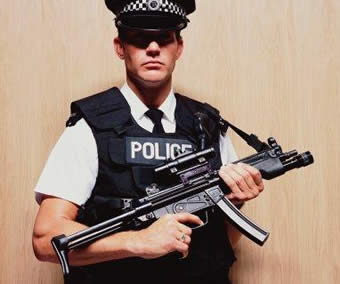
PoliceOfficerHoldingMachineGunJust having been to Germany a few weeks ago, I checked the Foreign Office’s travel warning about my home country: “There is a high threat from terrorism in Germany. Attacks could be indiscriminate.” The US State Department warns of the “potential for terrorist attacks in Europe”. This sounds dangerous indeed; more like a travel warning that I would expect for Mogadishu, Kabul or Baghdad.

But on second thought, it doesn’t sound dangerous. – It just sounds awfully vague. A threat in “Europe” with the “potential for terrorists to attack public transportation systems and other tourist infrastructure”. That can be pretty much anything, from the Metro in Paris, the tube in London to a bus in Berlin, a café in Marseille or a holiday apartment in the Alps.

By the way, even on days of terrorist attacks in Europe, fewer people die there violently than do on any given day in some cities in the US. Statistically it is safer to travel Europe (even with some terrorists lurking around) than to drive through New Orleans or Detroit.

I suggest a “terrorist threat template” that foreign offices around the world can use:

“The world is a dangerous place. There might be bad people somewhere, planning to do something bad at some place and some time against something or somebody. Please be warned that something terrible might happen to you, wherever you go. – And if it happens, don’t say that we didn’t warn you. Don’t hold us liable. And above all, be prepared that we might have to curtail civil liberties a bit more in order to avoid future terrorist attacks.”

Posted in Europe, Politics, Terrorism, Travel | Tagged | 9 Comments

New innovation from Iran: Islamic bikes

After its revolutionary space programme, sending a mouse, a turtle and a can of worms into space in February 2010, and after being set to uncover the secrets of nuclear fusion, Iran is continuing on its unstoppable path of innovation and progress.

Next are Islamic bikes. This new project is so special however that only women will benefit from it. Because as the deputy governor of Isfahan said: “Riding bicycle for women, if it is done to attract attention, is against Islamic law … But there are health benefits and we cannot only prohibit women from doing things … So we are designing biking provisions for women, such as specially designed bicycles.” I am curious to see the prototype…

The deputy governor Mr Mehdi Esmaeili also brought up the idea of “hidden and closed bike paths” especially for women. (This idea actually reminded me of the specially designated parking areas that we have for women in Germany, although I always thought that the reason for these is not segregation of the sexes but simply that they are wider so that it’s easier to park without denting your car.)

By the way, Mr Mehdi Esmaeili is right, women on bicycles can really be attractive. But with Iran’s strict dress code for women that forces them to cover their whole body from top to toe, I am not sure if being on a bike makes that much difference.

Posted in Iran, Islam, Politics, Technology | Tagged , | 1 Comment

Liebe Terroristinnen und Terroristen

Der Unsitte, “Mitbürgerinnen und Mitbürger”, “Studentinnen und Studenten” oder “Arbeitnehmerinnen und Arbeitnehmer” zu sagen, konnte ich mich schon aus sprachästhetischen Gründen nie anschließen. Ich fand es auch nicht notwendig, denn ich bin alt genug um mich an die Zeiten zu erinnen als sich meine Mitschülerinnen bei Ansprachen an die “lieben Schüler” nicht ausgegrenzt fühlten und als man bei der Bezeichnung “die Bürger dieses Landes” nicht fragte, ob da nicht versehentlich die Hälfte der Bevölkerung vergessen wurde.

Was mich aber wundert: Selbst die konsequentesten Vertreter(innen) dieser Sprachverkomplizierung und -verunstaltung wenden die weiblichen Suffixe nur im positiven Zusammenhang an. Noch nie habe ich von “Terroristinnen und Terroristen”, “Kinderschänderinnen und Kinderschändern” oder “Kriegverbrecherinnen und Kriegsverbrechern” gehört.

Wo bleibt denn da die sprachliche Gleichberechtigung?

“Und dabei haben wir uns so für die Gleichberechtigung eingesetzt.”

Posted in Language, Terrorism | Tagged | 3 Comments

Quotas for women – why only in boardrooms?

Both the UK and the EU are considering the implementation of quotas for women in corporate boardrooms, something that Norway already did in 2004.

This raises obvious questions which have been discussed many times before: What if not enough women apply? What if those who apply aren’t qualified? What if not enough women want to work in a certain sector or at one company? Isn’t it enough to provide equal chances in education? Is it really the government’s business whom I employ in my private company? Might quotas actually remove motivation for women?

But I always have another question when I hear the demand for quotas for women in boardrooms or in parliaments: If you want equality enforced by quotas, why not in ALL jobs? Why not quotas for women in slaughterhouses, garbage collection and infantry? Why not in coal mines and on fish trawlers?

As long as I don’t hear these demands voiced with the same vigour, I know these feminists don’t want equality. They want a fast lane for their own careers.

(Es gibt eine deutsche Version dieses Artikels.)

Posted in Economics, Law, Politics | Tagged , , | 18 Comments