
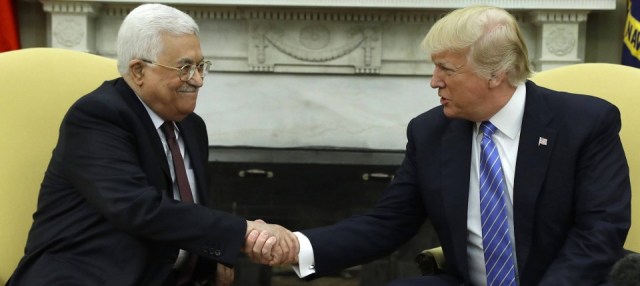
Abbas: Hey, Mr President, you know when I had my last election?
Trump: Um, um, I am not so good with history. I’ll have to ask Stephen.
Abbas: I’ll tell you. I was elected in 2005.
Trump: And you’re still in office now?
Abbas: Obviously.
Trump: Wow, that’s a loooong term, that’s yuuuuge. That’s like, um, um, a lot of years definitely.
Abbas: That’s 12 years – without another election! But you know what’s the best thing about it?
Trump: No.
Abbas: It’s unconstitutional. My original term was 4 years. Just like yours. *wink, wink*
Trump: How did you get around that?
Abbas: I simply cancelled the elections. You have to find some reason, of course, like terrorism or national security or some bla bla. But hey, what can people do? You’re the President!
Trump: Can you stay for lunch? I’d like you to meet some of my smarter guys and explain to them how you did it. I am really, really interested in this. Bigly.
Links:
- More politics.
- And more about Donald Trump.


 The Happy Hermit
Elect a clown, expect a circus.
Even joking about it sounds scary…
And many of my previous Trump jokes became reality far too soon.
Reblogged this on AirGap Anonymity Collective and commented:
“Real knowledge is to know the extent of one’s ignorance” and “Dunning-Kruger should cause people to reflect on themselves”.
Ever since Donald J. Trump was elected president, David Dunning’s phone has been ringing off the hook. Dunning, a social psychologist, is one of the lead authors of “Unskilled and Unaware of It: How Difficulties in Recognizing One’s Incompetence Lead to Inflated Self-Assessments,” an article in the Journal of Personality and Social Psychology based on the results of a study he and a student, Justin Kruger, conducted at Cornell in 1999.
As the title suggests, what they found was the existence of a cognitive bias in which the less able people are, the more likely they are to overestimate their abilities. Or as Dunning put it recently over the phone from the University of Michigan, where he now teaches:
“People don’t know what they don’t know.”
Only Donald Rumsfeld knew (partially) what he didn’t know.