
-
Recent Posts
-
Join 3,468 other subscribers
As you know, I am currently hiking on Easter Island.
Today, as I wanted to make siesta in the shadows of the stone statues, I spotted a familiar face.
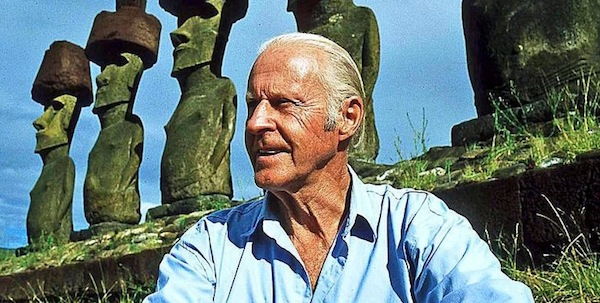
First, I thought it was some random man who happened to look like Joe Biden. But when I saw the six guys who were with him, all wearing the same khaki pants and blue shirts, I knew it was the US Vice President.
I didn’t want to disturb him, but when he noticed me staring, his grin became wider, he made a thumbs-up gesture and shouted “hey, how are you doing?” So I came closer and, trying to be funny, asked “Is this a campaign stop?”
“No man,” he laughed, “I am done with campaigning.” And then, more seriously: “If half the country wants a lunatic clown, who am I to stop them?”
We chatted a bit more about the election, but then sat down in the grass, unpacked our lunch boxes, and talked about life, from lawyer to lawyer, from old man to old man, and it ain’t nobody’s business what we talked about. But he’s a nice guy. I think people will miss him and President Obama rather sooner than later.
I have never seen a “George W. Bush Boulevard” or “George W. Bush Square” anywhere in the world. For some reason, he is not very popular anymore. I am not even sure if there is any “George W. Bush Street” in the US, except maybe in Texas.
But then I saw these signs just around the corner from my hotel in Tirana, the capital city of Albania: “George W. Bush Street”
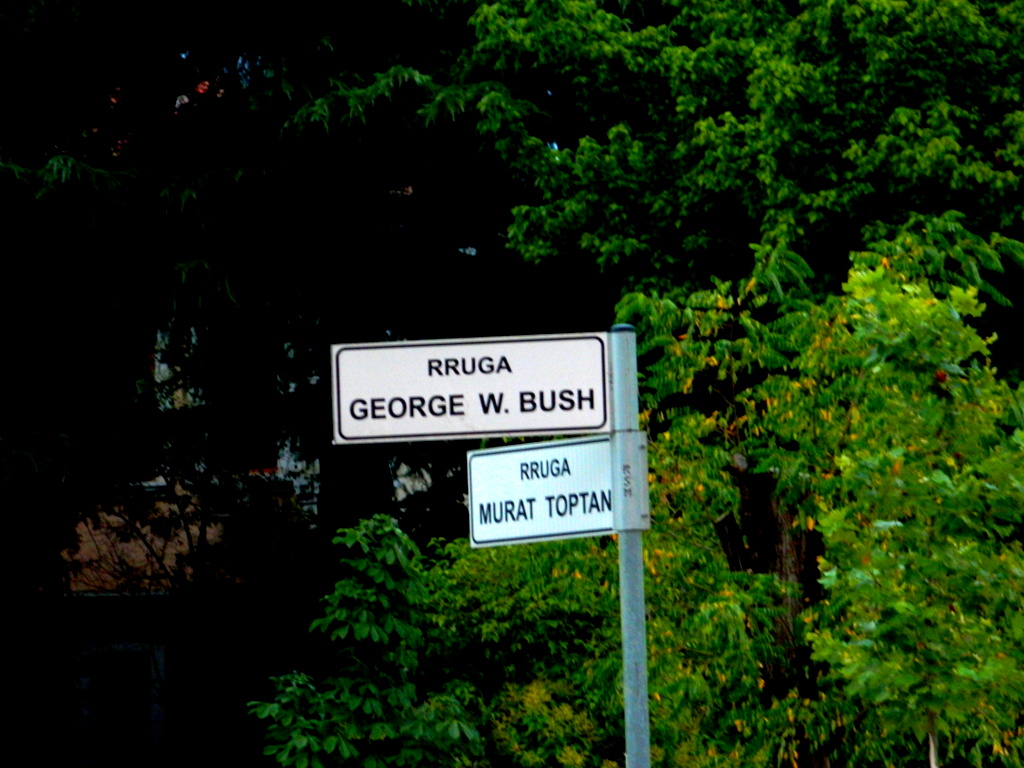

I wonder what American islamophobes will make of the fact that some of the most pro-American countries in Europe are those with a large Muslim majority (especially Albania and Kosovo).
Having heard about destiny, fate, premonition and other similarly unreal esoteric concepts the whole evening, I decided to give it a try.
I set out for a walk after leaving the bar, with no particular goal in mind, ready to be guided by the higher powers whose existence I had thus far denied.
After 30 minutes in the dark, fate had indeed led me to exactly the one house in the city to which the key – which had miraculously appeared in my pocket – fit. Even more miraculously, the apartment was empty, mine to take over. I did so, fully converted, for this was much more compelling evidence than anything that the believers had tried to produce. Never again shall I doubt the wisdom of the gods, destiny, the oracle and all the holy virgins and witches.
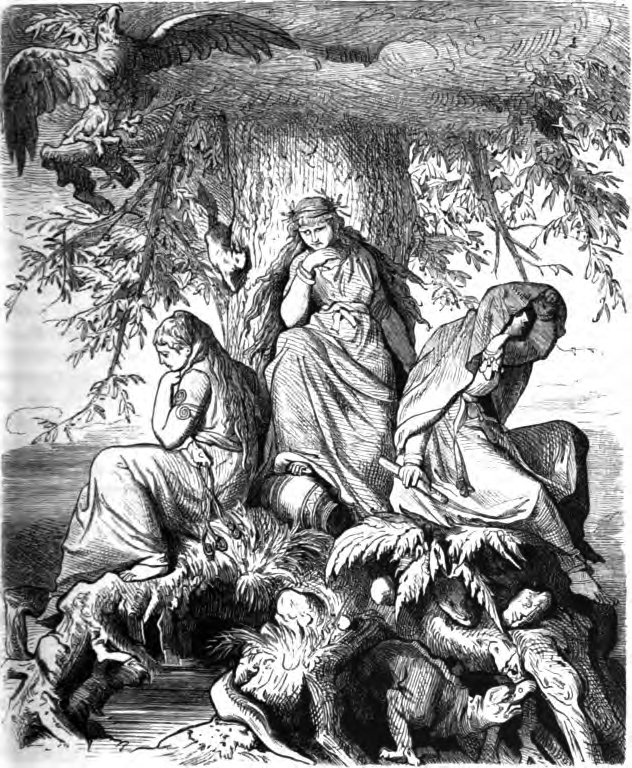
The Norns Urdr, Verdandi and Skuld controlling the destiny of all men, women, children and “Oh, look, there’s a squirrel!”
Preparing my trip to Easter Island, memories of Kon-Tiki leaped into my mind, one of the first travel/adventure books I read. Thor Heyerdahl and his crew did not sail to Easter Island in 1947, but further north, yet the underlying question if the islands of Polynesia were settled from Asia or from South America concerns all of the South Pacific.
Heyerdahl’s scientific methodology is outdated. Nowadays one would analyze DNA to reconstruct migration routes, instead of floating on a not very navigationable raft for a full 101 days through seas infested with sharks who’d love to eat a Scandinavian for change. But the Kon-Tiki expedition was definitely more thrilling. And the only way to make the general public aware of a debate which had until then only raged in academia.
The younger ones among you may only remember all this from the 2012 movie, which was a rather kitschy attempt to get a generation used to kitsch and action interested in the expedition.
If you think that the part about sharks and whales is over the top, here is a great cinematographic document for you: a film from the 1947 expedition.
Until now I hadn’t even known that the scientists/adventurers were also filming. Their material was made into a documentary which is endlessly more impressive than the recent movie. In 1952 it even won an Oscar.
Here’s the trailer:
To see the whole film, you do however have to visit the Kon-Tiki-Museum in Oslo. Fittingly, a taxi from Oslo train station to Bygdøy peninsula, where the museum is located, costs just as much as a flight to the Tuamotu archipelago.
In 1955, Thor Heyerdahl finally visited Easter Island, where he again advertised the hypothesis that the primary settlement came from South America. But he had some influence on Easter Island before. With the news of the successful Kon-Tiki expedition, it had become known that simple rafts were fit for long journeys if you caught the right current. When the Easter Islanders read about this in National Geographic, some of them built boats and used them to flee to Tahiti, a journey of 4,258 km.

(Photographed in Salvador, Brazil.)
Guinea pigs and cats. Seriously.
The first time I walked past a restaurant in Peru that advertised guinea pig, I disregarded it as one of those funny translation mistakes that sometimes sneak into menus like additives. But no, dear children, the animals that you have as pets at home and of whom you don’t notice when your parents replace them after they die, end up on the plate in Peru.
And not in any sanitized or genteel way, but with heads and hooves.


As you may see from the photos, this is no emergency meal for poor farmers stuck in the mountains. There are expensive restaurants offering this barbarity.
If the chef runs out of guinea pigs, he snatches a cat. “Why not a cow?” you are wondering, but you forget that in Hispanic countries, cows are needed for bullfights.
Because cats have a stronger lobby, they are at least hacked to unrecognizability and served like a goulash. Allegedly you can also find barbecued cat.

Admittedly, the cat food is limited in time and place. Each year in September there is the “Festival Comegato” in Cañete. Of course, like everything in Latin America, it serves to honor some virgin saint.
But the guinea pigs you can get anywhere and all year round.
Finally to something positive: rocoto relleno is, as I thought, stuffed pepper with melted cheese on top. It is pretty much the spiciest food I ever ate. Spicy, but good. Extremely good. It is also filled with meat, but at least you don’t recognize some cute legs or innocent eyes.

My assumption that this was bell pepper was confirmed by the same size, color and texture. The spiciness was due to some crazy spices, I guessed. So I went to the market to buy one kilogram of rocoto and prepared a salad with it, spicing it up lavishly with onions and pepper. Bell pepper alone might be healthy, but lame.
My mouth exploded! It was like eating fire. First, I thought that the onions had been damn spicy, but it was the bell pepper. Or rather the bell-peppery plant, which is fittingly called tree chili and which I as a European of course had never heard of before. During this research, I learned something else. You are aware of the problem that any debate about which food is more spicy suffers from subjective perceptions? Help is near in the form of the Scoville scale, which measures the pungency of peppers. Normal chillies have between 100 and 1000 Scoville points. A jalapeño, already the limit of what most people can bear, has between 3500 and 10,000 points. And the rocoto, which I cheerily snipped into my salad? Between 30,000 and 250,000.
If you ever get your hands on that vegetable, try it! Or even better, take it to some dinner party to innocently add to the salad. That’s gonna be a fun evening. But please hide your guinea pig when your Peruvian friends are coming over.
And now you have the 278th reason to visit Romania: Timișoara will be one of the European Capitals of Culture in 2021.
Although I lived in Romania for a year, I just noticed that I have no photos of Timișoara. I have only been to the city in Romania’s far west briefly on the way to and from Belgrade, always wanted to come back for longer, but never made it. Romania is much bigger than I had imagined. So I have a reason to return to Romania, too.
The first time I arrived in Timișoara was on a cold October day after a long and grueling bus ride. It rained without pause. I had to kill the afternoon until I could seek refuge with Elena, my Couchsurfing host for the night. All the streets in the Old Town had been dug up for some overdue repairs and still in the rain, I waded through mud, getting colder and colder by the hour.
And yet, I immediately liked the city. Timișoara was once Hungarian, Ottoman, Austrian, Serbian for a brief time and now of course Romanian. Some quarters of the town still have the Austrian names Josefstadt, Elisabethstadt or Freidorf. The Old Town is a typical Habsburg town, and long before it was crowned Capital of Culture, I remember a lot of book stores, galleries and an extensive theater program in Romanian, Hungarian and German.

Victory Square on the other hand is dominated by Romanian architecture, in particular by the Romanian-Orthodox Cathedral of the holy three Hierarchies with its fairy-tale-castle-like towers, the Chamber of Commerce and the National Theater.

Couchsurfing hosts are usually very friendly and helpful, but I really hadn’t expected the voluminous food package which Elena handed me the next morning. She had packed enough sandwiches, fruits and stuffed cabbage that I could eat during the whole train ride to Belgrade, could continue eating while sitting in a park there and could even give the rest of the food, which I couldn’t have possibly managed to devour that week, to a homeless man.
Two weeks later, on the train back from Belgrade to Timișoara, I met Tyler, a young man from Tennessee. He had worked hard for one year, had moved back in with his parents, didn’t party anymore, because he had wanted to save everything for a one-year trip around the world. Via Romania and Bulgaria his plan was to reach Istanbul, and he was very excited about Europe. “If I continue to have as much luck, I can even travel for three years. I spend far less than I had planned because there is always a girl who invites me to stay at her beach house for a few weeks,” he was amazed about continental hospitality, and I didn’t have the heart to tell him that this was mainly due to his striking likeness to Brad Pitt.
However, Tyler had too much confidence in the reliability of the Romanian railroad and thought that a planned stay of a few minutes in Timișoara would be enough to catch the night train to Bucharest. But the Romanian state railway CFR guarantees a minimum delay of 30% or 2 hours for each ride, depending on which is more. Because I didn’t want him to freeze to death at the train station and because I happened to have booked a hotel room with two beds, I simply invited my new friend to stay with me in exchange for an invitation to dinner (more stuffed cabbage). Then, I lay awake the whole night and regretted my hospitality because Tyler was snoring like a bear. But I digress into personal anecdotes when I actually wanted to write about Timișoara.
The choice is particularly deserved in my mind because Timișoara played a role in the fall of communism in Europe which has only been forgotten because so much else happened in 1989 that nobody could keep track. Maybe it was no accident that the Romanian revolution in December 1989 began in Timișoara. There, in the westernmost part of the country, one could receive the Yugoslav and Hungarian TV stations and the ethnic Hungarians and Serbs in Romania could understand the broadcasts. The ethnic Germans on the other hand were informed about the end of the GDR through family contacts with Germany. By that time, the Berlin Wall and the Iron Curtain in Hungary had already been opened. Thus, an overall image of the upheaval in Eastern Europe consolidated itself and motivated Romanians to get rid of the hated Ceaușescu couple. That however turned out to be a bloodier business than in all other European countries. The battles raged for ten days.
Maybe like no other city, Timișoara is thus suited to remind us of the progress made in the unification of Europe. 27 years ago there were civil war and massacres, only 9 years ago Romania joined the EU and now Timișoara is one of the cities with the lowest unemployment rate in Europe. Not only culture thrives here, but companies from all over the world are moving in and expanding. When I moved to Romania in 2014, I felt the boom myself, reflected in the real estate prices. I couldn’t find an affordable apartment in Timișoara and had to move to Târgu Mureș instead.
The other Capitals of Culture in 2021 will be yet-to-be determined cities in Greece and in Montenegro (I am rooting for Cetinje), which suggests that you go on a great Balkan tour. There is no reason however to wait another five years with that.
From Libertarian Party presidential candidate Gary Johnson:
If you take a “long-term view” of billions (!) of years on environmental problems, why bother about anything else then? Surely, when the sun is going to explode, it won’t ask us how balanced the budget is, how many people sit in prison and how high your SAT score is.
But for any future candidate, it’s good to know that “I don’t care” is now an acceptable stance. In the case of Gary Johnson, it goes hand in hand with “I don’t know”.
One year ago, I introduced a wonderful novel to you: Journey by Moonlight by Antal Szerb. Because I know that most of you disregard my advice and haven’t read the book, here are some of my favorite quotes:
Following a certain geographical pull, she travelled to Paris, as people often do when they have no hopes or plans but wish to start a new life.
Or more general:
Geography is my most potent aphrodisiac.
When Mihály decides not to return to his bourgeois life:
He knew that there was no going back. The whole horde of people and things pursuing him, the lost years and the entire middle-class establishment, fused in his visionary consciousness into a concrete, nightmarish shape. The very thought of his father’s firm was like a great steel bar raised to strike him.
And later:
His life would begin anew, not as it had been during all the wasted years. Incipit vita nova.
One of the problems Mihály has with a “career”:
You start off as Mr X, who happens to be an engineer, and sooner or later you’re just an engineer who happens to be called Mr X.
Waldheim, a scholar whom Mihály encounters in Rome gives this advice:
Anyone who isn’t actually stupid ought to study, in the interests of his soul’s salvation. It’s the only thing worth doing. […] To spend your time doing anything else, like working in a commercial company, for a man who isn’t totally stupid, I’ll tell you what that is: affectation.
I share this sentiment and always am more interested in learning new things than in applying the skills I already have, let alone the skills I definitely don’t have:
I could more easily become a Major-General than play the role of father. That’s one human quality I completely lack, amongst others. I can’t bear it when people depend on me, not even servants. That’s why I did everything on my own, as a boy. I hate responsibility and I always come to despise people who expect things from me.
When Mihály describes Waldheim, he introduces an interesting concept:
There’s a man who’s managed to stay fixed at the age that suits him. Everyone has one age that’s just right for him, that’s certain. There are people who remain children all their lives, and there are others who never cease to be awkward and absurd, who never find their place until suddenly they become splendid wise old men and women: they have come to their real age.
On the same subject:
“I know what’s wrong with me,” he told the doctor. “Acute nostalgia. I want to be young again. Is there a cure for that?”
Sometimes, I feel more like this:
“There is nothing wrong with you,” said the doctor, “just horrendous exhaustion. What were you doing, to get yourself so tired?”
“Me?” he asked, meditatively. “Nothing. Just living.” And he fell asleep again
The following quote will come in handy when you are tasked with writing the minutes of a meeting at work:
The discussion was becoming interminable. The matter could in fact have been resolved quite simply if all those around the table had been equally intelligent. But in this life that is rarely given.
Here’s a good description of my attitude which frustrates women in particular and makes relationships almost impossible:
He did not understand her since it never occurred to him that people other than himself had an inner life in which he might take an interest.
Waldheim on women:
Sometimes they really are almost human.
Why you better don’t insist on hugging me:
… and he was alone in that profound solitude that a man feels after he has embraced a woman with whom he has nothing in common.
On love:
For love, there has to be a distance across which the lovers can approach one another. The approach is of course just an illusion, because love in fact separates people.
Lastly, but most importantly:
An intelligent person doesn’t have a spiritual life.

 The Happy Hermit