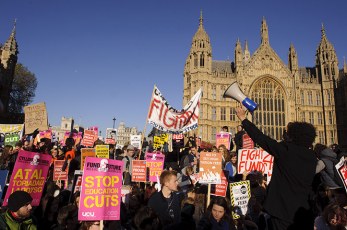
Ever since the UK government announced its plan to raise the cap of tuition fees that British universities are allowed to charge and to introduce changes in the student loan scheme, British students have filled the streets with protests,
"To pay? For education? No way!"
have gone on “strike” (whatever that is supposed to mean for a student) and have staged “sit-ins” at their universities. To no avail in the end, as the British parliament passed the amendments to higher education funding on 9 December 2010.
Although I am a student in the UK myself (of Philosophy and Economics), I have refused to participate in these protests, as it is not clear to me exactly what the students want. The are very outspoken about what they don’t want, but don’t seem to offer any alternatives.
Let’s examine the grievances in detail:
The increase of the cap from 3,290 £ to 9,000 £: An increase in the cap of what universities are allowed to charge for undergraduate degrees does NOT equal an increase in fees. It signals only a potential increase to anywhere between 3,290 £ and 9,000 £. When students (and indeed university staff and media) keep on speaking of a ” rise in tuition fees to 9,000 £ per year”, that is simply wrong. We don’t know yet if universities will make use of this higher cap and which universities will do so at what level. I assume that the more sought-after universities like Oxford, Cambridge and LSE will most likely raise their fees quite high. But I also assume that many other universities won’t do so. Even now, not every student can attend the university of his or her choice, not only for financial reasons, but simply because places are limited.
The burden of debt after graduation: Continuing with that error from argument # 1, students now always claim that everyone will graduate with a debt of 27,000 £. That is of course just as wrong. It might be that some students will have that debt-load upon graduation, but most students will have much less debt. And the new law actually increases the minimum salary that has to be attained before anything needs to be paid back from 15,000 £ to 21,000 £ per annum. Above this income threshold, repayment is capped at 9 % of the income. This is in fact a progressive graduate tax, which is only officially not a tax because then emigration from the UK would allow graduates to avoid the repayment. If part of the tuition fees still have not been paid back 30 years after the student’s graduation, his outstanding balance will be waived.
The deterrent effect on students from lower income families: Because fees will not necessarily be higher, depending on the university of your choice, and because repayment will only set in once you reach a certain income, I fail to see any deterrent effect. If at all, the deterrent effect is caused by the distorting propaganda of the protesting students about “mountains of debt”. Higher income for universities should actually lead to more available places in higher education which will benefit those who so far would not have had a chance to enter university.
As a student myself, I find it absolutely fair to pay for my education, as I will be the one who will reap the (intellectual and financial) benefits of it. I wouldn’t want people who never want or will become students to have to pay for my personal advancement with their taxes.
Last night, I attended a screening by the Birkbeck Law Society of the film “The Specialist” about the trial of Adolf Eichmann in an Israeli court in 1961. The film, by Israeli director Eyal Sivan, works with original footage from the trial, most of which had been televised, plus some technical tricks (which I found wholly unnecessary).
I found the film quite good as it showed some key points of Adolf Eichmann‘s testimony, the questioning by the prosecutor Gideon Hausner and by the three judges. It also included some very moving witness testimony by victims of the Holocaust, including one scene of a witness who enumerates all members of his family, his parents, uncles, aunts, grandparents, brothers, sisters, cousins, with their respective ages and upon the question who of his family is still alive today has to answer “I am the only one.”
When confronted with the evidence of the defendant’s role in the Holocaust, which was well documented due to the Nazis’ obsession with bureaucracy, protocols and reports, time and again Mr Eichmann replies “That is correct. I was following orders. I had to do it.” He still seemed proud of his “organizational talent” that he used for organizing the transports of millions of Jews (and other victims of the Nazis’ racist policies) to the concentration camps. Mr Eichmann didn’t even claim to not have known that he sent millions to their deaths, as he recounted four of his visits to concentration camps where he saw, and wrote reports about, how the killing was done. In some of his testimony, he still referred to Jews as “transport material”. When asked by the judges if he felt any remorse, Mr Eichmann responded “Remorse is pointless. Remorse is for children”. He clearly didn’t even attempt to win any sympathies.
Mr Eichmann’s only defense was that he was obeying orders. He in fact claimed that he didn’t like the nature of his job and had asked to be transferred (something which no documentary evidence exists about). He claims that he was a small part in a large machine and that he was bound by his oath to follow orders.
I found it shocking and disturbing to hear from one of the organizers of the Holocaust himself and to listen to his banal explanations of administrative responsibilities, showing flow-charts of intra-ministerial organisation. But listening to his voice and words, the story of a bureaucrat just following orders didn’t convince me. If even 16 years after the end of the Holocaust, you still cannot utter a word of remorse, and if all this time and the developments since have not forced you to rethink your past actions, then you were not only a cog in the wheel, but you were truly evil.
I applaud the film for showing this. Or applauded, I should maybe say. Because the subsequent discussion at the Birkbeck Law Society revealed to me that the film might not be too helpful if you don’t already know a lot of the facts and the background of the Eichmann trial. Thanks to an internship at the German Federal Agency for the Investigation of Nazi Crimes that I did as a law student, I have had the (at times horrifying) privilege of participating in the investigation of small parts of the Holocaust.
Here some points from the discussion at the Birkbeck Law Society:
Many participants dismissed the trial as a “show”, with the verdict known in advance.
Some even thought it worthwhile to discuss if Mr Eichmann was innocent.
Israel was criticised for violating international law.
Let me address these points (in more detail here than I could at the discussion):
It was a very fair trial. The defendant had defence lawyers of his own choosing, he could submit all the evidence that he wanted, his lawyers could cross-examine any witness (but regularly chose not to). The trial was not only interpreted in German, but the prosecutor and all three judges spoke German at times if they felt it was necessary. The judges were even surprisingly polite when questioning Mr Eichmann. I had the impression that they switched to German at times to get closer to the person of Mr Eichmann, to try to find out what drove such a man, what were his motives, his thoughts.
That people can watch this film and believe the “I was only following orders” defense shows that Mr Sivan might not have chosen the best scenes for his film (although I think he chose quite some powerful ones and I admit it is hard to make a 90 minute film of a trial that lasted 8 months). The film fails to mention some important points about Mr Eichmann: (a) He had joined a right-wing organisation in 1927 and became a member of the Nazi Party and the SS in 1932, one year before the Nazis came to power. (b) He volunteered to work for the SD of the SS in Berlin. (c) He set up the authorities responsible for the forced emigration of Jews from the Reich. (d) He was responsible for the rounding up of Jews from all of Europe and their transport to the concentration camp. He was the head of this department. (e) He was regularly visiting concentration camps and witnessed killings himself. (f) He personally attended the Wannsee Conference in 1942 at which the decision was made about how and where to execute the extinction of all Jews of Europe. As the person in charge of deportations and transport, it is unlikely that Mr Eichmann did not play a prominent role at this conference, which was attended by only 15 high-ranking officers and officials. (g) While living in Argentina, Mr Eichmann gave interviews to a former fellow SS member in which he stated “Had we killed 10.3 million Jews, then I would be satisfied and would say we have annihilated an enemy. […] I was not a normal subordinate, […] I was an idealist.” (h) He had the rank of a Lieutenant Colonel and thus was hardly a low-ranking bureaucrat.
International public law does not protect individuals, it protects the sovereignty of states. While the abduction of Mr Eichmann from Argentina did violate Argentina’s sovereignty, Argentina settled this issue with Israel later. The UN decided that Israel should be allowed to retain and prosecute Mr Eichmann. Germany, as his country of citizenship, did also not raise any objections.
Israel caught and tried Mr Eichmann because other countries refused to do so. Both Germany and the USA knew about Mr Eichmann’s fake identity and whereabouts since 1958 and failed to request extradition from Argentina.
Besides Adolf Eichmann, Israel only put one other (alleged) Nazi criminal on trial: John Demjanjuk who was first convicted, but then acquitted by the Israeli Supreme Court. This shows that trials even against Nazis in Israel were not show trials, but fair and thorough. Mr Demjanjuk is currently on trial in Germany for assisting in the murder of 27,900 people.
To those who represent legal positivism and therefore argue that Mr Eichmann was innocent because he did not break the laws of his country at the time, I would like to point out that most of the Holocaust happened in countries that had been attacked and occupied by Nazi-Germany against all international law, including in violation of treaties of non-aggression that Germany was a member to. So even if you think that positive law should be the decisive law (a view which I don’t subscribe to because it reduces law to just another tool of the exercise of power), you can still come to the conclusion of Mr Eichmann’s (and other Nazis’) guilt.
I guess one should neither judge the Holocaust by one trial, nor a trial by one film about it. For those with more time, the full transcripts and even the complete video footage of the Eichmann trial are available online.
As I am studying Philosophy, I couldn’t resist to share this study that analyses the mathematical and verbal aptitudes of students in different courses and reaches – inter alia – the following conclusion: “Philosophers are the smartest humanists, physicists the smartest scientists, economists the smartest social scientists.”
I hope I will be able to live up to these high expectations. And no, I don’t see any chance of me studying Physics next. Economics maybe.
Well, now we know how Iran’s sports administration has handled a similar case: An Iranian weightlifter, Hossein Khodadadi was banned from the sport for life for standing next to an Israeli athlete during the playing of the Israeli national anthem. At the World Masters Weightlifting Championships held in Poland, Mr Khodadadi scored the second place behind Israeli weightlifter Sergio Britva. As the respective silver and gold medal winners (bronze went to Germany) Mr Khodadadi and Mr Britva stood next to each other on the podium.
As you see in the video below [or rather on YouTube because I don’t know how to properly embed a video], Mr Khodadadi was clearly puzzled when the Israeli sportsman reached out his hand to congratulate him. He decided to refuse the handshake, but indicated a brief salute and remained standing for Israel’s national anthem, Hatikvah. No blame from my part for Mr Khodadadi personally, who surely knew that he was facing some tough questions upon returning home.
And the questions came indeed: Several Iranian media reported that this was the first time since 1979 that an Iranian athlete had directly competed against an Israeli. Mr Khodadadi had to point out that he had attended the ceremony in civilian attire and with flip-flops instead of the official dress, and that he only did not withdraw himself from the ceremony because otherwise the Iranian team would have forfeited all its medals.
Still, Mr Khodadadi and Mir Rasool Raisi, the head of the Iranian weightlifting team were subsequently banned by the Iranian government from all sport activities for life.
How sad is it that the Iranian regime’s zealous anti-Israel stance goes so far as to deny the basic principles of sportsmanship and to not only disrespect other countries’ athletes but to even punish its own? I don’t think Mr Britva would have had any problem, had Mr Khodadadi won.
This is a Christmas blog I wrote several years ago. I guess I have become calmer in the meantime. I still don’t like Christmas, but now I just ignore it. So, I wouldn’t write any longer what you will read below, definitely not in these harsh words. But some of the thoughts are still valid.
Why I hate Christmas
Yes, I actually hate it.
I would prefer to simply ignore it, because I usually respect everybody’s way of life and everybody’s ideas. But unfortunately, all these Christmas-junkies are making it impossible for me to ignore it: Wherever I go, whomever I meet, in every e-mail I read, it mentions something like “Merry Christmas”.
The problem is: I don’t believe in it. I am neither a Christian, nor do I believe in any other hokus-pokus-God-persons who allegedly let their children die brutally to make a point.
So, my natural response is: “Thank you, but I don’t believe in Christmas.” – Honest, but still polite, wouldn’t you think? – Hell NO, people look at me as if I was a terrorist! As if I was advocating the end of civilization.
Usually, I am then requested to justify my non-belief, which I find very silly, because one would assume that whoever strongly believes that a child was born without its Mom having been banged by her boyfriend, is the one who has to justify their very silly beliefs.
But anyway, I do not want to discuss religion today. After all, it’s a belief and not a science. BUT I want to be left alone with it, PLEASE! Please go to your churches and celebrate it. Sing and praise the lord (for whatever?) in your home. Do it all day long if you have nothing useful to do, like going to school, having a job, or educating yourself.
But leave the rest of us alone!
– Why do I have to listen to these ugly songs everywhere?
They make me puke!
– Why do I continue to get Christmas cards and greetings although I am open about my atheist attitude?
Don’t you feel bad that you can’t even call me or write me without using a silly festival of an obscure religion as a pretense?
– Why are you lighting everything up as if you wanted to attract aliens from far-away galaxies?
What a waste of energy. And even the last farmer in the farthest forest should have heard about energy conservation.
– Why is everybody in such a rush to buy presents?
We all know why: Because you suckers feel guilty because somebody else is giving you something and you think you ought to hand out bribes in return. Most presents are then thrown away or idly sit there, because the recipient doesn’t know what to do with it because he didn’t ask for it in the first place.
Just stop the shopping frenzy and buy something useful for YOURSELF. You’ll have much more fun. AND you don’t need to do it between mid-December and 24th December. The stores are open in March and July as well!
– Why do you cut Christmas trees to throw them away after two weeks?
Ok, I understand: It’s that old tradition of sacrificing life to please your Gods. Well, THANK YOU that you have at least come so far that you don’t do it with virgins and children anymore.
– Why do you allow pedophiles to play with your children just because they dress in red and put on a fake beard so as not to be recognized by law enforcement?
Oh, I forgot: Molesting children has some tradition in the church…
As I said, I see it a bit more relaxed now, in line with my general liberal world-view. I even accept presents now and have put together a wishlist for you. :-)
Neda Agha-Soltan after being shot by Iranian police/paramilitary at a protest on 20 June 2009.
The documentary “For Neda” about the life and death of Iranian protester Neda Agha-Soltan, which I had the honour to play a small role in, won the Foreign Press Association Media Award 2010 in the category of TV feature/documentary. The two producers Antony Thomas and Saeed Kamali Dehghan also won the prize as Journalists of the Year.
Congratulations and thanks again for including me in the film!
What, WikiLeaks? The attacks on Iranian nuclear scientists? The hijackings of 11 September 2001? Pearl Harbour? Global warming?
No. This time, it is something far more sinister that Israel’s intelligence agency Mossad is accused of: The Egyptian coast on the Red Sea has been plagued by shark attacks. In
How would authorities around the world react? They’d be concerned for swimmers’ and divers’ safety, they would close off beaches, they would go on boat patrols, they would maybe hunt for sharks (although that aggressive approach might be an over-reaction from an ecological point of view). – Not so in Egypt where the first instinct in any crisis is to resort to anti-Israeli reflexes: The governor of South Sinai, Muhammad Abdel Fadil Shousha, is quoted as saying: “What is being said about the Mossad throwing the deadly shark [in the sea] to hit tourism in Egypt is not out of the question, but it needs time to confirm.”
It speaks volumes about Egyptian society when government officials can utter such obvious nonsense and hope to find sympathetic listeners. The ludicrous theory was promptly spread by Egyptian state television. – Nobody seems to have taken into account that Israel has no interested in harming Egyptian tourism (many Israelis holiday in Sinai), that Israel shares the Red Sea coast at Eilat and would thus be exposed to the same sharks, and that the main threat to tourism is Egyptian home-grown terrorism.
To put this silly episode into a more serious context, it is symptomatic of Arab and/or Muslim anti-Israeli reflexes that I assume stem from a deeply rooted inferiority complex. Israel’s neighbours just cannot come to terms with the fact that this small country with a population of only 7 million and no natural resources has one of the most successful economies in the Middle East and a science record that would make anyone proud, and all of this while being surrounded by hostile countries that have repeatedly attacked Israel. – If Egyptians concentrate on anti-Semitic conspiracy theories instead of education and science, it will be centuries, not decades until they catch up.
“I was surprised that other countries even dared to compete with us. I hope they won’t repeat that mistake in 2018.”
Although I live in England, I am actually not sad about this country missing out on the opportunity to host another Football World Cup. Living in London, I am already annoyed with the daily dose of tourists, and I am dreading the prospects of the Olympics coming to town in 2 years. I certainly don’t need another global event that hikes up prices and overburdens public transport. I am also not convinced that host countries benefit economically from events like the World Cup or the Olympics.
But I was still a bit surprised by FIFA’s choice of Russia and Qatar as the two countries to host the Football World Cups in 2018 and 2022 respectively:
The candidates for 2018 were England, the Netherlands and Belgium with a joint bid, Spain and Portugal with a joint bid, and Russia. Five countries that are stable, peaceful democracies where the world could feel welcome in open societies with respect for human rights – and one country that is an autocracy at best and a mafia state at worst, where independent journalists routinely are targets of assassinations, where Stalinism is glorified, and a country that was engaged in a war with a neighbouring country just two years ago.
Given this choice, FIFA decided that Russia was the best place to do business to play football.
As if that had not been provocative enough, FIFA also already made the decision for the
“What did we win?”
2022 World Cup: Contestants were Australia, the USA, South Korea, Japan and Qatar. Four modern democracies with equal rights for their citizens – and one emirate without elections, where political parties are banned and members of “parliament” are all appointed by the Emir (who is not accountable to anyone). In February of this year, Qatar entered into a defence cooperation with Iran.
A tough choice, but FIFA thought that Qatar was the safest place to hide from an inquisitive press looking into FIFA corruption to play football.
Looking for a pattern here, this is what you have to consider if you are thinking of competing for the 2026 World Cup:
The less freedom, the better.
The more natural resources, the better.
The less democracy, the better.
The more authoritarian rule, the better.
The less freedom of speech, the better. (In the Press Freedom Index, Qatar is number 121 and Russia number 140, compared with an average of 23 among the competitor nations.)
Experience of football is irrelevant.
Sepp Blatter must be dreaming of an oil-rich country ruled by Nazis… But for 2026, maybe Iran or Zimbabwe will do.
When WikiLeaks announced last week that it would release hitherto secret communication between the US State Department and US embassies around the world, the levels of curiosity and anxiety were equally high. Overall though, the revelations might have bruised some egos and will certainly lead to more careful conversations at the next dinner parties, but we can’t say that the diplomatic world is in shock or that irreparable harm has been done.
So far, I have inferred three lessons:
Diplomats have far too much time on their hands and are too interested in tabloid-level gossip for my liking.
Everyone would have expected opinions of diplomats about other people to differ from what they tell foreign dignitaries face-to-face. This is standard human behaviour. Insofar, the leaked documents are not as shocking as anticipated, but they can serve as an indicator about which countries say the same in public as behind closed doors and which countries try to use different strategies, one for their own population and one for their allies.
Using this indicator, it becomes clear that Israel has the most honest and open foreign policy, while most Arab states are quite dishonest with their own people. A lesson that should be kept in mind for future Middle East negotiations.
Let me elaborate on the second and third point a bit: It becomes clear from the US embassy cables that the main concern of most states in the Middle East is being posed by the Iranian nuclear programme.
Let’s first examine Israel:
Israel is the country that has most consistently been warning of the dangers of the Iranian nuclear programme, not only to itself but also to the whole Middle East.
Israeli politicians, officials, journalists and academics have made these warnings in public, in speeches, and in writing. They have backed up these warnings by disclosing and sharing as much intelligence about the Iranian nuclear programme as is possible.
What do the WikiLeaks cables reveal about what Israeli government officials said in private, behind closed doors, in secret? – They said exactly the same. No discrepancy here.
Let us not forget that Israel has been accused because of these constant warnings as “alarmist” and as trying to divert attention from its own problems.
And then let’s have a look at the Arab states:
Arab leaders consistently lambast Israel for being an obstacle to peace and stability in the Middle East. They hold speeches and organise rallies against the Jewish state and are not even above playing on anti-semitic sentiments.
In public, that is; we have to add now. Because on this subject, WikiLeaks has indeed brought quite some revelations:
King Abdullah wants to “cut the head of the snake” but ends up holding hands.
The Crown prince of Abu Dhabi said “[Iranian President] Ahmadinejad is Hitler”, warning against appeasement with Iran. He said that “all hell will break loose” if Iran would attain nuclear weapons.
King Hamad of Bahrain called for the Iranian nuclear programme to be stopped.
Major-General al-Assar of Egypt said that his country “views Iran as a threat to the region”.
Has any of the Arab leaders told this to their own people? No. Politically, to be anti-Israel is to be on the safe side.
The Israeli newspaper Haaretz summed up the WikiLeaks with a nice headline: “Everybody hates Iran“. My own summary will attempt to be a bit more differentiated:
Most states in the Middle East agree with Israel on the subject of Iran’s nuclear programme.
None of them will admit this in public, which is a shame because it shows that Arab leaders are no leaders, they are either cowards or liars. Or is it their anti-semitic reflex?
Israel is the only country in the Middle East with an open and honest foreign policy that says exactly the same in public as behind closed doors.
Arab leaders prefer to lie to their own people.
If anyone is pushing for an attack on Iran, it is neither the US nor Israel. The vociferous demands for military action are coming from Iran’s Arab neighbours.
Israel seems to be the only country that has a coherent strategy towards Iran, consisting of “five pillars“: political approach, covert measures, counter-proliferation, sanctions and forcing a regime change. – Note that these options do not include a military strike.
In contrast to this strategy, the Arabs’ calls “to cut the head of the snake” appear extremely simple-minded.
On top of that, Arab states have not offered any military support themselves. It seems likely they would be happy to see the US (and possibly Israel) take care of Iran, while they would officially pretend to be outraged by “Western and Zionist imperialism”.
Durch das Leben in einer weltoffenen und multikulturellen Stadt wie London bin ich vielleicht etwas verwöhnt was den Umgang mit Minderheiten angeht, aber was ich diese Woche aus meiner deutschen Heimat vernehmen mußte, machte mich wirklich fassungslos:
Terrorgefahr?
Berlins Innensenator Ehrhart Körting weiß im ständigen Terrorkampf nicht mehr weiter und hat daher die alte Blockwart-Idee reaktiviert. Wörtlich sagte er: “Wenn wir in der Nachbarschaft irgendetwas wahrnehmen, dass da plötzlich drei etwas seltsam aussehende Menschen eingezogen sind, die sich nie blicken lassen oder ähnlich, und die nur Arabisch oder eine Fremdsprache sprechen, die wir nicht verstehen, dann sollte man glaube ich schon mal gucken, dass man die Behörden unterrichtet, was da los ist.”
An die ständige staatliche Panikmache mit Terrorwarnungen hat man sich ja schon gewöhnt. Ebenso leider an einen gewissen Level an Rassismus, der nicht zu tilgen ist. – Aber daß ein Innenminister die Furcht vor Terrorismus mit rassistischen Vorurteilen gegenüber einer Bevölkerungsgruppe in Zusammenhang bringt, das ist neu. Es ist volksverhetzend. Und es ist dumm und gefährlich:
Die meisten Deutschen können Arabisch nicht von Türkisch oder Suaheli oder Hebräisch unterscheiden.
Was bedeutet “seltsam aussehend”? Die am seltsamsten aussehenden Menschen in Deutschland sind in meinen Augen trachtentragenden Bayern.
Sind das die "seltsam aussehenden" Verdächtigen?
Und warum sollte es verdächtig sein, wenn ich mich “nie blicken lasse”? Ich z.B. lasse mich nicht oft blicken, weil ich viel zu tun habe und weil es nicht genug interessante Mitmenschen gibt, mit denen sich eine Unterhaltung lohnen würde. Das macht mich vielleicht zu einem eigenbrötlerischen Sonderling, sollte mich aber nicht unter Terrorismusverdacht stellen.
Wenn man eine Sprache nicht versteht, wie soll man denn die Behörden davon informieren “was da los ist”?
Wenn die Sicherheitsbehörden nun schon auf “Informationen” von Großmüttern über ihre Nachbarn hoffen müssen, dann können die Chancen auf wirkliche Aufklärung von Terrorismus nur aussichtslos sein.
Terrristen wissen jetzt, daß sie nur öfter in den Biergarten gehen und sich dort auf Englisch oder Deutsch unterhalten müssen, um vor Entdeckung sicher zu sein.
Eine Bevölkerungsgruppe unter Generalverdacht zu stellen, ist nicht dazu angetan, aus dieser Gruppe Hinweise an die Sicherheitsbehörden zu erhalten. Diese Hinweise wären aber womöglich die wertvollsten.
Gegen so einen Unsinn hilft nur der zivile Ungehorsam in Form massenhafter gegenseitiger Verdächtigungen unter Berufung auf Herrn Körting. Wenn der Polizeistaat alles wissen will, soll er die Informationen erhalten. Und dadurch hoffentlich lahmgelegt werden.



 Israeli weightlifter Sergio Britva. As the respective silver and gold medal winners (bronze went to Germany) Mr Khodadadi and Mr Britva stood next to each other on the podium.


 The Happy Hermit