Now I know why the Transfăgărășan is closed in winter.

Now I know why the Transfăgărășan is closed in winter.
Horses are tough. At least in Lithuania, where they have to live in the snow for half of the year.
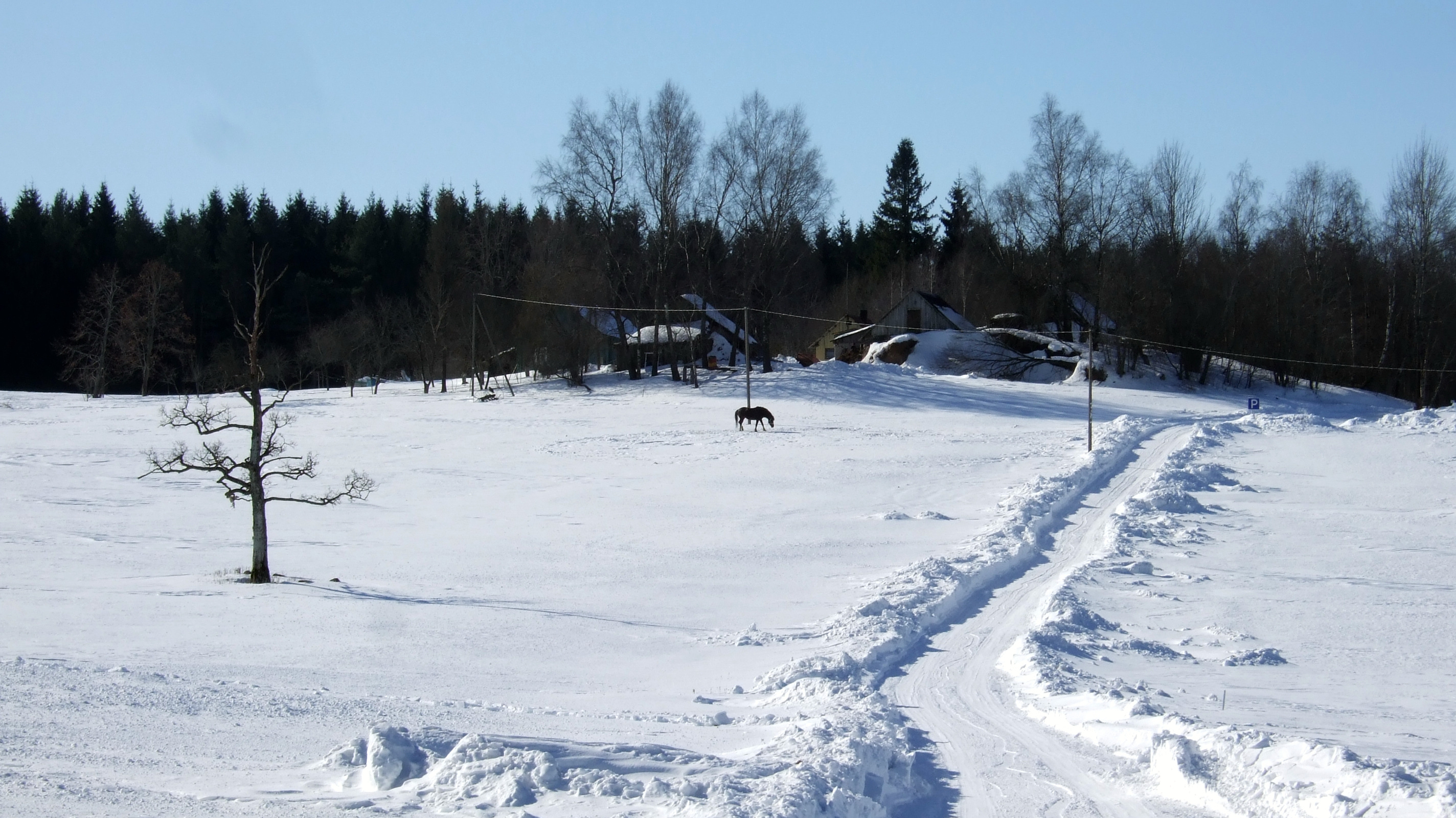


(Photographed during my hike to Lithuania’s highest mountain.)
Zur deutschen Fassung dieses Artikels.
Boyan Stoyanov is a mountaineer from Bulgaria who is on a mission to climb the highest mountain in each European country. This includes tough nuts like Mont Blanc, Triglav or Elbrus. Luckily, Boyan visited me when I lived in Lithuania. The highest point of the country is less than 300 meters/1,000 feet high. For that, I am ready.
It is 18 March 2013. It has been snowing almost every day for four months, the temperatures never went above zero (32° Fahrenheit). It looks accordingly white and winterly when we take a minibus from Vilnius towards the east. The villages are getting smaller, the snow is getting deeper and the bus is getting emptier.
We stay on all the way to Medininkai, the last village before the border to Belarus. Here, the European Union and the Schengen area come to an end. If there is any remnant of the Iron Curtain anywhere in Europe, then it is 2 km (1.2 miles) from here. Freedom on this side, Europe’s last dictatorship on the other side. F-16 fighter jets of the Danish Air Force patrol the skies. Lithuania has only one light attack aircraft, so the NATO partners intervene supportingly.
Not a single cloud roils the blue sky. The sun is mirrored in ice and snow. Picture-perfect weather. When you turn the face directly towards the sun, you can even bear the temperatures of minus 10 degrees (14° Fahrenheit). Nobody is out in the streets. Medininkai only has a population of 500, no mountain tourism has evolved yet.
Shortly after we leave the village, a sign points the way: 2 km (1.2 miles) to Aukštojo kalnas, 1 km (0.6 miles) to Juozapinės kalnas. “Kalnas” is the Lithuanian word for mountain and for hill. The further course of the expedition will reveal why this language, despite being more than 1,000 years old, is content with a single word for geographic elevations of different characteristics.
 So we will be able to climb two peaks just one kilometer (less than a mile) apart. We already spotted the first mountain, Juozapinės:
 “What mountain?” I hear the disappointed readers exclaim. But take a close look and you will recognize a wooden cross on the summit. Only a few minutes later we are already at the foot of the mountain. Here it is, in all its majestic size:

I could attempt to counter the noticeable disappointment by pointing out that this one is not the highest mountain in Lithuania. But in all honesty I would need to add that Juozapinės was considered to be Lithuanian’s highest mountain until 2004, before it was relegated to second place.
Boyan and me try to take our time with the ascent to get at least a bit of a mountaineering feeling, but for a Bulgarian and a Bavarian what we see in front of us is not more than a field which is slightly higher than the surrounding fields. Where we come from, only sledding children would call this a hill.
 To prevent the summit from being overlooked by those riding their horses across the fields, a heavy stone was rolled up and one of these totem poles which one sees everywhere in Lithuania was driven into the ground.
 From this elevated position, we finally see Aukštojas, the highest point of Lithuania. Some extra boost was provided by an over-sized hunting stand.

So this is our destination. We face a long and arduous ascent. Time to recapitulate the history of these two competing mountains. Since the beginning of time, Juozapinės was regarded as the highest point in Lithuania, until 1985 (when it was still the Soviet Union!) the geographer Rimantas Krupickas bravely dared to register doubts. Academic disputes between the geographic faculties of the universities in Lithuania ensued. At the University of Vilnius the Aukštojas faction was formed, while the majority of the surveying colleagues in Kaunas remained steadfast in their loyalty to Juozapinė. Seminars were organized, Master and doctoral theses were written, articles were published in scientific journals. The argument escalated so much that the Soviet Commission for Mountain Geography wanted to step in, but then the USSR broke up and Lithuania became independent in 1991.
With independence came progress and with progress came GPS. In 2004 a new field survey was carried out, and Aukštojas narrowly emerged as the victor. Students of geography saw themselves robbed of a fruitful subject and had to turn back to the Curonian Spit. But now the philologists appeared on the scene because the hill later known as Aukštojas didn’t have any name back then. After all, it was not yet a mountain, but a nobody, a nameless spot at the edge of the wood. A contest was proclaimed for the name of the newly discovered point, on which the pride of the nation would henceforth focus. Again academics debated, researched, argued and published. The winner of this contest was Libertas Klimka, professor of history at the Pedagogical University of Vilnius, whose proposal Aukštojas is derived from Aukštėjas, who is something like the Lithuanian Zeus. Lithuania was the last country in Europe to become christianized and which caught a crusade due to its slow conversion. Pagan cults are still widespread, as you can see from the woodcarving on the totem pole above. But I digress.
Aukštojas also received a heavy stone, of course.
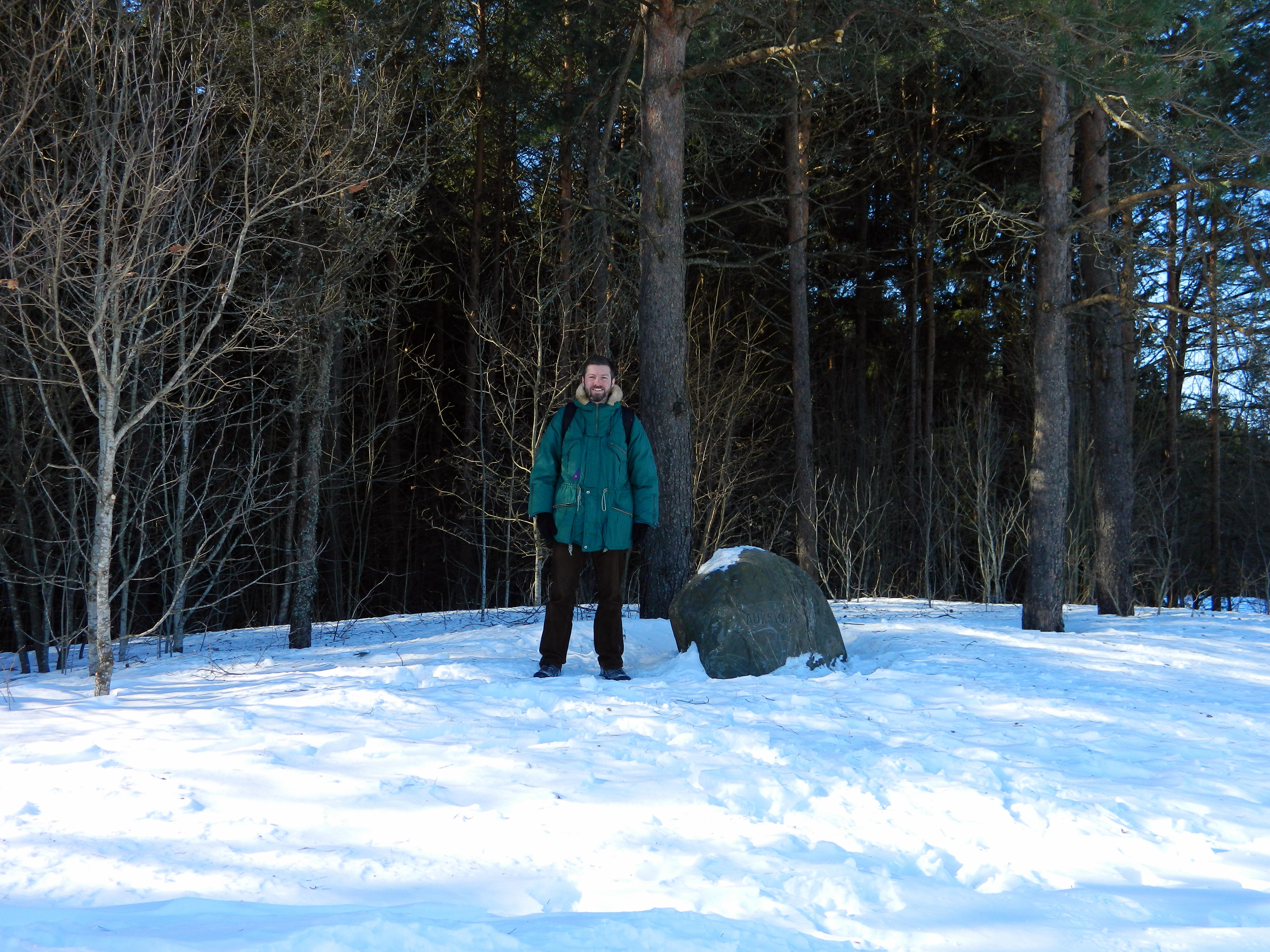
And the tower. Climbing it took almost as long as climbing the whole mountain, which it adorns. Finally we get out the thermos flask with tea and the chocolate cookies. We are only modestly hungry, and even that little bit of hunger was probably built up more during the bus ride than during the short walk.
 The look-out creates a distorted perception because from up there one looks down on Juozapinės like from the Matterhorn towards Zermatt.

But now I cannot postpone telling you the solution to the greatest geographical mystery of modern times. The curious reader has already prepared pen and paper to note down the exact altitude of the much discussed hills.
It is suggested that you take a seat before daring to glance at the values gained with the help of the most current scientific methods:
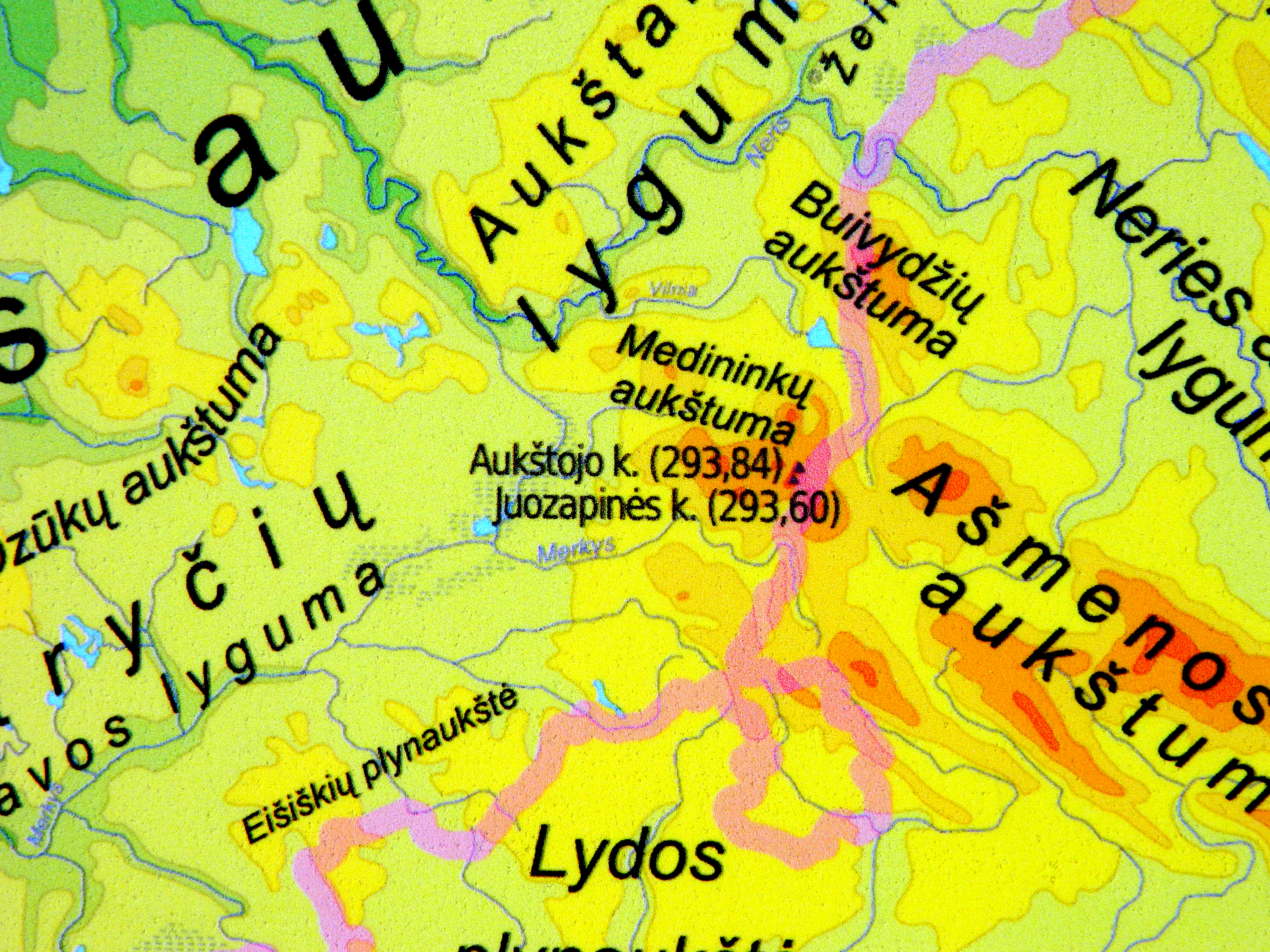
293.84 meters (964 feet 0.5 inches) beats 293.60 meters (963 feet 3 inches), but a difference in height of 24 cm (9.45 inches) makes the long-lasting discussions appear as ridiculous as your traveling reporter has tried to portray them. Twenty-four centimeters! Less than ten inches! In Nepal or in Switzerland nobody knows the decimal points of their highest mountains even. Twenty-four centimeters, that is less than the altitude gained if you take a book from a shelf and place it on the next shelf above. If one of the mountains grows a mohawk (after all, the totem pole is already in place), puts on a hat or wakes up one morning with something which I am too decent to mention, then the ranking has to be rewritten again.
Links:
Climate change is the no. 1 issue on the agenda of the World Economic Forum 2015 in Davos, Switzerland.
 The discussions about our planet will be led by people who are coming to Switzerland from all around the world. 1,700 private jets are expected.
 A further subject is the divide between poor and rich. Well, with so many speakers with private jets, that question surely is in the right hands!
Here is the simplified explanation:
 Well, at least it did work in Tunisia.
After my Balkan trip last October, I wrote down the following lessons that I had learnt during those two weeks. Here you can read my original plan for Romania, Serbia, Montenegro and Albania. Unfortunately, in the end I didn’t have time for Albania, but more on that below. I just remembered these notes as I am preparing a trip to Israel in March 2015.
Everyone travels differently, so these are not universal lessons. I do not wish to “teach” anything except that the world is a big, beautiful and exciting place and that you should experience it and that any fears which you might have are probably unjustified. Instead, I am putting out these personal lessons to open up a debate.
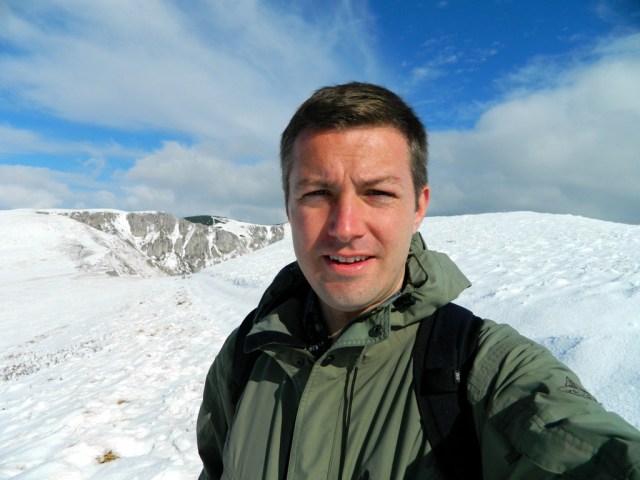
People warned me against going into the mountains in winter. Nobody would have joined me. I got lost and stuck in the snow. I was freezing and wet as I descended. – It was one of the best days!
Now I am curious to read what you learnt on your last trips!
If stuff like this keeps happening, how am I supposed to get settled in a place?
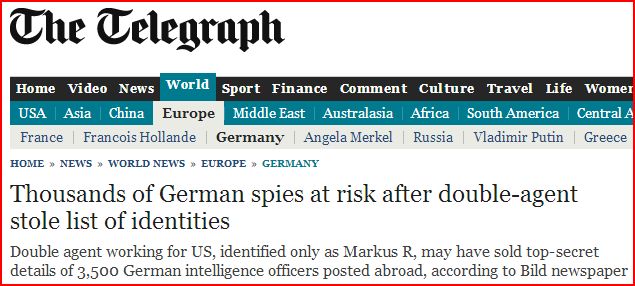
Which idiot had the idea to comprise one list of all foreign agents? With their real and their cover names even. “Does anyone want the key to the apartment where the money is?” Ostap Bender from the novel Twelve Chairs and the FSB colleagues, who like all Russians have read that book, would ask.
Just because a bureaucrat had a boring day and wanted to set up an Excel spreadsheet, people’s lives are now in danger. And these are not any people, these are heroes who put their lives on the line for your our security.
Experts will remember that this – a stolen list of all foreign agents – was also how the James Bond film Skyfall began.
By the way, if my name would somehow be on that list due to a stupid coincidence, I refer you to the press reports, according to which the list was rather outdated and also contains retired spies. So there is no reason to over-react and arrest me (again)! If you will see me in the streets of Marrakesh, Odessa or Kathmandu in the next months, it might still be saver to ignore me.
Ok, I have to pack my bag now.
I already described and documented photographically the Christmas lights in Târgu Mureș, where I currently live, which got a bit out of hand and strained the national electricity network.
Bogdan Nasca could easily top that because he has a camera which can fly and play cheesy radio music at the same time. Here is his video:
There is no question that I picked a beautiful city for my stay in Romania.
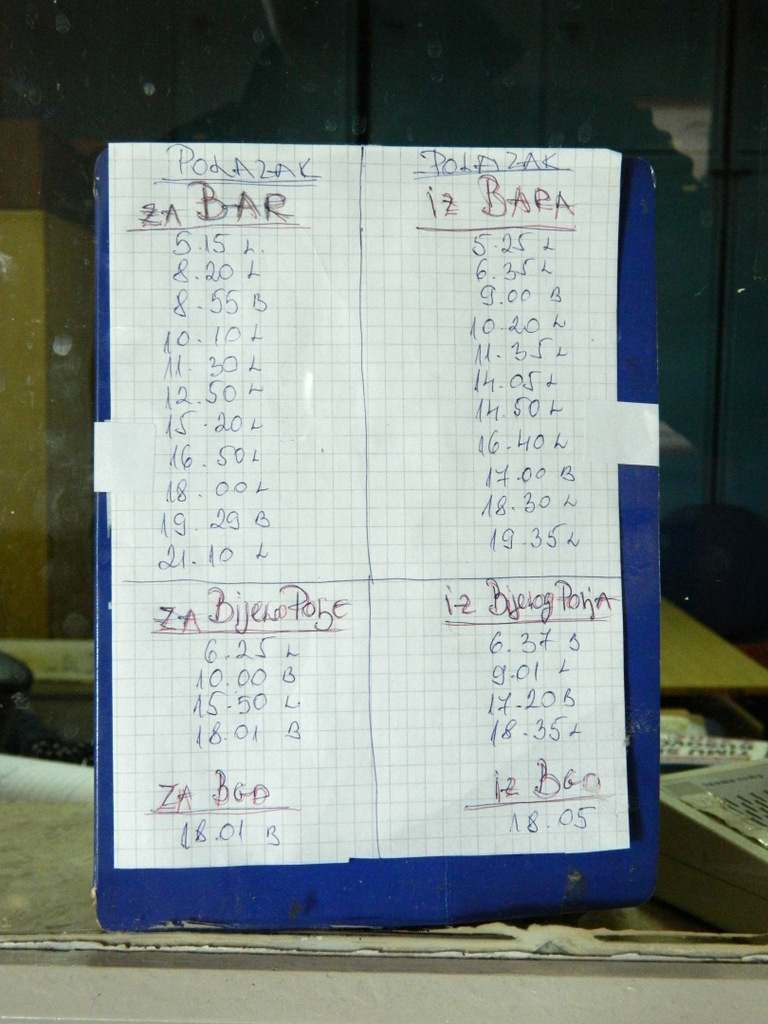 The next train will leave at 10 o’clock, the lady at the counter signals by raising both her hands and stretching out all of her ten fingers, as if a robbery was in progress. The ticket for one of the most beautiful train rides in Europe costs 3.20 Euros (less than 4 US dollars). At another counter, I later discover a handwritten note with the departure times of the most important train connection in former Yugoslavia.
I still have 20 minutes left. The little shop doesn’t have Coca Cola, but Cockta, a Slovenian Cola substitute which tastes more refreshing, but doesn’t inject any caffeine. And a chocolate bar for the train journey. On the platform for track 3, there is a man with a chainsaw. That one must be the right track for the train into the mountains.

 From Podgorica, the capital of Montenegro, I want to go to Kolašin, a small town in the mountains. Already before the first stop, still in the outskirts of the city, two police officers on the train are checking my passport as thoroughly as if I was about to leave the country. The route is indeed part of the train connection to Belgrade, but it’s still a few hours until we will approach the border.
Back in 1855, planning began for a rail connection from Belgrade to the Montenegrin coast. Only in 1976, a full 121 years later, the whole 454 km (282 miles) were opened. With 254 tunnels and 243 bridges, it was the most expensive infrastructure project in Yugoslavia. The railroad overcomes a difference in altitude of 1,000 meters (3,280 feet). The train station of Kolašin, my destination today, is the highest station along the route at 1,024 meters (3,360 feet).
Shortly after leaving the capital, the train begins to climb. A turquoise river meanders deep down in the canyon next to the rail track. Rivers in Montenegro display colors which you otherwise see only on postcards from Sardinia and the Caribbean.

My eyes quickly wander back and forth between canyons and mountains. A dramatic landscape with small mountain villages in between, in which the unplastered stone houses can only be told apart from the adjacent stables by the satellite dishes. And tunnels, tunnels, tunnels. A quarter of the whole distance runs through tunnels, the longest of which are piercing into the mountain for more than 6 km (3.8 miles).

Sitting alone in the compartment, I am writing these notes and jump up again and again to rush to the window and take photos. On the right hand side the mountains rise as steeply as they fall down on the left. This train journey has to be made at least twice, because once is not enough to absorb everything. There are not many countries in which one can marvel at the most impressive natural beauty in such a simple, convenient and affordable way.
There it is, Mala Rijeka Viaduct. 500 meters (1,636 feet) long and 200 meters (660 feet) deep. The tallest railway bridge in Europe. I see it from afar, then another tunnel, and immediately as it leaves the tunnel, the train is on the bridge. Fantastic views are opening up. I can’t decide which side to look down first.


The train winds its way across mountain passes, through canyons and across bridges. Building a straight line is impossible in this terrain. The engine takes the enormous ascent impressively easy. At stations like Bratonižići, where one railway employee stands in front of the lonely station building which is surrounded by dense forest, the train doesn’t even stop. It was not only geography which determined the route, but also politics. Before World War I, there was already an international conflict, mainly between Austria-Hungary and Serbia, about the routes of new long-distance railroads to be built. Serbia, which had no access to the sea, wanted to open up an Adriatic port with the rail connection. Austria-Hungary tried to counter with competing routes. It was this conflict over the Balkans, not the assassination in Sarajevo, which lead to World War I in 1914.
But now everything is peaceful. The first snow-covered mountain peaks appear in the distance. Down in the valley, the road winds beside the river, while the train keeps ascending and towers above all other means of transport. As it should.

At the stop at Lutovo, a train which came from the other direction is waiting. Nobody lives around here. Maybe the stop only serves the purpose of allowing the trains to pass because the line is mostly single-track. The railway staff working up here can only get to their place of work by train. That way, the company creates its own demand.


The river has dwindled to a trickle. Caves have been blown into the rock, maybe by partisans during World War II or maybe there was some dynamite left from building the tunnels. Fall-colored foliage, steep granite walls like in Yosemite, a lonesome wooden hut in between. The fir trees on top of the Ostrovica tunnel are already wearing white. It is October. I would like to make this journey once more, but in wintertime.
The journey to Kolašin took only 78 minutes, but it was 78 minutes of great natural cinema! Leaving the train, I see one of the police officers stretched out across three seats, sleeping, his shoes removed and his tie loosened.

Despite the noon sun, this highest train station in the country receives me with an ice-cold wind. Except for the treetops’ sough, there is absolute silence. Only a few birds are chirping. Most of them have moved away for the winter, have frozen to death or have been eaten by wolves. In a basin, there is the town of Kolašin, still a considerable march from the station. 78 minutes on a train, and I feel far away from the lowlands and reminded of the opening chapter in The Magic Mountain.

As I look back, the train has already left.

It will continue to Bijelo Polje, deeper into the mountains. Only one row of the chocolate bar is missing because I didn’t have time for it with all that marveling, photographing and writing. Usually, chocolate never survives that long in my company.
Practical information:
Links:

 The Happy Hermit