
Hier könnt Ihr diesen Artikel auf Deutsch lesen.
When I arrived in Bolivia, the arrivals hall at the airport in Cochabamba was so full that the police simply called out loudly: “Who is a local?” Anyone who raised their hand and their passport could walk through passport control without being checked. It was a concession to the late hour and to stressed travelers who wanted nothing more than to drop into bed after having flown halfway around the world.
I should have joined that crowd, but at the time I wasn’t yet confident enough that I would pass for a Bolivian.
So I got a one-month tourist visa at the airport. Free of charge. This I could extend twice for another month by going to the immigration office. When I told my Bolivian friends where I was heading, they all advised to take a few books, a bottle of water and the day off, because I would need to wait for at least half a day. In reality, you go directly to the friendly guy at counter no. 6 and before you can even sit down and start to explain your wish to stay for another month, he has already taken your passport, stamped it with the extension and handed it back to you. “How much do I have to pay?” I asked. “Nothing. Enjoy your stay in Bolivia!”
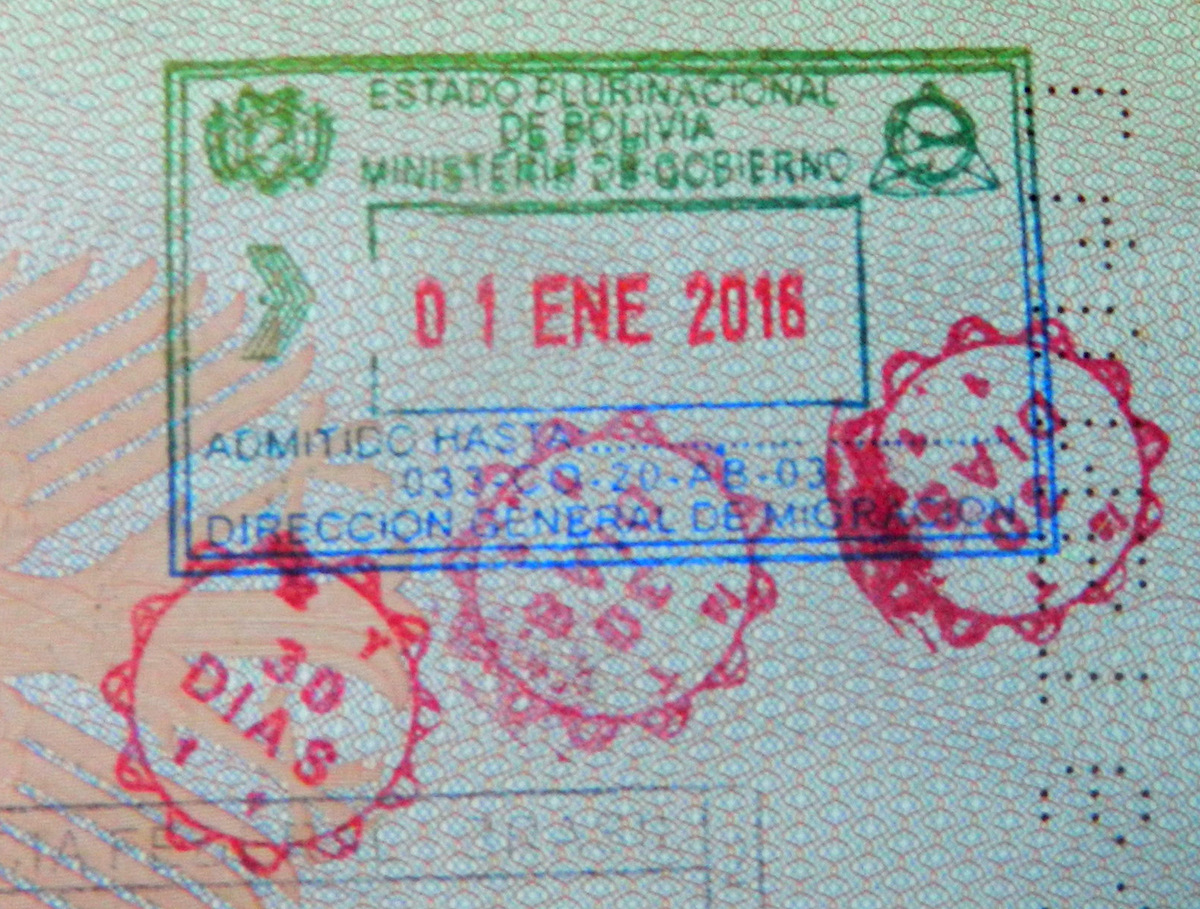
Three months per calendar year are the maximum allowed on a tourist visa. When I wanted to stay in Bolivia longer, I was overwhelmed with offers of employment contracts, volunteering contracts and marriage proposals, all of which could have served as the basis for a residence permit. It was also most surprising how many people could claim that “the head of the immigration office is my friend” or how many people had “a sister-in-law at the very top of the immigration department”.
But I didn’t want to do anything shady. Also, I was already intrigued by the prospect of getting arrested to take a look at the famous Bolivian prison system. Once, after my visa had already expired, I was held up at a police checkpoint. I was already hoping to be taken away in a van with metal-grilled windows, on the way to explore the justice system of a Latin American country. The officer checked my passport carefully, looked at me, looked at the visa with sorrow, looked back at me and handed my passport back. All he said was: “I am glad you are enjoying Bolivia, Señor.”
So I stayed four more months, illegally. From now on, whenever you are ranting about “illegal immigrants”, please remember that it’s people like me that you are talking about.
Bolivia is not only friendly to visitors, but also quite smart. Instead of locking up immigrants, building walls or deporting people, all of which would cost a lot of money, they impose a fine.
So I worked hard for a few months until I had saved thousands of bolivianos. The day before my planned departure, I went to the immigration office in La Paz, pockets filled with stacks of money, to pay the fine.

I was very nervous. After all, I was in a foreign country, I had committed a crime, I was on my way to the authority responsible for prosecuting these crimes, and I had to explain everything in Spanish.
There was a soldier at the gate of the immigration office who told me that unfortunately they were closed to the public on Wednesday afternoons.
“Oh,” I exclaimed, ”that’s sad. Because I still have to pay a fine before I leave the country tomorrow.” For the hundredth time in my life, I made a resolution that I would never again wait with important things until the last day of the deadline.
No matter what Tucholsky said about soldiers, this one was nice. He recognized my self-inflicted plight and said: “Well, come on in and we’ll see if anyone is still here.”
In fact, there was a lone civil servant at one of the counters. He had probably had been looking forward to a visitor-free afternoon, finally allowing him to sort through files or read the ministry’s new circulars.
But he was very friendly and offered me a seat and a cup of tea. When I started to apologize profusely for having lived in his country beyond the permitted time, he reassured me: “Señor, you don’t have to apologize for that. It can happen to anyone.” Whenever he noticed that I was nervous, he would say: “Don’t worry about it”, as if I had forgotten to get off my bicycle at a zebra crossing.
Zebra crossings were invented in Bolivia, by the way, but that’s another story.

When the official took my passport and saw that I had been in the country illegally for a whole four months, he too became concerned. Normally, tourists overstay by a few days because they miss their flight or get lost in the jungle.
He then set about calculating the fine that was due. Until then, I had read different figures, from 20 to 26 bolivianos per day.
The officer took the time to explain in detail how the fine was calculated, and for the benefit of other travelers, I can reveal that the amount is 12 UFV per day. An UFV is an unidad de fomento de la vivienda, which is an accounting unit introduced to make payable amounts independent of inflation. It is calculated by dividing the Consumer Price Index of the present month by the Consumer Price Index of the same month of last year, taking the 12th root of that result, then calculating the nth root, whereby n is the number of days of the present month, and finally multiplying this result by the value of the UFV of the previous day.
I did not understand it.
The officer had a computer and a calculator, but he preferred using a pencil and lots of paper to do his calculations. After about 10 minutes, he pronounced that I would have to pay a little more than 3,000 bolivianos.
“Good,” I said, because that was exactly the amount I had saved up. Just one boliviano more, and I would have had to sell another kidney.
“Not good at all,” said the official, who was visibly shocked by the hefty amount.
“That doesn’t matter. I knew it beforehand and saved accordingly.” Somehow, the roles had been reversed, and it was me who had to tell him that he needn’t worry.
“But the other tourists only ever pay a very small fine.” He used the word multita, the diminutive of multa. It’s difficult to translate, partly because you can’t imagine an ICE agent talking about a teeny-tiny fine. “It would be unfair if you had to pay so much more.”
I couldn’t think of any more arguments, other than pointing out that I even had the money with me and could pay the full amount on the spot.
“No, no,” he said in horror, ”let’s first see if there isn’t some kind of exception in the law. An upper limit perhaps, so that you only have to pay for one or two months.”
He called his boss.
The head of the immigration department came down immediately, greeted me warmly, also told me not to worry, and then discussed the case with his officer. I stood there, a lawbreaker, while the two law enforcement officers discussed whether there were any exceptions in the law that could be used in my favor. From the expressions on their faces, I realized that there was no easy solution.
Finally, the boss asked me how I was going to leave the country. By plane or by bus?
“I will take the bus to Peru,” I said.
“Very good!” he exclaimed with relief. “Then you won’t pay anything now, and if you get checked at the border, you can still pay there.” He only half-heartedly concealed his hope that I would somehow slip through, smiling about the solution he had found.
I don’t know why people have such a bad opinion about government offices. People are really helpful there. (A completely different mishap happened on the way to the border. That was a bit much for one day, even for me. But it wasn’t the authorities’ fault.)
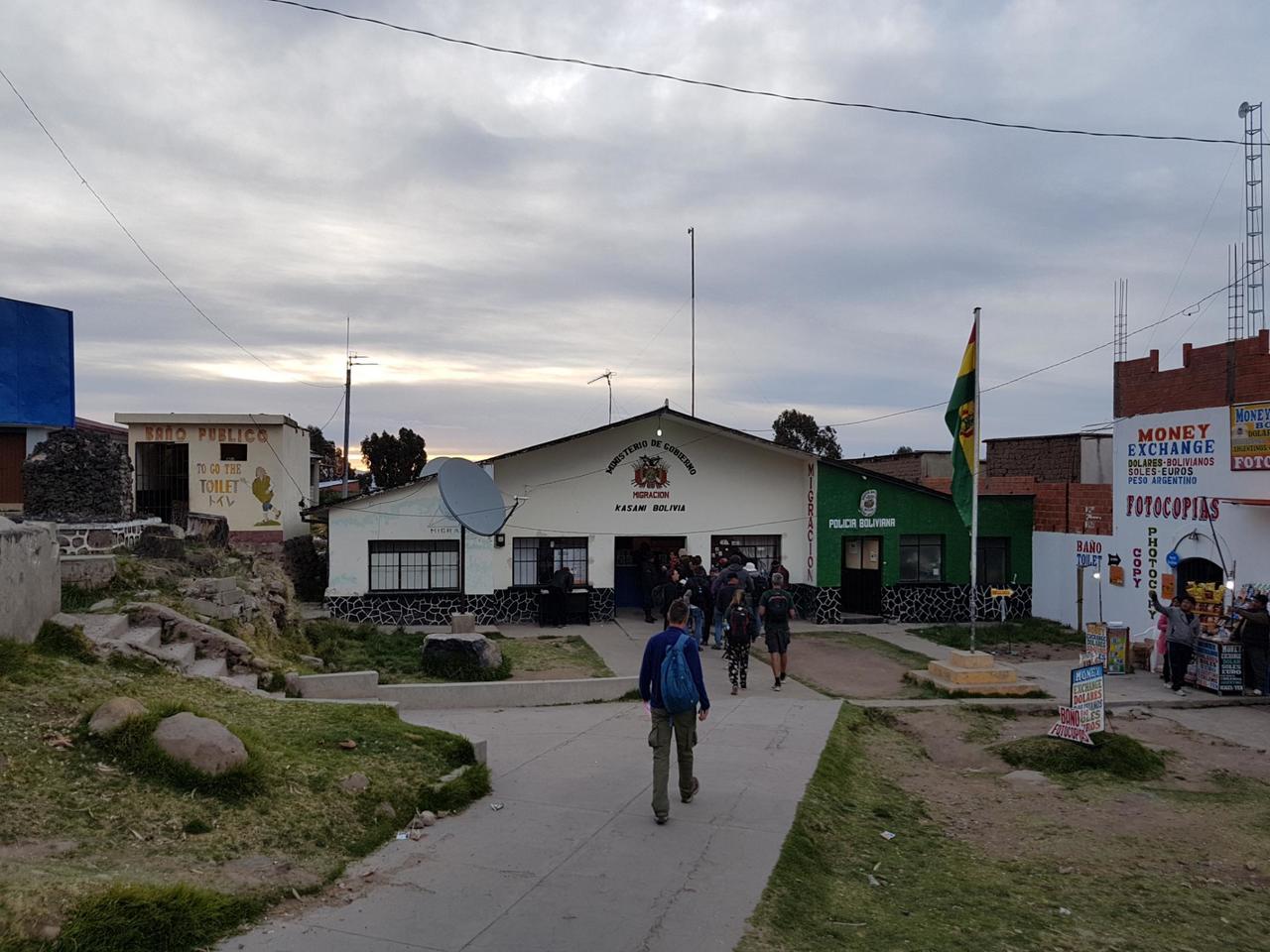
Unfortunately, I’m the type of person who can’t just put my passport on the counter without saying a word when leaving the country in the hope that nobody will notice. When I entered the Bolivian border post in Kasani on the sores of Lake Titicaca, I admitted it straight away: “I think I have to pay a fine before I’m allowed to leave the country.”
Because all the other passengers on the bus were less criminal than me and therefore quickly processed, all four counter officials soon gathered around me to hear my story. “If you like Bolivia so much, why didn’t you simply get married to a Bolivian woman?” one suggested. As they questioned me with serious curiosity about my travels, one of them did the same and equally complicated calculation of UFVs and bolivianos.
Again, the state representatives were shocked by the amount owed, discussed it among themselves and recalculated it several times. The border officials had smartphones with calculators and internet, which they used to exchange WhatsApp messages with their wives all the time, but for the complicated calculation of the 12th root of something, they too preferred paper and pencil.
Here too, they discussed whether there were any exceptions and whether something could be tweaked until one of them had the idea: “Let’s call the head office in La Paz, maybe they can think of something.” That was the office where I had been the day before.
I don’t know if one of the two men from yesterday was on the phone who would still remember me. In any case, the order came from the ministry to show no mercy to any gringos.
The border officials told me that with my fine of 3,082 Bolivianos, I would unfortunately only receive the silver medal. They had already taken more than 4,000 bolivianos from another traveler. I was disappointed.
By the way, all of this is done strictly above board. The payment is not a bribe. You get a receipt, lots of handshakes and best wishes for the trip. You are also given the useful hint that you are no longer allowed to enter Bolivia in the same year, but as the border official said with a broad smile: “From January 1st next year, everything will be forgotten and you will be very welcome again!”

As you can see from the receipt, I committed the “grave violation” of “staying in Bolivian territory in an irregular way”. The fine was 25.68 bolivianos per day. That’s 3.34 euros (3.70 US dollars) or exactly 100 euros per month. Not much for getting to live in the friendliest and cutest country in the world.
The following January, I immediately moved back from Peru to Bolivia. I only overstayed my second stay by a week or so, but this time, I wasn’t the least bit nervous about the small fine.
Links:
- More articles about Bolivia.
- Ironically, I now work as an immigration lawyer.


 The Happy Hermit
What’s story. What’s it about Bolivia? I never been there and it seems a great place to visit.
I dare say it’s the most beautiful and friendliest country I have been to so far.
I am still voting for Switzerland über alles!
Also very nice, but too organized, leaving too little room for surprises and human kindness. And of course it’s far too expansive for people like me.
Pingback: Wie geht Bolivien mit illegalen Einwanderern um? | Der reisende Reporter
I don’t need a degree in economics (but happen to have one) to tell me that the fine levied was DEPENDENT on inflation as the fine was based on the real value, not the nominal value. If it were independent, then it would have been a fixed number, as opposed to the number (dependent on inflation) calculated to represent the real value. What surprise me the most is that the inflation index is so readily available in Bolivia and that any Joe can do the calculations on finding . Here is a free business idea, I think there is a market for an app for inflation adjustment pricing. There is probably one out there already.
When I wrote “independent of inflation”, I also meant it to reflect that it still has the same purchasing power as when the fine was first set.
But the consumer price index is publicly available in almost any country, bar Argentina under Presidents Kirchner maybe, isn’t it? I actually think you can even get the UFV from the website of the Bolivian Central Bank and don’t need to do the complicated calculation that the maths genius in the immigration office explained to me.
Andreas, always pleased to read your blogs, especially about this one. Most expats talks about Panama, Colombia, Ecuador, Belize, Costa Rica and of course Mexico which I have all visited, but hardly or never about living in Bolivia. Will you kindly tell us all, why of all you chose Bolivia ? What are the nice and exciting things about living in Bolivia ?
Thanks.
Bolivia was the friendliest, kindest and most beautiful country I have ever lived.
You have almost all different climatic and topographic zones in one country, from the Amazon to the Andes. Particularly Cochabamba has a spring/summer climate all year round.
It’s affordable, also to travel around. Buses from everywhere to everywhere leave every five minutes and affordable planes every hour.
Very good quality of life and a lively and active political and social discourse.
It was very easy to make friends in Bolivia and these became genuine friends, nothing superficial (only Santa Cruz is a rather materialistic and superficial city). The Spanish in Bolivia is slow and clear, perfect for beginners.
Pingback: Where God takes Cash | The Happy Hermit
i want a visa in Bolivia plz give job working
You sound like you could find work as an English teacher.
Couldn’t you just apply for 1 year visa instead? Once in process, the fine is suspended;)
I was dreading all the paperwork. (I am a lawyer, after all. ;-) )
Pingback: The German passport is the best – and the worst – passport in the world | The Happy Hermit
Would it be different if you brought a motorcycle into the country with you. Or the same fine?
The immigration fine would be the same.
I don’t know if it would be possible to get insurance for the motorcycle for the time that you are overstaying.
hi from ireland,i plan to circumnavigate on foot the salt flats desert uyuni,means i can not come off the challenge to extend the 30 days visa.
ill be over by 43 days max.thanks for the heads up info.
told that a new 90 day visa is coming in,as of now april2019 no news
Wow, that’s quite a trip you got ahead of you!
If you have the cash (and as you see, it’s not very much), you shouldn’t have any problems with overstaying. I was treated very friendly and respectfully, even.
All the best for your walk!
I really enjoyed reading this! Got here following the surprise button. Reminds me just a little bit of Madeira – it might be the European version of Bolivia.
All the best,
Hana
Oh, I am glad you got something entertaining by using the surprise button!
Although it would have been even funnier if you had stumbled on a post about Madeira. :-) Well, admittedly, there isn’t much to read yet. I only visited Funchal once, on a stop during a trans-Atlantic cruise. And I haven’t even gotten round to writing the article about that.
But I loved it. Especially after 18 months in South America, which had been exhausting at times, it was beautiful to step into Europe again! I still remember the joy about finally being in a moderate climate again, an organized place without constant noise, and I ran into the newspaper shop and spent everything I had on catching up on what I had missed in one and a half years.
(Now, a few years later, I miss South America again.)
Coincidentally, I spent the first months of the Corona virus on Faial, another Portuguese island, and it as the best place to be during that time!
I think there might be quite a few things to remind you of Madeira: https://andreasmoser.blog/tag/faial
I had to google what Tucholsky said about soldiers, it’s interesting. And makes it all the more fortunate you met a nice one. A great read, much enjoyed. Bolivia sounds grand.
I feel lucky to have at least one reader who cares to look up the arcane references sprinkled over my articles.
Thank you very much!
And yes, it was a fabulous experience to live in Bolivia. In Cochabamba, I got to know an emotion which I had never known before: Being so happy that it overwhelmed me.
Sometimes, it became too much when I was strolling through town, it was sunny and colorful, the people were smiling and nice and cute and friendly, the language sounded sweet, you see the mountains on the horizon and plenty of lovely oddities, and then I had to rush home and lock myself in my room, because that feeling of happiness and beauty all around me had become to overbearing.