
It felt more like the middle of nowhere than the center of Europe, when the bus driver dropped me off at this intersection in the Lithuanian countryside.
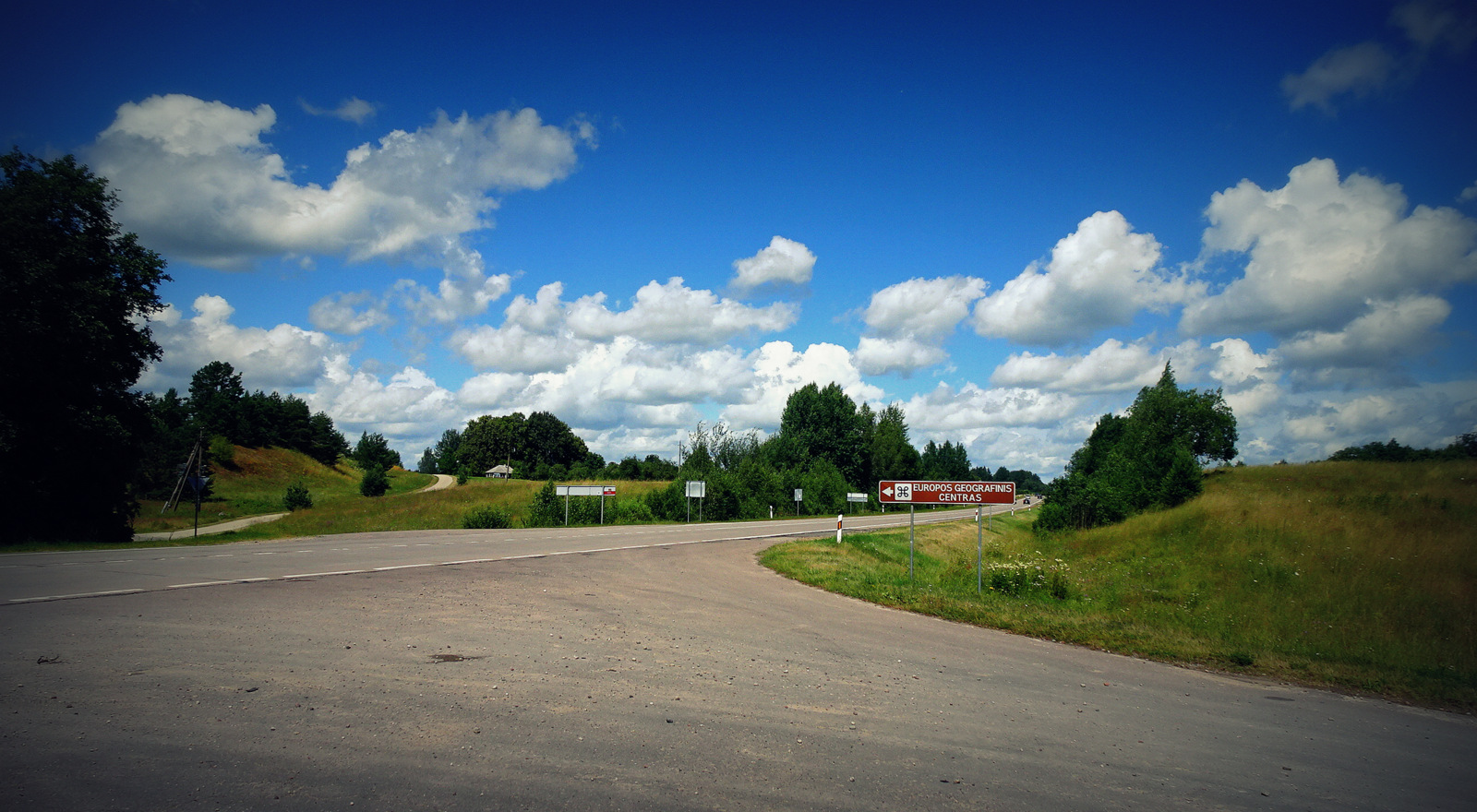
But the sign was unambiguous. Here it is.

The full story is coming soon, but first, I need to visit a competing center of Europe. In the meantime, you can read about this silly project of mine. Or about Lithuania in general.


 The Happy Hermit
Happy Birthday!
Thank you very much!
As usual, I spent all the day hiking, getting lost, and enjoying the day nonetheless. :-)
Last time I lived in Vilnius (12 years ago or so), I cycled to Europos Parkas. Today, I walked all the way.
It seems that I am having more and more stupid ideas every year.
And when I took the bus back in the late afternoon, I realized that all the buses are for free today. Because July 6th is not only mine, but also Lithuania’s birthday.
But I thought Europe was moving away from the centre?
That’s the problem with proportional representation.
Or with democracy in general, as the monarchists here would argue. :-)
I hiked up to the Center of New Zealand when I was living in the town of Nelson. But perhaps we can be persuaded to think more globally: a project to find the center of the world, anyone?
Looking at the map of New Zealand, I can think of various ways to determine the geographical center of the country.
There is still room for other towns/counties to come up with their own center. Although it is of course convenient, when it is on top of a hill with a great view.
The center of the world was already discovered by Jules Verne, though. ;-)
When you are in Lithuania, maybe you can find the opportunity to use the only Lithuanian word I know, “Meškinis česnakas”. It is Bärlauch in German. (“Meškinis” = bear, “česnakas” = garlic).
Aaron
Hello Aaron,
that is a very random piece of knowledge indeed!
I didn’t get to talk about food much, but it was beautiful to smell the “krapas” (dill) again.
And I was surprised how some expressions came back to memory immediately, after I had not been in Lithuania for many years.
Hi Andreas,
That is somehow heartening that memory is persistent like that and that given the suitable triggers or context, it will come back. I wonder if that will happen with the handful of Romanian phrases that I learned as well as the numbers if I ever return to Romania.
I definitely think so!
I just have a problem when I switch languages quickly, like when I am in Hungary one day, in Romania the next, and then in Serbia the day thereafter.
Then I get all mixed up.
Yes, that is very understandable!
Your mentioning Hungary gives me the opportunity to share a word that I noted down when I was there last month, seen in a dessert shop:
Fagylaltkülönlegességeinket
This is one word, and means “specialty ice cream.”
When I was house-sitting in Hungary for an English couple, the wife surprised me by having learned Hungarian.
“It’s not that complicated,” she explained, “you just have to learn the basic vocabulary and then stick it together to make bigger words. It’s all very logical.”
I am from Germany, we use compound nouns too. So, in theory I concur. But only in theory.
How interesting, and encouraging in fact. I wonder if any languages are inherently particularly difficult. I think I remember reading that Georgian is one.
I guess it always depends on what your first language is.
For English speakers, there is a rough ranking done by the Foreign Service Institute, where US diplomats study languages.
They have put foreign languages in four different groups, depending on how many hours of study will be required to obtain a level of proficiency: https://www.state.gov/foreign-language-training/
Yes, I remember that table from many years ago. It looks like they have since downgraded Indosian from category 3 to category 2. Maybe Indonesian has been getting easier for English speakers over the years!
Or the Indonesian teacher wanted a few extra weeks of holiday. ;-)
Ha, yes!