
Whenever someone wants to “ban Antifa”, I have to think of this photo. It shows the liberation of the concentration camp in Mauthausen by the US Army in May 1945.
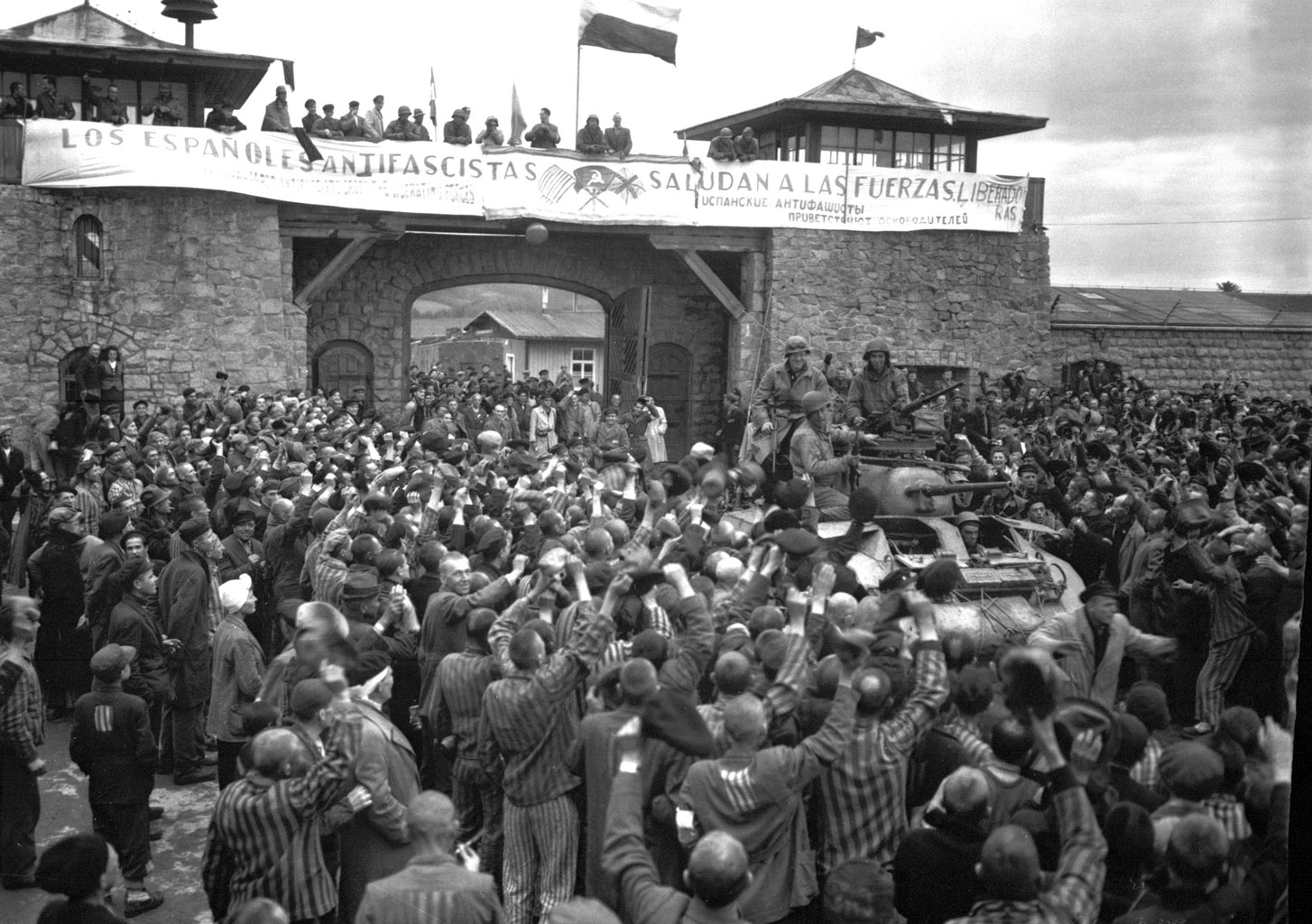
Looking at the banner with which the Spanish prisoners welcomed the liberators, it becomes evident that Anti-fascism is nothing negative. Quite the contrary.
The abbreviation “Antifa” became popular in post-war Germany, where hundreds of “Antifa Committees” had been established in spring and summer of 1945. People tend to overlook this, because it was quickly overtaken by further events, but for a few months in 1945, the old order (Nazi Germany) was gone, but the new order (Allied control) had not yet been established. This void, which in other post-war scenarios could have led to total chaos, was filled by local “Antifa Committees”, who took it upon themselves to organize daily life (especially food, housing and transport), to remove the Nazis and their collaborators from public offices, to take care of millions of refugees and homeless people, and to begin reconstruction of German cities and the economy.
The Antifa movement was a grassroots movement, which covered a wide range of people: Resistance fighters, former prisoners of concentration camps, with a focus on organized labor and the trade union movement, but also people from the political center.
In the towns where the old elite had fled (because they were too obviously Nazis), it was sometimes the local Antifa Committee that handed the town and the city hall over to the Allied Powers, peacefully of course. In the early weeks of the liberation/occupation, the Allies at times cooperated with local Antifa Committees.
But this came to an end soon. The Allies decided that rebuilding Germany quickly and the upcoming Cold War were more important than meticulous Denazification. In public administration and in the courts, the focus was now on keeping experienced staff, instead of building up a new system from scratch. Still in 1945, they dissolved the Antifa Committees, instead allowing the re-establishment of political parties.
Even then, Anti-fascism was the broad consensus, from the left to the right.

Admittedly, that poster from January 1946 may be less indicative than it seems, because it was only used by the CDU in the Soviet sector. (In subsequent years, East Germany used the term “antifaschistisch” so much that it fell out of fashion in West Germany. We have since adopted “Bekenntnis zur freiheitlich-demokratischen Grundordnung” instead, which rolls of the tongue more easily anyway.)
But even the CDU in West Germany, the conservative party which provided the first three chancellors of the Federal Republic, had contacts to the most radical elements of the Antifa, those very small parts that resort to violence. In 1967, they went so far as to nominate a Supreme Court justice who had previously tried to blow up a plane, personally putting the bomb on the aircraft.
I should clarify, though, that most Anti-fascists don’t blow up planes or commit any other acts of violence. In fact, some of them don’t even eat meat or beat their children. (I know, it’s wokeism gone mad.) Whenever I have time to attend an Antifa event, it is usually about history or culture of remembrance. They do a lot of great work on local history projects, for which universities or other academic institutions just wouldn’t have the time. They also conduct very comprehensive research on neo-Nazi networks, often putting together reports that are more detailed and up to date than anything else on that subject.
In any case, Antifa is not some centralized, organized structure. I would hope that most people are Anti-fascists and that Anti-fascism is something that most people can get behind, from lefties to conservatives. Historically, more and earlier Anti-fascism certainly would have been a good thing.


 The Happy Hermit
Pingback: Word of the Week: Antifa – THE FLENSBURG FILES
I’ve shared your piece on Antifa in my column to provide some information about the group. Nice write-up and I hope this will help debunk some of the arguments that come out of Trump’s mouth recently.
Thank you for pointing out this (in the West) forgotten piece of grassroots democratic history. The writer Stefan Heym, who participated in the liberation of Germany as a US soldier, vividly described this transitional period in his historical novel “Schwarzenberg.”
Oh ja, Schwarzenberg im Erzgebirge ist ein gutes Beispiel, das ich erwähnen hätte sollen. Ich habe das Buch vor kurzem gelesen, interessanterweise während ich in der Gegend um Aue/Schwarzenberg unterwegs war.
Interessantes Buch, allerdings hat mich das Frauenbild ein bisschen gestört. Aber gut, die James-Bond-Filme aus der Zeit waren auch nicht besser.
Bei der Stefan-Heym-Gesellschaft in Chemnitz war ich im April zu einer Lesung/einem Vortrag über Heyms “Reden an den Feind” und seine Rolle in der US-Armee.
Nachdem ich über Heyms Teilnahme an der Befreiung Deutschlands hörte, fand ich es im Nachhinein noch schäbiger, dass ihm Abgeordnete von CDU/CSU bei der Eröffnungsrede im Bundestag den Applaus verweigerten.
Being against Fascism is a good thing. Much less so calling someone a Fascist who isn’t in order to justify action against them.