
Zur deutschen Fassung dieser faszinierenden Geschichte.
Germans love plans. The bigger the plan, the better. World domination, an airport in Berlin which will never be opened, a spaceport in Congo, and so on. Between all the half-baked Schlieffen plans, it’s hard to establish a ranking because each one is dumber than the other. But I hereby nominate a surprisingly unknown candidate for the most stupid plan ever. On the other hand, I have full confidence in the anecdotal knowledge of my readers and I remain curious about your own nominations.
But first, let’s visit the Qattara Depression.
Never heard of it?
Good, because then you will leave this blog smarter than you came.
Well, Qattara is a depression in the Libyan Desert, which, confusingly, is not in Libya but in Egypt. But desert is desert, and at the arbitrary border demarcation conference of 1884/85, well-meaning Europeans couldn’t get dragged into the depths of every detail, could they? Especially when the detail is very deep, like the Qattara Depression, 133 metres below sea level to be exact.
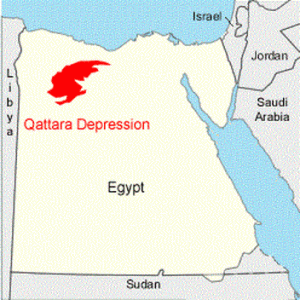
That’s quite a dent. The only reason this major manufacturing defect of our planet went unnoticed was its location far away from the next quality control center in Cairo. Otherwise, it really couldn’t have been overlooked. It’s 120 kilometres long and 80 kilometres wide. If you stumble into it while walking in the desert, you won’t crawl out that easily. At 18,000 km², the depression is almost as large as the land mass of New Jersey, which would provide ample opportunity for deep and dark comparisons of deep and dark holes, but those would not only be below sea level, but also below the level of this blog.

So, what do you do with something like that?
“Ignore it,” said the Stoic.
“Offer guided camel tours,” said the Egyptian minister of tourism.
“Build a secret chemical weapons factory,” said the neighboring Libyan dictator.
“Dig a canal from the Mediterranean Sea and lead water into the depression, which, because of the gradient, will power several turbines that generate electricity. It will also create an artificial lake [the size of Lake Ontario], whose evaporation will rain down and make the desert green. Tobacco and banana plantations can be created here, where Africans can work for us colonial masters, which, after all, should be better than drowning in the Mediterranean,” said Professor Albrecht Penck, a German geographer, geologist and expert on hollows and basins, who stopped off in Egypt in 1916 on his way back from Australia. Apparently, the long ship voyage had made him crave for activity.
At that time, however, the First World War was raging and every shovel and pickax was needed to dig trenches and to smash enemies’ heads in close combat. Peaceful canal digging on the sandy beach of the Mediterranean Sea was considered to be of secondary importance.
And then, in 1919, Germany lost all access to Africa under the Treaty of Versailles. Game over, one might think. But Professor Penck did not give up. He developed the theory of ethnic and cultural soil, of the need for a larger living space and colonial possessions for Germany. The Germans liked that. They voted for the Nazis and sent soldiers and tanks into the Egyptian desert. All for the Lake Qattara project.

Incidentally, the terrible habit of German men wearing short trousers until old age, which you may have observed on holidays, dates from that time.

But there are other blogs to discuss fashion. You have come here because you finally want to know why an enormous tank battle was fought at El-Alamein in 1942, in the middle of the desert.
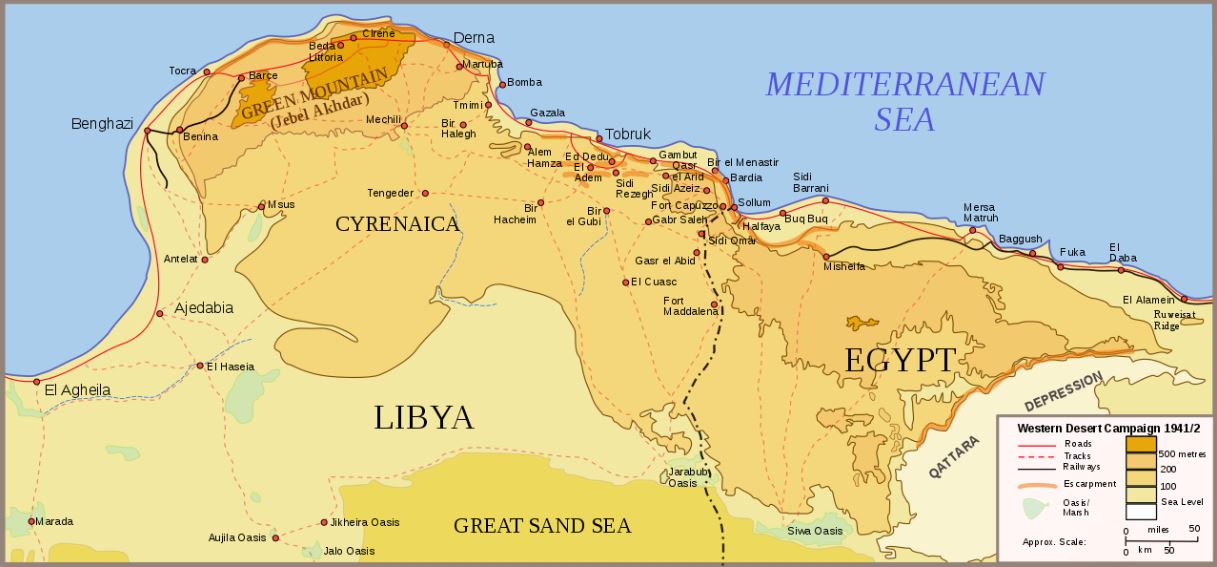
As you can see, El-Alamein (on the far right of the map) is located exactly where the channel to the Qattara Depression would link to the sea.
Just a coincidence? Ain’t nobody gonna believe that.
And anyway: Why were there several British divisions near El-Alamein, although they should have been preparing for the landing in Normandy?
At the time, Cairo was a nest of spies, and thus the British geologist, geographer and secret agent John Ball, who had good contacts with the German rock scene thanks to Erasmus semesters in Freiburg and Zurich, learned of the German plan to flood the basin. Initially, he offered his cooperation, perhaps out of genuine interest, maybe with perfidious motives from the outset. At any rate, when in 1933 Germany’s reputation began to suffer due to a certain Reich Chancellor, Ball jumped ship and in the autumn of the same year published his “own” proposal for canal construction and energy production.

And now, it should be clear why hundreds of thousands of German, Italian, British, South African, French, Greek, Indian, Australian and New Zealand soldiers came together at El-Alamein in 1942. Thanks to the desert-tested Australians, the victory went to the British side, and the Germans retreated to Tunisia. There they founded holiday resorts, which they still regularly invade, reminiscing about world-conquering times.
But, to not let the main thread of this story seep away in the desert sand like blood gushing from a foot blown off by a landmine, what happened to the Qattara Depression and the crazy plan?
History repeats itself, one might think, because Germany did not give up.
Professor Friedrich Bassler, a hydraulic engineer, became the driving force after the Second World War. Because colonialism no longer sounded so great, he spoke of a “hydro-solar depression power plant”, which feigned scientificity. As is well known, West Germany lived under Clausewitz’s motto “economics is the continuation of war by other means”, and so the German Ministry of Economics and Technology supported the plans, explorations and feasibility studies. Egypt probably thought “what a stupid idea”, but let the Germans carry on. Because of the minefields that the same Germans had previously generously laid around El-Alamein, the Egyptians couldn’t use this part of their country anyway. (The idea that Germany and Britain could clear the minefields first seems obvious to us today, but back then, kilowatts were more important than children’s legs.)
The plan was, as I said, to build a canal or a tunnel from the Mediterranean Sea to the Qattara Depression, with turbines powered by water in between.
“And once the basin is full?” you ask.
“The depression will never fill up,” Professor Bassler answers, “because it is so hot in the desert that the water evaporates just as quickly as new water flows in.” A perpetual motion machine, the dream of every scientist.
“But if the basin never fills up, won’t the water seep away faster than it evaporates?”
“We’ve calculated all that, young man. In the first ten years, we let more water flow in until the depression fills to a level of 60 metres below sea level. As a result, the surface of the lake slowly rises and with it the evaporation. When we have reached this desired level, we keep the water cycle in balance. That way, we not only produce energy, but we also create an artificial lake for fishing, shipping, etc. New cities and settlements will be built and Africa will become as rich as Europe.”
About 80 scientists and engineers, mainly from Germany, were working on the project.
“But this is salt water”, someone cautiously tosses in, thinking of the few freshwater oases in the basin.
“Salt water is better than no water at all,” answers the water scientist, because it’s not about his own oases. Besides, he really believed in progress, as people did in the 1960s and 1970s.
The only problem was the construction of the canal. It was not even the length of 55 to 80 km. After all, the Suez Canal was just around the corner, measuring 164 km. No, the problem was a mountain range between the Mediterranean and the Qattara Depression. Drilling a tunnel instead of digging a canal would take decades. Besides, it was too expensive.
But Professor Bassler had an idea: “I’ve already worked it all out, and it’s quite simple. We will drill 213 boreholes along the route that the watercourse is to take. In each of these boreholes, we detonate an atomic bomb with an explosive force of 1.5 megatons.”

This is the equivalent to one hundred times the Hiroshima bomb. In each of the 213 holes, respectively. Near a tectonic trench breach. Funded by the German government.
“Wouldn’t that lead to atomic contamination of the water, Professor? No one would be able to live there, neither fish nor man.”
“Oh, we will throw iodine tablets into the water.”
And then the project died a silent death. No one knows whether it was the Camp David peace agreement, the meltdown on Three Mile Island, or the murder of Anwar as-Sadat. Perhaps the West German government simply thought that the money could be better used to annex East Germany.
Links:
- More historical revelations.
- I would love to report to you directly from El-Alamein, but even if I hitchhike there, I still need a little bit of support for this blog. Thanks a lot!


 The Happy Hermit
Pingback: Der dümmste Plan aller Zeiten | Der reisende Reporter
A history lesson with a bunch of laughs! Thank you! 😂
Not being a Scientist or German, I’m wondering why this idea kept moving forward. Not to mention getting more ridiculous as it did. Nuclear bombs?!
Thank goodness they didn’t detonate those bombs. We wouldn’t be enjoying our pandemic now if they had.🙄
And neither Germany nor Egypt had any nuclear bombs, so I don’t know what they were thinking.
I think it was the “age of the atom”, when everything seemed possible and solvable. It reminds me of the space flight folks nowadays, whose solution to everything is “oh, we’ll just move to Mars”.
It seems like the amount of energy required to build this project may be more than the amount of energy this project would produce. It’s a pretty cool idea, though. Although I wouldn’t count on a thriving fishing industry there, because it seems like a plan to create a second Dead Sea.
Oh true, with salt water being fed into the pond and the water evaporating, it would become saltier and saltier.
But then, when you can float, the tourism minister would be happy again because you could have floating camels.
I am really worried that somebody will send this plan to Elon Musk.
I kind of think someone should, because he has a company that makes tunnels, loves alternative energy sources, and probably doesn’t think there’s such a thing as a stupid idea.
Interestin’is there going Caravanz
Seguí el relato como una película en mi mente.
Me haces pensar:
Tal vez es una idea por el Lago Poopó?
En ese caso sería un plan costoso pero con una finalidad brillante. Oye! Desde el Titicaca al Poopó hay aproximadamente 100 msnm a favor en diferencia de altitud y casi 240 kilómetros, es una propuesta muy interesante. Haría falta un análisis de territorio para ver la viabilidad del trayecto de ese tramo. Es muy muy interesante tu propuesta.
Pero qué va a pasar con el Lago Titicaca? Porque voy a faltar el agua ahí, no?
https://konecny-pavel.medium.com/boring-to-make-sahara-green-again-4d7aa7ab906d
They were fighting over the Suez. Holy shit.
Still makes more sense than fighting over Stalingrad, doesn’t it?
The Irish dug the Erie Canal by hand with shovels. One dollar and a quart of whiskey per day in wages. Since the Aswan Dam, the population of Egypt has quadrupled. Plenty of shovel wielders. From the Aswan Dam instead of the Mediterranean Sea. Give ’em something to do, besides planning their next invasion of Israel.
Id rather they invaded israel! Get rid of the big bully in the room and do the world a favor! 2 birds with one stone! No one can stand them any more! And for info! Its always israel that kept invading not Egypt (Except to regain sinai that israel had stolen)! And sadat made israel sign a peace agreement otherwise theyd be still attacking egypt! Get an education!
What if I do have an education, but it tells me otherwise?
Why not run a plastic pipe from the Nile just before it dumps into the Med? Would take care of a bit of rising sea levels and change the eco system of nearly 20000 square kilometres of desert. Sure the midges would love it. Go round the mountains not through.
Maybe not BOMBastic enough?
Not really. The Nile is not a reliable water source anymore, especially with the Ethiopian dam already causing tensions.
There’s another way the Qattari Depression Project could produce freshwater and fulfill all the ‘other’ dreams stakeholders have for it.
Yet to patent it though. It nonetheless meets the BOMBASTIC requirement in a sustainable way.
I am happy to hear that this old idea still keeps creative minds busy!
this post is noting but a blockage of a development idea 👎
Qattara Depression Project is actually a grat idea….. 👍
… which might explain why it has never been put into action.
I think you’ve misassociated the stupidness of one proposed construction method with the project as a whole. Nuclear bombs as a construction method are of course monumentally stupid. Let’s keep the Suez canal as a comparative here and say that someone had proposed the same method of construction. Yes, I know it was built 80 or so years before the advent of nuclear bombs. Hypothetically though, such a stupid proposal in terms of construction would not render the entire project stupid. Just, ya know, don’t use nuclear bombs to build the thing.
At the moment, conventional means might not be economically viable, which is more a matter when rather then if. Once large scale desalinization becomes economically viable, which it eventually will, then this project will make a ton more sense.
Looking at all the rock and sand that needs to be moved, it needs to make more than “a ton” more sense. ;-)
’ Not sure if you will see this, but loved the story. Coincidentally in more recent years there was an Australian (pseudo?) engineer who wanted to use nuclear bombs to create a long mountain range around the coast of the Australian mainland, to bring rain and ‘green’ the inland deserts.
Wonder where he got his inspiration. Possibly not from any depression. but from a manic moment or three!
cheers
I couldn’t find the name of the Australian, but if you look up Project Plowshare, you’ll find the good ol’ US of A jumped on the bandwagon, and did some fun nuclear tests for civil engineering purposes. It’s worth a read on Wiki.
cheers again
Of course I will see this!
This is a handwritten blog, nothing automated or nuclear here. Every comment is read and most are replied to.
It would have been fun if you blow up all those mountains, and then it doesn’t keep the clouds in, but rather keeps them out, and the desert got even worse.
Well, maybe not fun. :/
The Soviet Union also used nuclear explosions for civil-engineering purposes. They tried to build canals, speed up mining, create underground storage space and extinguish oil/gas leaks/fires like that.
It’s still amazing to me how cavalier people used to be about nuclear explosions.
Pingback: The Qattara Depression Project: Egypt’s Visionary Renewable Energy Initiative – GetScience
OMG, after so many stupid videos about this issue, finally “The Right One”. I can go back to believing in humanity.
Thank you, for your evident research on the subject, and the wonderful way in which you propose it to your readers.
And the laughters… which is the only way to really consider this.
Laura
Thank you, Laura!
Still, I receive messages every year from people, usually engineers of some sort, who explain in all earnest and with full conviction that the idea is not only feasible, but in fact very sensible.
The evaporated water from the depression will fall as rain to the south and east causing the desert to bloom back to life in the way it was 6000 years ago. The hot water from the surface levels of the Mediterranean (water below two meters is cold) will run through the tunnel and be cooled as it flows. The cold water that flows into the depression will draw carbon out of the atmosphere and they intend to set up filters in the pipelines to extract minerals from the water to mine the ocean water for elements that currently rip up the land. So, fertile land from the desert, the Sinai will bloom again, world ocean temperatures will cool, ocean levels will drop and the countries around the new sea will have tourist industries to rival anywhere on the planet.
I understand that the project is actually underway so, the question I’d ask is, wouldn’t it be the stupidest idea in the world not to proceed?
Regards,
William Bolton
But wouldn’t the fish in the new lake just produce more carbon again?